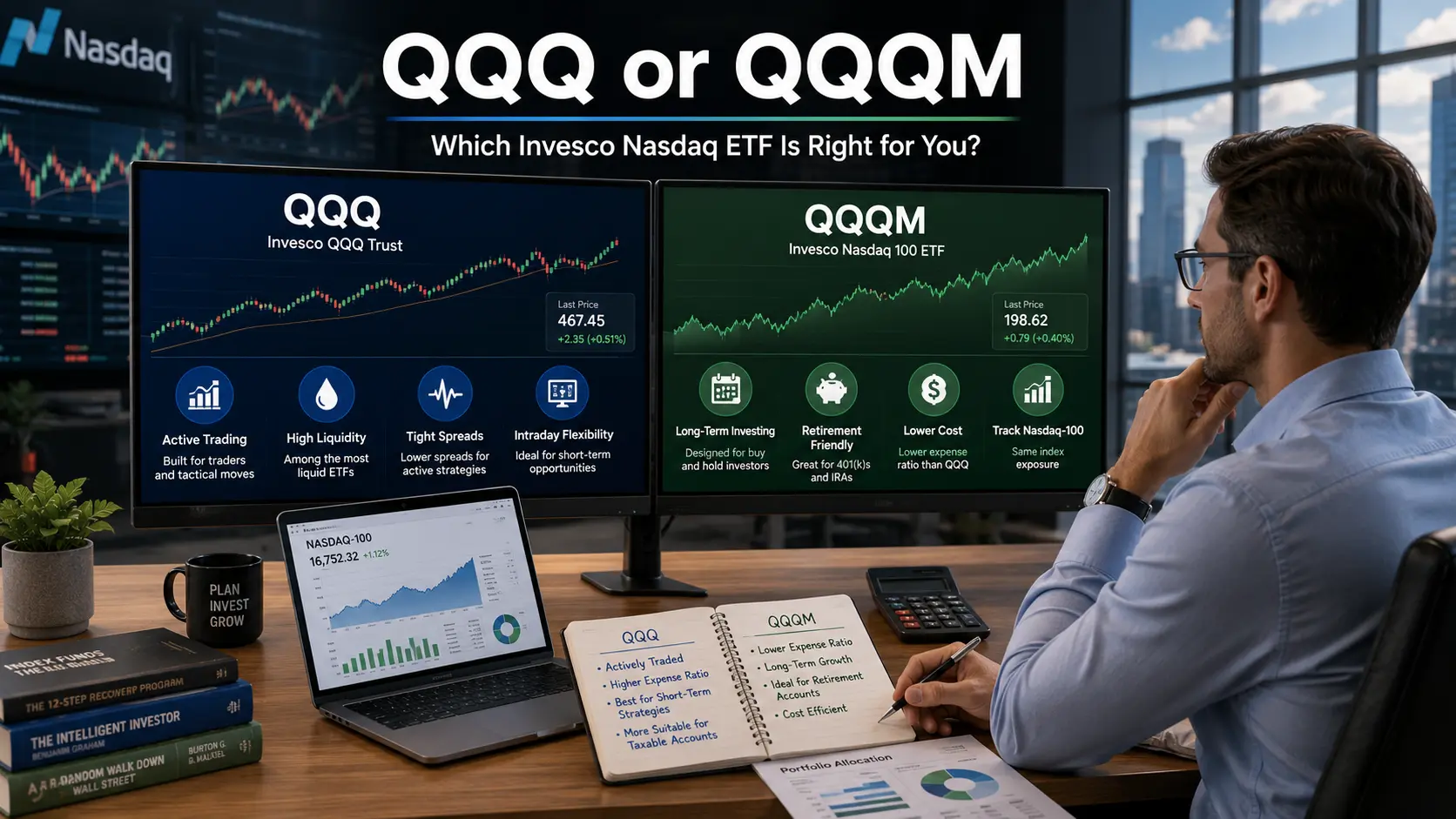
QQQ or QQQM depends on your investment goal rather than correctness. Both exchange traded funds track the Nasdaq One Hundred Index and hold many of the same companies. The main difference is that QQQ is designed for active traders with higher liquidity, while QQQM is intended for long term investors seeking lower costs.
When comparing qqq or qqqm, many investors assume one fund is better than the other. In reality, both funds track the same Nasdaq One Hundred Index, giving investors exposure to many of the largest nonfinancial companies in the United States. The confusion often leads people to choose an ETF based solely on popularity rather than understanding how each fund is designed to be used.
Although QQQ and QQQM share nearly identical holdings, they differ in expense ratio, trading activity, liquidity, and their intended audience. Understanding these distinctions can help you select the ETF that best matches your investing strategy, you trade frequently or invest steadily for years.
QQQ vs QQQM | What Is the Difference?
QQQ and QQQM are both exchange traded funds managed by Invesco. They aim to replicate the performance of the Nasdaq One Hundred Index. While their investment objectives are nearly identical, each fund serves a slightly different purpose.
| Feature | QQQ | QQQM |
|---|---|---|
| Part of speech | Proper noun | Proper noun |
| Investment type | Exchange traded fund | Exchange traded fund |
| Primary purpose | Active trading and investing | Long term investing |
| Tracks | Nasdaq One Hundred Index | Nasdaq One Hundred Index |
| Holdings | Nearly identical | Nearly identical |
| Liquidity | Very high | High |
| Trading volume | Extremely high | Lower than QQQ |
| Expense ratio | Slightly higher | Slightly lower |
| Best for | Frequent traders | Buy and hold investors |
Both ETFs provide exposure to leading technology and growth companies such as Apple, Microsoft, Nvidia, Amazon, and Meta. Performance differences are generally minimal because they follow the same benchmark. The most meaningful distinctions appear in trading costs and long term expenses rather than portfolio composition.
Is QQQ vs QQQM a Grammar, Vocabulary or Usage Issue?
Unlike common language comparisons, QQQ and QQQM are investment terms rather than grammar concepts. The distinction is a usage issue because each ticker represents a separate exchange traded fund.
These terms are not interchangeable in every situation. While both track the same index, using the wrong ticker could result in purchasing a different investment product than intended.
In formal financial writing, accuracy is essential because ticker symbols identify specific securities. Casual conversations may treat them as similar, but investors should always use the correct symbol when buying or discussing a fund.
Academic finance courses also distinguish between ticker symbols because precision matters when analyzing investment performance, expense ratios, and portfolio construction.
Understanding QQQ
QQQ is one of the most widely traded exchange traded funds in the world. It has existed for many years and attracts institutional investors, professional traders, and individuals who actively buy and sell shares throughout the trading day.
One major advantage of QQQ is its exceptional liquidity. High trading volume usually results in narrow bid and ask spreads, making it attractive for investors who execute frequent transactions.
Workplace Example
A financial adviser recommends QQQ to a client who regularly adjusts their portfolio based on market conditions because buying and selling shares is typically efficient.
Academic Example
A university finance class uses QQQ to demonstrate how exchange traded funds track market indexes and respond to daily price movements.
Technology Example
An automated trading platform includes QQQ among its most actively traded securities because of its consistently high market activity.
Usage Recap
QQQ is generally the preferred choice for investors who value trading flexibility, high liquidity, and efficient execution during market hours.
Understanding QQQM
QQQM was introduced to provide investors with another way to access the Nasdaq One Hundred Index while paying a slightly lower annual expense ratio.
Although its holdings closely mirror those of QQQ, QQQM targets long term investors who expect to buy shares and hold them for many years.
Because long term investing reduces the importance of daily trading activity, lower ongoing costs can make a meaningful difference over extended periods.
Workplace Example
An employee contributes monthly to a retirement account using QQQM because they plan to invest consistently for several decades.
Academic Example
Students comparing investment expenses calculate how a lower expense ratio may increase total returns over a long investment horizon.
Technology Example
A robo adviser automatically selects QQQM for clients focused on long term wealth accumulation rather than active trading.
Usage Recap
QQQM is often a practical choice for investors who prioritize low costs and long term portfolio growth instead of frequent buying and selling.
Key Similarities Between QQQ and QQQM
Despite their differences, these funds have much more in common than many investors realize.
| Similarity | Explanation |
|---|---|
| Same index | Both track the Nasdaq One Hundred Index. |
| Similar holdings | Each fund owns nearly identical companies. |
| Growth focus | Both emphasize large growth oriented businesses. |
| Technology exposure | Technology companies represent a significant portion of each portfolio. |
| Daily pricing | Both trade throughout the market day. |
| Professional management | Both are managed by Invesco. |
| Diversification | Each provides exposure to many leading companies through one investment. |
These similarities explain why long term performance between the two funds is usually very close. Most differences arise from expenses and trading characteristics rather than investment strategy.
Key Differences Between QQQ and QQQM
| Area | QQQ | QQQM |
|---|---|---|
| Launch history | Older fund | Newer fund |
| Typical investor | Active trader | Long term investor |
| Market activity | Extremely active | Moderately active |
| Expense ratio | Slightly higher | Slightly lower |
| Bid and ask spread | Usually narrower | Slightly wider |
| Trading suitability | Excellent for frequent transactions | Excellent for holding over time |
Investors who trade regularly may value liquidity more than expense savings. Long term investors, however, often focus on minimizing annual costs because even small savings can compound over many years.
Which Investors Usually Prefer QQQ?
QQQ appeals to investors with specific trading objectives.
Many day traders prefer it because of consistent trading volume and tight pricing.
Portfolio managers often use it for tactical market exposure when adjusting investment positions quickly.
Options traders also favor QQQ because it supports an active options market with significant liquidity.
Long term investors can certainly own QQQ, but many choose QQQM instead because lower ongoing expenses align better with extended investment horizons.
Which Investors Usually Prefer QQQM?
QQQM is designed for investors who emphasize patience rather than frequent trading.
Retirement savers often appreciate its lower annual expenses because they expect to remain invested for decades.
Individuals making automatic monthly contributions may also prefer QQQM since daily trading liquidity is less important than long term cost efficiency.
Financial planners frequently recommend evaluating investment objectives before selecting either ETF, since the best choice depends more on investing style than on expected returns.
When You Should NOT Use QQQ or QQQM
Although these two ETFs are very similar, there are situations where choosing one over the other can work against your investment goals. Understanding when not to use each fund is just as important as knowing when they fit.
| Situation | Avoid | Why |
|---|---|---|
| You trade several times a day | QQQM | Lower trading volume may result in slightly wider bid and ask spreads. |
| You are building a retirement portfolio for decades | QQQ | The slightly higher expense ratio can reduce long term returns over time. |
| You want broad market exposure | Both | These funds track only the Nasdaq One Hundred, not the entire stock market. |
| You need dividend focused income | Both | These ETFs primarily emphasize growth companies rather than high dividend stocks. |
| You want international diversification | Both | Most holdings are large United States companies. |
| You are uncomfortable with technology concentration | Both | Technology represents a significant share of each portfolio. |
| You expect guaranteed returns | Both | Like all stock investments, prices can rise or fall with market conditions. |
| You need a short term emergency fund | Both | Stock ETFs should not replace cash savings for unexpected expenses. |
Choosing an ETF without considering your investment horizon, risk tolerance, and financial objectives may lead to disappointment even if the fund itself performs well.
Common Mistakes and Decision Rules
Many investors believe QQQ and QQQM are completely different investment products. In reality, they share almost identical holdings. The real distinction lies in cost efficiency and trading characteristics.
| Correct Sentence | Incorrect Sentence | Explanation |
|---|---|---|
| I use QQQ because I trade frequently. | I use QQQ because it owns different companies than QQQM. | Their holdings are nearly identical. |
| QQQM has a slightly lower expense ratio. | QQQM tracks a different index. | Both follow the Nasdaq One Hundred Index. |
| Long term investors often consider QQQM. | QQQM is designed only for beginners. | Investors of all experience levels can use it. |
| QQQ is highly liquid. | QQQ cannot be traded during market hours. | It trades throughout the trading day. |
| Both ETFs focus on growth companies. | QQQ is a dividend focused income fund. | Growth investing is their primary objective. |
| Performance is generally very similar. | QQQM always outperforms QQQ. | Returns remain very close over time. |
Decision Rule
If you want maximum trading liquidity, choose QQQ.
If you want lower long term investment costs, choose QQQM.
This simple guideline helps many investors decide between the two funds without becoming overwhelmed by minor technical differences.
QQQ and QQQM in Modern Technology and AI Tools
Modern investing platforms have made comparing ETFs easier than ever. Artificial intelligence powered portfolio analyzers can evaluate expense ratios, diversification, historical volatility, and expected long term performance before suggesting an investment.
Many robo advisers recommend QQQM for long term portfolios because lower annual costs may improve returns over several decades. Meanwhile, trading platforms often highlight QQQ for investors who place frequent buy and sell orders due to its exceptional liquidity.
AI tools can also simulate future portfolio growth under different market conditions, allowing investors to understand how even small expense differences may affect wealth accumulation over time.
The History and Etymology of QQQ and QQQM
Ticker symbols are short identifiers assigned to publicly traded securities.
QQQ was introduced in nineteen ninety nine as one of the earliest exchange traded funds tracking the Nasdaq One Hundred Index. Over time it became one of the most actively traded ETFs in the financial markets.
QQQM was launched much later with a similar investment objective but a slightly lower expense ratio. Rather than replacing QQQ, it complements it by serving investors who focus on long term ownership instead of active trading.
Although the names appear similar, the additional letter in QQQM distinguishes a separate ETF with its own trading characteristics.
Expert Perspective
“Successful investing is rarely about finding completely different investments. It is often about selecting the version that best matches your investment behavior, costs, and long term goals.”
This principle explains why experienced investors compare both performance and expenses before choosing between similar exchange traded funds.
Case Study One | Active Trader
Sarah trades technology focused ETFs several times each week.
She selected QQQ because its high trading volume allowed her orders to be executed quickly with minimal price differences. Over hundreds of trades during the year, this liquidity helped reduce transaction costs and improved execution quality.
Result
Sarah achieved greater trading efficiency because QQQ matched her active investment style.
Case Study Two | Long Term Retirement Investor
Michael contributes to his retirement account every month and plans to invest for more than thirty years.
His financial adviser recommended QQQM because frequent trading was unnecessary, while the lower expense ratio could help preserve more of his investment returns over time.
Result
Michael built a disciplined investment strategy focused on long term growth while keeping annual costs as low as possible.
Error Prevention Checklist
Use this checklist whenever you compare these two ETFs.
| Always Use | Never Assume |
|---|---|
| QQQ for frequent trading | QQQ always earns higher returns |
| QQQM for long term investing | QQQM tracks a different index |
| Compare expense ratios | Lower cost guarantees better performance |
| Consider your investment goals | Popularity means better suitability |
| Review liquidity needs | Both funds fit every investor |
| Understand market risk | ETFs eliminate investment risk |
Before investing, ask yourself you value trading flexibility or lower long term costs. Your answer often determines which ETF is more appropriate.
Related Investment Comparisons You Should Master
Investors interested in QQQ and QQQM often research several related topics before making a decision.
- VOO versus SPY
- VTI versus VOO
- SCHD versus VIG
- Growth investing versus value investing
- ETF versus mutual fund
- Nasdaq One Hundred versus S and P Five Hundred
- Passive investing versus active investing
- Large cap versus small cap stocks
- Expense ratio explained
- Index fund versus exchange traded fund
These comparisons provide a broader understanding of portfolio construction and help investors make more informed financial decisions.
FAQs
Is QQQ better than QQQM?
Neither ETF is universally better. QQQ is often preferred by active traders, while QQQM is commonly chosen by long term investors seeking lower annual costs.
Do QQQ and QQQM own the same stocks?
Yes. Both funds track the Nasdaq One Hundred Index and hold nearly identical portfolios with similar weightings and performance.
Why is QQQ more popular than QQQM?
QQQ has been available for much longer and has become one of the world’s most actively traded exchange traded funds, attracting both institutions and individual investors.
Does QQQM have lower fees?
Yes. QQQM has a slightly lower expense ratio, which may help long term investors reduce investment costs over many years.
Can beginners invest in QQQM?
Absolutely. QQQM is suitable for beginners, experienced investors, and retirement savers who want diversified exposure to large growth companies.
Is QQQM less risky than QQQ?
No. Since both ETFs track the same index and hold nearly identical companies, their overall investment risk is very similar.
Should I switch from QQQ to QQQM?
It depends on your investing strategy. Long term investors may benefit from the lower expense ratio, while active traders may prefer the higher liquidity of QQQ.
Can I own both QQQ and QQQM?
Yes, although many investors choose one because the portfolios are almost identical, making additional diversification limited.
Conclusion
Choosing qqq or qqqm is less about finding a winner and more about selecting the ETF that aligns with your investing style. Both funds track the Nasdaq One Hundred Index, own nearly identical portfolios, and have delivered very similar long term performance. Their biggest differences are expense ratio, liquidity, and intended use.
If you trade frequently and value fast order execution, QQQ is generally the better fit because of its exceptional trading volume and narrow bid and ask spreads. If your goal is to invest consistently for many years, QQQM may be the smarter option thanks to its slightly lower annual expenses.
Before making a decision, consider your investment horizon, trading habits, and overall financial plan. By matching the ETF to your personal objectives rather than simply following popularity, you can build a more effective and disciplined investment strategy.
Discover More Related Articles:
- Starring or Staring | Why This Common Mistake Keeps Happening In 2026
- Send or Sent | The English Rule Made Surprisingly Easy In 2026
- Que or Queue | Why So Many People Get This Wrong In 2026