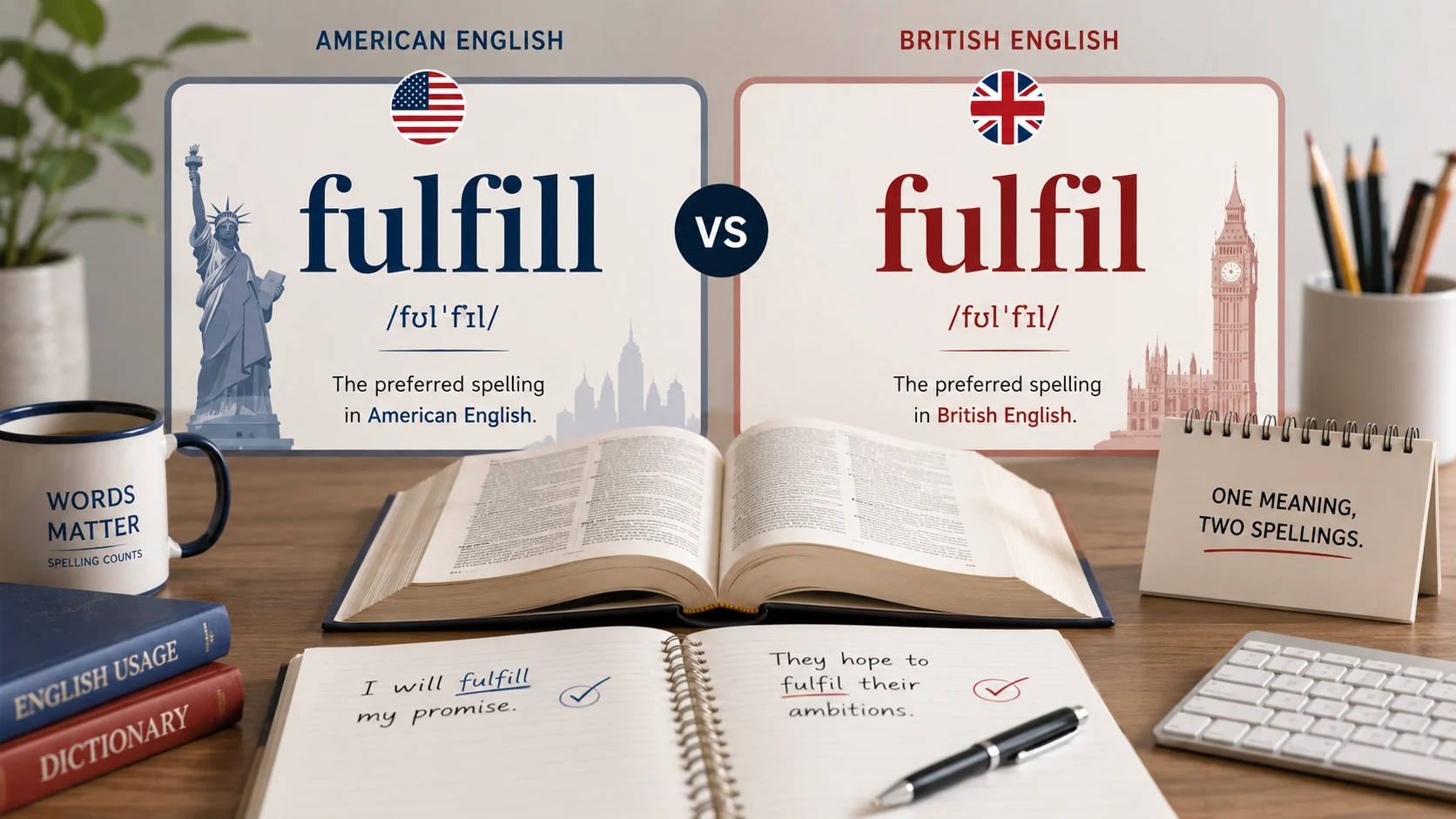
Fulfill or fulfil are two accepted spellings of the same English verb, meaning to complete something, satisfy a requirement, or carry out an obligation. “Fulfill” is the standard spelling in American English, while “fulfil” is preferred in British English and many other varieties. Choosing the wrong form can create spelling inconsistencies in professional and academic writing.
Have you ever wondered fulfill or fulfil is the correct spelling? You may have seen both forms in books, websites, and professional writing. The good news is that both are correct. The choice mainly depends on the variety of English you use.
Fulfill is the standard American English spelling. Fulfil is commonly preferred in British English. This is why searches such as fulfil or fulfill UK often appear when writers want to know which form to use in British writing.
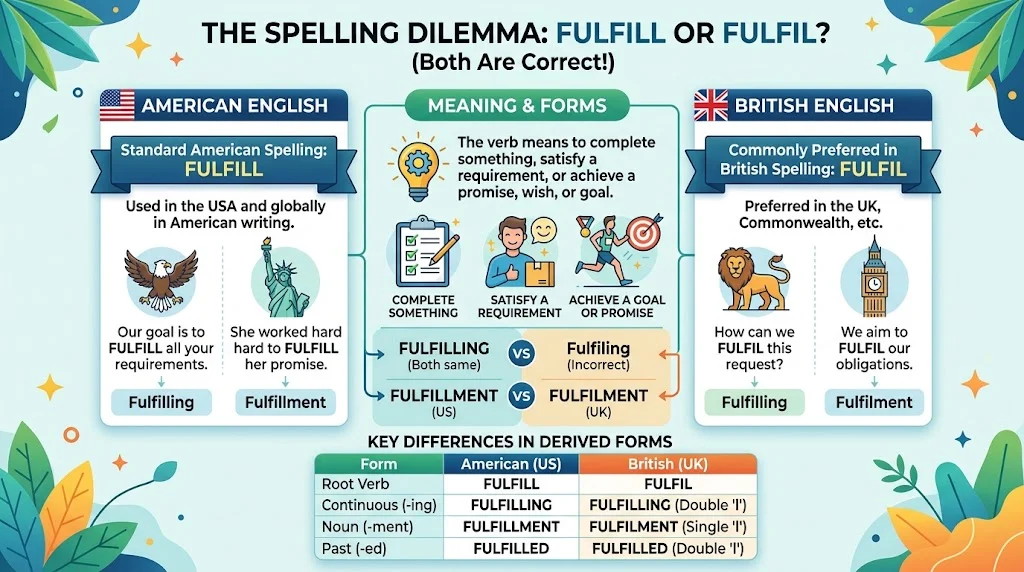
So, what does fulfil meaning actually involve? The verb means to complete something, satisfy a requirement, or achieve a promise, wish, or goal. In this guide, we will explain fulfil or fulfill, fulfill or fulfil, and related forms such as fulfilling or fulfiling, fulfillment or fulfilment, and fulfilment or fulfillment with clear examples and practical usage rules.
Fulfill vs Fulfil | What’s the Difference?
Fulfill and fulfil are both verbs. They have the same pronunciation and meaning, but their spelling reflects different regional standards.
Fulfill is the preferred American English spelling.
Both words can mean to complete something, satisfy a requirement, perform a duty, or make something happen as expected.
| Feature | Fulfill | Fulfil |
|---|---|---|
| Part of speech | Verb | Verb |
| Primary variety | American English | British English |
| Meaning | Complete, satisfy, or carry out | Complete, satisfy, or carry out |
| Pronunciation | The same | The same |
| Past tense | Fulfilled | Fulfilled |
| Present participle | Fulfilling | Fulfilling |
| Common spelling system | American English | British English |
Mini Recap
Use fulfill when following American English spelling conventions.
Use fulfil when following British English spelling conventions.
The meaning does not change between the two forms.
The most important rule is consistency within the same piece of writing.
Is Fulfill vs Fulfil a Grammar, Vocabulary or Usage Issue?
The distinction is primarily a spelling and usage issue, not a grammar issue.
Both forms function grammatically as verbs. You can use either one to describe completing a task, meeting a condition, satisfying a desire, or carrying out an obligation.
For example:
“Employees must fulfill their responsibilities.”
“Employees must fulfil their responsibilities.”
The grammatical structure is identical. The only meaningful difference is the spelling convention associated with the variety of English.
Are They Interchangeable?
They are interchangeable in meaning, but they are not always interchangeable in editorial contexts.
An American publication will normally expect fulfill. A British publication will normally expect fulfil. If a document uses British spelling throughout, suddenly switching to the American spelling may create an inconsistency.
The same principle applies in reverse.
Formal vs Casual Usage
Both forms are suitable for formal and casual writing. There is no rule stating that one is formal and the other is informal.
You can use fulfill in a legal document, academic paper, business report, or casual message if American English is being used.
Likewise, fulfil can appear in formal British writing or everyday British communication.
Academic vs Casual Usage
Academic writers should follow the spelling system required by their institution, publisher, journal, or intended audience.
If a university uses British English, fulfil is generally appropriate. If an American institution follows American English, fulfill is generally expected.
The important point is consistency rather than choosing one spelling universally.
How to Use Fulfill in American English
In American English, fulfill is the standard spelling. It can describe completing an obligation, satisfying a condition, achieving a purpose, or meeting a need.
Workplace Example
“Our team worked hard to fulfill the client’s requirements before the deadline.”
Here, fulfill means to satisfy or complete the requirements established by the client.
Another example is:
“Employees are expected to fulfill their professional responsibilities.”
The word describes carrying out a duty or obligation.
Academic Example
“The research was designed to fulfill the requirements of the university program.”
In this sentence, the verb refers to satisfying an academic requirement.
A student might also write:
“The experiment helped fulfill the objectives of the study.”
Technology Example
“Modern software can fulfill many repetitive administrative tasks.”
Here, fulfill means to perform or accomplish something.
E commerce platforms also frequently use this spelling in phrases such as “order fulfillment” and “fulfillment center” when following American English conventions.
Usage Recap
Use fulfill in American English.
It works in professional, academic, technical, and everyday contexts.
It has the same meaning as fulfil.
How to Use Fulfil in British English
In British English, fulfil is the conventional spelling. The meaning is exactly the same as the American form.
Workplace Example
“Our company aims to fulfil every contractual obligation.”
The verb means to carry out or satisfy an obligation.
Another example is:
“Managers must ensure that staff fulfil their responsibilities.”
Academic Example
“The study was conducted to fulfil the objectives established by the research team.”
The word describes accomplishing a planned purpose.
You may also encounter:
“Students must fulfil all course requirements before graduation.”
Technology Example
“The platform helps businesses fulfil customer orders efficiently.”
British English commonly uses fulfil in this context.
Related expressions can also appear as fulfilment, although spelling conventions can vary in specific compounds and regional publishing systems.
Usage Recap
Use fulfil when following British English conventions.
It is appropriate in formal and informal contexts.
Its meaning is identical to fulfill.
When You Should NOT Use Fulfill or Fulfil
There are several situations where writers accidentally choose between the two forms without considering their broader spelling system.
- Do not switch between fulfill and fulfil randomly in the same document.
- Do not assume fulfil is a more formal version of fulfill.
- Do not assume fulfill is grammatically different from fulfil.
- Do not use American spelling in a document that has been deliberately written according to British English conventions.
- Do not change every British spelling to American spelling simply because an international audience will read the document.
- Do not treat the two spellings as different vocabulary words.
- Do not correct fulfil as a spelling error when reviewing British English.
- Do not correct fulfill as a spelling error when reviewing American English.
The best approach is to identify your target variety of English first and then apply it consistently.
Common Mistakes and Decision Rules
| Correct sentence | Incorrect sentence | Explanation |
|---|---|---|
| We need to fulfill the agreement. | We need to fulfil the agreement. | The second sentence is not universally incorrect, but it conflicts with American spelling if the document otherwise follows American English. |
| We need to fulfil the agreement. | We need to fulfill the agreement. | The second sentence may be inconsistent in a document that follows British English spelling. |
| She fulfilled her promise. | She fulfil her promise. | The past tense is fulfilled in both American and British English. |
| They are fulfilling the requirement. | They are fulfiling the requirement. | The present participle is spelled fulfilling, with a doubled l. |
| The company fulfilled its obligation. | The company fulfill its obligation yesterday. | The past tense requires fulfilled. |
One of the most common mistakes is treating the extra letter in fulfill as though it changes the meaning. It does not.
Decision Rule Box
If you are writing American English, use fulfill.
If you are writing British English, use fulfil.
If you are editing existing content, follow the spelling system already established in that document.
If a publisher, university, employer, or client provides a style guide, follow that guide first.
Fulfill and Fulfil in Modern Technology and AI Tools
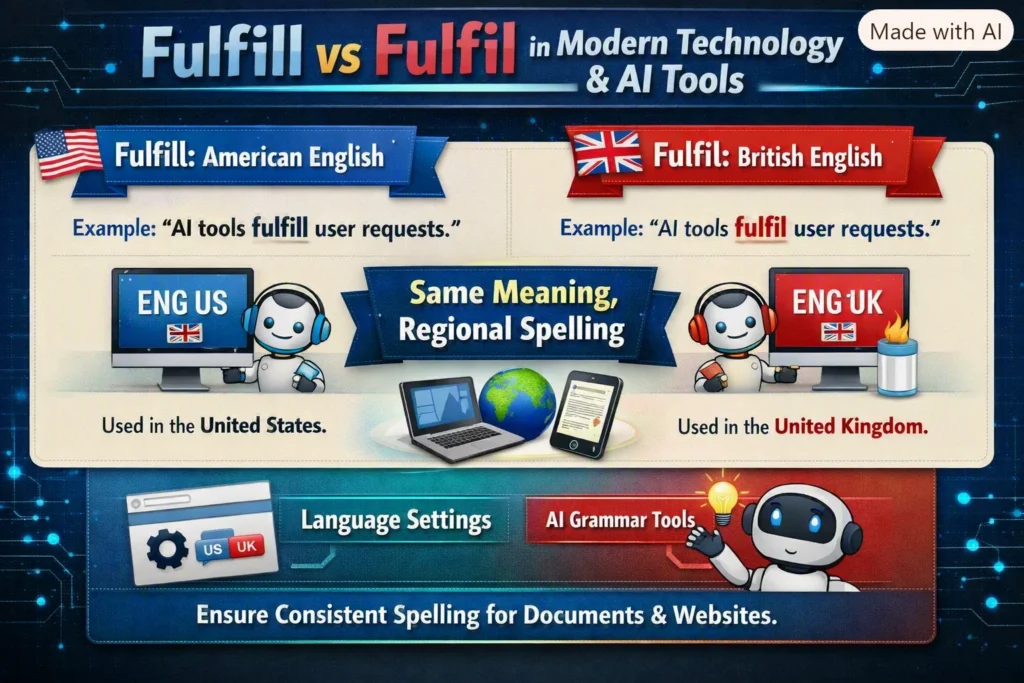
Modern technology makes spelling consistency easier to manage because many writing platforms provide language settings and automated grammar assistance.
Word processors can often be configured for American English or British English. Once the correct language setting is selected, spelling tools can identify regional inconsistencies.
AI writing tools can also recognize both spellings. However, writers should still specify the intended variety of English when generating or editing content.
For example, a business targeting the United States may request American English. A company publishing content for the United Kingdom may request British English.
This matters particularly for websites, software documentation, customer support content, product descriptions, and international marketing campaigns.
An AI tool may recognize both fulfill and fulfil as correct, but that does not mean both should appear randomly within one document.
Why Do American and British English Spellings Differ?
The difference has historical roots in the development of English spelling conventions.
American English spelling was influenced by efforts to simplify or standardize certain spellings. British English retained many traditional forms that became less common in American usage.
The distinction can be seen in several related spelling pairs, including color and colour, favor and favour, and organize and organise.
The difference between fulfill and fulfil follows this broader pattern of regional spelling.
An important detail is that both forms are historically legitimate. One is not a misspelling of the other.
Expert Style Perspective
A useful editorial principle is this: “Regional spelling is a convention, not a measure of correctness.”
This principle helps explain why both spellings can be correct while still requiring careful consistency within a particular publication.
Two Practical Case Studies
Case Study One: American Business Website
Imagine an American online retailer creating a customer service page. The company writes:
“We work hard to fulfill every order accurately and quickly.”
If the rest of the website uses American spellings such as color, favorite, and center, then fulfill fits naturally into the established style.
Changing only this word to fulfil would not necessarily make the sentence grammatically wrong, but it would create an unnecessary regional spelling inconsistency.
Case Study Two: British Academic Paper
Consider a British university student writing:
“The purpose of this research is to fulfil the requirements of the dissertation.”
If the paper consistently uses British spellings, fulfil is the appropriate choice.
Replacing it with fulfill could make the paper look as though different spelling standards had been mixed during editing.
Error Prevention Checklist
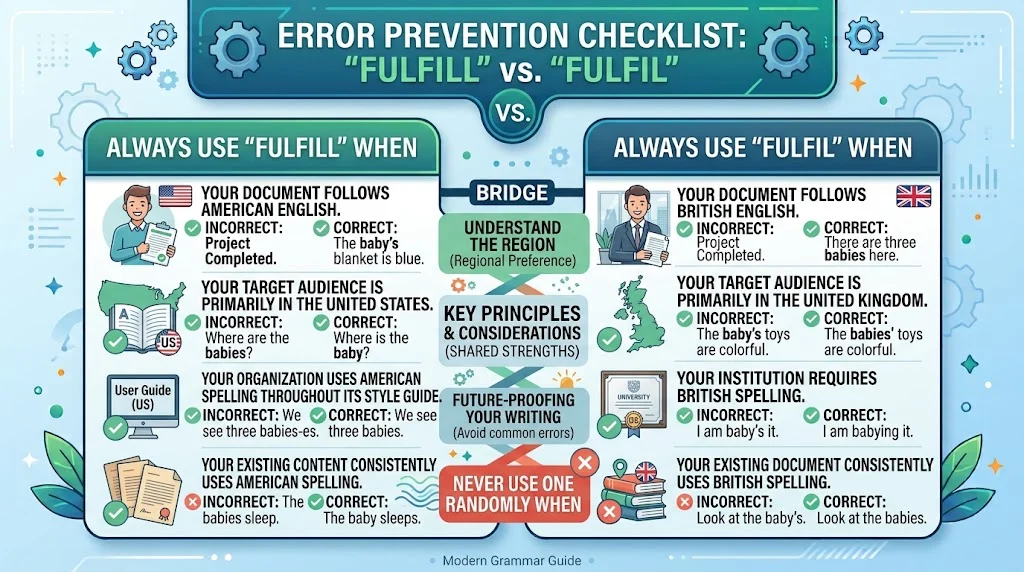
Always Use Fulfill When
[ ] Your document follows American English.
[ ] Your target audience is primarily in the United States.
[ ] Your organization uses American spelling throughout its style guide.
[ ] Your software documentation has been standardized to American English.
[ ] Your existing content consistently uses American spelling.
Always Use Fulfil When
[ ] Your document follows British English.
[ ] Your target audience is primarily in the United Kingdom.
[ ] Your institution requires British spelling.
[ ] Your publisher uses British English conventions.
[ ] Your existing document consistently uses British spelling.
Never Use One Randomly When
[ ] You are trying to maintain a consistent regional spelling system.
[ ] Your editor has provided a specific style guide.
[ ] Your website targets a clearly defined English speaking market.
Related Grammar Confusions You Should Master
Understanding regional spelling differences can help you avoid many other common English mistakes.
Important topics include:
- Color or colour
- Favor or favour
- Center or centre
- Organize or organise
- License or licence
- Practice or practise
- Program or programme
- Canceled or cancelled
- Traveling or travelling
- Learned or learnt
The correct choice often depends on the writing follows American, British, Australian, Canadian, or another established variety of English.
FAQs
Is fulfill or fulfil correct in English?
Both are correct spellings, but fulfill is standard American English while fulfil is standard British English.
What is the difference between fulfill and fulfil?
There is no difference in meaning or pronunciation; the difference is regional spelling.
Should I use fulfill in American English?
Yes, fulfill is the conventional American English spelling for the verb meaning to complete, satisfy, or carry out.
Should I use fulfil in British English?
Yes, fulfil is the conventional British English spelling and is widely used in British writing.
Is fulfil a British spelling?
Yes, fulfil is commonly associated with British English and other varieties influenced by British spelling conventions.
Is fulfill more correct than fulfil?
No, neither spelling is universally more correct; the appropriate choice depends on the English variety being used.
What is the past tense of fulfill or fulfil?
The past tense is fulfilled in both major spelling systems, although the base form differs regionally.
Why does American English use fulfill?
American English generally uses fulfill as its standardized spelling, while British English commonly retains fulfil.
Can I use fulfill and fulfil in the same article?
You can, but doing so without a clear reason may create inconsistent spelling, so one regional standard should normally be maintained.
Conclusion
The choice between fulfill and fulfil is straightforward once you identify the English variety you are using. American English generally prefers fulfill, while British English generally prefers fulfil. Both words have the same meaning, pronunciation, grammatical function, and historical relationship.
The most important rule is consistency. If your audience, publisher, university, employer, or style guide expects American English, choose fulfill. If British English is required, choose fulfil.
Neither spelling should automatically be labeled wrong. Instead, think of them as regional forms of the same English verb.
For writers, editors, students, businesses, and content creators, this simple distinction can prevent unnecessary spelling errors and make written communication look more professional.
When deciding between fulfill or fulfil, identify your target variety of English first, then use the appropriate spelling consistently throughout your work.
Discover More Related Articles:
- Spilt or Spilled | One Verb, Two Accepted Forms In 2026
- Ally or Allie | Stop Making This Common Spelling Mistake In 2026
- Everyones or Everyone’s | Which Form Should You Use in Formal Writing In 2026