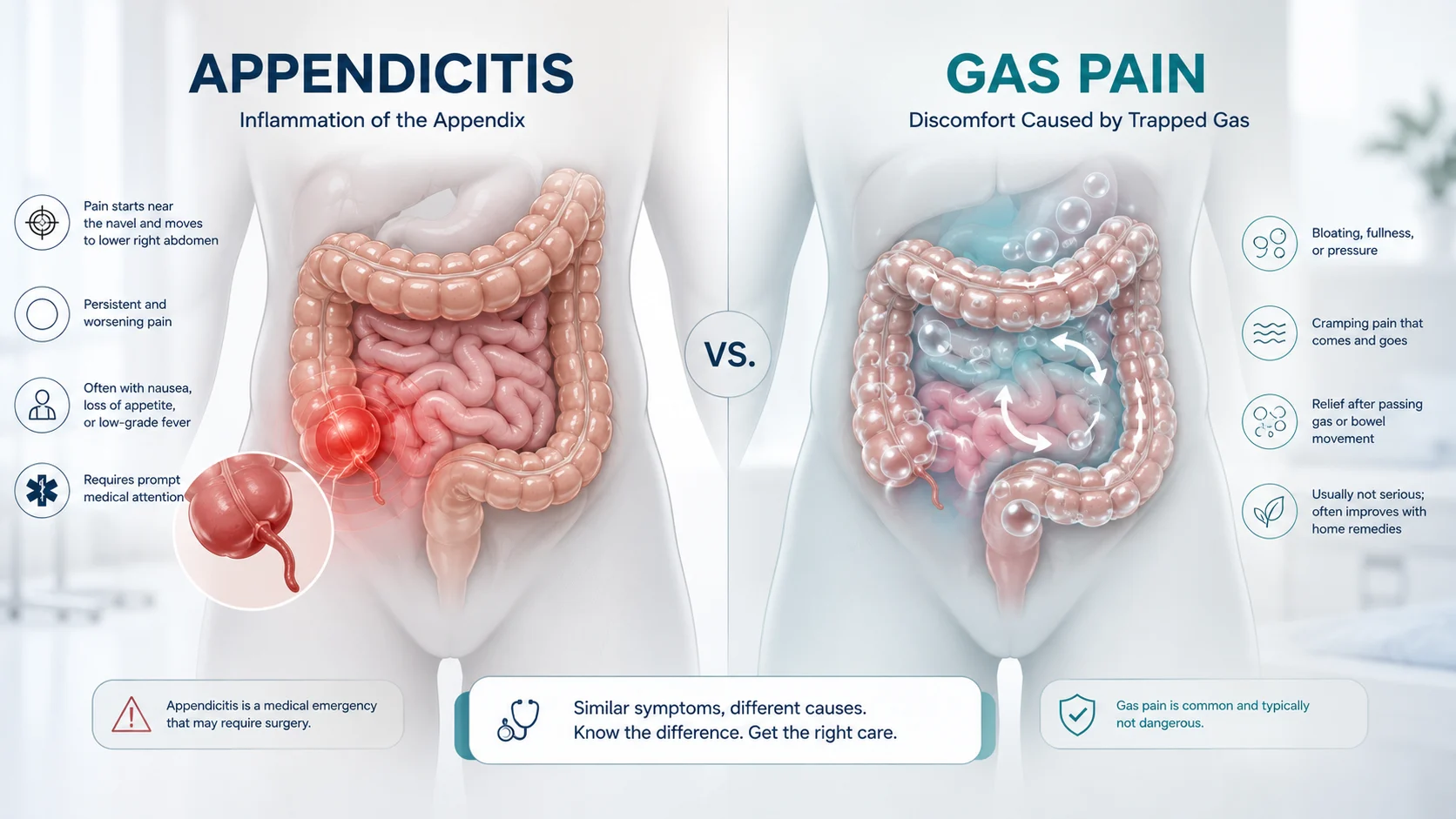
Appendicitis or gas can both cause abdominal discomfort, bloating, nausea, and changes in bowel habits, but they are not the same condition. Gas pain often comes and goes and may improve after burping or passing gas, while appendicitis commonly causes worsening abdominal pain that may move toward the lower right abdomen and requires urgent medical assessment.
Abdominal pain can be surprisingly difficult to interpret because several digestive problems can produce similar sensations. Trapped gas may cause pressure, cramps, bloating, and a feeling of fullness. Appendicitis, by contrast, occurs when the appendix becomes inflamed and can cause progressively worsening abdominal pain, nausea, vomiting, fever, and loss of appetite.
The confusion matters because assuming that serious abdominal pain is merely gas can delay medical attention. Appendicitis can progress to a ruptured appendix, peritonitis, or an abdominal abscess if treatment is delayed. At the same time, not every episode of abdominal discomfort indicates appendicitis. Gas is common and is usually harmless when it occurs by itself.
The most useful distinction is not simply where the pain occurs. Doctors consider the location, progression, severity, associated symptoms, physical examination, blood and urine tests, and sometimes ultrasound, CT, or MRI when appendicitis is suspected.
If abdominal pain is severe, steadily worsening, persistent, or accompanied by significant vomiting, fever, marked tenderness, confusion, or difficulty breathing, seek urgent medical care rather than attempting to diagnose the cause at home.
Core Definitions
What Is Appendicitis?
Appendicitis is inflammation of the appendix, a small finger shaped pouch connected to the large intestine. The appendix is located in the lower right area of the abdomen, although the exact location of pain can vary depending on a person’s anatomy, age, and pregnancy status.
Part of speech: Noun
The condition commonly begins with abdominal pain. In many people, discomfort starts around the belly button and later shifts toward the lower right abdomen. As inflammation progresses, the pain can become more severe and may worsen with walking, coughing, or other movement.
Other possible symptoms include nausea, vomiting, reduced appetite, fever, constipation, diarrhea, bloating, and difficulty passing gas. Because several of these symptoms also occur with ordinary digestive problems, symptoms must be considered as a pattern rather than as isolated clues.
What Is Gas?
Gas is air or digestive gas within the gastrointestinal tract. It is a normal part of digestion and can result from swallowed air or from bacteria breaking down certain foods in the colon. Most people regularly burp or pass gas as part of normal digestion.
Part of speech: Noun
When gas becomes trapped or moves poorly through the digestive tract, it can produce gas pain. Common sensations include cramps, pressure, bloating, abdominal fullness, and a knotted feeling. Gas may also be accompanied by increased burping or passing gas.
The important point is that gas can be painful without being dangerous. However, persistent or severe gas pain, particularly when accompanied by other concerning symptoms, deserves medical evaluation.
Appendicitis vs Gas | What’s the Difference?
| Feature | Appendicitis | Gas |
|---|---|---|
| Basic meaning | Inflammation of the appendix | Gas within the digestive tract |
| Typical pain pattern | May begin near the belly button and move toward the lower right abdomen | Often causes cramps, pressure, bloating, or shifting discomfort |
| Progression | Often becomes increasingly painful | May come and go and can improve after passing gas |
| Movement | Pain may worsen with walking, coughing, or movement | Movement is not usually the defining feature |
| Bloating | Can occur | Very common |
| Burping or passing gas | May occur but does not rule out appendicitis | Often accompanies gas related discomfort |
| Fever | Can occur | Not typical of ordinary gas |
| Nausea or vomiting | Can occur | Can occur, although persistent vomiting needs medical evaluation |
| Medical urgency | Can require urgent medical treatment | Usually not urgent when mild and isolated |
The key distinction is progression. Appendicitis often develops into increasingly significant pain, whereas ordinary gas pain commonly fluctuates.
Gas can cause substantial discomfort, so pain intensity alone cannot reliably distinguish the two.
No home symptom test can definitively rule out appendicitis. Medical evaluation may be necessary when symptoms are concerning.
How Appendicitis Pain Usually Develops
One of the most recognized patterns is pain that starts near the belly button and then moves toward the lower right abdomen. The pain may become more constant and severe as inflammation increases. Coughing, walking, or other jarring movement may make the discomfort worse.
However, this pattern is not universal. Some people experience pain in a different location or develop less typical symptoms. This is especially relevant in young children, older adults, and pregnant people, where the location or progression may differ.
Appendicitis may also involve loss of appetite, nausea, vomiting, fever, constipation, or diarrhea. Some people experience bloating or an inability to pass gas. These symptoms can overlap with other abdominal disorders, which is why professional assessment matters.
A particularly important warning sign is severe abdominal pain. If an appendix ruptures, pain can briefly change before becoming severe and more widespread. A ruptured appendix can cause serious infection inside the abdomen.
Usage Recap
Think of appendicitis as an inflammatory medical condition rather than ordinary digestive discomfort. Worsening pain, especially when accompanied by fever, vomiting, appetite loss, or localized tenderness, should not simply be attributed to gas.
How Gas Pain Usually Feels
Gas pain can feel sharp, crampy, tight, or pressure like. It may occur with bloating and a sensation that the abdomen is full or distended. Burping and passing gas may accompany the discomfort.
Gas can develop after eating certain foods, swallowing air, overeating, or because of digestive conditions that affect how food is processed. Beans and other foods that are fermented by bacteria in the colon can increase intestinal gas.
An important characteristic is variability. Gas discomfort may move, fluctuate, or improve when gas is released. Nevertheless, improvement after passing gas does not provide an absolute medical guarantee that appendicitis is impossible.
If abdominal pain continues, becomes severe, or occurs with symptoms such as blood in the stool, unexplained weight loss, persistent vomiting, or significant changes in bowel habits, medical advice is appropriate.
Usage Recap
Gas commonly produces bloating, pressure, cramps, burping, or flatulence. Mild symptoms that settle after digestion or gas release are generally less concerning, but persistent or severe abdominal pain should not be dismissed.
Is Appendicitis vs Gas a Grammar, Vocabulary or Usage Issue?
This is primarily a medical vocabulary and health information distinction, not a grammar problem.
The two terms are not interchangeable. Appendicitis identifies inflammation of the appendix, while gas describes air or digestive gas within the gastrointestinal tract. One is a specific medical condition, while the other describes a normal digestive substance or a common source of digestive discomfort.
In formal medical writing, appendicitis is used to identify a diagnosis or suspected diagnosis. Gas may be used when discussing digestive symptoms or gastrointestinal contents.
In casual conversation, someone might say, “I think it’s just gas,” when describing abdominal discomfort. That statement is not a reliable diagnosis.
Academic and medical writing should distinguish symptoms from diagnoses. Abdominal pain is a symptom. Gas may be a possible cause. Appendicitis is a medical condition that requires assessment.
When You Should NOT Use Appendicitis or Gas
Several common assumptions can create problems when people try to identify abdominal pain without medical evaluation.
Do not assume every right sided pain is appendicitis
Pain in the lower right abdomen can have multiple causes. Kidney stones, urinary conditions, bowel disorders, reproductive system problems, and other conditions can produce abdominal pain.
Do not assume passing gas proves there is no appendicitis
Gas and appendicitis can produce overlapping digestive symptoms. The presence of gas does not independently establish the cause of abdominal pain.
Do not assume appendicitis always begins on the right
Classic appendicitis may begin around the belly button before moving toward the lower right abdomen, and some people experience atypical pain locations.
Do not dismiss worsening pain as indigestion
Progressively worsening abdominal pain deserves attention, particularly when it becomes severe or is accompanied by vomiting, fever, or loss of appetite.
Do not rely on a single symptom
No individual symptom reliably confirms or excludes appendicitis. Doctors use a combination of history, examination, laboratory testing, and imaging when appropriate.
Do not self diagnose a serious abdominal condition
Online symptom comparisons can provide general education but cannot replace physical examination or appropriate diagnostic testing.
Do not ignore severe abdominal pain
Severe abdominal pain can require urgent assessment regardless of gas seems like a possible explanation.
Common Mistakes and Decision Rules
| Correct sentence | Incorrect sentence | Explanation |
|---|---|---|
| His doctor evaluated him for possible appendicitis. | His doctor confirmed gas was appendicitis. | Appendicitis is a specific medical condition and requires appropriate evaluation. |
| She had abdominal bloating and gas after eating. | She had gas, so appendicitis was impossible. | Gas symptoms do not independently exclude appendicitis. |
| His abdominal pain became progressively worse. | His worsening pain was definitely only gas. | Progressive pain can be concerning and should not be casually attributed to gas. |
| The doctor used an examination and imaging to investigate the pain. | The patient diagnosed appendicitis by location alone. | Diagnosis may require several forms of assessment. |
Decision Rule:
If the symptoms are mild, temporary, and consistent with ordinary digestive gas, gas may be one possible explanation. If abdominal pain is severe, persistent, progressively worsening, or accompanied by concerning symptoms, do not assume the cause. Seek medical assessment.
When Abdominal Pain Needs Urgent Attention
Certain patterns deserve particular caution. The NHS advises urgent medical help when abdominal pain is gradually getting worse, does not go away, or moves toward the lower right side. Severe abdominal pain, especially when accompanied by confusion, abnormal skin color, or difficulty breathing, can require emergency care.
The National Institute of Diabetes and Digestive and Kidney Diseases also recommends medical attention when appendicitis is suspected because prompt treatment reduces the risk of complications.
The most important principle is simple: do not wait for every classic symptom to appear before seeking help. Appendicitis does not always follow an identical pattern.
How Doctors Tell the Difference
A clinician usually begins by asking when the pain started, where it began, how it has changed, and what other symptoms developed. The abdomen is then examined for tenderness and other signs.
Blood testing can help identify signs of infection or inflammation. Urine testing may help rule out urinary causes. Depending on the person and circumstances, doctors may use ultrasound, CT, or MRI to investigate the appendix and other possible causes of abdominal pain.
There is no single test that always identifies appendicitis. Sometimes doctors observe how symptoms develop while the patient remains under medical supervision.
This diagnostic process explains why online comparisons should be treated as educational information rather than a substitute for examination.
Authority and Trust: What Medical Evidence Shows
Etymology and Medical Meaning
The word appendicitis combines the medical term appendix with the suffix itis, which is commonly used in medical terminology to indicate inflammation. Thus, the term literally identifies inflammation involving the appendix.
Gas has a much broader everyday meaning. In digestive medicine, intestinal gas refers to gas present within the gastrointestinal tract. It is a normal result of swallowing air and digestion.
Expert Style Explanation
A clinically useful way to think about these symptoms is this: the pattern and progression of abdominal pain matter more than one isolated symptom. This reflects the approach described by major medical authorities, which combine symptom history, physical examination, laboratory testing, and imaging when necessary.
Case Study One: A Classic Progression
Consider an illustrative clinical scenario involving an adult whose discomfort begins near the belly button, gradually becomes more severe, and moves toward the lower right abdomen. The person develops reduced appetite and nausea.
This pattern would warrant medical assessment because it resembles a recognized appendicitis presentation. It would not be appropriate to label the problem as gas solely because bloating or gas is also present.
Case Study Two: Typical Gas Symptoms
Consider another illustrative scenario involving abdominal fullness and cramping after eating, accompanied by increased burping and passing gas. The discomfort fluctuates rather than steadily worsening.
That pattern can be consistent with gas related discomfort. However, if the pain becomes persistent, severe, or associated with alarming symptoms, medical evaluation becomes important.
These are educational scenarios rather than real patient case reports. Their purpose is to demonstrate how symptom patterns differ without presenting fabricated medical outcomes.
Author expertise: This article is written from a health information and medical language perspective, using current guidance from established medical authorities to explain terminology and symptom patterns clearly.
Appendicitis or Gas in Modern Technology and AI Tools
Modern symptom checkers and AI tools can help organize health information, identify questions to discuss with a clinician, and explain medical terminology. They should not be treated as diagnostic substitutes.
An AI system cannot physically examine abdominal tenderness, assess guarding, measure vital signs, or independently perform imaging. Those limitations are particularly important with abdominal pain because several unrelated conditions can resemble one another.
For this reason, responsible health technology should support clinical decision making rather than encourage users to make definitive diagnoses from symptom descriptions alone.
Error Prevention Checklist
Always Use the Appendicitis Concept When
You are discussing inflammation of the appendix.
A clinician is evaluating suspected inflammation of the appendix.
The topic involves appendectomy, a ruptured appendix, an appendiceal abscess, or related complications.
Never Use Gas as a Guaranteed Explanation When
Abdominal pain is severe.
Pain is progressively worsening.
Pain persists or moves toward the lower right abdomen.
There is significant vomiting or fever.
The person appears seriously unwell.
There are symptoms that could indicate a medical emergency.
Why Gas Can Sometimes Be Confusing
Gas pain can be surprisingly intense. Trapped gas can produce sharp cramps and pressure, and bloating can make the abdomen feel uncomfortable or enlarged.
This is one reason people may confuse gas pain with other abdominal conditions. Pain location alone is not sufficiently reliable. Even appendicitis can present differently depending on the position of the appendix and the individual’s circumstances.
Another complication is that digestive symptoms can coexist. A person with appendicitis may experience bloating or gas, so the presence of gas does not automatically identify the underlying problem.
The strongest educational takeaway is therefore to look at the whole pattern: onset, progression, location, associated symptoms, and severity.
Related Grammar Confusions You Should Master
Although this topic is medical rather than grammatical, it belongs to a broader group of commonly confused health terms. Useful distinctions include symptom vs diagnosis, infection vs inflammation, constipation vs intestinal obstruction, stomach pain vs abdominal pain, indigestion vs acid reflux, food intolerance vs food allergy, nausea vs vomiting, bloating vs abdominal distension, chronic vs acute pain, and treatment vs prevention.
Understanding these distinctions improves both everyday health communication and the accuracy of educational writing.
FAQs
Can gas pain feel like appendicitis?
Yes. Gas can cause significant cramps, pressure, bloating, and abdominal pain. Because symptoms can overlap, severe or worsening pain should not automatically be attributed to gas.
How can you tell the difference between gas and appendicitis?
Gas often causes bloating, pressure, cramps, burping, or passing gas, while appendicitis commonly produces worsening pain that may move toward the lower right abdomen. Symptoms alone cannot confirm the diagnosis.
Does appendicitis always cause lower right abdominal pain?
No. Pain can begin near the belly button and later move to the lower right abdomen, but some people have pain in different locations.
Can you have gas with appendicitis?
Yes. Appendicitis can include bloating and gas related symptoms, so passing gas does not by itself rule out appendicitis.
Does passing gas mean abdominal pain is not serious?
No. Passing gas can occur with normal digestion, but it does not prove that another medical condition is absent.
What does appendicitis pain usually feel like?
Appendicitis pain commonly becomes increasingly severe and may start around the belly button before shifting toward the lower right abdomen. Movement may make it worse.
Can appendicitis cause bloating and constipation?
Yes. Appendicitis can be associated with bloating, constipation, diarrhea, and difficulty passing gas.
When should abdominal pain be treated as an emergency?
Severe abdominal pain, especially when accompanied by serious symptoms such as difficulty breathing, confusion, or signs of severe illness, warrants emergency medical attention.
How do doctors diagnose appendicitis?
Doctors consider the symptom history and physical examination and may use blood tests, urine testing, ultrasound, CT, or MRI depending on the circumstances.
Can appendicitis go away without treatment?
Suspected appendicitis should not be left untreated. Treatment commonly involves removal of the appendix, although selected mild cases may sometimes be treated with antibiotics under medical supervision.
Conclusion
The safest way to understand appendicitis or gas is to focus on the complete symptom pattern rather than one sensation. Gas commonly causes bloating, pressure, cramps, burping, and passing gas, while appendicitis can cause abdominal pain that progressively worsens and may move toward the lower right abdomen.
The distinction is important because appendicitis can become dangerous when treatment is delayed. If abdominal pain is severe, persistent, progressively worsening, or accompanied by fever, vomiting, appetite loss, or other concerning symptoms, professional medical assessment is the safest choice.
Discover More Related Articles:
- Jewellery or Jewelry | Which Version Is Right for Your Audience In 2026
- Lisa or Lena | Why Are These Names So Easy to Confuse In 2026
- Si or Sí | The Common Spanish Spelling Confusion Explained In 2026