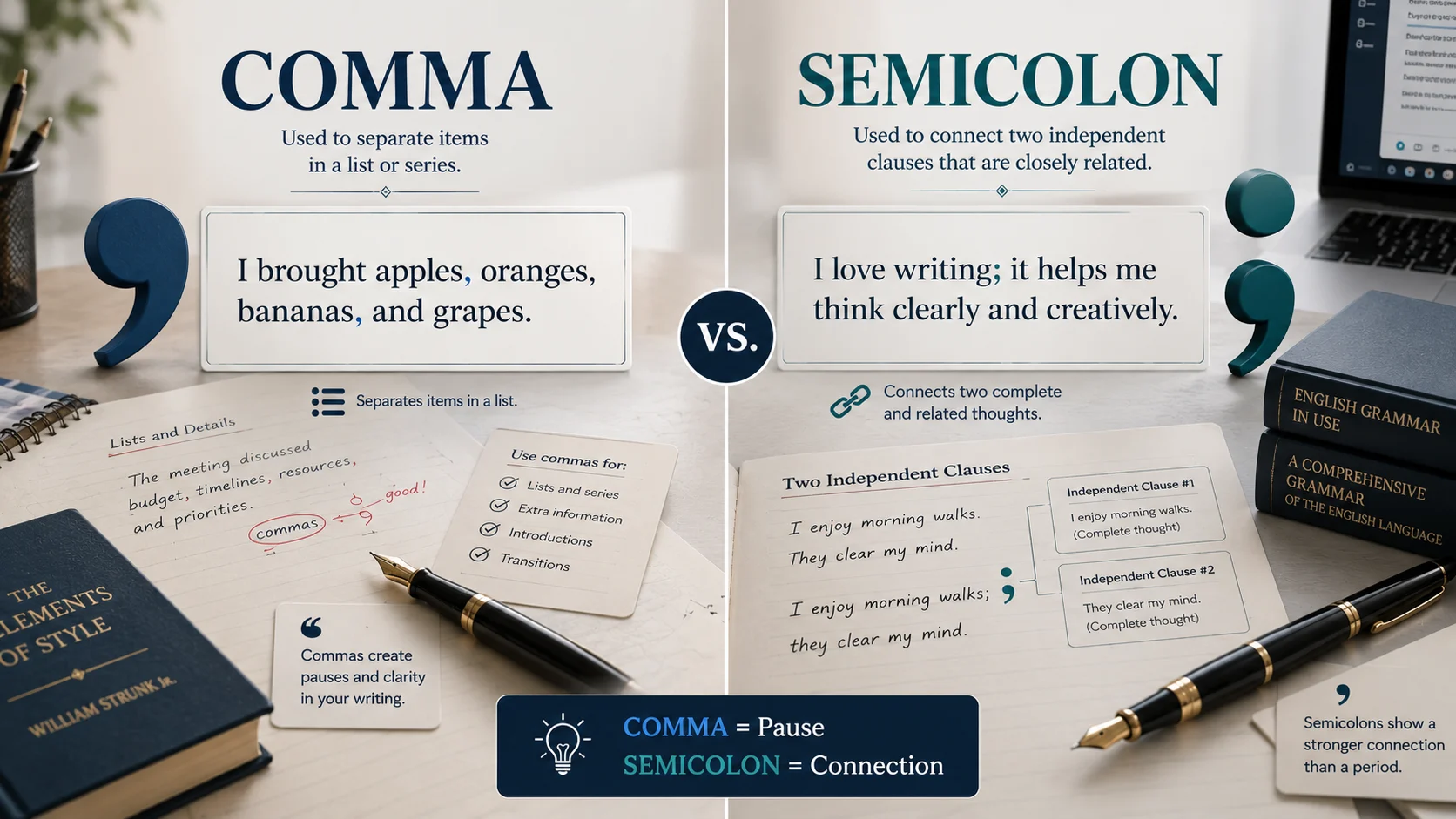
A comma separates closely related parts of a sentence, while a semicolon connects two independent clauses that are closely related in meaning. The key difference is grammatical strength: a comma creates a lighter pause, whereas a semicolon creates a stronger connection between complete thoughts without ending the sentence
Knowing when to use a comma or semicolon can make the difference between a polished sentence and a punctuation error. Both marks can connect ideas, separate information, and improve readability, but they do not perform the same grammatical job.
A comma is generally used to separate elements within a sentence, such as items in a series, introductory phrases, dependent clauses, or coordinate adjectives. A semicolon has a more specific role. It can join two closely related independent clauses when the writer wants to keep them within the same sentence.
The confusion often occurs because both punctuation marks can appear between related ideas. However, replacing one with the other without considering sentence structure can create a comma splice, an unnecessarily complicated sentence, or an incorrect connection between clauses.
For students, professionals, editors, and content writers, understanding this distinction is especially important. Correct punctuation improves clarity, prevents ambiguity, and makes formal writing easier to read.
Core Definitions
A comma is a punctuation mark used to create separation within a sentence. It can divide items in a series, separate introductory elements, set off nonessential information, and distinguish certain clauses. A comma usually represents a relatively light grammatical boundary.
A semicolon is a punctuation mark used primarily to connect two independent clauses that are closely related. Each side of the semicolon must normally be capable of functioning as a complete sentence on its own.
Consider these examples:
The report was detailed, accurate, and easy to understand.
The report was detailed; the conclusion was especially convincing.
In the first sentence, the comma separates items in a series. In the second, the semicolon connects two complete thoughts.
Comma vs Semicolon: What’s the Difference?
The most important distinction is grammatical structure. A comma generally works inside a sentence by separating elements that do not require a full sentence boundary. A semicolon can create a boundary between two independent clauses while showing that the ideas remain closely connected.
| Feature | Comma | Semicolon |
|---|---|---|
| Punctuation mark | Comma | Semicolon |
| Main function | Separates sentence elements | Connects closely related independent clauses |
| Strength of pause | Light | Stronger |
| Can join two independent clauses alone | Usually no | Yes, when the clauses are closely related |
| Common use | Lists, introductory phrases, dependent clauses | Independent clauses |
| Example | She studied carefully, but she felt nervous. | She studied carefully; she felt prepared. |
| Common error | Comma splice | Incorrectly joining unrelated ideas |
Mini Recap
A comma usually separates parts of a sentence.
A semicolon can connect two complete and closely related thoughts.
If both sides can stand alone as sentences, a semicolon may be appropriate.
If you are separating items, phrases, or dependent structures, a comma is usually more suitable.
Is Comma vs Semicolon a Grammar, Vocabulary, or Usage Issue?
The distinction is primarily a grammar and punctuation usage issue rather than a vocabulary issue. The words themselves do not carry different meanings. Instead, the punctuation changes how grammatical relationships are presented.
These marks are not freely interchangeable. A sentence may be grammatically correct with a comma in one position and incorrect with a semicolon in the same position.
For example:
I bought apples, oranges, and bananas.
A semicolon would be inappropriate because the punctuation is separating items in a simple series.
Now consider:
I wanted to leave early; the meeting continued for another hour.
Here, the semicolon is appropriate because both sides contain independent clauses.
Formal vs Casual Usage
In casual writing, people often use shorter sentences and may avoid semicolons altogether. In formal writing, semicolons can be useful when several complete ideas are closely connected.
Academic essays, reports, professional documents, and carefully edited articles may use semicolons to create logical relationships between independent clauses.
However, formal writing does not mean that semicolons should be used whenever a sentence feels long. A semicolon should have a grammatical reason.
Academic vs Casual Writing
Academic writing often requires precise relationships between ideas. A semicolon can help a writer connect two complete thoughts without using a conjunction.
Casual writing may favor shorter sentences:
The experiment failed. The researchers repeated it.
A more connected formal version could be:
The experiment failed; the researchers repeated it.
Both are grammatically correct. The difference is primarily stylistic and structural.
How to Use a Comma Correctly
A comma has many functions, which makes it one of the most frequently used punctuation marks in English.
Commas in Lists
Use commas to separate three or more items in a series.
The researcher collected surveys, interviews, and observations.
In American English, many professional style guides recommend the serial comma before the final conjunction:
The study examined accuracy, clarity, and consistency.
Commas After Introductory Elements
A comma often follows an introductory phrase or clause.
After reviewing the evidence, the editor changed the conclusion.
Because the deadline was approaching, the team worked late.
The comma helps readers identify where the introductory material ends and the main clause begins.
Commas With Coordinate Clauses
A comma can appear before a coordinating conjunction when two independent clauses are joined.
The results were promising, but the sample was small.
The comma works because the conjunction connects the two independent clauses.
Workplace Example
The manager reviewed the proposal, but she requested several changes.
Here, the comma appears before the coordinating conjunction but because two complete clauses are being connected.
Academic Example
After analyzing the data, the researchers identified several patterns.
The comma separates the introductory dependent structure from the main clause.
Technology Example
The application saves the settings automatically, so users do not need to enter them again.
The comma works with the coordinating conjunction so to connect the two clauses.
Usage Recap
Use a comma for separation within a sentence.
Use commas in lists, after many introductory elements, and before certain coordinating conjunctions.
Do not use a comma alone to join two independent clauses.
How to Use a Semicolon Correctly
A semicolon is stronger than a comma but weaker than a period. Its most important function is joining two closely related independent clauses.
Consider:
The server was unavailable; the technicians investigated the problem.
Both sides can stand alone:
The server was unavailable.
The technicians investigated the problem.
Because the ideas are closely connected, a semicolon provides a natural bridge.
Workplace Example
The presentation is ready; the client meeting begins at three.
Each clause is complete, and the ideas are directly related.
Academic Example
The first experiment produced inconsistent results; the second experiment produced more reliable findings.
The semicolon emphasizes the relationship between the two complete clauses.
Technology Example
The system detected unusual activity; the administrator reviewed the security logs.
The two statements describe related technological events.
Semicolons With Transitional Expressions
A semicolon can also be used before transitional expressions such as however, therefore, consequently, and nevertheless when they connect independent clauses.
The evidence was limited; however, the findings were still significant.
The project was expensive; therefore, the organization delayed implementation.
The semicolon separates the independent clauses, while the transitional expression explains their relationship.
Usage Recap
Use a semicolon between closely related independent clauses.
Use a semicolon before many transitional expressions connecting independent clauses.
Do not use a semicolon simply because a sentence feels long.
When You Should NOT Use Comma or Semicolon
Understanding incorrect situations is just as important as learning correct ones.
1. Do Not Use a Comma to Join Two Independent Clauses
Incorrect:
The report was complete, the editor approved it.
This creates a comma splice.
Better:
The report was complete, and the editor approved it.
Or:
The report was complete; the editor approved it.
Or:
The report was complete. The editor approved it.
2. Do Not Use a Semicolon Between a Subject and Verb
Incorrect:
The main reason for the delay; was the missing data.
The subject and verb should not be separated by a semicolon.
Correct:
The main reason for the delay was the missing data.
3. Do Not Use a Semicolon in a Simple List
Incorrect:
The team visited London; Paris; and Rome.
Correct:
The team visited London, Paris, and Rome.
4. Do Not Use a Comma Before Every Conjunction
A comma is not automatically required before every and, but, or, or so.
Incorrect:
She opened the document, and checked the figures.
Correct:
She opened the document and checked the figures.
5. Do Not Use a Semicolon Between a Dependent Clause and an Independent Clause
Incorrect:
Because the data was incomplete; the team postponed the analysis.
Correct:
Because the data was incomplete, the team postponed the analysis.
6. Do Not Use a Semicolon When the Ideas Are Unrelated
A semicolon signals a meaningful connection. If the ideas have little relationship, separate sentences may be clearer.
Weak:
The office closed early; the novel was published in June.
Better:
The office closed early. The novel was published in June.
7. Do Not Use a Comma Where a Stronger Boundary Is Required
When two independent clauses appear without a coordinating conjunction, a comma alone is usually insufficient.
Incorrect:
The deadline passed, the application was rejected.
Correct:
The deadline passed; the application was rejected.
8. Do Not Add Punctuation Just to Make a Sentence Look Formal
More punctuation does not automatically mean better writing. Every punctuation mark should have a grammatical or stylistic purpose.
Common Mistakes and Decision Rules
| Correct sentence | Incorrect sentence | Explanation |
|---|---|---|
| The report was finished, and the manager approved it. | The report was finished, the manager approved it. | A comma alone cannot normally join two independent clauses. |
| The report was finished; the manager approved it. | The report was finished; and the manager approved it. | A semicolon can join independent clauses, but the structure should be appropriate. |
| We bought pens, notebooks, and folders. | We bought pens; notebooks; and folders. | Commas separate items in a standard series. |
| After the meeting, we reviewed the report. | After the meeting; we reviewed the report. | An introductory phrase does not require a semicolon. |
| The system failed; the team restarted it. | The system failed, the team restarted it. | The semicolon correctly connects two independent clauses. |
| She opened the file and checked the figures. | She opened the file, and checked the figures. | A comma is generally unnecessary when one subject controls both verbs. |
Decision Rule Box
Decision Rule: If you are separating items, introductory material, or parts within a clause, consider a comma. If you are connecting two complete, closely related independent clauses without a coordinating conjunction, consider a semicolon.
Comma or Semicolon in Complex Sentences
Long sentences often create uncertainty because writers focus on length rather than grammatical structure. Length alone does not determine which punctuation mark you need.
Compare:
The company expanded rapidly, but its infrastructure remained limited.
The company expanded rapidly; its infrastructure remained limited.
Both can be correct, but they use different structures. The first uses a coordinating conjunction. The second places two independent clauses next to each other with a semicolon.
Now consider a list containing internal commas:
The conference included speakers from Madrid, Spain; Paris, France; and Rome, Italy.
Here, semicolons help separate the major list items because each item already contains a comma. This is one of the most useful advanced applications of semicolons.
Comma or Semicolon in Modern Technology and AI Tools
Modern writing platforms increasingly provide automated punctuation suggestions. Grammar checkers, word processors, editing applications, and AI writing tools can identify many comma and semicolon errors.
However, automated suggestions should not replace grammatical judgment.
An AI tool may recommend a semicolon because two clauses appear independent, but the writer still needs to determine the ideas are closely related. Likewise, a writing assistant may suggest removing a comma for stylistic reasons even though the punctuation helps clarify the sentence.
For professional content, human review remains valuable because punctuation depends on meaning, sentence structure, rhythm, and intended emphasis.
AI tools are most useful when they support grammatical reasoning rather than replace it.
Why the Distinction Matters for SEO and Online Content
Good punctuation improves readability, especially on pages containing explanations, comparisons, instructions, and technical information.
Search engines do not simply reward pages because they contain punctuation terms. Strong content performs better when it satisfies the reader’s question clearly and completely.
For educational content, correct punctuation can also improve passage level clarity. Clear sentences are easier for readers to scan, quote, understand, and use.
A well structured explanation should therefore answer the punctuation question directly, provide examples, explain exceptions, and address common mistakes.
Authority and Trust | Where These Punctuation Marks Come From
The comma has a long history in written English and developed from punctuation systems used to guide pauses and reading. Its modern role is broader than representing a simple pause, because grammatical structure now determines many comma rules.
The semicolon emerged later as a punctuation mark designed to represent a boundary stronger than a comma but weaker than a full stop. Its role became especially useful as written English developed more complex sentence structures.
A useful principle from traditional editing practice is:
Punctuation should clarify the relationship between ideas, not merely reproduce the pauses of speech.
That principle remains valuable because punctuation is fundamentally about structure and meaning.
Case Study One: The Comma Splice
Consider a business report containing this sentence:
The sales figures increased significantly, the marketing team expanded the campaign.
A reader can understand the meaning, but the sentence contains two independent clauses joined only by a comma. An editor could correct it in several ways.
The sales figures increased significantly, and the marketing team expanded the campaign.
Or:
The sales figures increased significantly; the marketing team expanded the campaign.
The revision improves grammatical accuracy while preserving the original relationship between the ideas.
Case Study Two: A Complicated List
Imagine a travel article describing several city and country combinations:
The company operates in Madrid, Spain; Paris, France; and Rome, Italy.
Using commas between every element would make the boundaries difficult to identify. Semicolons make each major item easier to recognize.
The practical result is better readability without changing the information itself.
Error Prevention Checklist
Always Use a Comma When
You are separating items in a straightforward series.
You are setting off many introductory words, phrases, or clauses.
You are separating nonessential information from the main sentence.
You are joining independent clauses with a coordinating conjunction where the construction calls for a comma.
Never Use a Semicolon When
You are separating a subject from its verb.
You are separating a verb from its direct object.
You are dividing ordinary items in a simple list.
You are separating a dependent clause from the independent clause it introduces.
You are using punctuation simply because a sentence is long.
Related Grammar Confusions You Should Master
Understanding punctuation becomes easier when you study related distinctions.
- Comma splice vs complete sentence
- Colon vs semicolon
- Comma vs parentheses
- Comma vs em punctuation
- Its vs it’s
- Affect vs effect
- Who vs whom
- That vs which
- Then vs than
- Their vs there vs they’re
These distinctions involve different grammatical principles, but they share one important lesson: accurate writing depends on understanding function rather than relying on how a sentence sounds.
Comma or Semicolon | A Simple Final Rule
When choosing punctuation, first examine the grammatical structure rather than the length of the sentence.
If you are separating items, introductory material, or other elements within a sentence, a comma will often be appropriate.
If you have two independent clauses that are closely related and you want to keep them in the same sentence without using a coordinating conjunction, a semicolon may be the better choice.
The easiest test is to look at both sides of the punctuation. If both sides can stand independently as complete sentences, you may have a semicolon situation. If one side cannot stand alone, a comma or another punctuation structure may be required.
The goal is not to use more punctuation. The goal is to use the right punctuation to make the relationship between ideas immediately clear.
Mastering comma or semicolon usage therefore comes down to one principle: identify the grammatical relationship first, then choose the punctuation mark that accurately represents it.
FAQs
When should I use a comma instead of a semicolon?
Use a comma when separating elements within a sentence or when joining clauses with an appropriate coordinating conjunction.
When should I use a semicolon instead of a comma?
Use a semicolon when connecting two closely related independent clauses without a coordinating conjunction.
Can a semicolon replace a comma?
No. A semicolon has a stronger grammatical function and cannot simply replace every comma in a sentence.
Can I use a comma to join two complete sentences?
Usually not. Joining two independent clauses with only a comma creates a comma splice.
Can a semicolon join two independent clauses?
Yes. A semicolon can connect two closely related independent clauses when no coordinating conjunction is used.
Should I use a comma before and?
Use a comma before and when it joins two independent clauses and the sentence structure requires it. Do not add it automatically when and joins simple elements.
Why is a semicolon used in a complicated list?
Semicolons can separate major list items when those items already contain commas, making the overall structure easier to understand.
Is a semicolon more formal than a comma?
A semicolon can create a more deliberate formal structure, but it is not simply a more formal version of a comma.
Is a semicolon the same as a colon?
No. A semicolon commonly connects closely related independent clauses, while a colon introduces or emphasizes information that follows.
Conclusion
A comma creates separation within a sentence, while a semicolon can connect two closely related independent clauses. Neither mark is automatically better, more formal, or interchangeable with the other.
The most reliable approach is to examine sentence structure before choosing punctuation. When you understand you are separating elements or connecting complete thoughts, comma or semicolon decisions become much easier.
Good punctuation should make writing clearer, not more complicated. With consistent practice, these choices become natural in academic writing, workplace communication, technology content, and everyday English.
Discover More Related Articles:
- Jewellery or Jewelry | Which Version Is Right for Your Audience In 2026
- Lisa or Lena | Why Are These Names So Easy to Confuse In 2026
- Si or Sí | The Common Spanish Spelling Confusion Explained In 2026