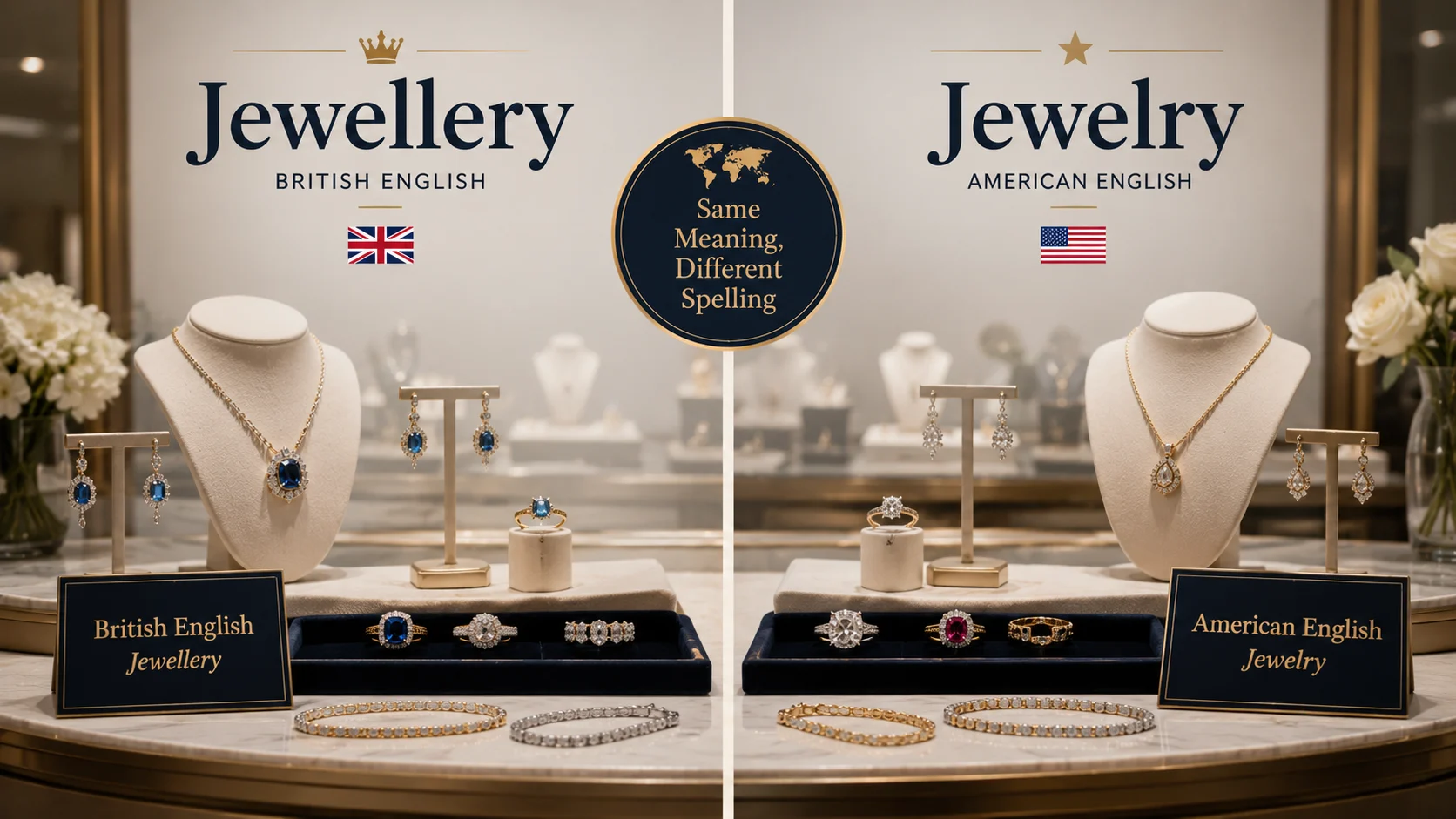
Both spellings refer to the same noun: decorative items such as rings, necklaces, bracelets and earrings. “Jewelry” is the standard spelling in American English, while “jewellery” is preferred in British English and many other varieties of English. Neither spelling is incorrect, but choosing the wrong regional form can create inconsistency in professional, academic and commercial writing.
Have you ever wondered jewellery or jewelry is the correct spelling? Both words refer to decorative items such as rings, necklaces, bracelets, and earrings, yet the difference lies in regional English usage. Choosing the right spelling can make your writing more natural and help you connect with your intended audience. Although the two forms look slightly different, neither is incorrect when used in the appropriate English variety.
The key distinction is simple: jewellery is the standard spelling in British English, commonly used in the UK, Pakistan, Australia, and other regions that follow British spelling conventions. Jewelry is the preferred American English spelling in the United States. Both words have the same meaning and pronunciation, so the choice depends on your audience rather than grammar. In this guide, you’ll discover the meanings, examples, and practical usage rules for jewellery vs. jewelry to help you write clearly and consistently.
Jewellery or Jewelry | What’s the Difference?
Jewellery and jewelry are both nouns. They describe decorative objects worn for personal adornment, including rings, necklaces, earrings, bracelets, brooches, pendants, and similar items.
The difference is primarily regional spelling rather than meaning, grammar, pronunciation, or definition. American English generally uses jewelry, while British English uses jewellery.
| Feature | Jewelry | Jewellery |
|---|---|---|
| Part of speech | Noun | Noun |
| Meaning | Decorative items worn as personal adornment | Decorative items worn as personal adornment |
| Main variety | American English | British English |
| Pronunciation | Essentially the same | Essentially the same |
| Meaning difference | None | None |
| Common usage | United States | United Kingdom and many British English contexts |
| Example | She bought a gold jewelry set. | She bought a gold jewellery set. |
The distinction is therefore simple.
Jewelry is the preferred American spelling.
Jewellery is the preferred British spelling.
Neither form changes the meaning of the word.
The best choice depends on the English variety you are expected to follow.
Is Jewellery or Jewelry a Grammar, Vocabulary or Usage Issue?
This is primarily a spelling and usage issue rather than a grammar problem. Both words belong to the same vocabulary item, and both function as nouns.
There is no grammatical rule saying that one form is correct while the other is incorrect everywhere. Instead, the spelling follows regional conventions. American English commonly removes the additional letters found in several British spellings, while British English often preserves them.
Consider these examples:
American English: The jewelry store opened at nine.
British English: The jewellery shop opened at nine.
The grammar in both sentences is perfectly sound. The difference lies in the spelling convention and, in the second example, the choice of shop rather than store also reflects a regional preference.
In formal writing, consistency is more important than trying to combine both forms. If an article begins with American spelling, continuing with British spelling later in the same article can make the text appear careless.
Academic writing follows the same principle. A university in the United States will generally expect American English, while a British university may expect British English. When an institution provides a style guide, that guide should take priority.
Casual communication is more flexible. A reader will understand either spelling in most English speaking environments. Still, professional writers should match the expected regional standard whenever possible.
When to Use Jewelry
Use jewelry when writing primarily for an American English audience. This is the standard spelling in the United States and is especially appropriate for American businesses, publications, educational materials, product pages, and general websites aimed at American readers.
For example, an American retailer might write:
Our jewelry collection includes gold rings, silver bracelets, and diamond earrings.
A workplace example would be:
The company launched a new jewelry collection for the holiday season.
An academic example could be:
The museum contains an extensive collection of ancient jewelry from several civilizations.
A technology example might appear in an ecommerce system:
The jewelry category contains rings, necklaces, watches, and earrings.
The same spelling is also useful when optimizing content for an American search audience. Search engines can understand both variants, but matching the language conventions of the intended audience creates a more natural experience for readers.
Usage recap for Jewelry
Use jewelry when your audience primarily uses American English. It is especially suitable for United States websites, American publications, product descriptions, school assignments, and business communication.
When to Use Jewellery
Use jewellery when writing primarily for a British English audience. This spelling is standard in British English and is also common in several countries and regions where British spelling conventions have traditionally influenced education and publishing.
A workplace example would be:
The company has introduced a new jewellery collection for the summer season.
An academic example could be:
The exhibition examines the cultural significance of jewellery in medieval Europe.
A technology example might appear on a British ecommerce website:
Browse our jewellery collection by material, style, or price.
The spelling is also appropriate when creating content specifically for readers who expect British English conventions. This can be important for retailers, publishers, educational institutions, and organizations operating in markets influenced by British English.
Usage recap for Jewellery
Use jewellery when British English is the chosen language standard. It works naturally in British publications, British academic writing, United Kingdom business content, and websites targeting readers who expect British spelling.
When You Should NOT Use Jewellery or Jewelry
The two spellings should not be treated as completely interchangeable in a carefully edited document. Although readers will understand both, switching between them without a reason can weaken consistency.
- Do not switch spelling standards halfway through an article. Choose the variety that matches your audience and maintain it.
- Do not use jewelry automatically when writing for a British publication simply because it appears frequently online.
- Do not use jewellery automatically in American business content when the company follows American English.
- Do not change the spelling inside a quotation merely to make it match your preferred variety. Preserve the original wording when quoting a source.
- Do not mix regional spelling conventions throughout an academic assignment unless the assignment specifically discusses language variation.
- Do not assume that one spelling is more correct simply because it contains fewer or more letters.
- Do not treat jewellery as a different product category from jewelry. The distinction is spelling, not meaning.
- Do not create separate product categories solely because one customer searches for jewelry and another searches for jewellery. A well structured website can handle both search variants while maintaining one consistent editorial standard.
Common Mistakes and Decision Rules
The most frequent mistake is believing that one spelling is universally correct. English spelling varies by region, and this word is a clear example.
| Correct sentence | Incorrect sentence | Explanation |
|---|---|---|
| She bought new jewelry in New York. | She bought new jewellery in New York. | American English normally uses jewelry. |
| She bought new jewellery in London. | She bought new jewelry in London. | British English normally uses jewellery. |
| The museum displays ancient jewellery. | The museum displays ancient jewelry. | The first sentence follows British spelling. |
| The store sells handmade jewelry. | The store sells handmade jewellery. | The first sentence follows American spelling. |
| Our British English guide uses jewellery throughout. | Our British English guide uses jewelry throughout. | Consistency matters in formal content. |
| Our American English guide uses jewelry throughout. | Our American English guide uses jewellery throughout. | American style normally uses jewelry. |
Decision Rule Box
If your audience follows American English, use jewelry.
If your audience follows British English, use jewellery.
If the required style guide specifies one spelling, follow that guide.
If no regional standard is specified, choose one variety and use it consistently.
This is a better decision rule than trying to determine which spelling is universally correct. Both forms are established English spellings.
Jewellery or Jewelry in Modern Technology and AI Tools
Modern technology has made regional spelling differences more visible because the same content can reach readers around the world.
Search engines generally understand that jewelry and jewellery represent the same concept. An ecommerce platform can therefore receive searches using either spelling even when its product catalog uses only one regional form.
Artificial intelligence tools also recognize the relationship between the two spellings. When generating content for a particular market, however, the writer or content strategist should specify the intended variety of English. Otherwise, an AI system may produce a mixture of regional conventions.
For example, an American product description might consistently use jewelry, color, favorite, and organize. A British version might use jewellery, colour, favourite, and organise.
This illustrates an important principle in modern content creation: localization is not simply translation. It also involves spelling, vocabulary, tone, punctuation, and audience expectations.
For SEO, there is no need to create awkward sentences simply to repeat both variants. Natural language is more valuable than keyword stuffing. A website targeting multiple markets can mention the alternate spelling where it genuinely helps users, while maintaining a clear primary language standard.
Etymology of Jewellery and Jewelry
The history of the word helps explain why the spelling can look unusual.
Both forms ultimately trace back through French to words associated with jewels and precious objects. The English word developed from the Old French term related to a jewel or ornament, eventually becoming associated with articles worn for decoration.
The spelling developed differently across varieties of English. British English retained the form jewellery, while American English adopted the shorter jewelry spelling.
This pattern is not unusual. British and American English contain many pairs in which spelling differs while meaning remains unchanged. Examples include colour and color, favour and favor, and centre and center.
The important point is that jewelry and jewellery are not two separate words with different definitions. They are regional spelling variants of the same word.
An Expert View of the Difference
A useful way to understand the distinction is to treat the two forms as regional equivalents rather than competing vocabulary items.
“Jewelry and jewellery express the same concept; the spelling signals the English variety being used.”
This principle applies broadly to English localization. Good writing is not simply about selecting a dictionary approved word. It is also about selecting the form that best fits the intended readership and maintaining that choice consistently.
Case Study 1: American Ecommerce
Imagine an online jewelry retailer based in California. Its product pages use jewelry in category names, headings, descriptions, and customer information. The consistent American spelling reinforces the company’s regional identity.
If several pages suddenly changed to jewellery, readers would still understand the content, but the website could appear to have been assembled from multiple sources. Consistency would be the more important editorial concern.
Case Study 2: British Academic Publishing
Now consider a British university publishing an article about historic jewellery. The publication uses British spelling throughout its editorial guidelines.
Changing jewellery to jewelry simply because the American form is common on international websites would introduce an unnecessary inconsistency. Maintaining jewellery supports the publication’s established language standard and gives the article a coherent editorial identity.
These examples show why spelling choices matter even when meaning remains unchanged. The spelling itself can communicate the linguistic environment in which the content was produced.
Error Prevention Checklist
Always use Jewelry when
- Your audience is primarily American.
- Your publication follows American English.
- Your organization uses an American English style guide.
- Your product catalog is localized for the United States.
- Your academic or professional institution requires American spelling.
Never use Jewellery when
- Your American style guide specifically requires jewelry.
- You are editing an American document where regional consistency matters.
- You are creating standardized American product categories.
- You are intentionally maintaining a consistent American English vocabulary throughout a publication.
The reverse applies when your content follows British English. In that setting, jewellery is normally the appropriate choice.
Related Grammar Confusions You Should Master
Learning this distinction becomes easier when you understand other regional spelling pairs and commonly confused forms.
- Colour or color
- Favourite or favorite
- Centre or center
- Licence or license
- Organisation or organization
- Travelling or traveling
- Cancelled or canceled
- Theatre or theater
- Programme or program
- Practise or practice
These examples demonstrate that English spelling is not a single fixed system. Different varieties have developed their own conventions, and successful writers learn to recognize those conventions instead of labeling one variety as universally correct.
FAQs
Is jewelry or jewellery correct?
Both are correct. Jewelry is the standard American spelling, while jewellery is the standard British spelling, so the correct choice depends on the English variety being used.
Why does American English spell jewelry differently?
American English generally uses the shorter jewelry form, while British English retains jewellery. The difference developed through regional spelling conventions rather than a difference in meaning.
Is jewellery British or American English?
Jewellery is primarily associated with British English. It is also used in other regions and publications that follow British spelling conventions.
Is jewelry American English?
Yes. Jewelry is the standard spelling used in American English and is common in United States business, education, publishing, and ecommerce content.
Do jewelry and jewellery have different meanings?
No. Both words refer to decorative objects worn as personal adornment, including rings, necklaces, bracelets, earrings, and similar items.
Which spelling should I use for SEO?
Use the spelling that matches your target audience and regional language standard. Search engines can generally understand both forms, so natural and consistent content is more important than repeating both spellings.
Can I use jewelry and jewellery in the same article?
You can, but unnecessary switching is best avoided. Choose the regional spelling appropriate for your audience and use it consistently throughout the article.
Which spelling is better for a British website?
Jewellery is normally the better choice for a British website because it follows the conventional British English spelling.
Which spelling is better for an American website?
Jewelry is normally the better choice for an American website because it follows standard American English spelling.
Conclusion
The difference between jewellery or jewelry is straightforward once regional English conventions are understood. Both spellings refer to the same type of decorative personal adornment, and neither changes the word’s meaning or grammatical function. The main distinction is regional: American English normally uses jewelry, while British English normally uses jewellery.
The most reliable approach is to identify your audience first, choose the appropriate English variety, and then apply that spelling consistently. This matters in academic writing, business communication, ecommerce, publishing, and SEO content.
If you are writing for readers in the United States, choose jewelry. If your content follows British English, choose jewellery. When a formal style guide exists, follow it above all else.
Consistency is ultimately the key. Once you know which regional standard your content requires, the choice between jewellery or jewelry becomes simple.
Discover More Related Articles:
- Excited or Exited | The Difference Every English Learner Should Know In 2026
- Suppose or Supposed | Which Word Is Correct & When Should You Use Each In 2026
- Misspelled or Misspelt | Why British & American English Differ In 2026