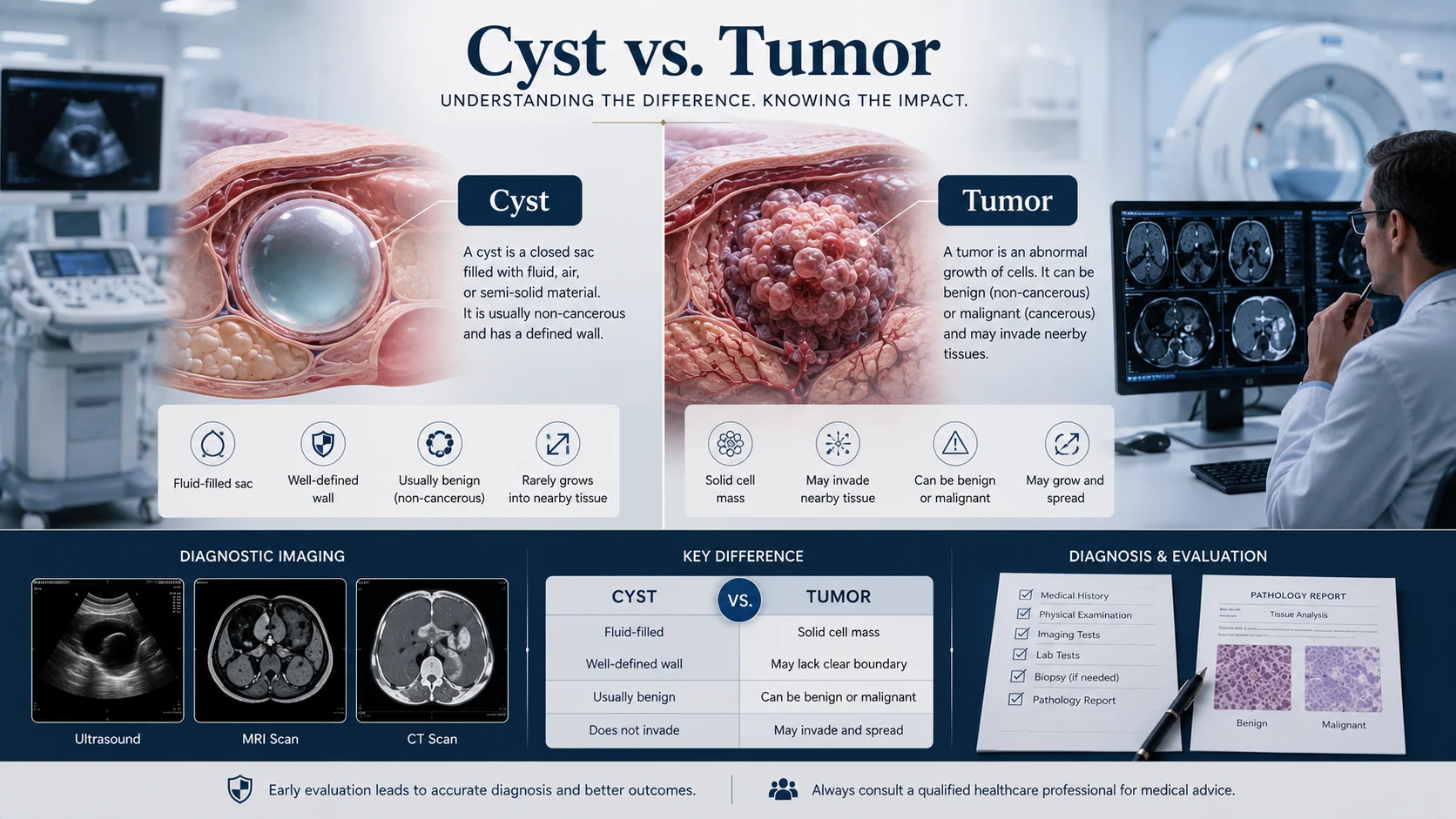
A cyst is a closed sac that usually contains fluid, air, pus, or other material, while a tumor is an abnormal mass of tissue caused by cells growing or dividing more than they should. Most cysts are benign, and tumors may also be benign, so neither term automatically means cancer.
Cyst or Tumor | What Is the Difference?
The terms cyst and tumor describe different kinds of abnormal growths or masses, although they can sometimes look similar on an imaging scan or feel similar when they occur near the skin.
A cyst is a noun that describes a closed, saclike structure containing fluid, air, pus, or another substance. Cysts can develop almost anywhere in the body, including the skin, organs, bones, and soft tissues. Most cysts are benign, meaning they aren’t cancerous.
A tumor is also a noun. In medical terminology, it refers to an abnormal mass of tissue that develops when cells grow and divide more than they should or fail to die when they should. A tumor can be benign or malignant. A malignant tumor is cancerous and can invade nearby tissues or spread to other parts of the body.
| Feature | Cyst | Tumor |
|---|---|---|
| Basic definition | Closed sac or pocket | Abnormal mass of tissue |
| Typical contents | Fluid, air, pus, or other material | Usually a mass of cells or tissue |
| Can occur anywhere | Yes | Yes |
| Usually cancerous | No, most are benign | Not necessarily |
| Can be benign | Yes | Yes |
| Can be malignant | Some cystic growths can be associated with cancer | Yes |
| Common evaluation | Ultrasound, CT, MRI, physical examination | Imaging, physical examination, and sometimes biopsy |
| Treatment | Observation, drainage, medication, or surgery depending on type | Observation, surgery, medication, radiation, or other treatment depending on type |
Quick Recap
A cyst is primarily defined by its saclike structure and contents.
A tumor is primarily defined as an abnormal mass of tissue.
Most cysts aren’t cancerous, while tumors can be either benign or malignant.
Imaging can provide important clues, but the exact diagnosis depends on the location and characteristics of the growth.
Is Cyst or Tumor a Grammar, Vocabulary or Usage Issue?
This is primarily a medical vocabulary and usage distinction, not a grammar issue. The words aren’t interchangeable because they describe different characteristics of a growth.
A doctor may use the word cyst when imaging or examination suggests a fluid filled or saclike structure. The word tumor is broader in another sense because it describes an abnormal tissue mass that can be benign or malignant. A solid tumor, for example, usually contains little or no cystic fluid.
In formal medical writing, choosing the correct term matters because it communicates information about the structure and possible cause of the lesion. In everyday conversation, people may call any unexplained lump a tumor, but that doesn’t necessarily mean the lump is cancerous.
The word mass is often even more neutral. According to the National Cancer Institute, a mass can result from abnormal cell growth, a cyst, hormonal changes, or an immune reaction. A mass can therefore be benign or malignant.
This distinction is particularly important when reading an ultrasound, CT scan, MRI report, or doctor’s note. Seeing the word tumor does not by itself establish a cancer diagnosis.
What Is a Cyst?
A cyst is a closed pocket or sac that contains material such as fluid, air, pus, or other substances. Cysts have many causes and can develop in almost every part of the body.
Some cysts develop because of blocked ducts or glands. Others are related to inflammation, infection, inherited conditions, developmental processes, or changes in organs and tissues. The exact cause depends heavily on the location and type of cyst.
For example, skin cysts may form beneath the surface of the skin. Ovarian cysts can develop as part of normal reproductive processes or from other conditions. Pancreatic cysts have several different forms, ranging from harmless pseudocysts to lesions that require careful monitoring because some types can be precancerous or cancerous.
Workplace Example
Suppose an employee notices a lump on the arm and describes it to a colleague as a tumor. That wording may unnecessarily suggest cancer. A more accurate statement would be that the person has noticed a lump or mass that needs medical evaluation.
Academic Example
In academic or medical writing, a sentence such as “the patient had a cystic lesion identified on ultrasound” is more precise than simply saying “the patient had a tumor.” The first wording provides structural information without making an unsupported conclusion about cancer.
Technology Example
Medical imaging technology such as ultrasound, CT, and MRI can help clinicians determine a lesion appears fluid filled, solid, or mixed. Imaging characteristics can guide the next step, although the appropriate test varies according to the body part and suspected condition.
Cyst Usage Recap
Use cyst when the medical finding is identified as a saclike structure containing fluid, air, pus, or another material. Don’t assume that a cyst is cancerous simply because it appears as a noticeable lump or is large.
What Is a Tumor?
A tumor is an abnormal mass of tissue that forms when cells grow and divide more than they should or don’t die when they should. The National Cancer Institute explains that tumors may be benign or malignant.
A benign tumor isn’t cancer. It can sometimes become large and cause symptoms by pressing on nearby structures, but it doesn’t invade surrounding tissue or spread throughout the body in the way malignant tumors can.
A malignant tumor, on the other hand, is cancerous. Malignant cells can invade nearby tissues and may spread through the blood or lymphatic system to other areas of the body.
This means the word tumor alone isn’t enough to determine a growth is dangerous.
Workplace Example
In a workplace health discussion, saying “the scan found a tumor” shouldn’t automatically be interpreted as “the person has cancer.” The medically accurate question is the tumor is benign or malignant and what further testing has established.
Academic Example
In a medical research paper, researchers may distinguish between benign tumors, malignant tumors, solid tumors, cystic lesions, and other masses. Such distinctions help readers understand the biological behavior and structural characteristics of the condition being studied.
Technology Example
Modern imaging systems can provide detailed information about the size, shape, location, internal composition, and relationship of a mass to surrounding structures. Radiologists use these characteristics to help determine additional evaluation is appropriate. Imaging can be highly informative, but it doesn’t always provide a definitive tissue diagnosis.
Tumor Usage Recap
Use tumor when referring to an abnormal tissue mass.
Don’t automatically equate tumor with cancer.
The terms benign and malignant provide the crucial information about a tumor is cancerous.
How Doctors Tell a Cyst From a Tumor
Doctors generally consider several pieces of information rather than relying on the name of a lump alone.
Physical Examination
A clinician may examine the location, size, mobility, tenderness, texture, and changes over time. However, physical examination cannot always establish a lump is a cyst, tumor, or another type of lesion.
A superficial cyst may feel soft or fluctuant, while some tumors may feel firm. These observations can provide clues, but they aren’t reliable enough to make a diagnosis by themselves.
Ultrasound
Ultrasound is particularly useful for determining a lesion appears fluid filled, solid, or mixed. This makes it an important tool for evaluating many types of cysts and masses.
Mayo Clinic notes that cysts that appear uniform on ultrasound or CT are almost always benign, whereas cysts containing solid components may require additional evaluation.
CT and MRI
CT and MRI can provide additional anatomical detail. They may help doctors determine the precise location and internal characteristics of a lesion and its relationship to nearby organs or tissues.
The choice between ultrasound, CT, MRI, or another examination depends on the body part involved and the clinical question.
Biopsy
When imaging cannot establish what a growth is, a biopsy may be necessary. A biopsy involves taking a sample of tissue or cells for laboratory examination.
Mayo Clinic identifies biopsy as the best test for determining a cystic or solid growth is benign or malignant when tissue diagnosis is required.
Not every cyst or tumor requires a biopsy. The decision depends on the location, appearance, symptoms, growth pattern, medical history, and the result would change treatment.
When You Should NOT Use Cyst or Tumor
Several common assumptions can create confusion.
1. Don’t call every lump a tumor
A lump can be a cyst, infection, inflammation, hormonal change, or another type of mass.
2. Don’t assume tumor means cancer
Tumors can be benign or malignant. The word itself doesn’t establish a cancer diagnosis.
3. Don’t assume every cyst is harmless
Most cysts are benign, but some cystic lesions can require additional investigation. Certain pancreatic cystic neoplasms, for example, may be precancerous or cancerous.
4. Don’t diagnose a lump by touch alone
A lump’s firmness, mobility, or tenderness can provide clues, but examination alone cannot reliably establish its nature.
5. Don’t interpret imaging terminology without context
Words such as lesion, mass, cystic, solid, and tumor have specific medical meanings. A complete radiology report provides more useful information than one isolated word.
6. Don’t assume size alone determines cancer risk
A large growth isn’t automatically malignant, and a small growth isn’t automatically harmless. Location, structure, behavior, and other clinical factors matter.
7. Don’t ignore a changing or symptomatic growth
A lump that grows, becomes painful, causes functional problems, or is associated with other concerning symptoms deserves professional evaluation.
8. Don’t assume treatment is always necessary
Some benign cysts and tumors can simply be monitored when they aren’t causing problems. Treatment decisions depend on the specific diagnosis and circumstances.
Common Mistakes and Decision Rules
| Correct sentence | Incorrect sentence | Explanation |
|---|---|---|
| The scan showed a cyst. | The scan showed cancer. | A cyst is usually benign and doesn’t automatically indicate cancer. |
| The doctor found a tumor. | The doctor found a cancer. | A tumor can be benign or malignant. |
| The mass appears cystic. | The mass is definitely harmless. | Imaging can suggest a cystic structure without proving every aspect of its cause. |
| The doctor recommended further testing. | The cyst definitely needs surgery. | Treatment depends on the type, size, location, symptoms, and clinical findings. |
| A biopsy may determine the growth is malignant. | An ultrasound always proves a growth is cancer. | Imaging and tissue testing serve different diagnostic purposes. |
Decision Rule: If the finding is a closed sac containing fluid, air, pus, or another material, the term cyst may be appropriate. If it is an abnormal mass of tissue formed by abnormal cell growth, the term tumor may be appropriate. The final diagnosis should come from a qualified healthcare professional.
Cyst or Tumor in Modern Technology and AI Tools
Modern medical technology has made it easier to identify and characterize masses before treatment decisions are made. Ultrasound, CT, MRI, and other imaging methods can reveal structural features that aren’t apparent during a physical examination.
Artificial intelligence is also increasingly being studied and incorporated into medical imaging workflows. AI systems can assist with image analysis, pattern recognition, measurement, and prioritization of findings. However, AI output shouldn’t be treated as an independent medical diagnosis.
The distinction remains important because an AI system, search engine, or automated report cannot replace clinical judgment. A medical professional considers the imaging appearance together with symptoms, medical history, examination findings, and other diagnostic information.
Etymology and Medical Meaning
The history of these terms helps explain why they aren’t interchangeable.
The word cyst comes from a Greek root associated with a pouch or bladder, reflecting its traditional anatomical meaning as a saclike structure.
The word tumor comes from Latin tumor, meaning swelling. Its modern medical meaning developed around the concept of an abnormal mass or swelling of tissue.
Interestingly, the older idea of a tumor as a swelling explains why the medical term doesn’t inherently mean cancer. The modern classification depends on biological behavior, particularly the growth is benign or malignant.
The National Cancer Institute similarly defines a tumor as an abnormal tissue mass and distinguishes benign tumors from malignant tumors.
Two Clinical Examples That Show Why the Difference Matters
Example One: Pancreatic Cystic Lesions
Pancreatic cysts demonstrate why the word cyst doesn’t automatically answer the question of cancer risk. Mayo Clinic describes several types of pancreatic cystic lesions. Some, such as pseudocysts, are benign, while certain mucinous cystic neoplasms and intraductal papillary mucinous neoplasms can be precancerous or cancerous.
The practical result is that doctors may monitor a pancreatic cyst, perform additional imaging, or recommend treatment depending on its type and characteristics. This is a concrete example of why the word cyst alone isn’t sufficient to determine prognosis.
Example Two: Ovarian Cystic Findings
Ovarian cysts provide another useful example. Many are benign and can be monitored, but the evaluation changes when a cyst has solid components or occurs in a higher risk clinical setting. Mayo Clinic notes that some solid ovarian cysts, particularly after menopause, may be cancerous and therefore require careful assessment.
The result is a more individualized approach rather than a simple rule that every ovarian cyst is harmless.
Expert Perspective
“Tumors and cysts are two distinct types of growths.”
This distinction from Mayo Clinic captures the central medical point. A cyst and a tumor aren’t simply two names for the same thing, and neither term alone provides enough information to determine a growth is cancerous.
Error Prevention Checklist
Always Use Cyst When
The finding is specifically identified as a saclike structure.
The lesion contains fluid, air, pus, or another material.
A medical report specifically describes the structure as a cyst.
The clinical context supports a known cyst type.
Never Use Tumor When
You are simply describing an unexplained lump and have no medical evidence that it is a tumor.
You are using tumor as a synonym for cancer.
You are assuming a benign cyst must be a tumor.
You are interpreting a single imaging word without considering the complete report.
Related Grammar Confusions You Should Master
Although this topic is medical rather than grammatical, several related terminology distinctions are useful for accurate health communication.
- Cyst vs mass: A mass is a broader term that can include a cyst or other growth.
- Tumor vs cancer: A tumor can be benign or malignant, while cancer refers to malignant disease.
- Benign vs malignant: Benign means not cancerous, while malignant means cancerous.
- Lesion vs tumor: A lesion is a broad term for abnormal or damaged tissue and can include cysts and tumors.
- Solid vs cystic: Solid describes a mass that generally doesn’t contain cysts or liquid areas, while cystic describes fluid or saclike characteristics.
- Biopsy vs imaging: Imaging creates pictures of internal structures, while biopsy examines sampled tissue or cells.
- Mass vs lump: These terms can describe a physical abnormality without establishing its exact cause.
- Growth vs tumor: Growth is often used generally, while tumor has a more specific medical meaning.
- Neoplasm vs tumor: The National Cancer Institute treats neoplasm as another term for tumor.
- Cancerous vs malignant: In medical usage, malignant generally means cancerous, particularly when describing a tumor.
FAQs
Is a cyst or tumor more dangerous?
A cyst is usually benign, while a tumor can be benign or malignant, so neither word alone determines how dangerous a growth is.
Can a cyst turn into a tumor?
A typical benign cyst doesn’t simply transform into a tumor, although some cystic lesions are associated with abnormal tissue growth and may require monitoring or further evaluation.
Can a cyst be cancerous?
Most cysts aren’t cancerous, but some cancerous conditions can have cystic features, which is why unusual or complex cysts may require additional testing.
How can you tell if a lump is a cyst or tumor?
A healthcare professional may use physical examination and imaging such as ultrasound, CT, or MRI, with biopsy used when tissue diagnosis is needed.
Does a tumor always mean cancer?
No. Tumors can be benign or malignant, and a benign tumor isn’t cancer.
Are cysts usually harmless?
Most cysts are benign, but their significance depends on the type, location, appearance, symptoms, and other clinical factors.
Can an ultrasound tell a growth is a cyst or tumor?
Ultrasound can often show a lesion appears fluid filled or solid, but additional testing may be necessary when its features aren’t clearly benign.
When should a lump be checked by a doctor?
A new, growing, painful, persistent, or otherwise concerning lump should be evaluated by a healthcare professional rather than diagnosed at home.
Is a benign tumor the same as a cyst? N
o. A benign tumor is a noncancerous tissue growth, while a cyst is a saclike structure containing fluid, air, pus, or another material.
Conclusion
The most important distinction is straightforward: a cyst is generally a saclike structure containing fluid, air, pus, or another material, whereas a tumor is an abnormal mass of tissue. Most cysts are benign, and tumors can also be benign, so neither term automatically means cancer.
The real answer comes from the complete clinical picture. Doctors may consider the location, size, internal structure, symptoms, growth pattern, medical history, and imaging findings before deciding observation, additional imaging, biopsy, or treatment is appropriate.
Understanding the terminology can make a medical report less frightening and more meaningful. If you’ve been told that you have a cyst, tumor, mass, or lesion, the most useful next step is to ask what type of growth it is, what the imaging shows, additional testing is needed, and what the findings mean in your particular situation.
Discover More Related Articles:
- Pimple or Herpes | How to Tell the Difference & When to Get Medical Advice In 2026
- Cetaphil or CeraVe | Which Is Better for Your Skin Type In 2026
- Innie or Outie | Meaning, Difference & Usage Explained In 2026