The difference between valentines or valentine’s depends on grammar and meaning. Valentines is the plural form of Valentine, while Valentine’s is the singular possessive form that shows ownership or association, most commonly in the phrase Valentine’s Day. Choosing the correct form helps you write clearly and avoid common punctuation mistakes.
Have you ever wondered it should be “valentines” or “Valentine’s” when writing about the day of love? This small spelling difference can easily cause confusion, especially in social media posts, greeting cards, blogs, and everyday messages. While both forms may look similar, they do not always mean the same thing. “Valentine’s” is the standard form when referring to Valentine’s Day or something belonging to a Valentine, while “valentines” is typically the plural form of the noun valentine, meaning multiple people or cards associated with the occasion.
Understanding the difference helps you choose the right word for the right context. You are writing a romantic message, creating content, or preparing a formal article, using the correct form makes your writing clearer and more polished. In this guide, we’ll explain valentines vs. Valentine’s, their meanings, grammar, usage, and practical examples so you can avoid this common writing mistake.
Valentines or Valentine’s | What’s the Difference?
At first glance, the only visible difference is an apostrophe. In reality, that small punctuation mark completely changes the function of the word.
| Feature | Valentines | Valentine’s |
|---|---|---|
| Part of speech | Plural noun | Singular possessive noun |
| Meaning | More than one Valentine | Something belonging or relating to one Valentine |
| Shows ownership | No | Yes |
| Common usage | Valentines cards, several Valentines | Valentine’s Day, Valentine’s gift, Valentine’s message |
| Correct for the holiday name | No | Yes |
| Example | We bought ten Valentines for our classmates. | Valentine’s Day is celebrated every February. |
The distinction becomes much easier once you remember that an apostrophe usually signals possession. Without the apostrophe, the word simply becomes plural.
If you are referring to the holiday itself, Valentine’s Day is always the correct form. If you are talking about several cards or several people called Valentines, then the plural form is appropriate.
Is Valentines or Valentine’s a Grammar, Vocabulary or Usage Issue?
This confusion is mainly a grammar and punctuation issue rather than a vocabulary problem. Both words come from the same noun, but each follows a different grammatical rule.
Many English learners assume the apostrophe is optional because both forms sound almost identical when spoken. However, written English depends heavily on punctuation to communicate meaning accurately.
Here is how the distinction works.
| Category | Explanation |
|---|---|
| Grammar | The apostrophe changes the noun into a possessive form. |
| Vocabulary | Both forms come from the same base word but serve different grammatical purposes. |
| Usage | The correct choice depends entirely on the sentence and possession is being shown. |
| Academic writing | Correct punctuation is expected and improves clarity and credibility. |
| Casual writing | People often confuse these forms, especially on social media and in text messages. |
Are They Interchangeable?
No.
Even though they refer to the same root word, the forms are not interchangeable because they perform different grammatical functions.
Compare these examples.
Correct: We exchanged Valentines in class.
Correct: Valentine’s Day is next week.
Incorrect: Valentines Day is next week.
Incorrect: I bought three Valentine’s for my classmates.
Formal Versus Informal Writing
In formal writing, using the correct form is essential. Newspapers, academic papers, business documents, and educational materials always distinguish between plural nouns and possessive nouns.
In casual conversations or text messages, people often omit the apostrophe by mistake. Although readers usually understand the intended meaning, the error can make your writing appear less polished.
Academic Versus Everyday Usage
Teachers, editors, and examination boards expect students to use possessive punctuation correctly. Since Valentine’s Day is the official name of the holiday, using Valentines Day in an essay or assignment is generally considered incorrect.
In everyday communication, paying attention to this small detail helps create a more professional impression.
Using Valentines Correctly

The word Valentines is the plural form of Valentine. It refers to more than one Valentine, that means greeting cards, letters, gifts, or even people with the surname or given name Valentine.
The plural form does not express ownership. It simply indicates quantity.
Workplace Example
Our marketing team designed hundreds of Valentines for the company’s seasonal campaign.
Academic Example
The students decorated colorful Valentines before the classroom celebration.
Technology Example
The online design platform offers templates for creating personalized Valentines.
Notice that each sentence refers to multiple cards rather than ownership.
More Correct Examples
We mailed twenty Valentines to local hospitals.
The children proudly displayed their handmade Valentines.
Several Valentines were left on the teacher’s desk.
The craft store sold thousands of Valentines during February.
My cousins exchanged funny Valentines at the family party.
Common Mistakes
Incorrect: I cannot wait for Valentines Day.
Correct: I cannot wait for Valentine’s Day.
Incorrect: I bought a Valentine’s for each student.
Correct: I bought Valentines for each student.
Usage Recap
Use Valentines whenever you mean more than one Valentine, especially when referring to greeting cards, crafts, or multiple people. Never use it as the official name of the February holiday.
Using Valentine’s Correctly
Valentine’s is the singular possessive form of Valentine. It shows that something belongs to or is associated with one Valentine.
The best known example is Valentine’s Day, the internationally recognized holiday celebrated each February.
Workplace Example
The company launched its Valentine’s Day advertising campaign in early January.
Academic Example
The history class explored the origins of Valentine’s Day traditions.
Technology Example
Our shopping app introduced a special Valentine’s Day section featuring seasonal gifts.
In each example, the apostrophe indicates association with Saint Valentine rather than a plural noun.
More Correct Examples
We decorated the office for Valentine’s Day.
She received a beautiful Valentine’s card from her friend.
The restaurant announced its Valentine’s dinner menu.
The museum opened a special Valentine’s exhibition.
Everyone enjoyed the Valentine’s celebration.
Although people sometimes shorten Valentine’s card to simply Valentine in everyday speech, the possessive form remains essential whenever ownership or the official holiday name is intended.
Usage Recap
Use Valentine’s whenever the noun shows possession or forms part of the official holiday name Valentine’s Day. The apostrophe is not optional and should never be omitted in formal writing.
When You Should NOT Use Valentines or Valentine’s
Even experienced writers occasionally confuse these two forms because the difference depends on punctuation rather than pronunciation. Learning when not to use each form will help you avoid common grammar mistakes.
| Situation | Incorrect Form | Correct Form | Why |
|---|---|---|---|
| Referring to the holiday | Valentines Day | Valentine’s Day | The holiday name is possessive. |
| Talking about several greeting cards | Valentine’s | Valentines | The plural noun is needed, not the possessive. |
| Writing a classroom activity | Valentine’s for everyone | Valentines for everyone | Multiple cards require the plural form. |
| Referring to one person’s card | Valentines card | Valentine’s card | The card belongs to or is associated with one Valentine. |
| Writing advertisements | Valentines Sale | Valentine’s Sale | The event is associated with Valentine’s Day. |
| Mentioning several people named Valentine | Valentine’s attended the meeting | Valentines attended the meeting | The sentence refers to multiple people, not possession. |
| Creating invitations | Happy Valentines Day | Happy Valentine’s Day | The official holiday spelling includes the apostrophe. |
| Labeling handmade cards | Valentine’s on the table | Valentines on the table | The sentence refers to many cards rather than ownership. |
A simple way to avoid confusion is to ask yourself you are talking about more than one item or something belonging to one Valentine. The answer will almost always point you to the correct form.
Common Mistakes and Decision Rules
The following examples show some of the most frequent errors found in emails, advertisements, social media posts, and classroom writing.
| Correct Sentence | Incorrect Sentence | Explanation |
|---|---|---|
| Valentine’s Day is on February fourteenth. | Valentines Day is on February fourteenth. | The holiday name is possessive and requires an apostrophe. |
| We exchanged Valentines at school. | We exchanged Valentine’s at school. | Multiple greeting cards require the plural noun Valentines. |
| She designed a beautiful Valentine’s card. | She designed a beautiful Valentines card. | The card is associated with Valentine’s Day, so the possessive form is correct. |
| The shop announced its Valentine’s sale. | The shop announced its Valentines sale. | The sale is connected with Valentine’s Day. |
| Our class made colorful Valentines. | Our class made colorful Valentine’s. | More than one Valentine card is being discussed, so the plural form is needed. |
| The museum hosted a Valentine’s event. | The museum hosted a Valentines event. | The event relates to Valentine’s Day, making the possessive form correct. |
Decision Rule Box
| If Your Meaning Is… | Use… |
|---|---|
| More than one card, message, or person named Valentine | Valentines |
| Something belonging to or connected with one Valentine | Valentine’s |
| The official February holiday | Valentine’s Day |
Remember this simple rule.
If you mean more than one item, use Valentines. If you mean ownership or the official holiday name, use Valentine’s.
Valentines or Valentine’s in Modern Technology and AI Tools
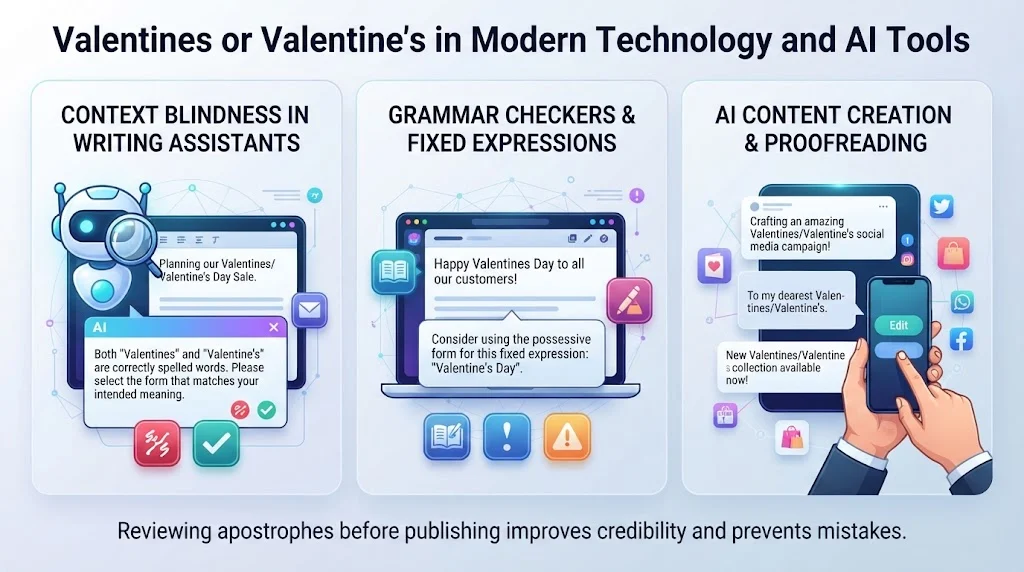
Modern writing tools can identify many spelling mistakes, but they do not always understand context. For example, an AI writing assistant may accept both Valentines and Valentine’s because each is a correctly spelled word. It is your responsibility to choose the form that matches your intended meaning.
Grammar checkers are becoming better at recognizing possessive nouns, especially in fixed expressions like Valentine’s Day. However, marketing content, captions, and short headlines still require careful proofreading because automated tools sometimes miss punctuation errors.
When using AI to create greeting cards, product descriptions, or social media campaigns, reviewing apostrophes before publishing can prevent embarrassing mistakes and improve credibility.
The Etymology Behind the Word
The word Valentine comes from the Latin name Valentinus, which was borne by several early Christian saints. Over time, Saint Valentine became associated with love and affection, leading to the celebration now known as Valentine’s Day.
The possessive form developed because the holiday literally meant the day of Saint Valentine. As English evolved, this shortened naturally to Valentine’s Day, preserving the apostrophe to show association with the saint.
Understanding this history makes the correct spelling much easier to remember.
Expert Insight
“Small punctuation marks often carry significant meaning. A correctly placed apostrophe tells readers a noun is plural or possessive, making writing more precise and easier to understand.”
This principle explains why Valentines and Valentine’s should never be treated as interchangeable.
Case Study One| Business Marketing Campaign
A national gift retailer prepared a February advertising campaign using the headline Happy Valentines Day. Before publication, the editorial team corrected it to Happy Valentine’s Day.
The updated campaign appeared more professional, reduced customer comments about grammar mistakes, and strengthened the company’s brand credibility across print and digital platforms.
Case Study Two | Classroom Writing Project
An elementary school asked students to create handmade greeting cards for classmates. Many children labeled their projects My Valentine’s even though they had made several cards.
After a short grammar lesson explaining plural and possessive nouns, nearly every student corrected the labels to My Valentines. The activity improved punctuation accuracy and helped students understand how apostrophes change meaning.
Error Prevention Checklist
Always Use Valentines When
| ✔ Always Use Valentines When |
|---|
| Referring to more than one greeting card |
| Talking about several people named Valentine |
| Describing multiple classroom cards |
| Mentioning collections of Valentines |
| Discussing handmade holiday cards in plural form |
Never Use Valentine’s When
| ✘ Incorrect Situations |
|---|
| You simply mean several greeting cards. |
| Referring to multiple Valentines without showing ownership. |
| Writing plural nouns that do not require a possessive apostrophe. |
| Describing a group of Valentine cards on a table. |
| Talking about several people named Valentine without indicating possession. |
Keeping this checklist in mind will help you choose the correct form every time and eliminate one of the most common punctuation mistakes in English writing.
Related Grammar Confusions You Should Master
If you often struggle with valentines or valentine’s, you may also encounter other grammar topics involving apostrophes, plurals, and possessive nouns. Mastering these common confusions will strengthen your writing and reduce punctuation errors.
| Grammar Confusion | Main Difference |
|---|---|
| Its or It’s | Possession versus contraction |
| Your or You’re | Possession versus you are |
| Whose or Who’s | Possessive pronoun versus contraction |
| Teachers or Teacher’s | Plural noun versus singular possessive |
| Parents or Parent’s | More than one parent versus belonging to one parent |
| Childrens or Children’s | Incorrect plural versus possessive plural |
| Peoples or People’s | Multiple groups versus possessive noun |
| Friends or Friend’s | Plural noun versus ownership |
| Boys or Boy’s | More than one boy versus belonging to one boy |
| Dogs or Dog’s | Plural noun versus possessive noun |
Learning these grammar patterns will make it much easier to recognize when an apostrophe belongs in a sentence and when it does not.
FAQs
Is Valentine’s Day the correct spelling?
Yes. Valentine’s Day is the official and grammatically correct name of the holiday because it refers to the day associated with Saint Valentine.
Can I write Happy Valentines Day without an apostrophe?
No. Omitting the apostrophe creates a grammar mistake in formal writing. The correct greeting is Happy Valentine’s Day.
What does Valentines mean?
Valentines is the plural form of Valentine. It usually refers to multiple greeting cards or several people named Valentine.
Why does Valentine’s have an apostrophe?
The apostrophe shows possession or association. In Valentine’s Day, it indicates that the day is connected with Saint Valentine.
Is Valentines card correct or Valentine’s card?
Valentine’s card is correct when referring to one card associated with the holiday or a single Valentine. Valentines is only correct when talking about several cards.
Why do people confuse Valentines and Valentine’s?
Both words sound nearly identical in speech, so many writers overlook the apostrophe when writing quickly or relying on pronunciation alone.
Do grammar checkers always correct Valentine’s correctly?
Not always. Many grammar tools recognize spelling but may miss contextual punctuation mistakes, so proofreading is still important.
Can Valentines refer to people?
Yes. The plural form Valentines can refer to several individuals whose surname or given name is Valentine, although this usage is uncommon.
Is Valentine’s used outside the holiday name?
Yes. It can describe gifts, cards, dinners, or events connected with one Valentine or with Valentine’s Day, such as Valentine’s dinner or Valentine’s gift.
Conclusion
Understanding the difference between valentines or valentine’s comes down to recognizing the difference between a plural noun and a possessive noun. While the words look similar, they perform different grammatical functions and should never be used interchangeably.
Use Valentines when referring to more than one greeting card or more than one person named Valentine. Use Valentine’s whenever you need to show possession or when writing the official holiday name Valentine’s Day. Paying attention to this small punctuation mark will improve your writing, strengthen your grammar, and help you avoid one of the most common English punctuation mistakes.
You are preparing a school assignment, writing a business advertisement, designing greeting cards, or creating social media content, choosing the correct form demonstrates professionalism and careful attention to detail. Once you remember that the apostrophe signals possession, the choice becomes simple every time.
Discover More Related Articles:
- Bought or Brought | The Grammar Mistake Millions Still Make In 2026
- Champaign or Champagne | What Is the Difference & When to Use Each In 2026
- Pannel or Panel | Which Word Is Correct & What Is the Difference In 2026