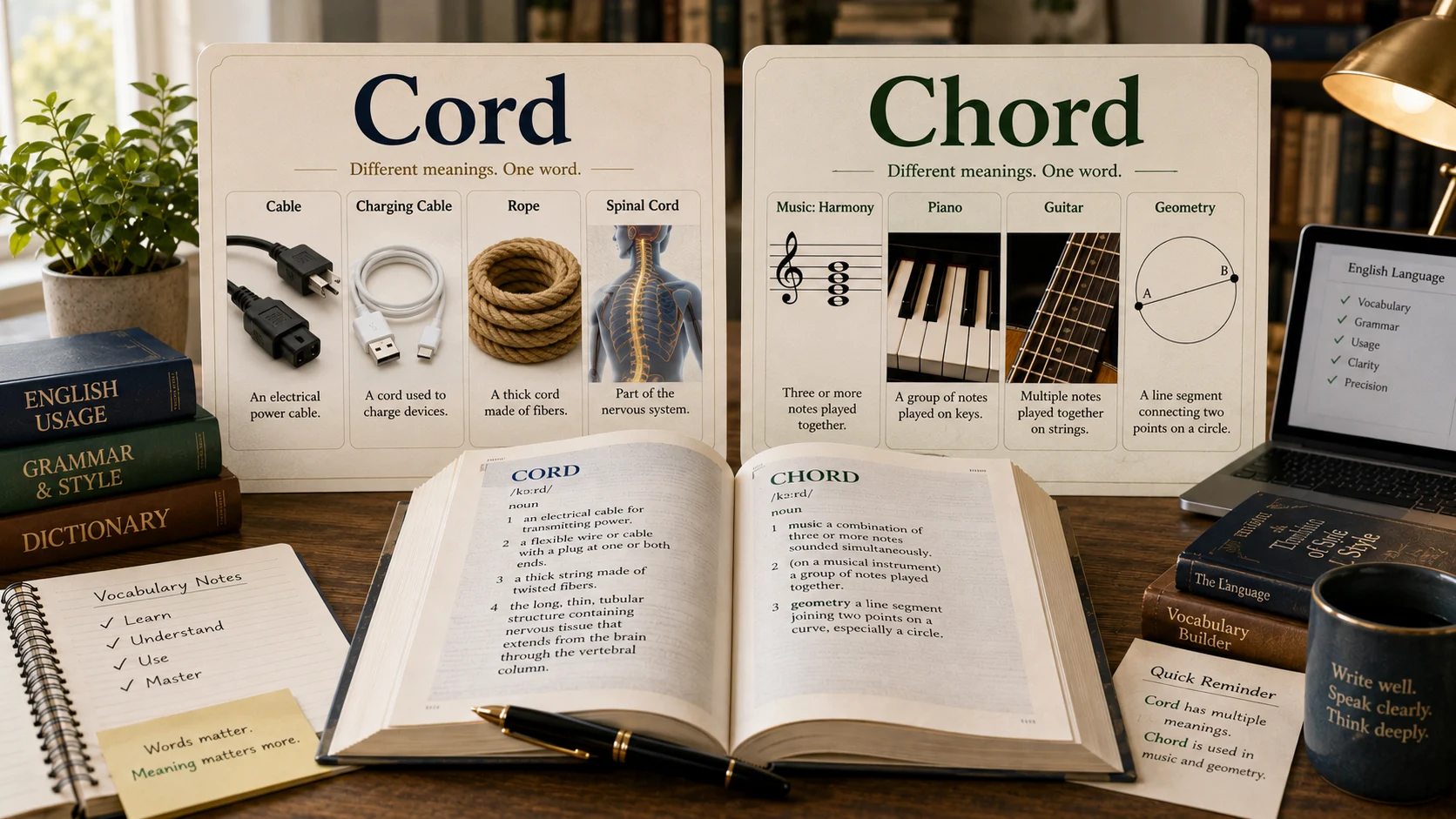
Cord and chord are different words with different meanings, even though they sound exactly alike in most standard varieties of English. A cord usually refers to a flexible string, rope, wire, or anatomical structure, while a chord commonly refers to several musical notes played together or a straight line connecting two points on a circle. Confusing them can change the meaning of a sentence.
Have you ever confused cord vs. chord because these two words sound exactly alike? Although their pronunciation is identical, their meanings, spellings, and uses are entirely different. A cord usually refers to a thin rope, wire, or cable used to connect, tie, or power something. In contrast, a chord can describe a group of musical notes played together or a straight line connecting two points on a circle. Choosing the wrong word can change the meaning of your sentence, especially in writing about music, technology, or everyday objects.
Understanding the difference between cord and chord is easier when you learn their definitions, recognize common examples, and see how each word works in context. This guide explains their meanings, practical uses, and correct spellings with clear examples to help you avoid common mistakes. You are writing a school assignment, discussing music, or describing an electrical cable, you will know which word to use with confidence.
Cord or Chord | What’s the Difference?
The two words are homophones, but they belong to different semantic categories.
Cord is a noun that commonly describes a flexible length of material used for tying, connecting, supporting, or transmitting something. It can refer to rope, string, electrical wiring, or certain structures in the human body.
Chord is a noun with two major meanings. In music, it means a group of notes sounded together. In geometry, it means a line segment whose endpoints lie on a circle.
| Word | Part of speech | Main meaning | Common context | Example |
|---|---|---|---|---|
| Cord | Noun | A flexible length of material, wire, rope, or a similar structure | Electrical devices, clothing, crafts, anatomy | The lamp cord is too short. |
| Chord | Noun | A group of musical notes played together | Music and harmony | She played a beautiful chord on the piano. |
| Chord | Noun | A line segment joining two points on a circle | Geometry | The diagram shows a chord across the circle. |
Quick Recap
A cord is usually something flexible, connected, or elongated.
A chord is usually related to music or geometry.
Both words can sound the same, so spelling and context matter.
If the sentence involves plugging, tying, connecting, or wiring, cord is usually the right choice.
If the sentence involves harmony, notes, circles, or geometry, chord is usually the right choice.
Is Cord or Chord a Grammar, Vocabulary or Usage Issue?
The distinction is primarily a vocabulary and usage issue, rather than a grammatical one.
Both words are grammatically valid nouns. The problem occurs when a writer selects the wrong word for the intended meaning. A sentence can have perfect grammar and still contain an incorrect choice between these homophones.
For example, consider the sentence, “Please replace the damaged chord on the computer.” The grammatical structure is fine, but the vocabulary is wrong if the writer means the electrical cable. The correct sentence is, “Please replace the damaged cord on the computer.”
The same principle works in the opposite direction. “The pianist played a beautiful cord” is structurally understandable, but chord is required when referring to musical harmony.
There is no meaningful formal versus informal distinction between the two spellings. Cord is not a casual form of chord, and chord is not a more formal version of cord. Each word has its own established meaning.
The distinction applies equally in academic and casual writing. A student writing about music needs chord. An employee writing about equipment needs cord. A mathematician describing a circle needs chord.
Cord | Meaning, Examples and Correct Usage
The word cord has several related meanings. Its central idea is something long, narrow, flexible, or connected.
One of the most familiar examples is an electrical cord. Household appliances, lamps, computers, chargers, and many other devices use cords to carry electrical power.
A cord can also mean a piece of strong string or rope. A hoodie may have a cord used to adjust the opening, while a bag may use a cord as a fastening mechanism.
The word also appears in anatomy. The spinal cord is the long bundle of nervous tissue that carries signals between the brain and the body. The umbilical cord connects a developing fetus to the placenta during pregnancy.
Workplace Example
A technician might write:
“The equipment should remain unplugged until the power cord has been inspected.”
Here, cord clearly refers to the physical cable that carries electrical power.
In an office, an employee could say:
“The monitor cord is tangled behind the desk.”
Again, the word refers to a physical connection.
Academic Example
A biology student might write:
“The spinal cord plays an important role in transmitting signals between the brain and the body.”
A literature student might encounter the word in a completely different context, such as a description of a rope or string.
Technology Example
Technology provides some of the most common modern uses of cord. Examples include power cord, charging cord, extension cord, and USB cord.
For example:
“Check the charging cord is securely connected before replacing the device.”
Here, cord describes a physical accessory used to connect equipment.
Usage Recap for Cord
Use cord when you mean a flexible physical connector, string, rope, cable, or anatomical structure. Common compounds include power cord, extension cord, electrical cord, spinal cord, and umbilical cord.
Chord | Meaning, Examples and Correct Usage
The word chord is strongly associated with music, but music is not its only meaning.
In music, a chord consists of multiple notes that sound together. Chords are fundamental to harmony and appear in virtually every major style of Western music.
A guitarist may learn major and minor chords. A pianist may practice chord progressions. A composer may use a particular chord to create tension, resolution, sadness, excitement, or stability.
Workplace Example
A music teacher might write:
“Students should practice each chord slowly before attempting the complete progression.”
A recording engineer could say:
“The final chord should continue for two beats.”
In both examples, chord refers to musical harmony.
Academic Example
A mathematics textbook may use chord in geometry:
“A chord divides the interior of a circle into two regions.”
In this context, chord has nothing to do with music. It refers to a line segment whose endpoints are located on the circumference of a circle.
This second meaning is important because students sometimes assume that chord is exclusively a musical term.
Technology Example
Digital music software frequently uses the word chord. Applications for guitar, piano, songwriting, music education, and audio production may identify chord names such as C major, A minor, or G major.
For example:
“The software detected the chord progression in the recorded track.”
The spelling remains chord because the subject is musical harmony.
Usage Recap for Chord
Use chord when discussing musical harmony or the geometric line segment connecting two points on a circle. The word is standard in musical theory, mathematics, education, and technical writing.
When You Should NOT Use Cord or Chord
Choosing the correct spelling becomes easier when you identify contexts where one word clearly does not belong.
- Do not use chord when you mean an electrical cable. Write “power cord” or “electrical cord.”
- Do not use cord when you mean a combination of musical notes. Write “musical chord.”
- Do not use cord for the geometric segment connecting two points on a circle. The mathematical term is chord.
- Do not use chord when describing a rope or string used to tie something.
- Do not write “spinal chord” when referring to the nervous system. The correct anatomical term is spinal cord.
- Do not write “guitar cord” when you mean a combination of guitar notes. The standard expression is guitar chord.
- Do not assume that the extra letter in chord makes it more formal. The spelling difference reflects meaning, not register.
- Do not choose the spelling based on pronunciation alone. These words are homophones, so sound cannot provide the answer.
Common Mistakes and Decision Rules
| Correct sentence | Incorrect sentence | Explanation |
|---|---|---|
| The power cord is damaged. | The power chord is damaged. | An electrical cable is a cord. |
| She played a beautiful chord. | She played a beautiful cord. | Musical harmony requires chord. |
| The spinal cord carries nerve signals. | The spinal chord carries nerve signals. | The anatomical structure is the spinal cord. |
| The chord connects two points on the circle. | The cord connects two points on the circle. | The geometric term is chord. |
| He tied the package with a cord. | He tied the package with a chord. | A flexible piece of string is a cord. |
| The guitarist changed the chord progression. | The guitarist changed the cord progression. | Musical progressions use chords. |
Decision Rule Box
If you mean a flexible connector, cable, string, rope, or anatomical structure, use cord.
If you mean musical harmony or a line segment joining two points on a circle, use chord.
This simple rule covers the overwhelming majority of everyday cases.
Cord and Chord in Modern Technology and AI Tools
Modern technology creates frequent opportunities to encounter both words.
A device may require a charging cord, power cord, or connection cord. Technical support documentation therefore uses cord when describing a physical cable or flexible connection.
Music technology uses chord in a different way. AI music generators, digital audio workstations, songwriting applications, and music education platforms can analyze chord progressions, identify chords, or generate harmonic sequences.
Artificial intelligence can help detect the intended word from context, but writers should still understand the distinction. Automated correction systems are not perfect, especially when a sentence contains unusual terminology. Human knowledge remains important when a homophone has multiple legitimate meanings.
Consider the sentence, “The software detected the C major cord.” A language system may recognize that the intended word is probably chord because C major is a musical harmony. Conversely, “The laptop cord is damaged” clearly points to the physical cable.
Etymology | Where Did Cord and Chord Come From?
The histories of these words help explain why their spellings differ.
Cord comes through French and Latin traditions associated with words referring to string, rope, or related forms of connection. Over time, English developed several physical and anatomical uses.
Chord comes from a Greek root associated with string, particularly in the context of musical instruments. Its later musical sense developed through the history of musical theory and harmony. The mathematical meaning also developed from the idea of a string or straight segment spanning part of a circle.
Interestingly, the historical relationship between the words is closer than their modern meanings might suggest. Their shared association with a string or line helps explain why they can feel conceptually related, even though modern English treats them as separate words.
An Expert Perspective on the Distinction
A useful linguistic principle is that pronunciation alone does not determine spelling or meaning. English contains many homophones whose identities become clear only through context.
An expert editor might summarize the distinction this way:
“When two words sound alike, meaning and context must guide spelling.”
That principle extends beyond these two terms. Similar problems occur with words such as there and their, principal and principle, and stationary and stationery. Careful writers learn to identify the meaning first and select the spelling second.
Case Study One: Workplace Technical Writing
Imagine a company preparing maintenance instructions for office equipment.
The original sentence reads:
“Inspect the computer chord before connecting the monitor.”
The technician understands the instruction, but the terminology is incorrect. A professional revision changes the sentence to:
“Inspect the computer cord before connecting the monitor.”
The change improves technical accuracy without altering the sentence structure. In a workplace environment, this distinction matters because equipment documentation should use established terminology consistently.
The practical result is clearer communication. Employees know that the instruction concerns a physical cable rather than a musical or mathematical concept.
Case Study Two: Academic Music Writing
Now consider a student writing a paper about piano harmony.
The student writes:
“The composer repeats the same cord at the end of each phrase.”
The intended meaning is a group of notes used in harmony, so the correct sentence is:
“The composer repeats the same chord at the end of each phrase.”
The correction changes only one letter, but it makes the terminology academically accurate. In music theory, chord is the established term, and using cord could distract readers or make the writer appear unfamiliar with basic terminology.
These examples demonstrate an important lesson: small spelling distinctions can have a large effect on perceived accuracy.
Error Prevention Checklist
Always use cord when
You mean an electrical cable.
You mean a rope, string, or flexible fastening material.
You mean an anatomical structure such as the spinal cord.
You are describing a physical connector or cable.
Never use chord when
You are talking about a power cable.
You are describing a piece of rope or string.
You mean the spinal cord.
You are referring to a physical charging connection.
Always use chord when
You mean several musical notes played together.
You are discussing harmony or chord progression.
You are describing a geometric line segment joining two points on a circle.
Never use cord when
You mean a musical harmony.
You are discussing guitar or piano harmony.
You are describing a chord in geometry.
Related Grammar Confusions You Should Master
Once you understand this distinction, several other homophone and commonly confused word pairs are worth studying.
- There or Their: Learn the difference between location and possession.
- Your or You’re: Understand possession versus the contraction of you are.
- Its or It’s: Distinguish possession from the contraction of it is or it has.
- Principal or Principle: Separate a person or main element from a rule or belief.
- Stationary or Stationery: Distinguish something that remains still from writing materials.
- Advice or Advise: Learn the noun and verb distinction.
- Affect or Effect: Understand the most common differences between influence and result.
- Complement or Compliment: Separate something that completes from an expression of praise.
- Capital or Capitol: Distinguish financial or uppercase concepts from a government building.
- Weather or Whether: Separate atmospheric conditions from a word introducing alternatives or uncertainty.
Mastering these pairs strengthens overall vocabulary accuracy because they require the same fundamental skill: identifying meaning before choosing spelling.
FAQs
What is the difference between cord and chord?
A cord is usually a cable, rope, string, or anatomical structure, while a chord refers to musical notes played together or a line segment in geometry.
Is a guitar cord or chord the correct spelling?
The correct spelling is chord because a guitar chord is a combination of musical notes played together.
Is it power cord or power chord?
Power cord is correct when referring to the cable that supplies electricity to a device. Power chord is a musical term referring to a particular guitar harmony.
Is spinal cord or spinal chord correct?
Spinal cord is correct because the term refers to the nervous tissue running through the vertebral column.
Is chord only used in music?
No. Chord is also a mathematical term for a line segment whose endpoints lie on a circle.
How can I remember cord versus chord?
Associate cord with cables, ropes, strings, and physical connections. Associate chord with music and geometry.
Are cord and chord homophones?
Yes. In standard English pronunciation, they are generally pronounced the same even though they have different spellings and meanings.
Which word should I use for a charging cable?
Use cord when referring to a charging cable, especially in expressions such as charging cord or power cord.
Which word is used for several musical notes played together?
Use chord. Major chords, minor chords, seventh chords, and chord progressions are all musical terms.
Conclusion
The difference between cord or chord becomes straightforward once you stop relying on pronunciation and focus on meaning. A cord usually describes something physical, flexible, connected, or anatomical. A chord commonly describes musical harmony or a geometric segment inside a circle.
When you see a cable, rope, string, or spinal structure, choose cord. When you see musical notes, harmony, chord progressions, or a geometric circle, choose chord.
The most reliable habit is simple: identify what the sentence means first, then select the spelling. That approach will help you avoid this common homophone error in casual messages, academic assignments, workplace documents, and technical writing.
Discover More Related Articles:
- Effective or Affective | Clear Up This Tricky English Confusion In 2026
- Pancakes or Waffles | Which Breakfast Choice Is Better for You In 2026
- Blanky or Blankie | Which Spelling Is Correct & When Should You Use Each In 2026