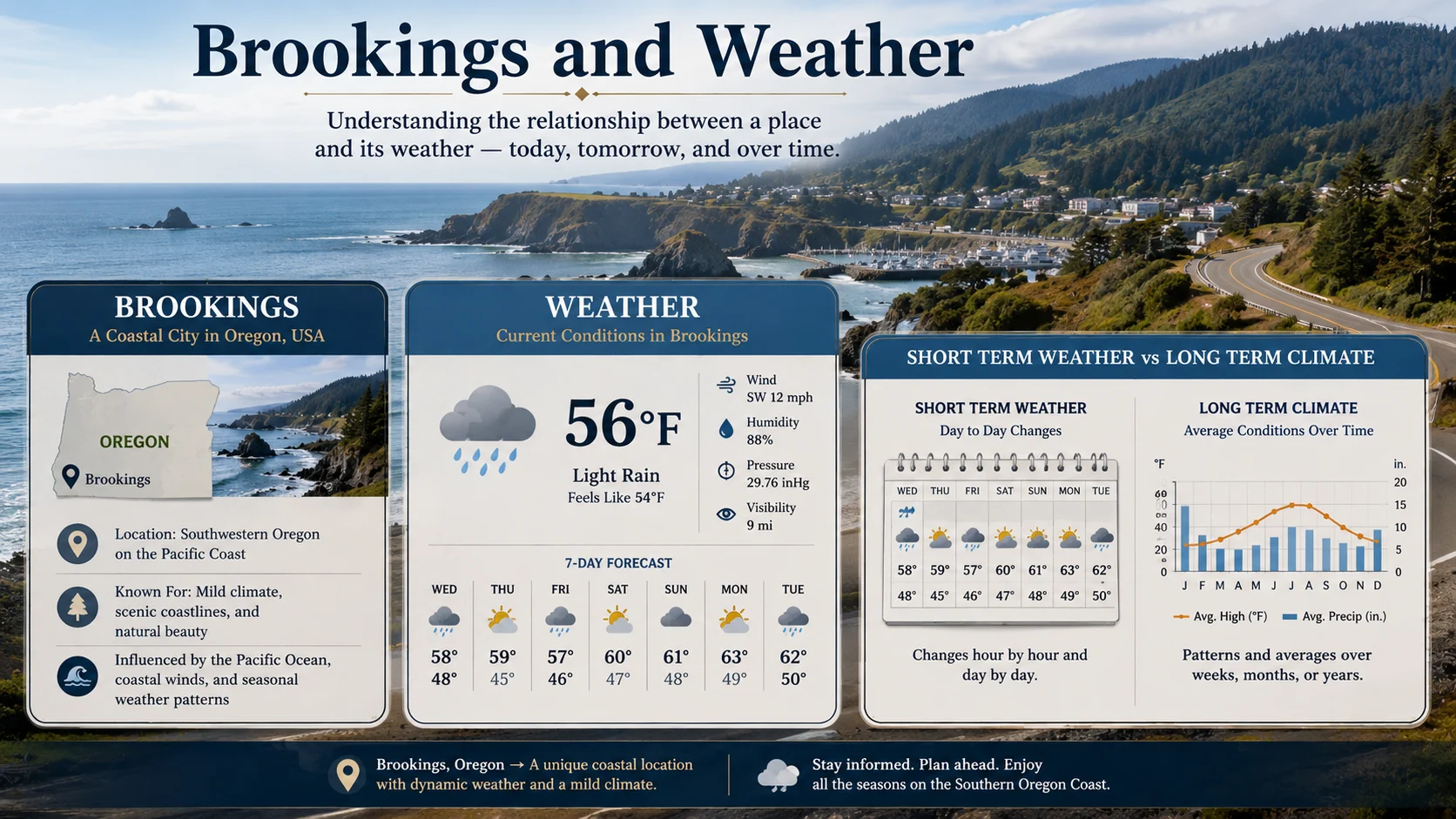
Brookings or weather usually refers to a search for weather conditions in Brookings, a coastal city in southern Oregon. Brookings is known for mild temperatures, marine influence, frequent cloud cover and much wetter winters than summers. Understanding the difference between weather and climate helps readers interpret forecasts accurately and avoid confusing a short term forecast with the area’s long term conditions.
Have you ever wondered “Brookings” or “weather” is the correct word to use? Although these words may appear in searches, conversations, or written content, they have entirely different meanings and purposes. Brookings is a proper noun commonly used as a place name, such as Brookings, South Dakota, or in the name of an organization like the Brookings Institution. In contrast, weather is a common noun that describes atmospheric conditions, including temperature, rainfall, wind, and sunshine. Understanding this distinction helps you avoid confusion when writing about locations, forecasts, or current events.
In this guide, you will learn how Brookings and weather differ, how each term is used in context, and which examples clarify their meanings. you are researching a city, checking a local forecast, or improving your vocabulary, recognizing the purpose of each word will help you communicate more clearly and accurately. Let’s explore their meanings and practical usage.
Brookings vs Weather | What’s the Difference?
The phrase Brookings or weather can look like a comparison between two unrelated words, but search intent usually makes the meaning clearer. Brookings is a proper noun used as the name of a place, while weather is a common noun describing atmospheric conditions at a particular time and location.
Brookings most commonly refers to Brookings, Oregon, a coastal community near the California border. The National Weather Service provides forecast information specifically for Brookings, Oregon, including temperature, wind, humidity, cloud cover, and precipitation probabilities.
Weather, by contrast, describes what the atmosphere is doing now or over a relatively short period. A forecast can tell you Brookings is likely to experience rain tomorrow, how warm the afternoon may become, or strong winds are expected.
Quick Recap
Brookings identifies a location, while weather identifies atmospheric conditions.
Brookings weather combines the place name with the subject people are searching for.
A forecast describes short term conditions, while climate describes long term patterns.
The two concepts should not be treated as interchangeable.
Is Brookings or Weather a Grammar, Vocabulary or Usage Issue?
This is primarily a vocabulary and search intent issue, rather than a traditional grammar problem.
The word Brookings is a proper noun, so it should normally begin with a capital letter when it refers to the place. Weather is a general noun and does not require capitalization unless it begins a sentence or appears in a title where title capitalization is appropriate.
The confusion often comes from the unusual wording of natural search queries. Someone may type “Brookings weather” into a search engine because they want a forecast. Another person may write “weather in Brookings” because they are asking about conditions in the city. Both expressions communicate essentially the same idea.
In formal writing, weather in Brookings is usually the clearest construction. In search queries, Brookings weather is shorter and highly natural because search engines understand the relationship between the location and the requested information.
There is also an important distinction between weather and climate. Weather describes immediate or short term atmospheric conditions. Climate is based on patterns observed over much longer periods. NOAA explains that climate normals use a thirty year period to establish a benchmark for comparing weather conditions.
Therefore, saying “Brookings weather is rainy” may describe a particular period, while saying “Brookings has a wet climate” makes a broader statement about long term conditions.
Brookings Weather | What the Term Means in Practical Use
When people search for Brookings weather, they may have very different goals. A local resident may want to know rain is expected during the morning commute. A visitor may be deciding what clothes to pack. A business may need information about outdoor operations.
The most useful interpretation is therefore location plus atmospheric conditions.
Workplace Example
Imagine an employee planning an outdoor inspection in Brookings. The sentence “I checked the Brookings weather before scheduling the inspection” clearly communicates that the person reviewed the forecast.
A more formal version would be:
“The inspection was scheduled after reviewing the weather forecast for Brookings.”
This wording works well in business correspondence because it makes the location and purpose explicit.
Academic Example
In academic writing, researchers should distinguish between an individual weather event and a climate pattern.
For example:
“The study examined precipitation patterns and temperature variation in Brookings.”
That sentence is more precise than saying simply that “Brookings weather was studied.”
Technology Example
Weather applications and digital assistants commonly combine a place name with weather information. A user might enter “Brookings weather tomorrow” into a search engine or ask an AI assistant for the forecast.
A weather application may then return hourly temperature, precipitation probability, wind speed, humidity, and other forecast variables.
Usage Recap
Use Brookings when identifying the location.
Use weather when discussing atmospheric conditions.
Use Brookings weather as a concise search phrase.
Use weather in Brookings when you want a more natural phrase in ordinary prose.
Use climate when discussing long term patterns rather than today’s forecast.
Brookings Weather and the Coastal Climate
Brookings, Oregon has a distinctly coastal environment. Its location near the Pacific Ocean strongly influences temperatures and seasonal conditions. This marine influence helps explain why temperatures can remain comparatively moderate rather than showing the extreme seasonal swings found farther inland.
The National Weather Service’s Brookings forecast point is located close to the coast, and its forecast information includes variables such as temperature, dew point, wind, cloud cover, precipitation probability, and relative humidity.
The practical result is that visitors should not judge Brookings solely by a generalized Oregon forecast. Conditions can vary considerably between coastal communities, inland valleys, mountain locations, and other parts of the state.
Workplace Example
A construction company planning exterior work may monitor wind and rainfall rather than temperature alone. A day that feels comfortable may still be unsuitable for certain operations if wet conditions or stronger winds are expected.
Academic Example
A geography student could examine how the Pacific Ocean moderates coastal temperatures and compare those conditions with inland locations.
Technology Example
A modern forecast application can present hourly conditions instead of only a daily high and low. That distinction is valuable because coastal weather can change during the day.
Usage Recap
Brookings weather should be interpreted in its coastal context.
Temperature alone doesn’t tell the entire story.
Rain, wind, humidity, cloud cover, and timing can all affect outdoor conditions.
When You Should NOT Use Brookings or Weather
Several common situations can lead to unclear or inaccurate wording.
Another important point is that “Brookings” can refer to more than one place. Brookings, South Dakota is a separate city with a very different climate from Brookings, Oregon. A search that simply says “Brookings weather” can therefore require location confirmation.
That distinction is especially important for travel, navigation, emergency planning, and location based applications.
Common Mistakes and Decision Rules
Decision Rule Box
If you mean conditions happening now, today, or over the next several days, use weather. If you mean long term atmospheric patterns, use climate. If you mean the location itself, use Brookings.
This simple rule eliminates most confusion surrounding the phrase.
Brookings or Weather in Modern Technology and AI Tools
Modern search engines and AI systems interpret location based queries through context. A short phrase such as “Brookings weather” can be understood as a request for meteorological information about a location.
However, precise location matters. If a user means Brookings, Oregon, adding the state can make the request more reliable:
“Brookings, Oregon weather tomorrow.”
This is particularly useful because Brookings, South Dakota is also a recognized place name.
Weather applications increasingly provide detailed information rather than a single temperature. Users may see hourly precipitation probability, wind direction, humidity, cloud cover, visibility, sunrise and sunset information, and other forecast variables.
AI tools can summarize those details, but users should still distinguish between forecast information and historical climate information. A current forecast is not evidence of a long term climate pattern.
Brookings Weather Through the Seasons
Understanding seasonal patterns can make a weather search more useful.
Winter
Winter is generally the wetter portion of the year in coastal southern Oregon. Rain can be a major consideration for visitors, outdoor workers, and road users. A forecast should therefore be checked close to the travel date rather than relying solely on general seasonal expectations.
Spring
Spring can bring changing conditions. Temperatures may feel moderate, but rainfall and cloud cover remain relevant. Travelers benefit from flexible plans and clothing suitable for changing conditions.
Summer
Summer is typically the drier period along much of the southern Oregon coast. Even so, coastal temperatures can remain noticeably cooler than inland areas, particularly when marine air influences the region.
Autumn
Autumn brings a transition toward wetter conditions. Visitors planning outdoor activities should pay attention to both rainfall probability and wind conditions.
The important lesson is that seasonal averages provide context, but they do not replace a current forecast.
Etymology and Meaning
Brookings is a place name rather than a weather term. The city of Brookings, Oregon takes its name from the Brookings family and the Brookings Timber and Lumber Company associated with the area’s development.
Weather has a much older linguistic history. The English word developed from Old English terminology associated with atmospheric conditions and the passage or movement of air and storms. Over centuries, its meaning broadened to cover the general state of the atmosphere.
Climate has a different historical development, ultimately tracing through Latin and Greek forms associated with a region’s prevailing conditions.
These different origins reinforce an important linguistic distinction. Brookings identifies a place, while weather identifies atmospheric conditions.
Expert Perspective
A useful principle for accurate weather communication is:
“A forecast describes expected atmospheric conditions, while climate provides the long term context needed to understand what those conditions mean.”
This distinction is consistent with the way NOAA describes climate normals as benchmarks for comparing weather against long term conditions.
Two Practical Case Studies
Case Study One: Planning a Coastal Trip
Consider a traveler planning a weekend in Brookings, Oregon. The traveler searches for Brookings weather and sees that the forecast changes from relatively clear conditions to a higher chance of rain.
The practical result is straightforward. Instead of packing only warm weather clothing, the traveler prepares for variable coastal conditions and schedules outdoor activities during the most favorable forecast window.
The lesson is that a current forecast can directly improve short term travel decisions.
Case Study Two: Scheduling Outdoor Work
Now consider a landscaping company arranging several outdoor jobs. The manager checks the Brookings forecast and notices that rainfall is expected during part of the working period.
The manager moves the most weather sensitive tasks to a drier period and reduces the likelihood of delays.
The result is a more efficient schedule because the decision is based on current weather information rather than a general assumption about the season.
These examples also show why weather and climate should not be treated as synonyms. Climate can guide broad expectations, while forecasts support immediate decisions.
Error Prevention Checklist
Always Use Weather When
• You mean today’s atmospheric conditions.
• You are discussing tomorrow’s forecast.
• You are describing rain, wind, temperature, or cloud cover at a particular time.
• You are asking what conditions travelers should expect during a specific period.
Never Use Climate When
• You are describing a single afternoon.
• You are reporting today’s rain.
• You are asking an event should be postponed tomorrow.
• You are interpreting a short term forecast.
The reverse is also important. Do not use weather to make unsupported claims about decades of atmospheric patterns.
Related Grammar Confusions You Should Master
Understanding Brookings weather also connects with several broader language and usage distinctions.
These distinctions matter because strong informational content depends on precision. A weather article that confuses climate, forecast, and current conditions can give readers the wrong impression even when individual sentences are grammatically correct.
FAQs
What is the weather like in Brookings, Oregon?
Brookings generally has mild coastal conditions, with seasonal rainfall and marine influence affecting temperatures, cloud cover, humidity, and wind.
Is Brookings, Oregon rainy all year?
No. Rainfall is strongly seasonal, with wetter conditions generally concentrated in the cooler months and a drier summer pattern.
What is the best way to check Brookings weather before traveling?
Use a current local forecast close to your travel date and examine temperature, precipitation probability, wind, and hourly conditions rather than relying only on seasonal averages.
Is Brookings weather different from inland Oregon weather?
Yes. Brookings is directly influenced by the Pacific Ocean, so coastal conditions can differ substantially from temperatures and weather farther inland.
What is the difference between Brookings weather and Brookings climate?
Weather describes short term atmospheric conditions, while climate describes long term patterns established from many years of observations.
Does Brookings, South Dakota have the same weather as Brookings, Oregon?
No. They are different locations with different geographic settings and climate patterns, so a precise state name is useful when searching for a forecast.
Why does Brookings weather change during the day?
Coastal atmospheric conditions can shift because of marine air, wind direction, cloud movement, and changing pressure patterns.
Should I use weather or climate when writing about Brookings?
Use weather for current or short term conditions and climate for long term patterns. Use Brookings as the location name.
Conclusion
The phrase Brookings or weather is best understood as a location based search rather than a true comparison between two equivalent terms. Brookings identifies the place, while weather describes atmospheric conditions affecting that place at a particular time.
For everyday searches, Brookings weather is a concise and useful phrase. For formal writing, weather in Brookings, Oregon is often clearer. When discussing long term rainfall, temperature patterns, or seasonal characteristics, the word climate is more accurate.
The most important rule is simple: use weather for what is happening now or what is expected soon, and use climate for long term patterns. Checking a current forecast is especially important for travel and outdoor activities because seasonal expectations cannot tell you exactly what conditions will occur on a particular day.
NOAA’s climate normals provide useful long term context, while National Weather Service forecasts provide location specific short term information.
Discover More Related Articles:
- Presentor or Presenter | Which Spelling Is Correct & When Should You Use It In 2026
- Skied or Skiied | Which Past Tense Is Correct In 2026
- Sesamoiditis or Gout | How to Tell the Difference and Why Diagnosis Matters In 2026