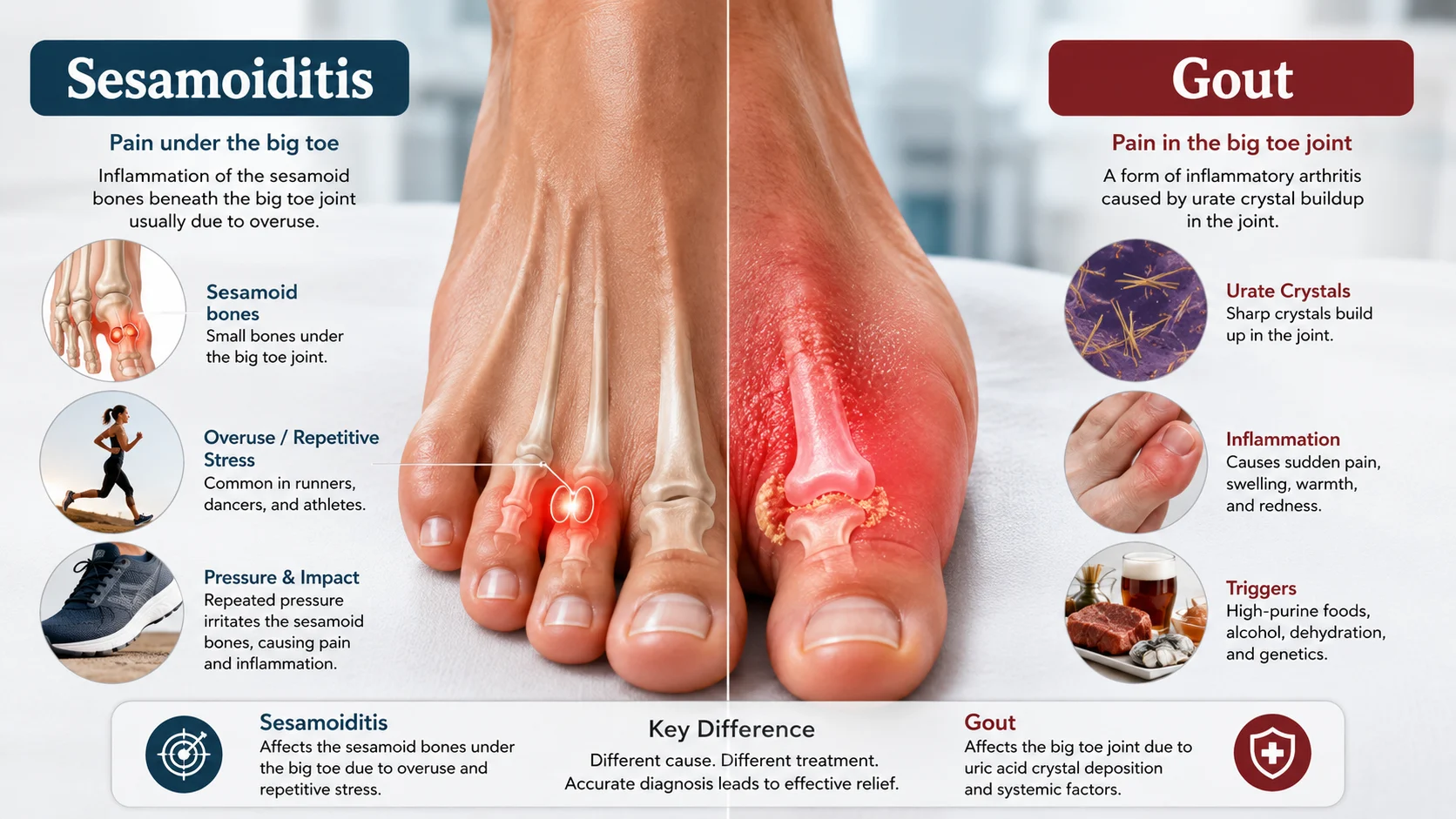
Sesamoiditis or gout can both cause pain around the base of the big toe, but they are different conditions with different causes and treatments. Sesamoiditis usually involves irritation from repeated stress around the small sesamoid bones, while gout results from urate crystal deposits that trigger inflammation. Distinguishing them matters because treating the wrong cause can delay recovery.
Pain beneath the big toe can be surprisingly difficult to identify because several foot conditions produce similar symptoms. The two small sesamoid bones sit beneath the big toe joint and help absorb pressure during walking and running. When these structures become irritated, the result can be sesamoiditis. Gout, by contrast, is an inflammatory arthritis caused by urate crystal deposition and most commonly affects the joint at the base of the big toe.
The confusion becomes especially important when gout affects the structures around a sesamoid. Although uncommon, published medical literature describes cases in which gout initially appeared to be ordinary sesamoiditis or even a stress injury.
This guide explains the differences, symptoms, diagnostic clues, treatment approaches, common mistakes, and situations in which persistent sesamoid pain deserves further investigation.
Sesamoiditis or Gout | What’s the Difference?
Sesamoiditis is a condition involving inflammation and irritation of the sesamoid bones and the tendons surrounding them. The two foot sesamoids are located beneath the big toe joint. They help distribute pressure and allow tendons to work efficiently as the foot moves. Repetitive stress from running, dancing, sports, high heels, or changes in activity can irritate these structures.
Gout is a form of inflammatory arthritis. It develops when urate crystals accumulate in and around joints and trigger an inflammatory response. The base of the big toe is the most familiar location, although gout can affect other joints as well.
| Feature | Sesamoiditis | Gout |
|---|---|---|
| Main cause | Repetitive stress and irritation | Urate crystal deposition |
| Main location | Beneath the big toe joint | Usually the joint at the base of the big toe |
| Typical onset | Often gradual | Often sudden |
| Pain pattern | Frequently worsens with weight bearing | Often severe and rapid during a flare |
| Swelling | May occur locally | Common during an acute attack |
| Redness and warmth | Usually less dramatic | Often prominent |
| Common triggers | Running, dancing, sports, pressure | Changes in urate levels and gout triggers |
| Diagnosis | Examination and imaging | Clinical assessment, blood testing, imaging, or crystal identification |
| Main treatment approach | Rest and pressure reduction | Treatment of the gout flare and urate management |
| Long term prevention | Reduce mechanical stress | Control urate and prevent recurrent attacks |
The key distinction is the underlying mechanism.
Sesamoiditis is generally a mechanical or overuse problem.
Gout is a systemic inflammatory condition caused by urate crystal deposition.
However, the two conditions can overlap. Gout can involve the sesamoid region, which is why persistent or unusual symptoms sometimes require additional testing.
Is Sesamoiditis or Gout a Grammar, Vocabulary or Usage Issue?
In this context, sesamoiditis or gout is not a grammar or vocabulary issue. It is a medical differential diagnosis question.
The terms are not interchangeable. Sesamoiditis describes inflammation involving the sesamoid structures, whereas gout describes a crystal driven inflammatory disease.
The distinction also matters in formal medical writing. A healthcare professional may initially describe a patient as having sesamoid pain or suspected sesamoiditis before determining the underlying cause. If testing later demonstrates urate crystals, gout may become the more important diagnosis.
In casual conversation, people may simply say that their big toe hurts or that they think they have gout. Those descriptions are understandable, but they cannot establish the diagnosis.
Academic and clinical discussions require more precision because pain beneath the big toe can result from several different problems, including sesamoiditis, a sesamoid fracture, arthritis, gout, or other inflammatory conditions.
What Does Sesamoiditis Feel Like?
Sesamoiditis commonly produces pain on the underside of the foot beneath the big toe. The discomfort may begin gradually and become more noticeable during walking, running, dancing, jumping, or other activities that place pressure on the ball of the foot.
A person may experience tenderness directly over one of the sesamoid bones. Bending or straightening the big toe can also reproduce the pain. Difficulty putting weight on the affected area and localized swelling may occur.
A useful clue is the relationship between activity and symptoms. If pain consistently increases after activities that load the front of the foot, a mechanical cause such as sesamoiditis becomes more plausible.
Workplace Example
Someone who spends long periods standing at work may develop increasing tenderness beneath the big toe after changing to less supportive footwear or increasing daily walking.
Academic Example
A sports medicine discussion might describe gradually developing plantar pain beneath the first metatarsophalangeal joint after a sudden increase in running mileage as a possible presentation of sesamoiditis.
Technology Example
Modern imaging can help clinicians investigate persistent sesamoid pain. X rays may identify structural abnormalities, while MRI can reveal inflammation or a subtle stress injury when initial imaging does not explain the symptoms.
Usage recap: Sesamoiditis is particularly associated with localized pain beneath the big toe that develops or worsens with mechanical stress.
What Does Gout Feel Like?
Gout often behaves differently. An attack can begin suddenly, sometimes during the night, with intense pain, swelling, warmth, redness, and tenderness. The base of the big toe is the most frequently affected joint.
During an acute attack, even light pressure can be extremely uncomfortable. The pain commonly reaches its worst intensity quickly, and the affected joint may become visibly swollen and warm.
Gout can also become recurrent. Without appropriate management, repeated attacks may eventually contribute to joint damage or the formation of tophi, which are deposits associated with longstanding gout.
Workplace Example
A person may wake with sudden severe big toe pain and find it difficult to walk or stand at work. The abrupt onset is more characteristic of an acute gout attack than ordinary overuse related sesamoiditis.
Academic Example
In a clinical case study, sudden inflammatory pain in the big toe accompanied by swelling and warmth would prompt consideration of gout alongside other causes of joint inflammation.
Technology Example
Healthcare professionals may use ultrasound or dual energy CT to detect urate deposits in appropriate circumstances. Joint fluid analysis can also identify urate crystals when fluid can be obtained.
Usage recap: Gout is more strongly associated with sudden inflammatory attacks, marked tenderness, warmth, swelling, and redness around a joint.
When You Should NOT Use Sesamoiditis or Gout Interchangeably
There are several situations in which assuming that these conditions are the same can create diagnostic problems.
- Do not assume every pain beneath the big toe is gout.
- Do not assume every athlete with pain beneath the big toe has ordinary overuse related sesamoiditis.
- Do not use a normal uric acid result by itself to completely exclude gout.
- Do not diagnose gout solely because the big toe hurts.
- Do not assume swelling automatically means a sesamoid fracture.
- Do not continue high impact activity simply because the pain initially resembles a minor overuse injury.
- Do not assume that treatment for mechanical sesamoid pain will address gout.
- Do not ignore symptoms that appear in both feet or repeatedly return despite appropriate mechanical treatment.
A particularly important point is that blood uric acid levels are not enough by themselves to establish or exclude gout. During an attack, some people with gout can have a uric acid result that is not elevated.
Common Mistakes and Decision Rules
| Correct sentence | Incorrect sentence | Explanation |
|---|---|---|
| The athlete has pain consistent with sesamoiditis after repetitive activity. | The athlete definitely has gout because the big toe hurts. | Location alone cannot establish gout. |
| Gout can sometimes affect the sesamoid region. | Gout and sesamoiditis are always the same condition. | Gout can cause secondary inflammation around the sesamoids, but the diseases are not identical. |
| Imaging can help investigate persistent sesamoid pain. | A normal initial X ray always rules out a sesamoid problem. | Some injuries or inflammatory changes may require additional imaging. |
| Joint fluid can be examined for urate crystals when appropriate. | A blood uric acid test alone proves gout. | Blood uric acid is useful but does not independently confirm every case. |
| Gradual pain related to activity can suggest mechanical sesamoid irritation. | Every gradual big toe pain is sesamoiditis. | Several conditions can produce similar symptoms. |
Decision Rule: If the symptoms primarily suggest repetitive mechanical irritation beneath the big toe, sesamoiditis may be considered. If there is a sudden inflammatory attack involving the big toe joint, gout should also be considered and medically evaluated.
How Doctors Distinguish Sesamoiditis From Gout
Diagnosis begins with the history and physical examination. A healthcare professional may ask when the pain began, what activities make it worse, there was an injury, swelling appeared suddenly, and similar episodes have occurred before.
For suspected sesamoiditis, examination usually focuses on tenderness directly over the sesamoids and movement of the big toe. X rays can help identify structural abnormalities or fractures. If the diagnosis remains uncertain, bone scanning, CT, or MRI may be considered.
Gout requires a different diagnostic approach. A healthcare professional may evaluate the clinical presentation, serum uric acid, imaging, and, when possible, joint fluid. Identification of urate crystals in joint fluid provides strong diagnostic evidence. Ultrasound and dual energy CT can also help identify urate deposits.
The diagnostic challenge becomes greater when gout affects the sesamoid region without producing the classic appearance of an acute gout attack.
Sesamoiditis or Gout in Modern Technology and AI Tools
Modern medical technology is increasingly useful when symptoms overlap.
MRI can demonstrate marrow edema and soft tissue inflammation associated with sesamoid problems. CT can provide detailed information about bone structure. Dual energy CT has a particularly useful role when clinicians need to identify urate deposits in suspected gout.
Artificial intelligence can assist with medical image analysis and clinical decision support, but it should not be treated as a standalone diagnostic authority. An AI system may help organize information or identify patterns, but diagnosis still requires appropriate clinical assessment, relevant testing, and professional judgment.
For a patient, the practical lesson is simple: technology can help distinguish similar conditions, but the correct test depends on the clinical question.
Why the Cause Matters More Than the Location
One of the most important lessons from the medical literature is that location does not always reveal the underlying disease.
The sesamoid region can become painful because of repetitive mechanical stress. But inflammatory diseases can also involve the same area. Cleveland Clinic specifically lists gout among conditions that can occasionally lead to sesamoiditis.
This means the question is not simply pain is located beneath the big toe.
The more useful question is why that area is inflamed.
That distinction can change the entire treatment strategy.
Authority and Trust | What Clinical Evidence Shows
The American Academy of Orthopaedic Surgeons explains that sesamoids “act like pulleys,” helping tendons move efficiently while supporting weight bearing in the forefoot.
That simple description explains why these small bones can become painful. They participate in every step, particularly when the big toe pushes the body forward.
Gout is fundamentally different because the inflammation comes from urate crystal deposition rather than ordinary repetitive mechanical stress.
Case Study One: Gout Initially Resembling Sesamoiditis
A published case involved a 38 year old athlete with gradually developing pain beneath the left big toe. Initial laboratory testing did not reveal an obvious inflammatory or uric acid abnormality, while MRI suggested sesamoiditis with possible stress fracture.
The patient received immobilization and anti inflammatory treatment but experienced only partial improvement followed by recurrence. Four months later, similar symptoms developed in the opposite foot. Because of the bilateral presentation and family history, clinicians investigated gout. Dual energy CT demonstrated urate deposits in both feet. Colchicine treatment resolved symptoms within one week, followed by allopurinol therapy. After two months, the patient was asymptomatic and had resumed sports at his previous intensity.
This case demonstrates why persistent or bilateral symptoms can justify reconsidering the original diagnosis.
Case Study Two: Isolated Sesamoid Gout Mimicking Another Lesion
Another published report described a 37 year old laborer who developed pain and swelling around the right great toe after falling from a ladder. The initial working diagnosis was a medial sesamoid fracture, and treatment with a controlled ankle movement boot gradually improved symptoms.
The patient had experienced a similar episode one year earlier. Further evaluation eventually revealed isolated gout related changes involving the medial sesamoid, creating a diagnostic problem because there was no established history of gout. The report highlights how gout can occasionally produce isolated sesamoid abnormalities that resemble traumatic or other structural disease.
These reports are uncommon, but that is precisely why they matter. They show that gout involving the sesamoid region is possible even when the presentation does not initially look like classic gout.
Error Prevention Checklist
Always Consider Sesamoiditis When
☐ Pain is localized directly beneath the big toe.
☐ Symptoms developed gradually after increased activity.
☐ Running, jumping, dancing, or prolonged standing increases discomfort.
☐ Pressing directly over the sesamoid region reproduces the pain.
☐ Movement of the big toe increases symptoms.
☐ Imaging suggests inflammation around the sesamoid structures.
Never Assume Gout Without Evaluation When
☐ The only symptom is pain beneath the big toe.
☐ There is no sudden inflammatory episode.
☐ There is no assessment of other possible causes.
☐ A single uric acid result is being used as the entire diagnosis.
☐ Mechanical treatment has not yet been evaluated appropriately.
At the same time, persistent symptoms should not automatically be dismissed as ordinary overuse. Gout can rarely involve the sesamoid region, and published cases demonstrate that the diagnosis may require additional investigation.
Treatment Differences You Should Understand
Treatment depends on the underlying diagnosis.
For ordinary sesamoiditis, treatment generally focuses on reducing stress on the affected structures. Rest, activity modification, appropriate footwear, cushioning, taping, and other measures may reduce pressure. Physical therapy may be used during recovery, while severe or persistent cases may require additional medical intervention. Surgery is generally reserved for selected cases that do not respond to conservative care.
Gout treatment has a different objective. During an acute attack, medicines such as nonsteroidal anti inflammatory drugs, colchicine, or corticosteroids may be used depending on the individual’s circumstances. Long term urate lowering treatment may be recommended for appropriate patients to reduce future attacks and complications.
This difference is crucial.
If gout is responsible for the inflammation, simply reducing mechanical pressure may not address the underlying disease.
If ordinary mechanical sesamoiditis is responsible, treating someone as though they automatically have gout would also be inappropriate.
When Should You See a Doctor?
Persistent pain beneath the big toe deserves medical evaluation, particularly when it interferes with walking, exercise, work, or sleep.
Sudden severe pain accompanied by a hot, swollen, inflamed joint should be assessed promptly. A fever with a hot and inflamed joint requires urgent medical attention because infection can sometimes produce similar symptoms.
Evaluation is also particularly important when symptoms repeatedly return, occur in both feet, fail to improve with appropriate mechanical treatment, or seem inconsistent with the original diagnosis.
Related Foot and Joint Conditions You Should Know
If you are researching sesamoid pain or gout, several related conditions can produce overlapping symptoms.
- Sesamoid fracture
- Stress fracture
- Turf toe
- Osteoarthritis of the big toe
- Metatarsalgia
- Pseudogout
- Rheumatoid arthritis
- Plantar plate injury
- Bunion related pain
- Infection of a joint
Understanding these alternatives helps explain why location alone cannot establish a diagnosis.
FAQs
Can sesamoiditis be caused by gout?
Yes. Gout can rarely cause inflammation and pain involving the sesamoid region, although ordinary sesamoiditis is more commonly associated with repetitive mechanical stress.
How can you tell gout from sesamoiditis?
Gradual activity related pain beneath the big toe favors a mechanical sesamoid problem, while sudden severe warmth, swelling, and tenderness around the big toe joint raises concern for gout.
Can gout affect the sesamoid bones?
Yes, although isolated or prominent sesamoid involvement is uncommon and has mainly been described in case reports.
Can normal uric acid rule out gout?
No. A normal uric acid result during symptoms does not by itself exclude gout, so the complete clinical picture and appropriate testing matter.
Does sesamoiditis cause swelling?
It can. Local swelling and tenderness may occur around the sesamoid structures, particularly when inflammation is significant.
What test can confirm gout?
When appropriate, examination of joint fluid for urate crystals can provide strong diagnostic evidence. Ultrasound and dual energy CT can also help identify urate deposits.
Can MRI diagnose sesamoiditis?
MRI can show inflammation around the sesamoids and may reveal subtle stress injuries when other imaging does not fully explain symptoms.
Is sesamoiditis treated differently from gout?
Yes. Sesamoiditis treatment usually focuses on reducing mechanical stress, while gout treatment addresses acute inflammation and, when indicated, long term urate management.
Why can gout be mistaken for sesamoiditis?
Both conditions can cause pain around the base of the big toe, and rare gout cases can produce imaging findings that resemble mechanical sesamoid injury.
Conclusion
The important distinction between sesamoiditis or gout is not simply where the pain occurs, but what causes it.
Sesamoiditis generally reflects irritation of the sesamoid structures from repetitive mechanical stress, while gout results from urate crystal driven inflammation. Their symptoms can overlap, especially around the base of the big toe, which can make diagnosis challenging.
Gradual pain linked to activity, localized tenderness beneath the big toe, and mechanical loading are clues that support sesamoiditis. Sudden severe pain, warmth, swelling, and redness around the big toe joint make gout more important to consider.
Rare medical cases demonstrate that gout can involve the sesamoid region and initially resemble ordinary sesamoiditis or a stress injury.
For that reason, persistent, recurrent, bilateral, or unexplained symptoms deserve professional evaluation rather than self diagnosis. The correct diagnosis determines the most appropriate treatment and can prevent months of treating the wrong problem.
Discover more Related Articles:
- Coyote or Fox | What Is the Difference & When Should You Use Each In 2026
- Vulkan or DX12 | Which Graphics API Should You Choose In 2026
- Craigslist or Portland | Complete Guide to Using Craigslist Portland Safely & Effectively In 2026