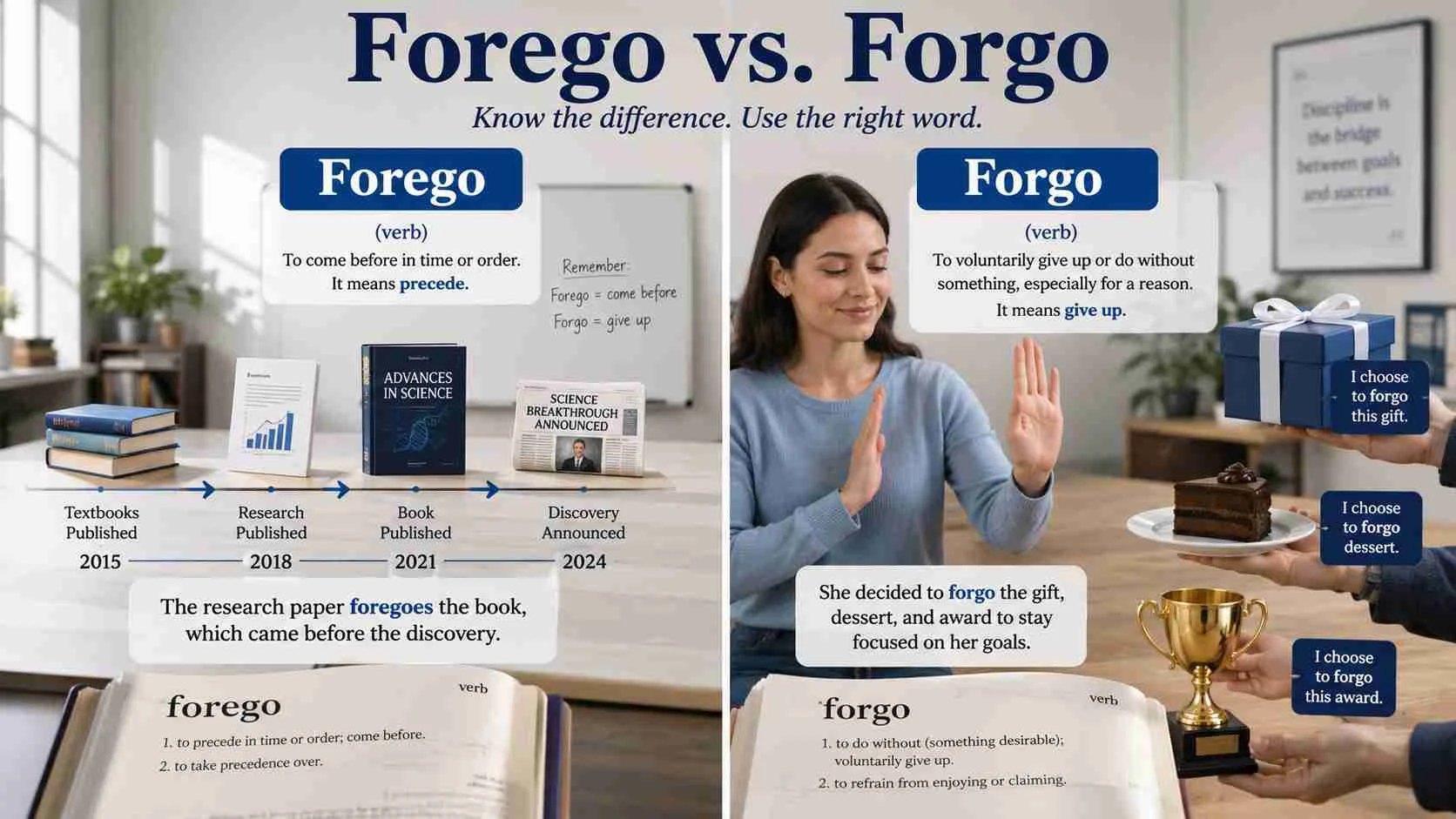
Forego or forgo often causes confusion because the two words look almost identical but have different meanings. Forego usually means to go before or to precede, while forgo means to do without, give up or voluntarily abstain from something.
If you have ever wondered forego or forgo is the correct choice, you are not alone. These two words differ by only one letter, yet they express entirely different ideas. Forego traditionally refers to something that comes before another thing, whereas forgo means to willingly give up or do without something.
Because they look and sound similar, many writers accidentally use one when they mean the other. Knowing the difference improves your grammar, strengthens your writing, and helps you communicate with greater confidence in academic, business, and everyday situations.
Forego or Forgo | What Is the Difference?
Although these words share similar spelling, they are not interchangeable in most situations.
| Feature | Forego | Forgo |
|---|---|---|
| Part of speech | Verb | Verb |
| Primary meaning | To go before or precede | To give up or do without |
| Common usage | Rare and mostly formal | Very common in modern English |
| Typical context | Literary, historical, or formal writing | Everyday, academic, and business writing |
| Example | The foregone conclusion referred to earlier events. | She decided to forgo dessert after dinner. |
Quick Recap
The easiest way to remember the difference is to focus on the meaning rather than the spelling.
Forego relates to something that comes before another event or action. It is uncommon in modern English.
Forgo means choosing not to have something or voluntarily giving something up. It is the word most people intend to use.
When in doubt, forgo is usually the correct choice.
Is Forego or Forgo a Grammar, Vocabulary or Usage Issue?
The confusion between these words is mainly a usage and vocabulary issue rather than a grammar problem.
Grammar determines how words function within a sentence. Vocabulary focuses on the meaning of individual words. Usage concerns choosing the correct word for a particular situation. Since both forego and forgo are legitimate verbs, the mistake happens when writers select the wrong one.
In modern English, these words are not interchangeable.
Forgo appears regularly in newspapers, academic journals, business communication, and everyday conversation because people frequently discuss giving something up or choosing not to receive it.
Forego survives mostly in historical texts, formal literature, and a few established expressions. Outside these contexts, readers often assume the writer intended to use forgo.
In academic writing, precision matters. Using forego instead of forgo can change the meaning of your sentence or make it appear as though you misunderstood the vocabulary. The same applies to workplace communication, where clarity is essential.
Whenever your sentence involves sacrifice, choice, or voluntarily giving something up, forgo is almost always the correct word.
Understanding Forego
The verb forego means to go before, to precede, or to come earlier than something else. Although dictionaries still recognize this meaning, it is relatively uncommon in present day English.
You are most likely to encounter forego in historical documents, literary works, or highly formal writing where the emphasis is on sequence or order.
Workplace Example
The forego discussion provided important context before the committee reached its final decision.
Academic Example
Researchers examined the forego events to understand how the policy developed over time.
Technology Example
The software manual referred readers to the forego section before explaining the advanced settings.
In each example, forego describes something that comes earlier rather than something that is abandoned.
Usage Recap
Remember forego whenever your meaning involves something that comes before another event, section, or action. Because this use is uncommon, many modern writers rarely need it.
Understanding Forgo
The verb forgo means to give up, to do without, or to voluntarily decline something. This is the version that appears most frequently in modern English.
People use forgo when discussing choices, sacrifices, financial decisions, personal goals, or opportunities that someone decides not to take.
Workplace Example
The company chose to forgo unnecessary travel expenses to reduce costs.
Academic Example
Several students decided to forgo optional credit in order to focus on their major assignments.
Technology Example
Many users forgo automatic updates because they prefer to install new versions manually.
Notice that every sentence involves a conscious decision not to receive, use, or experience something.
Usage Recap
If your sentence could be rewritten using give up, skip, decline, or do without, then forgo is almost certainly the correct word.
When You Should Not Use Forego or Forgo
Even experienced writers occasionally misuse these words. Avoiding these common situations will help you choose the correct term with confidence.
Do not use forego when you actually mean give up
Incorrect: She decided to forego dessert.
Correct: She decided to forgo dessert.
Do not use forego simply because it looks more formal
Many people believe forego sounds more sophisticated, but using it incorrectly weakens your writing rather than improving it.
Do not replace forgo in business writing
When discussing budgets, investments, opportunities, or company decisions, forgo is almost always the intended word.
Do not assume both spellings are interchangeable
Although older dictionaries sometimes list forego as an alternative spelling of forgo, modern style guides strongly prefer using forgo when the meaning is to give up.
Do not confuse forego with foregoing
The adjective foregoing means mentioned earlier or previous. It comes from the idea of going before and is different from forgo.
Do not rely only on spell check
Most grammar checkers recognize both words because they are correctly spelled. They may not detect that you selected the wrong one for your sentence.
Do not ignore context
Always ask yourself a simple question before choosing the word. Are you talking about something that comes before, or are you talking about giving something up? The answer will almost always reveal the correct choice.
Do not follow common internet mistakes
Many online articles and social media posts use these words incorrectly. Trust reliable dictionaries and established style guides instead of assuming frequent usage makes a word correct.
Common Mistakes and Decision Rules
Writers often confuse forego and forgo because the words differ by only one letter. The table below highlights some of the most common errors and explains how to avoid them.
| Correct Sentence | Incorrect Sentence | Explanation |
|---|---|---|
| She decided to forgo the bonus this year. | She decided to forego the bonus this year. | Forgo means to give up or do without. |
| The foregoing chapter explains the background. | The forgoing chapter explains the background. | Foregoing means mentioned earlier or preceding. |
| The company will forgo hiring this quarter. | The company will forego hiring this quarter. | The company is giving up the hiring plan. |
| He chose to forgo dessert after dinner. | He chose to forego dessert after dinner. | The sentence describes a voluntary choice. |
| The forego remarks introduced the main topic. | The forgo remarks introduced the main topic. | The meaning is preceding or coming before. |
| They agreed to forgo unnecessary expenses. | They agreed to forego unnecessary expenses. | The idea is giving something up. |
Decision Rule
Remember this simple rule whenever you are unsure.
If you mean to give up, decline, skip, or do without something, use forgo.
If you mean to come before or precede something, use forego, although this meaning is uncommon in modern English.
Most modern writing uses forgo, so if your sentence describes making a choice or sacrifice, that is almost certainly the correct word.
Forego or Forgo in Modern Technology and AI Tools
Modern grammar checkers and AI writing assistants have become much better at identifying word choice errors, but they are not perfect. Because forego and forgo are both valid English words, some tools focus only on spelling and may overlook the word fits the context.
For example, an AI assistant may accept the sentence The company will forego the opportunity because the spelling is correct. However, a careful editor recognizes that the intended meaning is to give up the opportunity, making forgo the correct choice.
This is why understanding vocabulary remains valuable even when using advanced writing software. Human judgment is still the best way to ensure your writing communicates exactly what you intend.
Word Origins
The history of these words explains why they continue to confuse writers today.
Forego comes from Old English roots meaning to go before or to precede. For centuries, it described events or actions that happened earlier than others.
Forgo developed through a different historical path and came to mean to refrain from, to give up, or to do without. Over time, this meaning became much more common in everyday English.
Because older publications sometimes used forego as an alternative spelling for forgo, modern readers occasionally encounter conflicting examples. Today, however, most dictionaries and style guides clearly distinguish the two meanings.
Expert Insight
“Strong writing depends on choosing words for their meaning rather than their appearance. Similar spellings often create confusion, but precision is what gives writing credibility.”
This principle applies perfectly to forego and forgo. Selecting the correct word demonstrates attention to detail and helps readers understand your message immediately.
Real World Case Studies
Case Study One: Business Communication
A financial report originally stated that the company would forego several expansion projects. During editing, the communications team corrected the word to forgo because the company was choosing not to pursue the projects.
The revised report eliminated ambiguity, improved clarity for investors, and reduced follow up questions from stakeholders who initially interpreted the sentence incorrectly.
Case Study Two: Academic Writing
A university student wrote that participants forewent optional training sessions to save time. A classmate suggested replacing the word with forwent, assuming it sounded more modern.
The instructor confirmed that forewent was acceptable only if the intended meaning related to preceding events. Since the student meant participants chose not to attend, the correct revision was forwent, the past tense of forgo.
This small correction improved the accuracy of the research paper and strengthened the student’s overall argument.
Error Prevention Checklist
Use this checklist whenever you edit your writing.
Always use forgo when
- You mean to give something up.
- Someone voluntarily declines an opportunity.
- A person chooses not to receive something.
- You could replace the word with skip, decline, or do without.
- You are writing business, academic, or everyday English.
Never use forego when
- You mean to sacrifice something.
- You are describing a personal choice.
- You are discussing costs, opportunities, rewards, or benefits that someone gives up.
- You simply want a word that looks more formal.
- You are unsure of the historical meaning.
Related Grammar Confusions You Should Master
Mastering similar word pairs will make your writing even more accurate.
- Affect or Effect
- Adviser or Advisor
- Complement or Compliment
- Ensure or Insure
- Farther or Further
- Lay or Lie
- Lose or Loose
- Then or Than
- Who or Whom
- Principal or Principle
Each of these pairs contains words that appear similar but express different meanings. Learning them improves both writing accuracy and reading comprehension.
FAQs
Is forego or forgo correct?
Both words are correct English verbs, but they have different meanings. Forgo means to give something up or do without it, while forego traditionally means to go before or precede another event. In modern writing, forgo is the word people usually need.
What is the difference between forego and forgo?
The main difference is meaning. Forego refers to something that comes before, whereas forgo refers to voluntarily giving something up. They should not be treated as interchangeable in modern English.
Can I use forego instead of forgo?
In most cases, no. Although older dictionaries sometimes accepted forego as a spelling variant of forgo, modern dictionaries and style guides recommend using forgo whenever you mean to give something up.
Why do people confuse forego and forgo?
The confusion happens because the words differ by only one letter and have similar pronunciation. Many people assume they are alternative spellings of the same word, even though they carry different meanings in current English.
Is forgo formal or informal?
Forgo works well in both formal and informal writing. It appears regularly in newspapers, academic papers, business reports, and everyday conversation.
Is forego still used today?
Yes, but it is relatively uncommon. Most modern writers encounter forego in historical works, legal writing, or literary contexts where the meaning is to precede or come before.
What is the past tense of forgo?
The past tense of forgo is forwent, and the past participle is forgone. Example: She forwent the promotion because she wanted a better work life balance.
How can I remember the difference between forego and forgo?
Think about the meaning of your sentence. If someone is giving something up, choose forgo. If something comes before another event, choose forego.
Conclusion
Understanding forego or forgo becomes much easier once you focus on meaning instead of spelling. Although the words look remarkably similar, they perform different roles in English. Forego refers to something that comes before another event, while forgo means to voluntarily give something up or do without it.
Because forgo is far more common in modern English, it is usually the correct choice when discussing decisions, sacrifices, or missed opportunities. By remembering this simple distinction, you can write with greater confidence, avoid common vocabulary mistakes, and communicate more clearly in academic, professional, and everyday situations.
Discover More Related Articles:
- Modelling or Modeling | Which Version Is Right for Your Audience In 2026
- Bride or Die | Everything You Need to Know In 2026
- Modelled or Modeled | Which Spelling Is Correct & Why It Matters In 2026