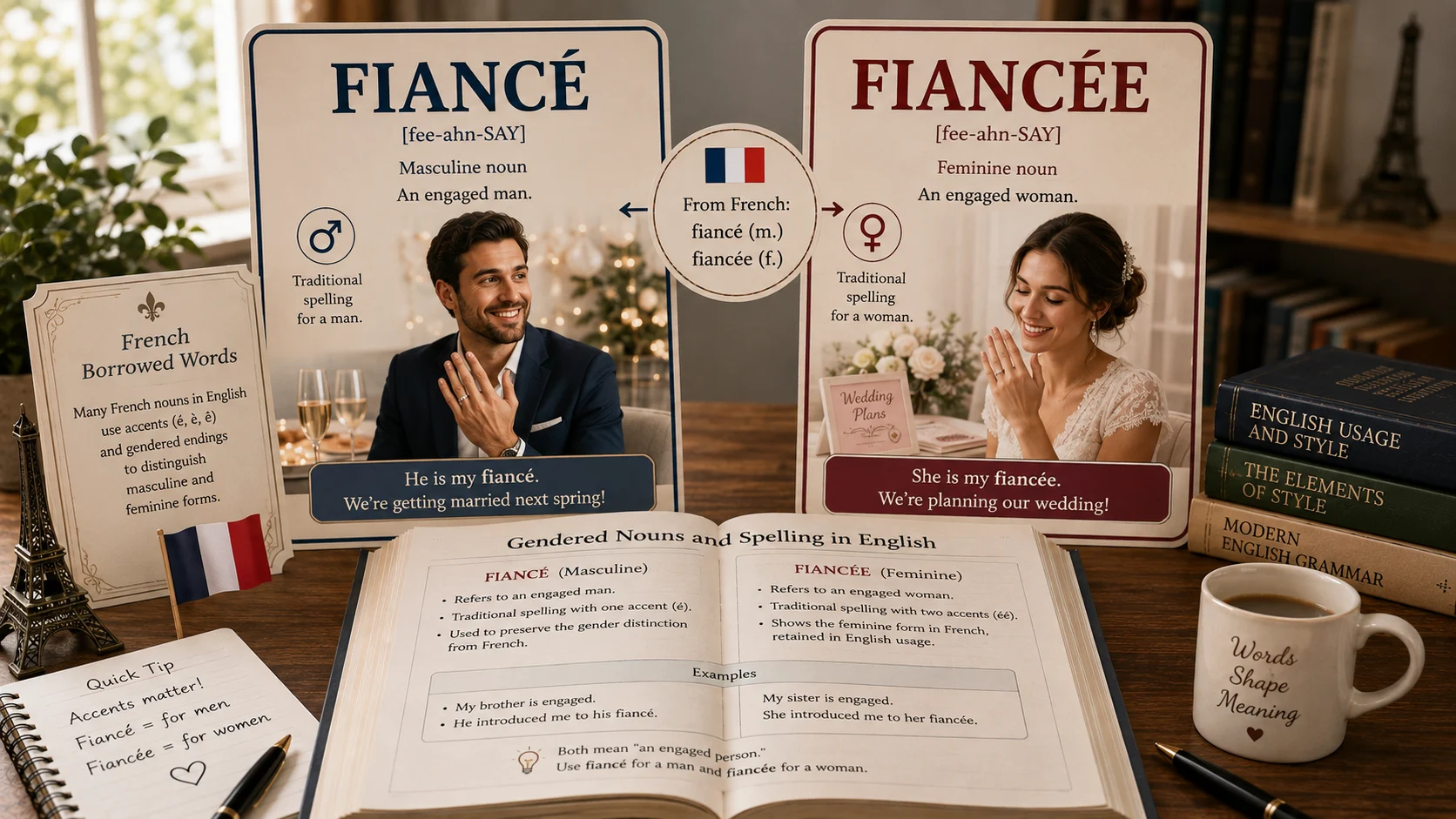
Fiancee or fiance refers to two gender specific terms for a person who is engaged to be married. Fiance means a man who is engaged, while fiancée means a woman who is engaged. The confusion usually comes from the French spelling, pronunciation, and the accent marks, which can make the two forms appear interchangeable when they are not.
Confused about fiancée or fiancé? You’re not alone. These two words look almost identical, sound nearly the same, and both describe someone who is engaged to be married. The difference, however, is important: fiancée traditionally refers to a woman who is engaged, while fiancé refers to a man who is engaged. The extra -e in fiancée is a small spelling detail that changes the word’s traditional gender-specific meaning.
Understanding fiancé vs. fiancée can help you avoid awkward mistakes in wedding invitations, announcements, social media posts, formal writing, and everyday conversations. While modern English sometimes uses these terms more flexibly, the traditional distinction remains widely recognized. In this guide, we’ll explain the difference between fiancé and fiancée, show you how to use each word correctly, and provide clear examples so you can confidently choose the right spelling in any context.
Fiancee or Fiance | What’s the Difference?
The main difference between fiance and fiancée is gender. Both words describe a person who is engaged to be married, but traditional English usage distinguishes between a male and female fiancé.
The word fiancé is a noun referring to a man who is engaged to be married. The word fiancée is a noun referring to a woman who is engaged to be married.
Both words come from French, where the final letter and accent help distinguish the feminine form. In everyday English, however, many people write the words without accent marks, especially when using keyboards that do not make accented characters convenient.
The spelling fiancee without the accent is also widely encountered in English, particularly in informal writing and digital communication. However, fiancée is the traditional standard spelling for the feminine form.
Quick Recap
Fiancé traditionally refers to an engaged man.
Fiancée traditionally refers to an engaged woman.
Both words describe someone who is engaged to be married.
The difference is primarily grammatical gender and spelling.
Is Fiancee or Fiance a Grammar, Vocabulary or Usage Issue?
The difference between fiancé and fiancée is mainly a vocabulary and usage issue rather than a complicated grammar rule. The words have related meanings, but they are traditionally used according to the gender of the person being described.
For example, if Sarah is engaged to be married, she can be described as a fiancée. If James is engaged to be married, he can be described as a fiancé.
They are therefore not completely interchangeable under traditional usage.
English speakers sometimes use fiancé as a general term, particularly when gender is not considered important. Modern English also increasingly favors gender neutral language when a person’s gender does not need to be specified.
Formal Versus Informal Usage
In formal writing, wedding documents, invitations, biographies, journalism, and carefully edited publications, using the traditional distinction can demonstrate precision.
For example:
“My fiancée will attend the ceremony.”
“My fiancé will attend the ceremony.”
In casual conversation, however, many speakers simply say “my fiancé” regardless of gender. The pronunciation is also generally very similar in English, which makes the distinction much easier to miss when speaking than when writing.
Academic Versus Casual Usage
Academic writing should use the form that accurately identifies the person being discussed. If the subject is a woman, fiancée is the traditional form. If the subject is a man, fiancé is the traditional form.
Casual writing is more flexible. Text messages, social media posts, and informal conversations frequently omit accent marks and may even use fiance as a simplified spelling.
How to Use Fiancé Correctly
Fiancé traditionally describes a man who is engaged to be married.
The word functions as a noun and normally appears after a possessive word or article.
For example:
“My fiancé proposed during our vacation.”
“Her fiancé works in London.”
“Daniel introduced his fiancé to his colleagues.”
Workplace Example
Imagine that an employee is discussing an upcoming wedding with a colleague:
“My fiancé and I are taking two weeks off for our wedding.”
Here, the speaker is referring to a male partner who is engaged to be married.
Academic Example
A sociology paper might discuss marriage patterns using a sentence such as:
“The participant explained that her fiancé had recently moved to another city.”
The term identifies the participant’s male partner before marriage.
Technology Example
A person might write a message using a wedding planning application:
“My fiancé has already approved the guest list.”
The word has exactly the same meaning in a technology context as it does in ordinary conversation.
Fiancé Usage Recap
Use fiancé when traditionally referring to an engaged man.
It is a noun describing a person before marriage.
The accent on the final vowel is the traditional French influenced spelling.
How to Use Fiancée Correctly
Fiancée traditionally describes a woman who is engaged to be married.
The word is also a noun and can appear in many of the same sentence structures as fiancé.
For example:
“My fiancée is organizing the reception.”
“His fiancée lives in Manchester.”
“Emma introduced her fiancée to the family.”
Workplace Example
Consider a professional conversation about an employee’s upcoming wedding:
“My fiancée and I are getting married in September.”
The word identifies the speaker’s female partner.
Academic Example
A researcher writing about relationships might say:
“The participant described how her fiancée supported her during graduate school.”
Here, fiancée identifies the female partner of the participant.
Technology Example
A wedding planning application might contain a note such as:
“My fiancée selected the venue yesterday.”
The spelling remains the same regardless of the word appears in an application, email, website, or printed document.
Fiancée Usage Recap
Use fiancée when traditionally referring to an engaged woman.
The word is a noun.
The final e and accent distinguish the traditional feminine form from fiancé.
When You Should NOT Use Fiancee or Fiance
There are several situations in which choosing fiancé or fiancée can create an inaccurate or unnecessary statement.
1. When the Person Is Already Married
Do not normally describe someone as a fiancé or fiancée after the marriage has taken place. Once the couple is married, terms such as husband, wife, spouse, or partner may be more appropriate.
2. When the Couple Is Dating but Not Engaged
Being in a romantic relationship does not automatically make someone a fiancé or fiancée. The terms traditionally indicate an engagement to marry.
3. When Referring to a Former Fiancé
If an engagement has ended, the phrase former fiancé or former fiancée provides clearer information.
4. When You Need a Gender Neutral Term
If gender is unknown, irrelevant, or intentionally omitted, fiancé may not always be the best choice. A phrase such as “engaged partner” can avoid gender assumptions.
5. When Discussing a Future Possibility
Someone who may become engaged in the future is not yet a fiancé or fiancée. The engagement needs to exist before the traditional term applies.
6. When the Person Is Simply a Romantic Partner
Calling a boyfriend, girlfriend, or partner a fiancé or fiancée can imply an engagement that does not exist.
7. When the Relationship Has Ended
If someone is no longer engaged, using the present tense term without clarification can be misleading.
Common Mistakes and Decision Rules
Many mistakes happen because writers remember that both words mean an engaged partner but forget the traditional distinction between the masculine and feminine forms.
Decision Rule
If you mean an engaged man, use fiancé.
If you mean an engaged woman, use fiancée.
If gender does not need to be specified, consider a gender neutral phrase such as engaged partner.
This rule is more reliable than trying to remember which spelling “looks right.” Focus on the person being described first, then select the appropriate form.
Fiancee or Fiance in Modern Technology and AI Tools
Modern technology has changed how people type accented words. Many keyboards, search systems, spell checkers, and writing applications recognize fiancé and fiancée, but users may still enter simplified forms such as fiance and fiancee.
Search engines generally understand these variations because they are closely related. However, recognition by a search engine does not mean every spelling is equally appropriate in polished writing.
AI writing tools can also generate either form depending on context. If a prompt simply says “my fiancé,” an AI system may preserve that wording without knowing the gender of the person involved.
For professional content, the safest approach is to establish the person’s gender when relevant and then use the traditional spelling consistently.
The Etymology of Fiancé and Fiancée
Both words originated in French and are connected to the verb fiancer, meaning to promise or become engaged.
The masculine form is fiancé, while the feminine form is fiancée. English adopted both forms as borrowed words, retaining much of the original French spelling.
The accent marks are not merely decorative. They reflect the original French forms and help distinguish the two words in carefully edited English.
English has borrowed thousands of words from French, and many retain spelling patterns that are unusual in modern English. Fiancé and fiancée are good examples of this linguistic history.
An Expert Perspective
A useful way to understand the pair is this:
The distinction is not about the relationship itself, but about the grammatical gender traditionally assigned to the person being described.
This makes the choice easier. Both terms describe engagement, while the spelling traditionally signals the person is male or female.
Case Study 1: Wedding Communication
Suppose a wedding invitation website contains the sentence:
“Please join Olivia and her fiancé for their engagement celebration.”
If Olivia is marrying a man, fiancé is the appropriate traditional form. Changing it to fiancée would incorrectly identify her partner as female.
Case Study 2: Academic Writing
Consider a university essay that discusses a woman preparing for marriage:
“The participant explained that her fiancée helped her manage the financial planning.”
Using fiancée immediately communicates that the participant’s engaged partner is female. The distinction improves precision without requiring an additional explanatory sentence.
Error Prevention Checklist
Always Use Fiancé When
The engaged person is traditionally identified as male.
You are writing formal or carefully edited English.
You want to preserve the traditional French influenced distinction.
You are describing a male partner before marriage.
Never Use Fiancée When
The engaged person is male and the traditional distinction matters.
You are referring to someone who is not actually engaged.
The person is already married and no longer a fiancé.
You are using the term simply to mean boyfriend or romantic partner.
Always Use Fiancée When
The engaged person is traditionally identified as female.
You are writing a formal document where precise usage matters.
You want to preserve the traditional feminine form.
You are describing a female partner before marriage.
Related Grammar Confusions You Should Master
Learning fiancé and fiancée is part of a larger group of English usage distinctions that can improve writing accuracy.
Advice vs Advise
Advice is a noun, while advise is a verb.
Affect vs Effect
Affect is commonly used as a verb, while effect is commonly used as a noun.
Compliment vs Complement
A compliment expresses praise, while a complement completes or enhances something.
Principal vs Principle
Principal can refer to a person or something important, while principle refers to a fundamental rule or belief.
Stationary vs Stationery
Stationary means not moving, while stationery refers to writing materials.
Your vs You’re
Your shows possession, while you’re is the contraction of you are.
Their vs There vs They’re
Their shows possession, there generally refers to a place or existence, and they’re means they are.
Advice vs Advise
The spelling changes because the words belong to different parts of speech.
Who vs Whom
Who generally functions as a subject, while whom traditionally functions as an object.
FAQs
Is fiancé male or female?
Fiancé traditionally refers to a man who is engaged to be married. The feminine form is fiancée.
Is fiancée male or female?
Fiancée traditionally refers to a woman who is engaged to be married. The masculine form is fiancé.
What is the correct spelling, fiance or fiancée?
Both forms can appear in English, but fiancé and fiancée are the traditional spellings. The correct choice depends on the gender of the engaged person.
Can I write fiancee without an accent?
Yes, fiancee is commonly used when accent marks are unavailable or omitted. In polished writing, however, fiancée is the traditional spelling.
Are fiancé and fiancée pronounced differently?
In English, they are usually pronounced very similarly. Their distinction is therefore much easier to see in writing than to hear in conversation.
Can fiancé be used as a gender neutral word?
Some modern speakers use fiancé more broadly, but traditional usage distinguishes fiancé and fiancée. Engaged partner is a clear gender neutral alternative.
What do you call someone who is engaged but not married?
A man is traditionally called a fiancé and a woman is traditionally called a fiancée. These terms describe the period between engagement and marriage.
Is fiancee a French word?
Fiancée comes from French and represents the feminine form of fiancé. English adopted both words as terms for people who are engaged.
Should I use fiancé or fiancée in formal writing?
Use fiancé for an engaged man and fiancée for an engaged woman when following traditional English usage. This is the clearest approach for formal and carefully edited writing.
Conclusion
The difference between fiancé and fiancée is straightforward once you connect each spelling with the person it describes. Fiancé traditionally refers to an engaged man, while fiancée traditionally refers to an engaged woman.
The pair comes from French, which explains the accent marks and gender distinction. In informal digital writing, you may see simplified forms such as fiance or fiancee, but polished writing generally benefits from retaining the traditional spellings.
If you are unsure which form to choose, identify the person first. For an engaged man, write fiancé. For an engaged woman, write fiancée. If gender is irrelevant, a phrase such as engaged partner can provide a clear modern alternative.
Discover More Related Articles:
- Grandad or Granddad | Which Word Is Correct & When Should You Use It In 2026
- Fazed or Phased | What Is the Difference & Which Word Should You Use In 2026
- Whiney or Whiny | Which Word Do Dictionaries Recommend In 2026