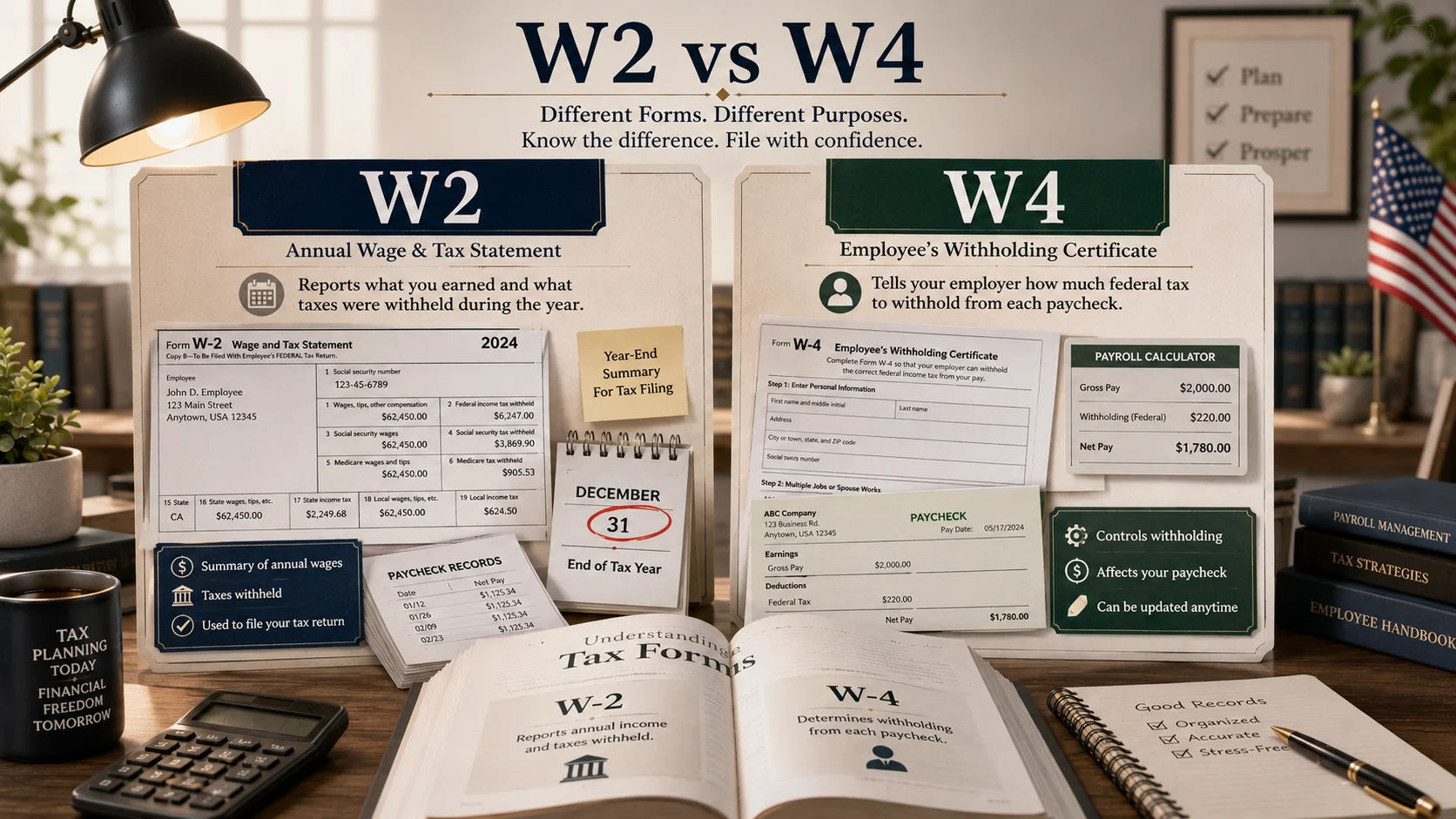
W2 or W4 refers to two different United States employment tax forms with completely different purposes. Form W2 reports an employee’s annual wages and taxes withheld, while Form W4 tells an employer how much federal income tax to withhold from each paycheck. Knowing the difference helps employees complete payroll paperwork correctly and file accurate tax returns.
Have you ever come across W2 and W4 on tax forms and wondered what the difference is? Although these terms look similar, they serve different purposes in the United States tax and payroll system. Understanding them is important because choosing the right form can help you provide accurate information and avoid unnecessary confusion when starting a job or managing your tax paperwork. A W-2 form reports an employee’s annual wages and the taxes withheld by their employer, while a W-4 form tells an employer how much federal income tax to withhold from an employee’s paycheck.
In this guide, we’ll explain the difference between W2 and W4 in simple terms, including their purposes, key details, and when each form is used. you’re a new employee, changing jobs, or reviewing your payroll documents, you’ll learn how these forms work and why both matter. By the end, you’ll have a clearer understanding of which form you need and how it fits into your tax responsibilities.
W2 or W4 | What’s the Difference?
The simplest way to understand the difference is to remember the timing and purpose of each form. A W4 is generally completed by an employee when starting a job or when personal or financial circumstances change. A W2 is prepared by the employer after the tax year and reports the employee’s wages and taxes withheld.
The Internal Revenue Service identifies Form W4 as the Employee’s Withholding Certificate. The information supplied on this form helps an employer calculate federal income tax withholding from an employee’s pay.
Form W2, officially called the Wage and Tax Statement, serves a different purpose. It reports wages paid during the year along with amounts withheld for federal income tax, Social Security, Medicare, and applicable state or local taxes.
In short, W4 comes before and during employment because it helps determine withholding. W2 comes after the year ends because it documents what happened during the year.
A useful memory trick is simple: W4 helps determine what comes out of your paycheck, while W2 shows what happened over the year.
Is W2 or W4 a Grammar, Vocabulary or Usage Issue?
The confusion between W2 and W4 is not really a grammar problem. It is primarily a terminology and usage issue involving two official tax forms.
Neither form is an alternative spelling of the other. They are separate documents with different functions. Therefore, you cannot normally use W2 when an employer asks you to complete a W4, and you cannot substitute a W4 for a W2 when preparing your annual tax return.
The confusion is understandable because both forms begin with the letter W and contain a number. Both are connected with employment, wages, and federal taxes. However, the number is part of the official form name, so changing it changes the document entirely.
The difference also matters in formal settings. Human resources departments, payroll departments, accountants, tax professionals, employers, and government agencies use the form numbers precisely. Saying that you need a W2 when you actually need a W4 can result in unnecessary delays or incorrect paperwork.
In academic or educational writing, it is also important to distinguish the forms clearly. A discussion of paycheck withholding should generally refer to Form W4, while a discussion of annual wage reporting should generally refer to Form W2.
What Is Form W2?
Form W2 is the Wage and Tax Statement. Employers use it to report an employee’s wages and certain taxes withheld during the year. The information is important because employees use the W2 when preparing their federal and, when applicable, state and local income tax returns.
An employee normally receives a W2 after the end of the tax year. The form contains information such as taxable wages, federal income tax withheld, Social Security wages, Social Security tax withheld, Medicare wages, and Medicare tax withheld. Depending on the employee’s situation, additional information may also appear.
Workplace example
Imagine that Maria works for a company throughout 2026. Her employer pays her every two weeks and withholds taxes from each paycheck. After the year ends, the employer prepares her W2 showing the relevant annual wage and withholding information.
Maria does not complete the W2 herself. Her employer is responsible for preparing and furnishing it to her.
Academic example
A business course might explain payroll reporting by saying:
“An employee’s W2 summarizes wages and applicable taxes withheld during the tax year.”
That sentence uses W2 correctly because the discussion concerns annual reporting rather than setting paycheck withholding.
Technology example
Many employers now provide electronic W2 forms through payroll platforms. An employee may log into an online payroll account, open the tax documents section, and download a digital copy of the W2.
The technology used to deliver the form can change, but the purpose of the W2 does not.
W2 usage recap
Use W2 when discussing annual wages and taxes already reported by an employer. Think of it as a year end record that helps an employee complete a tax return.
What Is Form W4?
Form W4 is the Employee’s Withholding Certificate. Employees provide information on this form so their employer can determine the appropriate amount of federal income tax to withhold from their pay.
The current W4 asks for information relevant to withholding, including filing status, multiple job adjustments, certain credits, other income, deductions, and additional withholding. The redesigned form no longer uses the old withholding allowance system.
A W4 is not an annual wage statement. It is an instruction and information document used in the withholding process.
Workplace example
Suppose Daniel starts a new job. During the onboarding process, his employer asks him to complete Form W4. Daniel provides the required information so the payroll department can calculate federal income tax withholding from his pay.
If Daniel’s financial circumstances later change, he may submit a revised W4 to update his withholding.
Academic example
A payroll textbook might state:
“Employers use information provided by employees on Form W4 when determining federal income tax withholding.”
This is correct because the sentence concerns the calculation of tax withheld from wages.
Technology example
An employer may allow workers to complete a W4 through a secure payroll system rather than using a printed form. The digital process does not make the document a different tax form. It is still Form W4.
The IRS also explains that employers may maintain electronic W4 systems, subject to applicable requirements.
W4 usage recap
Use W4 when discussing federal income tax withholding from future or current paychecks. Think of it as information an employee gives the employer to help determine withholding.
When You Should NOT Use W2 or W4
Several common situations make the distinction especially important.
1. Do not use W2 when starting a new job
A new employee is generally asked to complete Form W4 so the employer can determine federal income tax withholding. A W2 is not a substitute for that process.
2. Do not use W4 to report annual wages
A W4 does not replace the annual wage statement. The W2 provides the annual wage and tax information used when filing an income tax return.
3. Do not call a W2 a withholding instruction
A W2 reports what was paid and withheld. It does not tell the employer how much federal income tax should be withheld from future paychecks.
4. Do not treat W2 and W4 as interchangeable
They serve different stages of the employment tax process. One helps establish withholding, while the other reports annual results.
5. Do not assume the form number refers to a spelling variant
W2 and W4 are not alternate names for the same document. The number identifies a specific IRS form.
6. Do not ignore a change in circumstances
Employees may submit a new W4 when their personal or financial circumstances change and they want to adjust withholding.
7. Do not use a missing W2 as a reason to ignore tax filing
If an employee does not receive a W2, the IRS provides procedures for addressing a missing or incorrect form.
8. Do not assume a contractor should receive a W2
Not every worker is an employee. Independent contractors are generally treated differently for federal tax purposes and may receive different tax reporting forms.
Common Mistakes and Decision Rules
Decision Rule:
If you mean the annual wage and tax record, use W2. If you mean the employee information used to determine federal income tax withholding, use W4.
The generic rule of choosing one word for an action and another for a person or tool does not accurately describe these forms. W2 and W4 are official document names, so the correct choice depends on the tax process you are describing.
W2 or W4 in Modern Technology and AI Tools
Modern payroll systems have made both forms easier to access and manage electronically.
An employee might complete a W4 through an online onboarding platform. The information can then flow into the employer’s payroll system so withholding calculations can be performed.
Later, the same employee might access a digital W2 through a payroll portal. Instead of receiving a paper document in the mail, the employee can view or download the electronic form.
AI based tax tools can also help users understand the difference between these forms. However, users should distinguish between explaining a form and making a personalized tax decision. Official IRS instructions remain the appropriate authority for determining how a particular form should be completed.
The IRS maintains current versions of its forms and instructions, including the 2026 Form W4.
W2 or W4 | Etymology and Form Naming
The names W2 and W4 are not ordinary English words. They are identifiers assigned to official United States tax forms.
The letter W is associated with wage reporting and withholding forms, while the number distinguishes one form from another. That numbering system explains why the two names look similar even though the forms perform different jobs.
The similarity creates a natural source of confusion. Someone unfamiliar with American payroll terminology may reasonably assume that W2 and W4 represent different versions of one document. They do not.
An expert style explanation would be:
“The W4 establishes withholding information, while the W2 documents the wages and taxes reported for the year.”
That distinction captures the central difference without requiring knowledge of complicated tax terminology.
Case study example 1: New employee
Consider an employee named Jordan who begins a new position in September. During onboarding, Jordan completes Form W4. The employer uses the information to determine federal income tax withholding from subsequent paychecks.
At the end of the tax year, Jordan receives a W2 covering the wages and applicable taxes reported by the employer.
The result is a clear sequence: W4 during employment for withholding, followed by W2 for annual reporting.
Case study example 2: Changed financial circumstances
Now consider an employee named Taylor who experiences a financial change and wants to review federal income tax withholding. Taylor can provide a revised W4 to the employer.
The practical result is that the employer can use the updated information when calculating withholding, subject to the applicable IRS rules. The W2 does not perform this function because it records the year’s reported information rather than serving as a current withholding instruction.
These examples demonstrate why using the correct form name matters in real payroll situations.
Error Prevention Checklist
Always use W2 when
• You mean the annual Wage and Tax Statement.
• You are discussing wages reported for a completed tax year.
• You are referring to information used to prepare an income tax return.
• You are discussing taxes already withheld and reported by an employer.
• You are talking about an employee’s year end wage record.
Never use W4 when
• You mean the annual wage statement.
• You are describing the document used to report yearly wages.
• You are replacing a missing annual wage record.
• You are discussing the document an employee uses to report completed yearly earnings.
Always use W4 when
• You mean the Employee’s Withholding Certificate.
• You are discussing federal income tax withholding from paychecks.
• You are talking about information supplied by an employee to an employer for withholding purposes.
• You are discussing an employee updating withholding information.
Related Grammar Confusions You Should Master
Although W2 and W4 are tax form names rather than grammar terms, learning related terminology can prevent similar mistakes.
- W2 and 1099: Employee reporting compared with certain nonemployee reporting.
- W4 and W9: Employee withholding information compared with information commonly requested from independent contractors and other payees.
- W2 and W3: Employee wage statements compared with the transmittal form used with W2 reporting.
- Gross pay and net pay: Earnings before deductions compared with the amount received after deductions.
- Withholding and estimated tax: Tax withheld through payments compared with tax paid through estimated payments.
- Tax credit and tax deduction: Two different mechanisms that can affect tax calculations.
- Employee and independent contractor: Different worker classifications with different tax treatment.
- Federal tax and state tax: Different levels of taxation that can appear in payroll records.
- Wage and salary: Related employment compensation terms that are not always used identically.
- Tax return and tax statement: A return is filed by the taxpayer, while a statement can provide information used to prepare that return.
FAQs
What is the difference between a W2 and a W4?
A W2 reports annual wages and taxes withheld, while a W4 provides employee information used to determine federal income tax withholding.
Do I fill out a W2 or a W4 when I start a new job?
You generally complete Form W4 when starting a new job, while your employer prepares your W2 for annual wage reporting.
Is a W4 the same as a W2?
No, they are different IRS forms with different purposes in the employment tax process.
What is a W2 used for?
A W2 provides annual wage and tax information that employees generally use when preparing their income tax returns.
What is a W4 used for?
A W4 provides information that an employer uses to calculate federal income tax withholding from an employee’s pay.
Can I change my W4 after starting a job?
Yes, an employee can generally provide a revised W4 when circumstances change or when the employee wants to update withholding information.
Who gives me my W2?
Your employer generally prepares and furnishes your W2, which reports your wages and taxes withheld for the year.
Does a W4 show my yearly income?
No, a W4 provides withholding information and is not an annual wage statement.
What should I do if I do not receive my W2?
You should first contact your employer, and the IRS provides additional procedures if the missing form is not resolved.
Conclusion
The difference between W2 and W4 becomes easy once you focus on their purpose. A W4 is connected with withholding and is generally completed by the employee so the employer can determine federal income tax withholding. A W2 is connected with annual reporting and shows wages and taxes withheld during the tax year.
Remember the simplest distinction: W4 helps determine withholding, while W2 reports the results.
If an employer asks you for a W4, they are generally asking for information needed for payroll withholding. If you are preparing your tax return and looking for your annual wage information, you are generally looking for your W2.
Using the correct form name is more than a matter of terminology. It helps prevent payroll delays, reduces confusion, and makes employment tax communication much clearer.
Discover More Related Articles:
- Scrapping or Scraping | What’s the Difference & Which Word Should You Use In 2026
- Combating or Combatting | Which Version Should You Use in Formal Writing In 2026
- Zillow or Salem | What Does This Search Really Mean In 2026