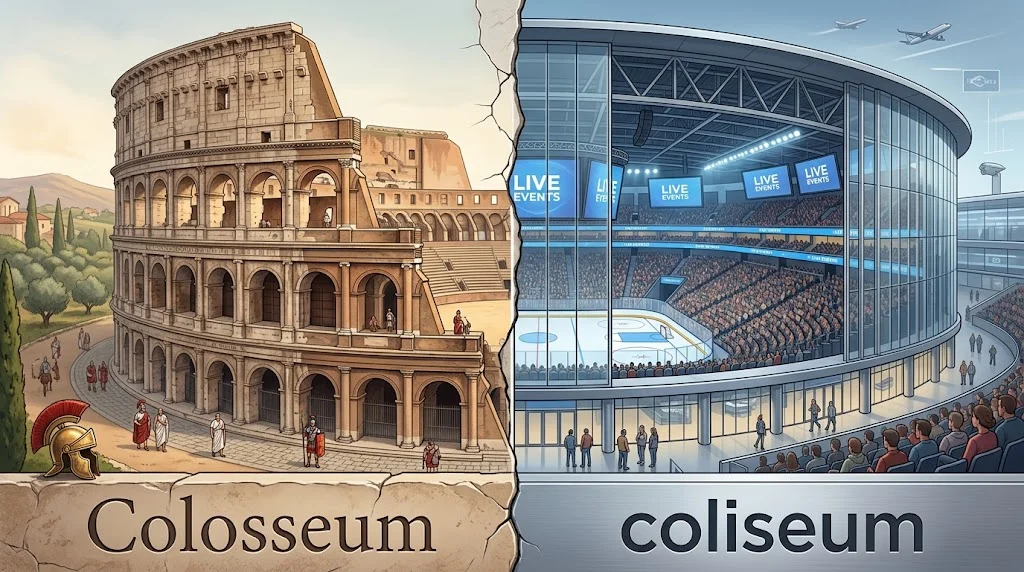
The correct choice depends on what you mean. Coliseum or Colosseum can refer to a large arena or amphitheater, but Colosseum is the standard spelling for Rome’s ancient Flavian Amphitheatre, while coliseum is a general English noun for a large stadium or arena. Knowing the distinction prevents spelling, historical, and geographical errors.
If you have ever wondered to write coliseum or colosseum, you are dealing with more than a simple spelling variation. The two forms are closely related, but modern English gives them slightly different roles.
Coliseum is a common noun that can describe a large stadium, arena, or amphitheater. It may be used for a modern sports venue or, in some contexts, as a general term for a large public entertainment building.
Colosseum, with two s letters in the middle, is the proper name of the famous ancient amphitheater in Rome, Italy. The building was originally known as the Flavian Amphitheatre and became associated with the name Colosseum.
The confusion creates real mistakes because writers sometimes use coliseum when specifically referring to the Roman monument, while others capitalize Colosseum when they actually mean a generic arena. The spelling therefore depends on you are naming a particular historical landmark or describing a type of building.
Coliseum vs Colosseum | What’s the Difference?
The easiest way to remember the distinction is to consider capitalization, meaning, and context.
Coliseum is generally a common noun. It refers to a large arena, stadium, or amphitheater. The word can describe a building without identifying one particular historical structure.
Colosseum is primarily a proper noun. It is the established English name of Rome’s ancient amphitheater, one of the most recognizable monuments of the Roman Empire.
| Term | Part of Speech | Meaning | Typical Context | Example |
|---|---|---|---|---|
| coliseum | Common noun | A large arena, stadium, or amphitheater | General or modern venues | The city built a new coliseum for sporting events. |
| Colosseum | Proper noun | The famous ancient amphitheater in Rome | Roman history, tourism, architecture | We visited the Colosseum during our trip to Rome. |
The distinction is simple once the context is clear.
Use Colosseum when referring specifically to the ancient Roman landmark.
Use coliseum when using the word as a general term for a large arena.
Capitalization is also important because a proper name identifies one particular place.
Is Coliseum vs Colosseum a Grammar, Vocabulary or Usage Issue?
This is primarily a vocabulary and usage issue, rather than a grammar problem.
Both spellings can appear in legitimate English, but they do not always carry the same meaning. Grammar determines how a word functions in a sentence, while vocabulary and usage determine which word is appropriate for the intended meaning.
In historical or academic writing, Colosseum is the expected spelling when discussing Rome’s ancient amphitheater. Writing coliseum in that context can make an otherwise accurate sentence look careless.
In casual English, coliseum may be used as a general noun for an arena. A sentence such as “The new coliseum can hold thousands of fans” can be perfectly acceptable when the writer is describing a modern venue.
The terms therefore are not completely interchangeable. Context matters more than pronunciation because both words are associated with large public arenas.
When to Use Coliseum
Use coliseum when you are referring to a large arena or stadium in a general sense.
The lowercase form works particularly well when the venue is not being presented as the official name of a specific historical monument.
Workplace Example
The company hosted its annual conference inside the city’s largest coliseum.
Here, coliseum describes the type of venue. It does not identify Rome’s ancient amphitheater.
Academic Example
Researchers examined how the design of a modern coliseum can influence crowd movement and public safety.
Again, the word functions as a general noun rather than a historical proper name.
Technology Example
The venue management system can monitor seating capacity throughout the coliseum.
The technology context does not change the basic meaning. The word simply describes the large venue where the system is being used.
Usage Recap
Use coliseum as a general noun for a large arena or stadium. Keep it lowercase unless it forms part of an official name. If you are talking about the famous Roman monument, choose Colosseum instead.
When to Use Colosseum
Use Colosseum when you mean the ancient Roman amphitheater in Rome.
Because it is a proper name, it is capitalized. The spelling with the additional s is the conventional English form used for this particular landmark.
Workplace Example
The travel company created a new itinerary featuring the Colosseum, Roman Forum, and Pantheon.
The word identifies a specific historical location, so capitalization is appropriate.
Academic Example
The Colosseum provides important evidence for understanding public entertainment and architecture in ancient Rome.
This is the standard choice in historical, archaeological, and architectural writing.
Technology Example
A virtual reality application allows users to explore a digital reconstruction of the Colosseum.
Although technology is involved, the subject remains the specific Roman monument.
Usage Recap
Use Colosseum for Rome’s ancient amphitheater. Capitalize it because it is a proper name. Historical, archaeological, architectural, travel, and educational contexts normally require this spelling.
When You Should NOT Use Coliseum or Colosseum
There are several situations where choosing the wrong form can weaken your writing.
| Situation | What to Avoid | Better Choice |
|---|---|---|
| Writing about Rome’s ancient monument | Calling it a generic coliseum | Colosseum |
| Describing a modern arena generally | Automatically capitalizing Colosseum | coliseum |
| Academic writing about Roman architecture | Using inconsistent spellings | Colosseum |
| Travel writing about Rome | Writing Rome’s Coliseum | Rome’s Colosseum |
| Talking about an official venue name | Changing its official spelling | Use the venue’s official name |
| General discussion of large arenas | Treating every arena as the Colosseum | coliseum or arena |
| Historical research | Using the generic word for the specific monument | Colosseum |
| Geographical references | Leaving the Roman landmark lowercase | Colosseum |
The most important point is that you should not treat the two spellings as interchangeable in every sentence. One usually identifies a famous place, while the other can describe a general type of venue.
Common Mistakes and Decision Rules
Many errors occur because writers remember the sound of the word but not its function.
| Correct Sentence | Incorrect Sentence | Explanation |
|---|---|---|
| The Colosseum is in Rome. | The Coliseum is in Rome. | Colosseum is the standard English name for the ancient Roman landmark. |
| The new coliseum seats 20,000 people. | The new Colosseum seats 20,000 people. | A generic modern arena should normally use the common noun coliseum. |
| Tourists visited the Colosseum. | Tourists visited the coliseum. | The Roman landmark is a proper noun, so it should be capitalized. |
| The city planned a large coliseum. | The city planned a large Colosseum. | The sentence describes a general building rather than Rome’s specific monument. |
| Roman engineers designed the Colosseum. | Roman engineers designed the coliseum. | The historical structure has a specific proper name, Colosseum. |
Decision Rule
If you mean the famous ancient amphitheater in Rome, use Colosseum.
If you mean a large arena or stadium in general, use coliseum.
Do not apply the commonly repeated rule that one word must represent an “action” and the other a “person or tool.” That distinction does not apply here. Both words refer to places or types of structures, with the key difference being specificity and usage.
Coliseum and Colosseum in Modern Technology and AI Tools
Modern technology has introduced new contexts in which these terms appear.
Search engines, translation systems, grammar checkers, and AI writing tools may recognize both forms, but context remains essential. An AI system might correctly identify Colosseum as the Roman landmark while interpreting lowercase coliseum as a general arena.
This is especially important for automated content generation. If a travel article discusses Rome, an AI generated sentence that changes Colosseum to coliseum may introduce a factual or stylistic error even though the sentence remains understandable.
For search engine optimization, semantic context also matters. A page about Roman history should naturally use related terms such as ancient Rome, Roman architecture, amphitheater, Flavian Amphitheatre, Roman Empire, gladiators, archaeological site, and Rome tourism.
The goal should not be keyword repetition. Clear topical relevance is more valuable than repeatedly forcing one spelling into every paragraph.
Etymology and Historical Background
The history of these words helps explain why they look so similar.
The ancient Roman structure was commissioned under the Flavian emperors and became known as the Flavian Amphitheatre. The name Colosseum became associated with the enormous statue of Nero known as the Colossus, which once stood nearby.
Over time, the name developed into the English form Colosseum. The related common noun coliseum came to be used more broadly for large public arenas.
This historical relationship explains why the two forms are visually and conceptually connected. They share a historical association with monumental public entertainment, but modern English gives them different practical roles.
An Expert Style Rule
A useful editorial principle is: “Use the proper name when identifying the landmark, and the common noun when describing the type of building.”
That rule is more reliable than trying to memorize the spelling without considering context.
Two Practical Case Studies
Case Study 1: A Travel Article About Rome
Imagine a travel website publishing an article titled “Best Historical Places to Visit in Rome.”
A sentence such as “The Colosseum remains one of Rome’s most recognizable ancient landmarks” is precise because it identifies the specific monument.
Replacing Colosseum with coliseum would make the sentence less accurate from a standard usage perspective. The reader would still understand the meaning, but the spelling would not match the conventional proper name.
Case Study 2: A Report About a New Sports Venue
Now imagine a city council discussing construction of a new indoor arena.
The sentence “The proposed coliseum will provide seating for thousands of spectators” uses the common noun naturally.
If the facility eventually receives an official name containing Coliseum, the capitalization and spelling should follow that official name. Proper names can differ from ordinary dictionary usage, so official venue branding should always be checked separately.
Error Prevention Checklist
Always Use Colosseum When
☑ You mean the ancient amphitheater in Rome.
☑ You are writing about Roman history.
☑ You are discussing the Flavian Amphitheatre.
☑ You are describing Rome’s famous archaeological landmark.
☑ You are writing an academic or travel article about the Roman monument.
Never Use Colosseum When
☑ You are simply describing an unspecified modern arena.
☑ You are discussing a generic stadium.
☑ You are referring to a large venue without identifying Rome’s monument.
☑ You are inventing a generic example involving an arena.
For a generic structure, coliseum is usually the more appropriate common noun.
Related Grammar Confusions You Should Master
If you are interested in commonly confused English words, several related pairs are worth learning:
| Confusion | Main Difference |
|---|---|
| affect or effect | Usually a verb versus a noun |
| compliment or complement | Praise versus something that completes or enhances another thing |
| principal or principle | A person or primary element versus a fundamental rule or belief |
| stationary or stationery | Not moving versus writing materials |
| practice or practise | Spelling and grammatical usage differs between American and British English |
| license or licence | Spelling and grammatical usage vary by English variety |
| advice or advise | Noun versus verb |
| everyday or every day | Adjective versus time expression |
| historic or historical | Something significant or notable versus a broader reference to history |
| emigrate or immigrate | Leaving a country versus entering a country |
Learning these distinctions improves accuracy because effective writing depends on selecting words according to meaning, not simply appearance.
FAQs
Is Colosseum or Coliseum correct for the Roman landmark?
Colosseum is the standard spelling for Rome’s ancient amphitheater. Coliseum is generally used as a common noun for a large arena.
What is the difference between coliseum and Colosseum?
Coliseum can describe a large arena generally, while Colosseum is the proper name of the famous ancient Roman amphitheater.
Should Colosseum always be capitalized?
Yes, when referring to Rome’s ancient monument, Colosseum is treated as a proper noun and is capitalized.
Is Coliseum an incorrect spelling?
No. Coliseum is a legitimate English word when used as a general noun or as part of an official name.
Why is the Roman Colosseum spelled with two s letters?
Colosseum developed as the established English name associated with Rome’s ancient amphitheater and its historical connection to the Colossus.
Can I use Coliseum when writing about Rome?
You may be understood, but Colosseum is the standard choice when specifically referring to the ancient Roman landmark.
Is coliseum a common noun or proper noun?
Lowercase coliseum is generally a common noun, although it can become part of a proper name when used in an official venue name.
Which spelling should students use in academic writing?
Students writing about the Roman monument should use Colosseum because it is the conventional proper name used in historical and academic contexts.
Does American English use Coliseum differently?
American English commonly uses coliseum as a general noun and may also use Coliseum in official names of venues, while Colosseum specifically identifies the Roman monument.
Conclusion
The answer becomes straightforward once you identify the intended meaning.
Use Colosseum for the famous ancient Roman amphitheater in Rome. It is a proper noun and should be capitalized.
Use coliseum when referring generally to a large arena, stadium, or amphitheater. The word normally remains lowercase when it is functioning as a common noun.
So, when discussing Roman history, architecture, archaeology, tourism, or the ancient Roman landmark, choose Colosseum. When describing an unspecified large entertainment venue, coliseum is the appropriate general term.
Understanding this distinction helps prevent spelling errors, improves academic credibility, and makes your writing more precise. The difference is small visually, but meaningful grammatically and semantically.