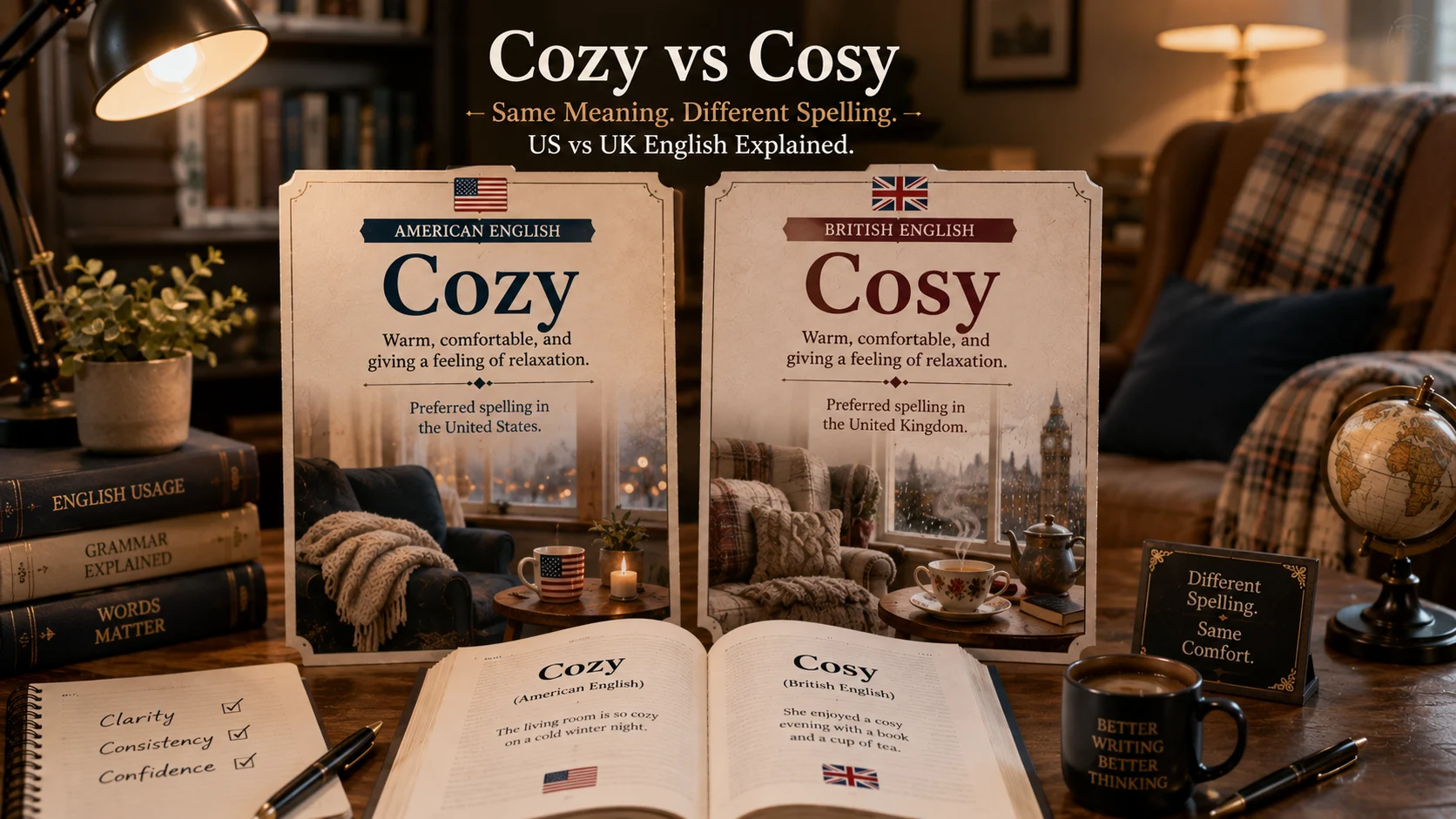
Cozy or cosy are two correct spellings of the same English adjective meaning comfortable, warm, snug, and pleasant. Cozy is the standard spelling in American English, while cosy is preferred in British English and many other varieties that follow British spelling. The choice is mainly a regional spelling difference, not a difference in meaning.
Have you ever confused “aide” and “aid” because they sound exactly alike but carry different meanings? You are not alone. These two words often create confusion in everyday conversations, academic writing, and professional communication. However, understanding their difference is easier than you might think. “Aide” refers to a person who provides assistance, such as a teacher’s aide or a political aide, while “aid” means help, support, or the act of assisting someone. Although their pronunciation is identical, using the wrong word can change the meaning of your sentence and weaken your writing.
In this guide, you will learn the difference between aide and aid, explore clear examples, and discover how to use each word correctly in different contexts. you are writing an essay, preparing a professional email, or improving your vocabulary, this practical explanation will help you avoid common mistakes. By the end, you will confidently know when to use “aide” and when “aid” is the right choice.
Cozy vs Cosy | What’s the Difference?
The simplest answer is that cozy and cosy have the same meaning and grammatical function. They are spelling variants used in different varieties of English.
The pronunciation is essentially the same in both varieties. The difference appears in spelling rather than meaning.
American readers generally expect cozy, especially in American newspapers, websites, books, and commercial writing. British readers generally expect cosy, particularly in British publications and formal documents.
The distinction also extends to related words. American English normally uses coziness, whereas British English normally uses cosiness.
Quick recap
Cozy is the American English spelling.
Cosy is the British English spelling.
Both words mean comfortable, warm, snug, or inviting.
The choice should depend on the English variety used throughout your writing.
Is Cozy vs Cosy a Grammar, Vocabulary or Usage Issue?
The difference between cozy and cosy is primarily a spelling and regional usage issue. It is not a meaningful difference in grammar or vocabulary.
Both forms can function as adjectives. They can describe rooms, homes, clothes, restaurants, cafés, atmospheres, relationships, and experiences.
For example:
The room feels cozy.
In British English, the same sentence would normally appear as:
The room feels cosy.
Nothing about the grammatical structure changes. Only the spelling changes.
Are Cozy and Cosy Interchangeable?
In meaning, yes. In regional spelling conventions, not always.
An American writer can use cozy naturally throughout an article. A British writer will generally choose cosy. If you are writing for an international audience, either spelling can be understood, but consistency is still important.
Switching randomly between the two forms can make your writing appear careless. For example, an article that uses cozy in one paragraph and cosy in another without a reason may look as though it contains spelling mistakes.
Formal and Informal Usage
Both spellings can appear in formal and informal contexts.
A formal American sentence might say:
The hotel provides guests with a cozy lounge overlooking the garden.
A formal British sentence might say:
The hotel provides guests with a cosy lounge overlooking the garden.
Neither form is inherently informal. The regional spelling determines which version sounds standard.
Academic and Casual Usage
Academic writers should follow the spelling convention required by their institution, publisher, or target readership.
If you are preparing an academic paper for an American university, cozy will usually be appropriate. If your work follows British English conventions, cosy is normally the better choice.
Casual communication is more flexible, but maintaining one spelling is still a good habit.
How to Use Cozy in American English
Cozy is the standard American English spelling. It describes a pleasant sense of comfort, warmth, or intimacy.
The word is frequently used for homes and interior spaces.
The family gathered in a cozy living room.
It can also describe a restaurant or café.
We found a cozy café near the park.
The word can describe clothing, especially clothing that feels warm and comfortable.
She wore a cozy sweater on the cold evening.
It can also describe an atmosphere.
The soft lighting created a cozy atmosphere.
Workplace Example
The company created a cozy break room where employees could relax during lunch.
Here, cozy describes the comfortable atmosphere of the workplace.
Academic Example
The researcher describes the library as a cozy environment that encourages extended reading.
The spelling is appropriate in American academic writing when American English is the chosen style.
Technology Example
The new smart home system can create a cozy atmosphere by adjusting the lights and temperature.
Technology companies also use cozy in product descriptions because the word communicates comfort and warmth quickly.
Usage Recap
Use cozy when your writing follows American English spelling conventions. It is suitable for professional, academic, commercial, creative, and everyday writing.
How to Use Cosy in British English
Cosy is the standard British English spelling. It carries exactly the same basic meaning as cozy.
It is especially common when describing homes and rooms.
The cottage has a cosy sitting room with a fireplace.
It can describe cafés and restaurants.
The restaurant has a cosy atmosphere and friendly service.
It can also describe clothing, environments, and experiences.
The blanket made the evening feel warm and cosy.
Workplace Example
The office has a cosy reading area where employees can take a short break.
This sentence follows British spelling conventions.
Academic Example
The author presents the library as a cosy environment that supports quiet study.
Again, the meaning is identical to the American version.
Technology Example
The application uses warm lighting settings to create a cosy atmosphere at home.
British technology writing can use cosy naturally when the publication follows British English.
Usage Recap
Choose cosy when you are writing in British English or another variety that follows British spelling conventions. The meaning is exactly the same as cozy.
When You Should NOT Use Cozy or Cosy
There are several situations where choosing one form without considering context can create unnecessary problems.
1. Do not mix regional spellings randomly
If your article follows British English, changing from cosy to cozy halfway through the text creates inconsistency.
2. Do not assume one spelling is universally correct
Both forms are standard. Calling cosy incorrect simply because you normally use American English is inaccurate.
3. Do not change the spelling inside a quotation
If a source uses cosy, preserve that spelling when quoting the source unless your editorial guidelines specifically require another treatment.
4. Do not use American spelling in a strongly British publication without checking its style guide
A British newspaper, university, publisher, or company may have established spelling conventions.
5. Do not use British spelling in American copy without a reason
American readers normally expect cozy, especially in commercial and editorial content produced for the United States.
6. Do not switch between cozy and cosy for SEO variation
Using both spellings merely to target different keywords can damage editorial consistency. Choose the form appropriate to your audience.
7. Do not treat the spelling difference as a difference in meaning
The two words do not describe different levels or types of comfort.
8. Do not confuse cozy or cosy with completely different words
The spelling difference is regional. It does not create two separate vocabulary items.
Common Mistakes and Decision Rules
Decision Rule
If you are writing in American English, use cozy.
If you are writing in British English, use cosy.
This is a better decision rule for this word pair than trying to distinguish the words by meaning. There is no separate action, person, or tool distinction between them.
Cozy and Cosy in Modern Technology and AI Tools
Modern technology has made regional spelling differences more visible because digital writing is often produced for international audiences.
A content management system may be configured for American English, British English, Australian English, or another language variety. Spell checking software can then identify one spelling as preferred depending on the selected language.
AI writing tools can also generate either spelling. If the requested language setting is American English, an AI system will generally favor cozy. If British English is selected, cosy is generally preferred.
This is particularly important for websites serving international audiences. A company targeting customers in the United States may want cozy home, while a British retailer may naturally use cosy home.
The key lesson is simple: technology can recognize both forms, but writers still need to select the appropriate regional convention.
Etymology and Language History
The word cozy has an interesting history, although its exact origin has been debated. The form became established in English with meanings connected to comfort, warmth, and pleasant surroundings.
The spelling developed differently across English varieties. American English generally settled on cozy, while British English retained cosy as its conventional spelling.
This is similar to several other regional spelling differences in English. American English often favors simplified or distinct spellings, while British English frequently preserves traditional forms.
The difference between cozy and cosy is therefore part of a much larger pattern in English spelling.
An Editorial Language Principle
A useful principle for professional writers is:
“Choose the spelling that matches your audience, then use it consistently.”
This is especially valuable when producing long form articles, educational resources, product descriptions, or academic content.
Illustrative Case Study 1: An American Website
Imagine an American home decor website that publishes an article about comfortable living rooms. The editor initially uses both cozy and cosy throughout the article.
During editing, the writer changes every instance to cozy to match the site’s American English style.
The result is a cleaner article with consistent spelling and a stronger regional identity. The improvement is editorial consistency rather than a change in the word’s meaning.
Illustrative Case Study 2: A British Lifestyle Publication
Consider a British lifestyle publication discussing small cottages and comfortable interiors. Its editor chooses cosy throughout the article, including related forms such as cosiness.
The result is a consistent British English style that aligns naturally with the publication’s readership.
These examples demonstrate why regional consistency matters even when two spellings are equally correct.
Error Prevention Checklist
Always Use Cozy When
- Your content follows American English.
- Your target audience is primarily in the United States.
- Your organization uses American spelling throughout its style guide.
- Your surrounding vocabulary follows American conventions.
- Your keyword research specifically targets the American spelling.
Always Use Cosy When
- Your content follows British English.
- Your target audience is primarily in the United Kingdom.
- Your organization uses British spelling.
- Your publication follows a British editorial style.
- Your surrounding vocabulary follows British conventions.
Never Use One Form Randomly
The biggest mistake is not choosing the supposedly wrong spelling. The biggest mistake is failing to maintain a consistent spelling system.
Related Grammar Confusions You Should Master
Learning these pairs helps writers understand that English spelling is not always governed by a single worldwide standard.
FAQs
Is cozy or cosy correct in English?
Both are correct. Cozy is standard in American English, while cosy is standard in British English and other varieties that follow British spelling.
Is cozy American or British English?
Cozy is the standard American English spelling. British English normally uses cosy instead.
Is cosy the British spelling of cozy?
Yes. Cosy is the conventional British spelling of the same adjective, with no difference in basic meaning.
Do cozy and cosy have the same meaning?
Yes. Both describe something comfortable, warm, snug, or pleasantly inviting.
Which is correct in academic writing, cozy or cosy?
Use the spelling required by your academic style guide or regional English variety. American academic writing normally uses cozy, while British academic writing normally uses cosy.
Should I use cozy or cosy for an American audience?
Use cozy for an American audience. It matches the spelling convention most readers in the United States expect.
Should I use cozy or cosy for a British audience?
Use cosy for a British audience. It is the standard British spelling.
Can I use both cozy and cosy in the same article?
You can when discussing regional differences, but ordinary writing should normally choose one spelling and use it consistently.
What is the plural or related form of cozy and cosy?
The related American form is coziness, while the British form is cosiness. Both refer to a state or quality of being comfortable and snug.
Conclusion
The choice between cozy or cosy is straightforward once you identify the English variety you are using. Cozy is the standard American spelling, while cosy is the standard British spelling. Both adjectives have the same meaning, pronunciation, and grammatical function.
If your audience is American, choose cozy. If your audience is British, choose cosy. For international content, either form can work, but consistency is essential.
The most important lesson is that neither spelling should automatically be labeled wrong. English has several legitimate regional spelling systems, and professional writing respects those differences.
For SEO content, academic writing, business communication, and everyday English, the best approach is to identify your target audience first and then maintain the same spelling convention throughout the entire piece.
Discover More Related Articles:
- Scrapping or Scraping | What’s the Difference & Which Word Should You Use In 2026
- Combating or Combatting | Which Version Should You Use in Formal Writing In 2026
- Zillow or Salem | What Does This Search Really Mean In 2026