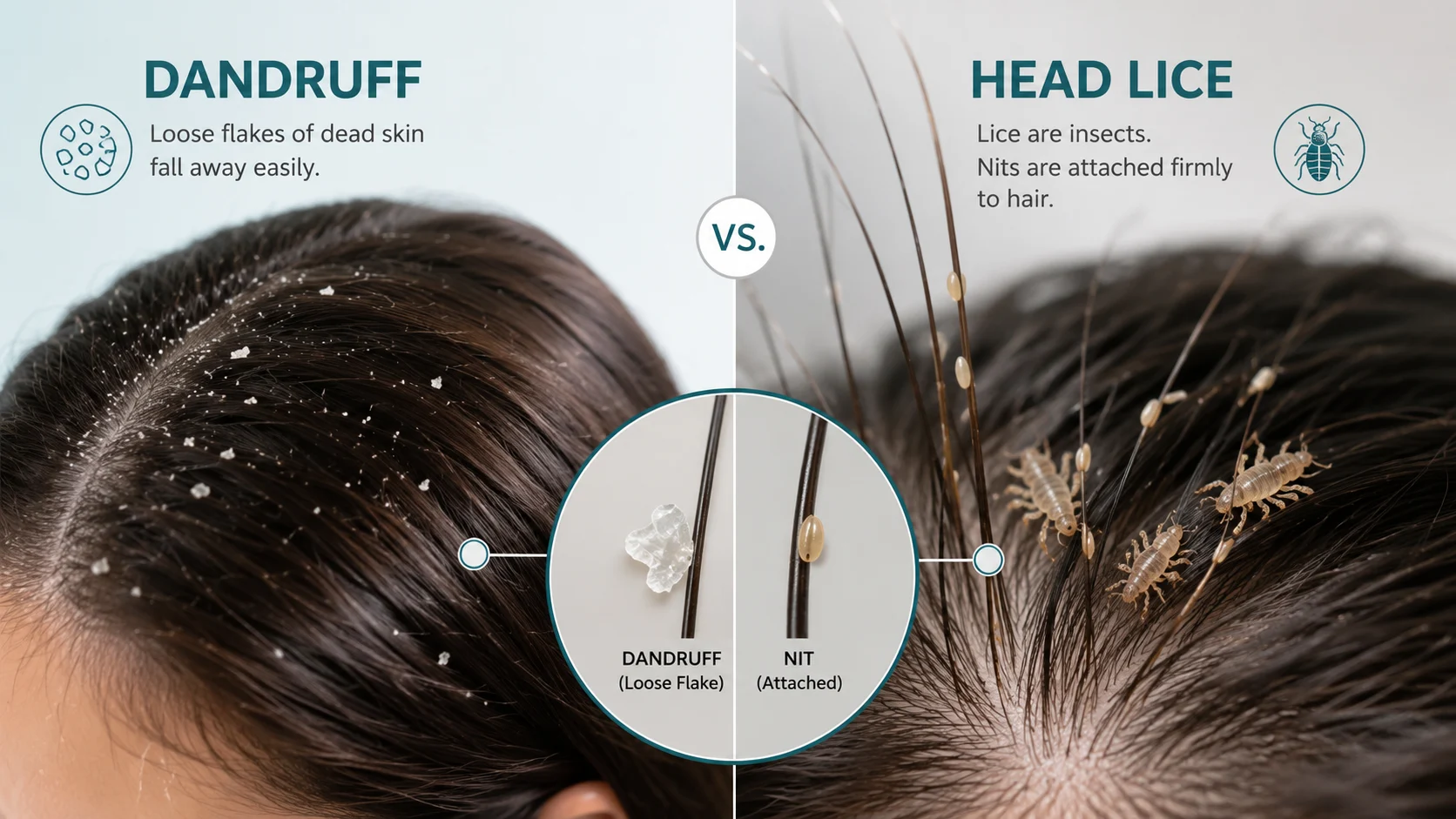
Dandruff or lice can both cause an itchy scalp and small white particles in the hair, but they are very different conditions. Dandruff is flaky skin that sheds from the scalp, while head lice are tiny insects that live near the scalp and feed on blood. Confusing them can lead to unnecessary treatment or missed infestation.
An itchy scalp does not automatically mean that someone has head lice. In many cases, the visible flakes are simply dandruff, a common scalp condition associated with skin flaking, irritation, oily skin, or conditions such as seborrheic dermatitis. Dandruff is not contagious. Head lice, by contrast, are living parasites that can spread mainly through close head to head contact.
The confusion happens because lice eggs, called nits, can resemble small flakes of dandruff. The most useful distinction is not simply their color or size. Dandruff tends to loosen easily from the scalp or hair, whereas nits are attached firmly to individual hair shafts.
Understanding this difference matters because the treatments are completely different. Dandruff is generally managed with appropriate scalp care and dandruff shampoo, while confirmed head lice require treatment designed to eliminate lice and their eggs.
Dandruff vs Lice: What’s the Difference?
Dandruff is a noun referring to flakes of dead or shedding skin from the scalp. It is a common scalp condition and may occur with itching or irritation. Head lice are plural nouns referring to small parasitic insects that live on the scalp and feed on human blood. Their eggs are known as nits.
| Feature | Dandruff | Head Lice |
|---|---|---|
| What it is | Flaking skin from the scalp | Tiny parasitic insects |
| Main cause | Scalp skin changes, oil, irritation, or related skin conditions | Infestation with head lice |
| Contagious | No | Yes, mainly through close contact |
| Appearance | Loose white or pale flakes | Moving insects or firmly attached nits |
| Attachment to hair | Usually loose | Nits stick firmly to hair shafts |
| Common symptom | Flaking and itching | Itching and crawling sensation |
| Common locations | Scalp and hair | Near scalp, especially behind ears and neck |
| Main treatment | Dandruff shampoo and scalp care | Appropriate head lice treatment |
The simplest distinction is this: dandruff is loose scalp material, while lice are living insects and their eggs.
If a white particle falls away or brushes off easily, dandruff is more likely.
If a particle remains firmly attached to a hair shaft, especially close to the scalp, a nit is more likely.
Is Dandruff vs Lice a Grammar, Vocabulary, or Usage Issue?
The phrase dandruff or lice is not primarily a grammar problem. It is a vocabulary and health clarification issue because the two terms identify different conditions.
Dandruff describes a scalp condition involving flaking skin. Lice describes an infestation involving parasitic insects. The terms are therefore not interchangeable.
In casual conversation, someone may say, “I think I have dandruff or lice,” when they are uncertain about the cause of scalp itching. That sentence is perfectly understandable. In academic, medical, workplace, or educational writing, however, the distinction should be made more precisely.
For example, a school nurse might write that a child has “possible head lice” rather than simply saying that the child has “dandruff.” A dermatologist may describe visible scaling, seborrheic dermatitis, or a suspected infestation depending on the examination.
The important point is that these terms do not represent formal versus informal versions of the same word. They name different things.
What Is Dandruff?
Dandruff is a common scalp condition characterized by flakes of skin. It can produce visible flakes in the hair or on clothing and may cause scalp itching. It is not considered contagious.
Several factors can contribute to dandruff. These may include oily skin, hair care habits, dry conditions, stress, or underlying skin conditions. Dandruff is also associated with seborrheic dermatitis, which can produce scaling and inflammation.
A person with dandruff may notice flakes after brushing the hair, scratching the scalp, or simply moving their head. The flakes can vary in size and appearance.
Mild dandruff can often be managed with regular washing and an appropriate dandruff shampoo. Dermatologists recommend looking for active ingredients such as ketoconazole, selenium sulfide, salicylic acid, sulfur, zinc pyrithione, or coal tar, depending on the product and individual needs.
Dandruff in the Workplace
Imagine an employee wearing a dark jacket and noticing small white flakes on the shoulders. If those particles are loose and the scalp is mildly itchy, dandruff may be a reasonable possibility.
The person does not need to assume that they have a contagious condition simply because flakes are visible. Dandruff itself is not spread from person to person.
Dandruff in Academic Settings
A student who notices flakes in their hair may worry about head lice, particularly if classmates have recently discussed an infestation. However, visible flakes alone do not establish the presence of lice.
A careful examination of the scalp and hair is more useful than assuming the cause.
Dandruff and Technology
Technology can help people research scalp symptoms, but online symptom searches cannot reliably diagnose a scalp condition. An image may show a similar looking flake without revealing it is dandruff, a nit, a scab, or another scalp issue.
AI tools can explain general differences, but they should not replace professional assessment when symptoms are persistent, severe, or unclear.
Usage recap: Dandruff refers to scalp flaking. It is not the name of an insect and does not mean that a person has head lice.
What Are Head Lice?
Head lice are tiny, wingless insects that live on the human scalp and feed on blood. Adult lice can be difficult to see because of their small size, while nits may be easier to spot because they remain attached to hair shafts.
Head lice commonly cause itching, although itching may not appear immediately after an infestation begins. A person may also experience a crawling sensation or develop small irritated areas from scratching.
Lice are especially associated with close head to head contact. They crawl rather than jump or fly.
The eggs, called nits, are particularly important when distinguishing lice from dandruff. Nits are attached to individual hairs, usually close to the scalp. They do not simply fall away like ordinary flakes.
Head Lice in the Workplace
If an adult notices intense scalp itching and discovers particles that are firmly attached to hair close to the scalp, they should not automatically assume the particles are dandruff.
A careful inspection is more appropriate. If live lice or firmly attached nits are found, medical or pharmacy guidance can help determine the appropriate treatment.
Head Lice in Academic Settings
Schools and childcare environments can be especially relevant because children often have close physical contact. Parents may notice scratching, especially around the ears and the back of the neck.
The CDC recommends examining areas including the crown, bangs, areas behind the ears, and the nape of the neck when checking for head lice.
Head Lice and Technology
Digital tools can provide educational information about lice symptoms, treatment options, and prevention. However, a digital assistant cannot reliably confirm an infestation simply from a description such as “white flakes.”
The physical distinction between a loose flake and an attached nit remains important.
Usage recap: Head lice are living parasites. Their eggs are called nits and remain attached to hair, making attachment one of the most useful clues when distinguishing them from dandruff.
When You Should NOT Use Dandruff or Lice
There are several situations in which casually labeling every itchy scalp problem as dandruff or lice can be misleading.
- Do not call every white particle dandruff when it is firmly attached to a hair shaft.
- Do not assume every itchy scalp means lice because dandruff and several other scalp conditions can also cause itching.
- Do not call a suspected infestation dandruff simply because no adult lice are immediately visible. Nits may be easier to find than live insects.
- Do not use lice treatment simply because flakes are visible. Unnecessary treatment can irritate the scalp.
- Do not assume dandruff is caused by poor hygiene. The American Academy of Dermatology specifically notes that poor hygiene is a common misconception about dandruff.
- Do not assume dandruff and dry scalp are identical. They can look similar but may have different causes and management approaches.
- Do not diagnose yourself from an online photograph alone.
- Do not ignore persistent scalp problems when appropriate home care does not improve them.
Common Mistakes and Decision Rules
| Correct sentence | Incorrect sentence | Explanation |
|---|---|---|
| I have dandruff and my scalp is flaky. | I have lice because I see loose flakes. | Loose flakes are more consistent with dandruff. |
| The nit is attached to the hair shaft. | The nit brushes away like dandruff. | Nits are firmly attached to hair. |
| The child may have head lice. | The child definitely has lice because the scalp itches. | Itching alone does not confirm lice. |
| Dandruff can cause scalp flakes. | Dandruff is a contagious insect. | Dandruff is a scalp condition, not an insect. |
| Head lice can spread through close contact. | Dandruff spreads through casual contact. | Head lice can spread between people, while dandruff is not contagious. |
| A dermatologist can assess persistent scalp symptoms. | Any itchy scalp can be diagnosed from one symptom. | Scalp itching has multiple possible causes. |
Decision Rule Box
If you see loose flakes that come away easily, dandruff is more likely.
If you see an insect or an egg firmly attached to a hair shaft near the scalp, head lice are more likely.
If you cannot tell the difference, do not guess based on itching alone. Examine the scalp carefully or seek professional advice.
Dandruff and Lice in Modern Technology and AI Tools
Modern search engines, health websites, and AI assistants make it easier to learn about scalp conditions. A person can quickly compare dandruff flakes, nits, itching, scalp irritation, and treatment approaches.
However, technology has an important limitation. A written description such as “small white dots in my hair” is not enough to establish a diagnosis.
AI can help organize information and explain terminology, but it should be treated as an educational resource rather than a substitute for a clinical examination.
This distinction is especially important because nits can resemble dandruff, hair product residue, scabs, and other material attached to hair.
Why Dandruff and Lice Are So Often Confused
The confusion has a simple visual explanation. Both can involve small particles around the scalp and hair, and both may be associated with itching.
The key difference is their nature.
Dandruff consists of flakes of skin. Lice are insects. Nits are their eggs.
Another important difference is movement and attachment. Loose dandruff can generally be removed from the hair relatively easily. Nits remain attached to individual hairs. The CDC specifically recommends trying to flick or pull off a suspected white speck when distinguishing dandruff from nits.
Location also provides a useful clue. Head lice and their eggs are often found around the ears and at the back of the neck, close to the scalp.
Short Etymology of Dandruff and Lice
The word dandruff has a long history in English and has been used to describe scalp flakes for centuries. Its exact historical development is complex, with earlier forms connected to words describing scaly or flaky material.
The word louse, whose plural is lice, is much older. It comes from Old English and related Germanic forms referring to the small parasitic insect.
These different histories reflect the fundamental difference between the terms. Dandruff names a scalp condition or its visible flakes, while lice names parasitic insects.
An Expert Perspective
As a practical dermatological distinction, the most useful question is not simply the scalp itches. It is the material is loose skin or something firmly attached to the hair.
That approach aligns with dermatological guidance emphasizing direct examination of the scalp and hair when the cause is uncertain.
A useful expert style principle is:
“When symptoms overlap, identify the physical feature that separates the conditions rather than relying on one symptom.”
Case Study 1: Loose Flakes
Consider a teenager who notices white flakes on a black shirt and has mild scalp itching. During examination, the flakes fall away from the hair and scalp easily.
The result is more consistent with dandruff than head lice. A suitable dandruff care routine may be appropriate, while persistent symptoms should be evaluated by a healthcare professional.
Case Study 2: Firmly Attached Nits
Now consider a child with persistent scalp itching. During examination, small particles are discovered close to the scalp behind the ears. Attempts to remove them from individual hairs are unsuccessful.
That finding raises concern for head lice because nits remain firmly attached to hair shafts. Further examination for live lice can help establish an infestation is present.
Author expertise: Written from a linguistics and SEO perspective with medical information cross checked against guidance from dermatology and public health sources.
Error Prevention Checklist
Always use Dandruff when
- You are describing loose flakes of scalp skin.
- You are discussing a common noncontagious scalp condition.
- You are explaining the use of dandruff shampoo or scalp care.
- You are describing flakes that can be removed easily from the hair.
Never use Lice when
- You only know that someone has scalp flakes.
- You have no evidence of live insects or attached nits.
- You are describing ordinary dandruff.
- You are using the word as a synonym for poor scalp hygiene.
Related Grammar Confusions You Should Master
Understanding dandruff or lice is primarily a vocabulary distinction, but English contains many similar pairs where precise word choice matters.
- Dry scalp or dandruff
- Lice or nits
- Itch or scratch
- Symptom or condition
- Affect or effect
- Advice or advise
- Practice or practise
- Breath or breathe
- Loose or lose
- Everyday or every day
These distinctions become especially valuable in health writing because a small vocabulary error can change the meaning of an explanation.
FAQs
How can you tell the difference between dandruff and lice?
Dandruff usually appears as loose flakes that can be removed easily, while lice or nits are associated with insects or eggs firmly attached to hair.
Can dandruff look like head lice?
Yes. Dandruff can resemble nits visually, which is why checking the particle is firmly attached to a hair shaft is useful.
Can dandruff cause an itchy scalp?
Yes. Itching is a common symptom of dandruff, although an itchy scalp can have many other causes.
Do lice cause white flakes in the hair?
Lice themselves are insects, while their eggs are nits that can look like small white or yellowish particles attached to hair.
Can you brush dandruff out of your hair?
Dandruff flakes are generally loose and can be removed more easily than nits, which remain attached to hair shafts.
Can you brush lice eggs out of your hair?
Nits are firmly attached to individual hair shafts, so they do not come away as easily as ordinary dandruff flakes.
Is dandruff contagious like head lice?
No. Dandruff is not contagious, whereas head lice can spread through close contact, particularly head to head contact.
What should you do if you cannot tell you have dandruff or lice?
Inspect the scalp and hair carefully, especially around the ears and back of the neck, and seek professional advice when the diagnosis remains uncertain.
When should you see a dermatologist for an itchy scalp?
Consider professional evaluation when symptoms are severe, persistent, unexplained, or do not improve with appropriate dandruff care.
Conclusion
Knowing the difference between dandruff or lice can prevent unnecessary worry and inappropriate treatment. Dandruff is loose, flaky scalp skin and is not contagious. Head lice are parasitic insects, while nits are their eggs and remain attached to individual hairs.
The most useful practical clue is attachment. If the material comes away easily, dandruff is more likely. If it remains firmly attached to a hair shaft close to the scalp, nits deserve closer inspection. When symptoms persist or the distinction is unclear, professional assessment is the safest approach.
Discover More Related Articles:
- Crain or Crane | Correct Spelling, Meaning & Usage Guide In 2026
- Leary or Leery | Learn the Difference with Easy Examples In 2026
- Afterwards or Afterward | Which Is Correct & When Should You Use Each In 2026