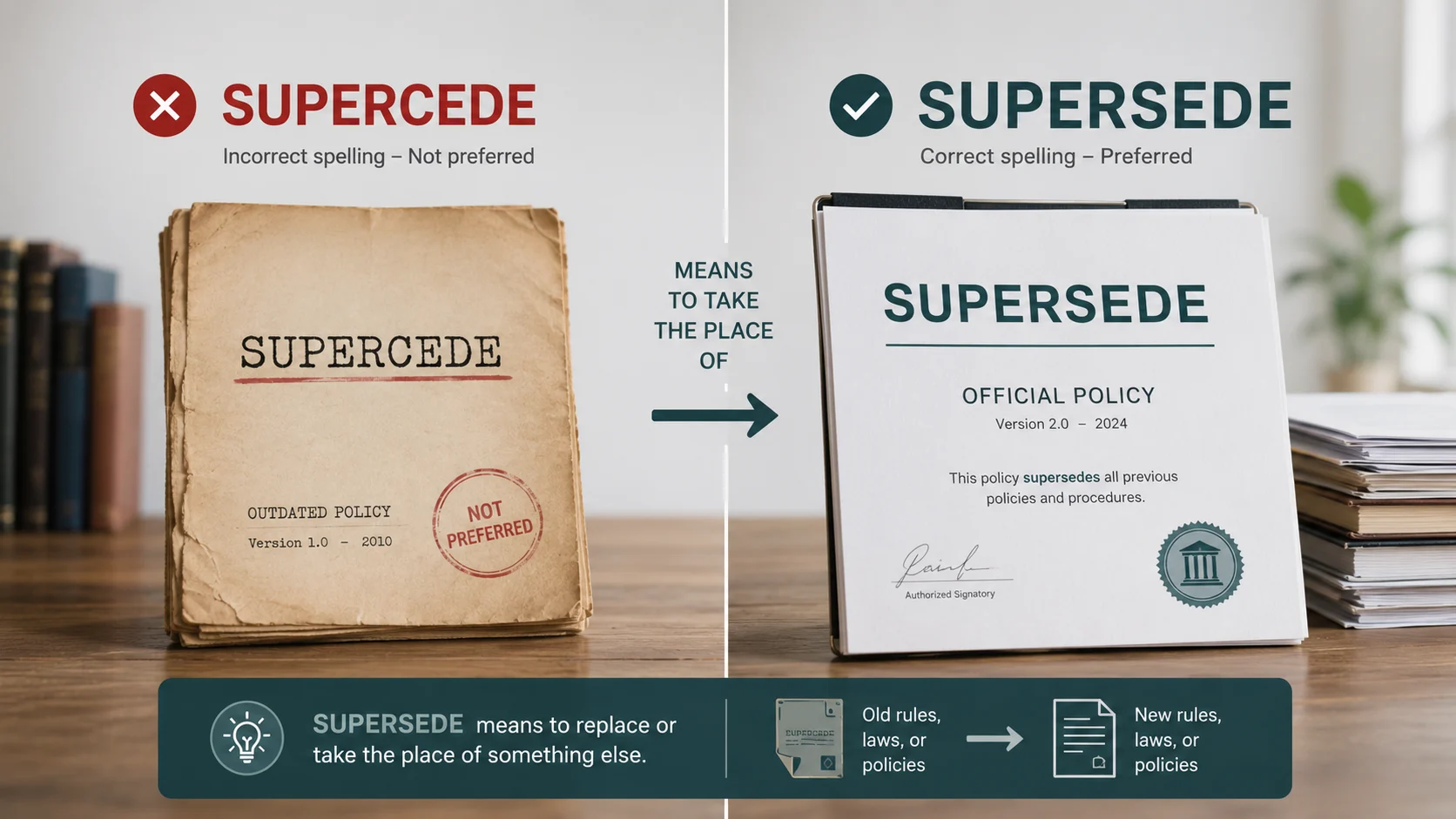
The correct spelling is supersede. It is a verb meaning to replace something that is older, less effective, or no longer preferred. Supercede is a recognized spelling variant, but it is widely treated as an error in standard modern English. Choosing the wrong form can create problems in academic, professional, legal, and technical writing.
If you have ever hesitated over supercede or supersede, you are not alone. The confusion is understandable because the spelling with c has appeared in English for centuries. Modern standard English, however, strongly favors supersede.
The word means to take the place of something or someone, especially when the replacement is newer, better, more effective, or officially preferred. Cambridge defines supersede as replacing something, particularly something older or more old fashioned. Oxford similarly explains that it means taking the place of something or someone that is no longer considered the best available.
The problem matters because spelling errors can affect credibility. A misspelled word in an academic paper may look careless. In workplace communication, it can weaken professional presentation. In technical documentation, incorrect spelling can also make a document appear poorly edited.
Merriam Webster identifies supercede as a disputed spelling variant of supersede and notes that it continues to be widely regarded as an error.
So, when you need the safest choice for standard English, remember one simple fact: supersede is the preferred spelling.
Supercede or Supersede: What’s the Difference?
The two forms are closely related, but they do not have equal status in modern standard English.
| Term | Part of Speech | Meaning | Standard Usage | Example |
|---|---|---|---|---|
| Supersede | Verb | To replace something older, weaker, or no longer preferred | Correct and standard | The new policy will supersede the old policy. |
| Supercede | Verb | Intended to mean the same thing as supersede | Variant spelling widely regarded as an error | Avoid this spelling in formal writing. |
Mini recap:
Supersede is the standard spelling.
Supercede is an established variant but is generally considered incorrect in careful modern writing.
Both forms are associated with the same intended meaning.
For academic, business, legal, and professional writing, choose supersede.
Merriam Webster explains that supersede means to take the place or position of something, while Cambridge describes it as replacing something older or more old fashioned.
Is Supercede or Supersede a Grammar, Vocabulary or Usage Issue?
Primarily, this is a spelling and usage issue, rather than a difference in grammar or meaning.
Both forms are intended to function as verbs. The important distinction is that standard edited English overwhelmingly prefers supersede. The two spellings are therefore not safely interchangeable in formal contexts.
In casual writing, someone may use supercede and still be understood. Search engines, readers, and automated systems can often recognize what the writer intended. Understanding, however, is not the same thing as correctness according to conventional editorial standards.
For academic writing, professional reports, applications, business documents, technical manuals, and formal correspondence, supersede is the appropriate choice.
The distinction is especially important when writing for an audience that evaluates language accuracy. Editors, teachers, hiring managers, publishers, and professional organizations may notice the spelling immediately.
The word is also more common in formal contexts because its meaning often concerns policies, laws, agreements, systems, theories, documents, procedures, and technologies. Cambridge specifically gives examples involving laws, regulations, agreements, processes, systems, and products.
How to Use Supersede Correctly
Supersede is a transitive verb, which means it normally takes a direct object.
You can say:
The new regulation supersedes the previous regulation.
You can also use the passive structure:
The previous regulation was superseded by the new regulation.
The verb usually suggests more than simple replacement. It often carries the idea that something newer, more effective, more suitable, or more authoritative has taken the place of something older.
Workplace Example
The updated employee handbook will supersede the previous version next month.
Here, the updated handbook replaces the older handbook as the current official document.
Another example is:
The revised procedure supersedes the instructions issued last year.
This sentence is appropriate for professional communication because it clearly establishes which procedure has authority.
Academic Example
Recent research has superseded several earlier assumptions about the subject.
This usage works particularly well in academic writing because theories, models, and interpretations can change as new evidence becomes available.
Oxford gives a similar academic construction in which a theory has been superseded by more recent research.
Technology Example
Cloud based storage has superseded many older methods of managing digital files.
Technology provides one of the clearest contexts for this verb. A newer system can supersede an older one when it becomes more practical, efficient, popular, or capable.
Usage Recap
Use supersede when one thing takes the place of another, particularly when the replacement is newer or considered better.
Think:
New system replaces old system.
Then:
The new system supersedes the old system.
How to Use Supercede
Although supercede appears in published English and has a long historical record, it is not the preferred spelling for modern standard writing.
Merriam Webster explicitly lists it as a disputed spelling variant and says that it is still widely regarded as an error.
This creates an important distinction between recognition and recommendation.
A dictionary may document a spelling without recommending it for general use. Language changes over time, and dictionaries often record variants that speakers and writers actually use. That does not mean every recorded variant is equally suitable for formal writing.
Therefore, if you encounter supercede in an old document, online article, database, or informal message, the word may still be understandable. However, if you are writing the sentence yourself, the safest and most accepted choice is supersede.
Workplace Example
Avoid:
The new contract will supercede the existing agreement.
Prefer:
The new contract will supersede the existing agreement.
Academic Example
Avoid:
Recent evidence may supercede the earlier theory.
Prefer:
Recent evidence may supersede the earlier theory.
Technology Example
Avoid:
The new platform could supercede the current system.
Prefer:
The new platform could supersede the current system.
Usage Recap
Supercede may appear in real English usage, but it is not the spelling you should choose when accuracy matters.
When proofreading your own writing, replace supercede with supersede.
When You Should NOT Use Supercede or Supersede
The word supersede is useful, but it is more formal than ordinary verbs such as replace. It should not automatically be inserted whenever you mean that something has changed.
Here are common situations where another word may be clearer.
- Do not use supersede when you simply mean that you physically exchanged one object for another. In that context, replace is usually more natural.
- Do not use supersede when a person merely takes another person’s position temporarily. Words such as substitute or cover for may be more precise.
- Do not use supersede when you mean that two items are being used together. Superseding implies replacement rather than simple addition.
- Do not use supersede when you only mean that something was updated without becoming obsolete.
- Do not use supercede in formal documents when supersede is available and correct.
- Do not assume that supersede means simply improve. Something can supersede another thing because it becomes the accepted replacement, even if the improvement is not absolute.
- Do not use supersede when override is more accurate. In legal and technical contexts, these terms can have different implications.
- Do not use either spelling when replace, substitute, update, revise, or override expresses your intended meaning more precisely.
Common Mistakes and Decision Rules
| Correct sentence | Incorrect sentence | Explanation |
|---|---|---|
| The new policy will supersede the old policy. | The new policy will supercede the old policy. | The standard spelling is supersede. |
| The revised edition supersedes the previous edition. | The revised edition supercedes the previous edition. | The spelling remains supersede when the verb takes third person singular form. |
| The old system was superseded by new software. | The old system was superceded by new software. | The past form is superseded. |
| New evidence may supersede the earlier conclusion. | New evidence may supercede the earlier conclusion. | The standard verb is supersede. |
| The updated agreement supersedes the previous contract. | The updated agreement supercedes the previous contract. | The verb refers to official replacement. |
Decision Rule
If you mean that something replaces an older or less suitable thing, use supersede.
If you are tempted to write supercede, stop and change the spelling to supersede.
There is no separate modern standard meaning that requires the spelling supercede. The practical spelling decision is therefore straightforward.
Supersede in Formal Writing
The word appears naturally in professional, legal, academic, and institutional language.
For example:
This agreement supersedes all previous agreements between the parties.
This style is common because the verb efficiently communicates that the newer document has replaced the authority or effect of an earlier document.
Similarly:
The revised policy supersedes the guidance issued in 2024.
The sentence is concise and formal without being unnecessarily complicated.
In everyday conversation, however, most speakers would probably say:
The new policy replaces the old one.
Both sentences communicate the basic idea. The difference is register. Supersede has a formal tone, while replace is more familiar and conversational.
Supersede in Modern Technology and AI Tools
The concept of supersession is particularly relevant to technology.
Software platforms, programming frameworks, operating systems, hardware standards, databases, and artificial intelligence systems are frequently replaced by newer versions.
For example:
The new model has superseded the previous generation of the system.
Or:
The updated security protocol supersedes the older protocol.
In AI documentation, the word can be especially useful when describing model versions, data processing methods, software releases, or policies.
However, writers should be precise. A new AI tool does not necessarily supersede an older tool merely because it is newer. Supersession implies that the newer option has taken the relevant place or authority of the earlier one.
That distinction matters in technical documentation because saying that one system supersedes another can imply that the older system should no longer be used.
Etymology: Why Is the Spelling So Strange?
The spelling becomes easier to understand when you look at the word’s history.
Oxford traces supersede to the Latin verb supersedēre, involving the ideas of being above and sitting. The word entered English through earlier French and Middle English forms. Oxford notes that its modern sense developed later, with the current meaning dating from the seventeenth century.
Merriam Webster also explains that historical English forms included a spelling with c, which helps explain why modern writers sometimes hesitate between the two forms.
This history is important because the spelling supercede is not a completely random invention. It has historical roots. The problem is that modern standard English settled on supersede as the preferred form.
An expert editorial principle captures the distinction well:
“Supersede means to take the place or position of another.”
That concise definition reflects the central meaning recognized by major dictionaries.
Two Practical Case Studies
Case Study One: Academic Editing
Consider a university research paper containing the sentence:
New evidence may supercede earlier interpretations.
During editing, the writer changes supercede to supersede. The meaning remains unchanged, but the sentence now follows the preferred standard spelling.
Concrete result: One spelling error is removed without changing the argument, structure, or meaning of the sentence.
This demonstrates why proofreading matters. A small spelling correction can improve the perceived reliability of an otherwise strong academic document.
Case Study Two: Software Documentation
Imagine a software company releasing version two of an application. Its documentation says:
Version two supercedes all previous installation instructions.
An editor changes the sentence to:
Version two supersedes all previous installation instructions.
Concrete result: The documentation uses the standard spelling and communicates clearly that the new instructions replace the old instructions.
The change is small, but technical documentation often depends on precision. When users are deciding which instructions have authority, wording should be unambiguous.
Error Prevention Checklist
Always use supersede when
- You mean replace an older or less preferred thing.
- You are writing an academic paper.
- You are preparing a professional document.
- You are writing legal or policy material.
- You are creating technical documentation.
- You are describing a newer system replacing an older system.
Never use supercede when
- You are submitting formal academic work.
- You are writing for professional publication.
- You are preparing an official report.
- You are editing business correspondence.
- You want the safest standard spelling.
- You are writing content intended for careful editorial review.
A simple proofreading trick is to remember the ending sede rather than cede.
Think:
supersede
Not:
supercede
Related Grammar Confusions You Should Master
Learning this spelling distinction is useful, but it is part of a larger group of commonly confused English forms.
- Affect or effect
- Advice or advise
- Principal or principle
- Complement or compliment
- Stationary or stationery
- Its or it’s
- Their, there, or they’re
- Then or than
- Accept or except
- Further or farther
These pairs and groups cause problems because English spelling often reflects historical development rather than simple pronunciation rules. Learning the meaning and grammatical function of each word is more reliable than depending on sound alone.
FAQs
Is supersede or supercede correct?
Supersede is the preferred standard spelling. Supercede is a documented variant but is widely regarded as an error in modern formal English.
Why is supersede spelled with an s instead of a c?
The spelling developed through a complicated historical path involving Latin, French, and Middle English forms. Although historical forms with c existed, supersede became the established modern spelling.
What does supersede mean in English?
Supersede means to replace something or someone, especially when the earlier option is older, less effective, or no longer considered the best available.
Is supercede a misspelling?
In modern standard usage, supercede is generally treated as an incorrect or nonpreferred spelling, even though dictionaries document it as a historical variant.
Is supersede a verb or a noun?
Supersede is a verb. Its forms include supersedes, superseded, and superseding.
What is the past tense of supersede?
The past tense and past participle are both superseded. For example, “The old policy was superseded by a new policy.”
What is a simple synonym for supersede?
The simplest synonym is replace. Depending on context, related words can include displace and supplant.
Is supersede formal English?
Yes. Supersede is particularly common in formal, academic, legal, business, institutional, and technical contexts. In casual conversation, replace is usually more natural.
How do you remember the spelling of supersede?
Remember that the standard spelling ends in sede. The safest form to use is supersede, not supercede.
Conclusion
When choosing between supercede or supersede, always use supersede in standard modern English. It means to replace something older, outdated, or less effective, and it is the preferred spelling in academic, professional, legal, and technical writing.
Although supercede appears as a historical variant, it is widely considered incorrect in careful writing. The easiest rule to remember is simple: when you mean replace, write supersede.
Discover More Related Articles:
- Crain or Crane | Correct Spelling, Meaning & Usage Guide In 2026
- Leary or Leery | Learn the Difference with Easy Examples In 2026
- Afterwards or Afterward | Which Is Correct & When Should You Use Each In 2026