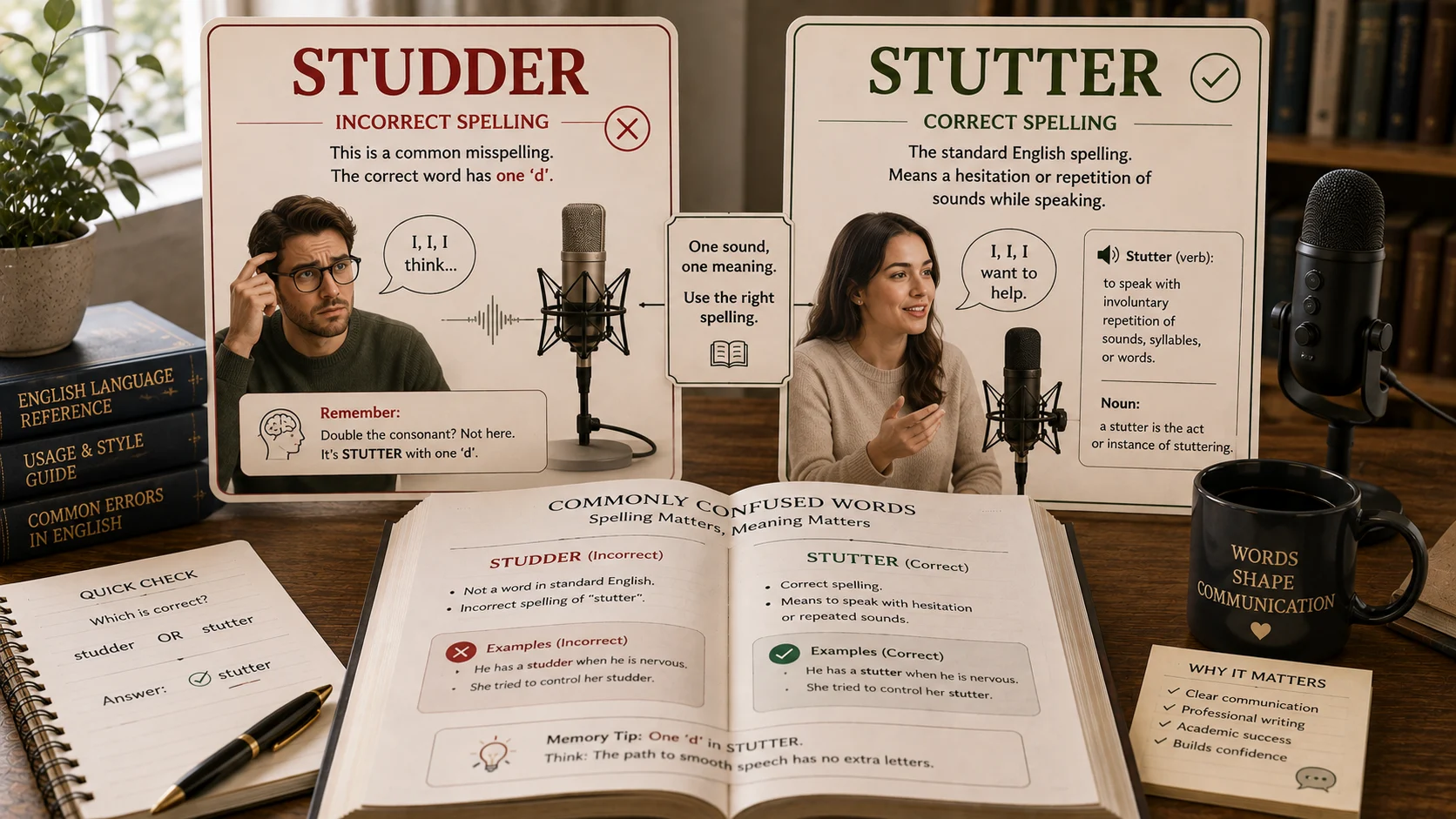
Studder or stutter is a common spelling confusion, but stutter is the standard and correct English spelling. It can function as a verb meaning to speak with repeated sounds or pauses and as a noun referring to this speech pattern. Studder is generally considered a misspelling and should be avoided in formal, academic and professional writing.
Ever typed studder when you actually meant stutter? You’re not alone. These two spellings look surprisingly similar, but only one is the standard English word. Stutter refers to a speech difficulty in which a person may repeat sounds, syllables, or words, or experience pauses while speaking. Studder, on the other hand, is generally considered a misspelling rather than a recognized standard spelling.
Knowing the difference matters, especially when writing about speech, communication, education, or personal experiences where accurate terminology is important.
In this guide, we’ll break down studder vs. stutter, explain the correct spelling, meaning, pronunciation, and common usage, and show you how to use stutter naturally in sentences. you encountered “studder” online or simply want to avoid this common spelling mistake, this comparison will help you choose the right word confidently in both everyday and formal writing.
Studder or Stutter | What’s the Difference?
The main difference is simple: stutter is the standard English word, while studder is generally an incorrect spelling.
Stutter can be used as both a verb and a noun. As a verb, it describes speaking with involuntary repetitions, interruptions, or prolonged sounds. As a noun, it refers to the speech pattern itself.
For example:
He began to stutter when he became nervous.
Her stutter became less noticeable during the presentation.
The spelling studder does not normally represent a separate standard English word with the same meaning. People sometimes write it because they hear a sound that seems to support the spelling, but standard written English uses stutter.
| Word | Part of Speech | Meaning | Correct Usage |
|---|---|---|---|
| Stutter | Verb and noun | To speak with repeated sounds, pauses, or interruptions, or the speech pattern itself | Standard English |
| Studder | Not standard for this meaning | Usually an incorrect spelling of stutter | Avoid in standard writing |
Quick recap
Stutter is the correct spelling.
Studder is generally a spelling error when the intended meaning is interrupted or repeated speech.
Use stutter in essays, emails, articles, reports, and other formal writing.
The easiest rule is to remember the middle sequence utt, not udd.
Is Studder or Stutter a Grammar, Vocabulary or Usage Issue?
The studder or stutter question is primarily a spelling and vocabulary issue rather than a complicated grammar problem.
Grammar determines how a word functions within a sentence. Spelling determines how that word should be written. In this case, the standard vocabulary item is stutter, and changing the second t to d produces a nonstandard spelling.
The two forms aren’t interchangeable in standard English. You may encounter studder online, in informal messages, social media posts, comments, or user generated content, but its appearance does not make it an accepted alternative spelling.
In formal writing, stutter should be used consistently.
Formal versus informal usage
In professional communication, academic writing, journalism, educational material, and edited publications, stutter is the appropriate choice.
Informal online communication is different. People frequently make spelling mistakes when typing quickly, and search engines may display incorrect forms because users search for them. This explains why studder can sometimes appear frequently on the internet.
Frequency alone does not establish correctness.
Academic versus casual usage
Academic writing should use stutter because students are expected to follow established spelling conventions.
In casual conversation, someone might type studder without realizing it is incorrect. That doesn’t make the spelling acceptable in carefully edited writing.
This distinction is useful when checking grammar exercises, proofreading blog content, or preparing professional documents.
How to Use Stutter Correctly
Stutter is the word you should choose when referring to speech that contains repeated sounds, syllables, words, prolonged sounds, or noticeable interruptions.
As a verb, stutter describes an action or manner of speaking.
For example:
The speaker began to stutter during the interview.
He sometimes stutters when speaking in front of a large audience.
As a noun, stutter identifies the speech pattern.
The character has a noticeable stutter.
The documentary discusses experiences associated with stuttering.
The related form stuttering is also widely used when describing the ongoing speech pattern or the act of speaking with interruptions.
Workplace example
Imagine that a manager is describing an employee’s presentation:
The speaker began to stutter during the final part of the presentation.
This is the standard spelling and works naturally in professional writing.
It is better to avoid casually labeling someone in a way that could sound insensitive. When the subject is a real person, respectful and context appropriate language matters just as much as spelling accuracy.
Academic example
A student writing a linguistics paper might write:
Researchers have studied stuttering as a speech fluency disorder.
Here, stuttering is the appropriate derived form of stutter.
An incorrect version such as:
Researchers have studied studdering as a speech fluency disorder.
contains a spelling error.
Technology example
Technology related writing may discuss speech recognition, voice interfaces, transcription systems, or conversational software:
The speech recognition system struggled when the speaker began to stutter.
This spelling is appropriate in technical documentation as well as general technology writing.
Usage recap
Use stutter when describing the speech behavior or the noun referring to it.
Use stuttering when describing the ongoing speech pattern or process.
Do not replace the second t with d.
How Studder Is Commonly Misused
The spelling studder most often appears when writers attempt to spell the word according to an imagined pronunciation.
English spelling can be deceptive because pronunciation does not always provide enough information to determine the correct letters. Similar sounding words can encourage incorrect spellings, especially when someone has heard a word many times but has rarely seen it written.
For example, a person might naturally type:
I started to studder when I became nervous.
The standard version is:
I started to stutter when I became nervous.
The error is easy to overlook because both forms look plausible at first glance.
When You Should NOT Use Studder or Stutter
There are several situations where careful word choice matters.
1. Do not use studder as an alternative spelling
If you mean interrupted or repeated speech, stutter is the standard spelling. Do not treat studder as a stylistic variant.
2. Do not assume pronunciation determines spelling
English contains many words whose spelling cannot be predicted perfectly from their pronunciation. The sound of stutter should not lead you to invent studder.
3. Do not use studder in academic assignments
Academic work requires standard spelling. Use stutter in essays, research papers, presentations, and examinations.
4. Do not use studder in professional communication
Emails, reports, presentations, resumes, and workplace documentation should use the established spelling.
5. Do not treat internet frequency as proof
A misspelled word can appear thousands of times online. Search results reflect what people type, not necessarily what dictionaries recognize as correct.
6. Do not confuse stutter with a different technical word
The word stutter can also describe intermittent performance in technology, such as a video or game that repeatedly pauses briefly. In that context, the spelling remains stutter.
7. Do not correct someone insensitively
When discussing a person’s speech, spelling accuracy should be accompanied by respectful language. A stutter is not simply a humorous speaking mistake.
Common Mistakes and Decision Rules
The following examples show how the incorrect spelling can appear in everyday writing.
| Correct Sentence | Incorrect Sentence | Explanation |
|---|---|---|
| He began to stutter during the interview. | He began to studder during the interview. | Stutter is the standard spelling. |
| She sometimes stutters when she is nervous. | She sometimes studders when she is nervous. | The correct verb form is stutters, not studders. |
| The speaker has a noticeable stutter. | The speaker has a noticeable studder. | The noun is spelled stutter. |
| The software produced a brief stutter in the audio. | The software produced a brief studder in the audio. | The same standard spelling applies to intermittent technical performance. |
| He was stuttering during the presentation. | He was studdering during the presentation. | The correct continuous form is stuttering. |
Decision Rule
If you mean interrupted, repeated, or hesitant speech, use stutter.
If you are tempted to write studder, check the spelling and change it to stutter.
This rule is more accurate for this word pair than treating the two forms as different meanings. They are not two standard words with separate definitions.
Stutter in Modern Technology and AI Tools
The word stutter isn’t limited to human speech. Modern technology frequently uses the term to describe interruptions in audio, video, animation, gaming, and digital playback.
For example:
The video began to stutter because of a weak connection.
A game might also experience stuttering, meaning that visual movement becomes uneven because frames are not being delivered smoothly.
Voice recognition and artificial intelligence systems can encounter another form of complexity when processing disfluent speech. Repeated sounds, pauses, corrections, and incomplete phrases can make automatic speech recognition more challenging.
In both human communication and technology writing, the spelling remains stutter.
The Etymology of Stutter
The history of stutter helps explain why the established spelling should be learned as a whole rather than reconstructed from pronunciation.
The English verb has Germanic roots and is related to words found in other Germanic languages that describe faltering or interrupted speech. Over time, stutter became established in English as the standard spelling for a speech pattern involving repetition or interruption.
Because English has developed through centuries of linguistic borrowing, sound changes, and spelling conventions, modern spelling cannot always be predicted simply by listening to a word.
That is why remembering the established written form is more reliable than trying to spell the word phonetically.
An expert perspective
A useful linguistic principle is that correct spelling depends on the established written form of a word, not merely on how that word sounds in everyday speech.
This principle applies particularly well to confusing spellings such as stutter, where a small change in one consonant creates a nonstandard form.
Case study 1: Academic proofreading
Consider a student preparing an essay about communication. During proofreading, the student finds several instances of studder.
Replacing each occurrence with stutter immediately improves the linguistic accuracy of the paper. The student also learns a reusable spelling pattern that can prevent the same error in future assignments.
The concrete improvement is straightforward: every incorrect occurrence is replaced with the accepted spelling, producing a consistent final document.
Case study 2: Website editing
Now consider an educational website publishing an article about speech patterns. If the article repeatedly uses studder, readers may interpret the spelling as an error and question the reliability of the information.
Changing the term to stutter throughout the page creates consistency and aligns the article with standard English usage.
For an educational publisher, this matters because spelling accuracy contributes to perceived authority, especially when the page is intended to answer a language question.
Author expertise: Written from an English language and SEO perspective, with emphasis on standard usage, spelling accuracy, search intent, and reader friendly explanations.
Error Prevention Checklist
A quick checklist can make this spelling much easier to remember.
Always use stutter when
☐ You mean interrupted or repeated speech.
☐ You are writing an academic assignment.
☐ You are preparing professional communication.
☐ You are writing educational content.
☐ You are describing intermittent audio, video, or game performance.
☐ You are using the noun or verb form of the standard word.
Never use studder when
☐ You intend to mean stutter.
☐ You are writing for a formal audience.
☐ You are proofreading published content.
☐ You are preparing a report or presentation.
☐ You are creating educational or linguistic material.
The safest approach is simple: whenever this particular meaning is intended, choose stutter.
Related Grammar Confusions You Should Master
These distinctions become easier when you learn each word through meaning and example rather than memorizing spelling in isolation.
Learning stutter is useful, but it is only one example of a much broader English spelling problem. English contains many pairs and near pairs that can create uncertainty.
| Confusion | Main Difference |
|---|---|
| Affect or Effect | Affect is commonly a verb, while effect is commonly a noun. |
| Advice or Advise | Advice is a noun, while advise is a verb. |
| Lose or Loose | Lose means to misplace or fail to win, while loose means not tight. |
| Than or Then | Than is commonly used for comparisons, while then relates to time or sequence. |
| Your or You’re | Your shows possession, while you’re means you are. |
| Principal or Principle | Principal commonly refers to a person or something important, while principle means a rule or belief. |
| Compliment or Complement | Compliment expresses praise, while complement means something that completes or enhances another thing. |
| Stationary or Stationery | Stationary means not moving, while stationery refers to writing materials. |
| Farther or Further | Farther commonly refers to physical distance, while further often refers to additional extent or development. |
| Who or Whom | Who functions as a subject, while whom traditionally functions as an object. |
FAQs
Is stutter or studder correct?
Stutter is correct. Studder is generally a misspelling.
How do you spell stutter correctly?
The correct spelling is stutter, with two t letters in the middle.
Is studder a real English word?
Studder may appear in informal writing or specialized contexts, but it is not the standard spelling when referring to interrupted speech.
What does stutter mean?
Stutter can mean to speak with repeated sounds or interruptions, and it can also refer to that speech pattern as a noun.
Is stuttering spelled with one or two t letters?
Stuttering is spelled with two t letters in the middle, followed by ing.
Why do people spell stutter as studder?
The error probably comes from pronunciation and the natural tendency to represent a perceived sound with the letter d.
Can stutter describe technology?
Yes. Stutter can describe brief interruptions or uneven performance in audio, video, games, and other digital systems.
What is the past tense of stutter?
The past tense is stuttered, as in “He stuttered during the interview.”
Is stutter a noun or a verb?
Stutter can be both a noun and a verb, depending on how it is used in a sentence.
Conclusion
When choosing between studder or stutter, the correct standard spelling is stutter. It can function as a noun or verb and can describe interrupted speech as well as intermittent performance in technology.
The form studder is generally a spelling mistake when the intended word is stutter. Although it may appear in online searches, casual messages, and user generated content, that does not make it an accepted alternative spelling.
The simplest memory trick is to focus on the middle of the word: stutter contains utt, not udd. Once you remember that pattern, this common spelling confusion becomes much easier to avoid.
Discover More Related Articles:
- Grandad or Granddad | Which Word Is Correct & When Should You Use It In 2026
- Fazed or Phased | What Is the Difference & Which Word Should You Use In 2026
- Whiney or Whiny | Which Word Do Dictionaries Recommend In 2026