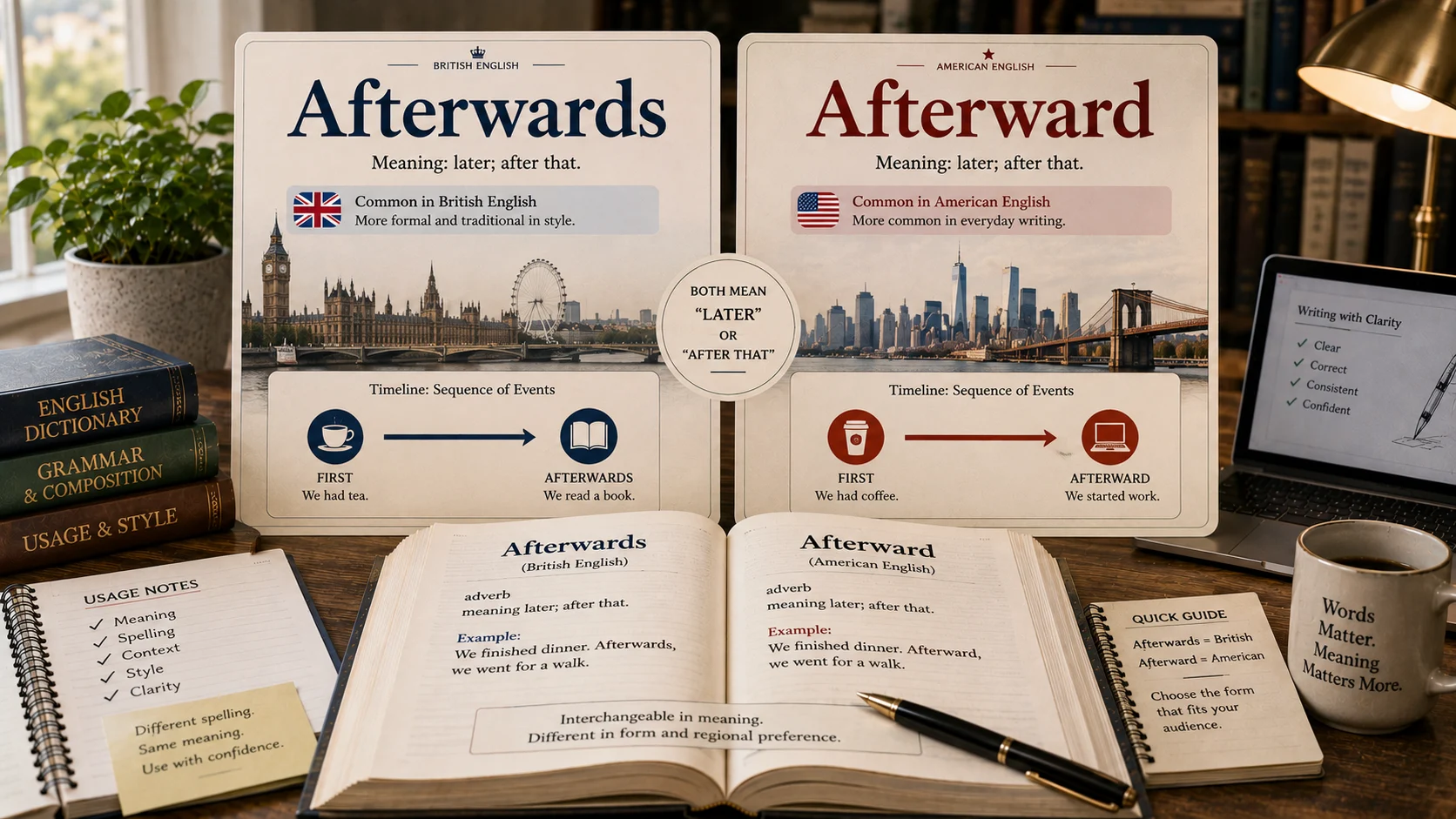
Both afterwards and afterward are correct adverbs meaning “later” or “at a later time.” The main difference is regional preference rather than meaning: afterwards is more common in British English, while afterward is especially common in American English. Choosing the form that matches your audience can prevent awkward or inconsistent writing.
Have you ever wondered to use afterwards or afterward in your writing? Both words refer to something that happens later, so choosing between them can be confusing. The good news is that both spellings are correct and share almost the same meaning. However, the difference often comes down to regional preferences and writing style. Understanding when to use each form can help you write more naturally, you are creating a blog post, writing an academic paper, or communicating professionally.
Afterward is more common in American English, while afterwards is generally preferred in British English. For example, you might write, “We finished dinner and went for a walk afterward” or “We finished dinner and went for a walk afterwards.” Both sentences are grammatically correct. As a practical writing tip, choose the spelling that matches your target audience and remain consistent throughout your content. By learning this simple distinction, you can avoid unnecessary spelling confusion and make your writing clearer and more polished.
Afterwards vs Afterward | What’s the Difference?
Afterwards and afterward are both adverbs. They tell readers that something occurs later than an event or action already mentioned.
| Word | Part of speech | Meaning | Common usage | Example |
|---|---|---|---|---|
| Afterwards | Adverb | Later or subsequently | Especially common in British English | We discussed the results afterwards. |
| Afterward | Adverb | Later or subsequently | Especially common in American English | We discussed the results afterward. |
| Meaning | Same | At a later time | No meaningful difference | She called me afterwards. |
| Formality | Neutral | Suitable for most contexts | Both are standard | They met afterward. |
| Regional preference | British and international usage | Often preferred in British English | Common in many varieties | We went home afterwards. |
| Regional preference | American usage | Often preferred in American English | Common in US writing | We went home afterward. |
The important point is that neither spelling is inherently more correct. Both are established English words.
Afterwards is particularly familiar to readers of British English, including writing from the United Kingdom and many Commonwealth contexts. Afterward is strongly associated with American English, although it is not exclusively American.
Quick recap
Afterwards and afterward have the same basic meaning.
Both words are grammatically correct.
Afterwards is often preferred in British English.
Afterward is often preferred in American English.
Your audience and preferred variety of English should guide your choice.
Is Afterwards vs Afterward a Grammar, Vocabulary or Usage Issue?
The distinction is primarily a usage and regional style issue, not a grammatical correctness issue.
If a learner asks “afterwards” is grammatically correct, the answer is yes. If the same learner asks “afterward” is grammatically correct, the answer is also yes. There is no grammatical rule that makes one form universally correct and the other incorrect.
The difference becomes more noticeable when considering regional English.
British English commonly uses afterwards. American English commonly uses afterward. Neither variety has exclusive ownership of the word, however. You can encounter afterward in British publications and afterwards in American writing.
This distinction also matters in academic writing. A university student writing for an American institution may naturally choose afterward, while a British university publication may favor afterwards. The word itself does not make the writing formal or informal.
Both forms are neutral. What matters more is consistency.
If an article follows British spelling and vocabulary throughout, afterwards may create a more natural overall style. If the article follows American conventions, afterward may fit better.
How to Use Afterwards Correctly
Afterwards means at a later time, usually after something that has just been discussed or described.
It often appears near the end of a sentence, although it can also occur in other positions.
Consider these examples:
“We finished the meeting and went to lunch afterwards.”
“She felt tired afterwards.”
“They apologized afterwards.”
“He realized his mistake afterwards.”
In each case, afterwards refers back to an earlier event. The reader understands that the second action happened later.
Workplace example
“Please send the revised report afterwards.”
Here, afterwards indicates that sending the report should happen after an earlier activity. The exact activity would normally be clear from the surrounding context.
A more complete example would be:
“We will review the figures first and discuss the revised report afterwards.”
This sounds natural in professional communication, especially in British English.
Academic example
“The researchers interviewed the participants and analyzed the responses afterwards.”
The adverb establishes a clear sequence. The interviews happened first, followed by the analysis.
Academic writers can use afterwards without making their prose less formal. It is a standard adverb and does not need to be replaced simply because the writing is scholarly.
Technology example
“Restart the application and check the settings afterwards.”
This kind of instruction is common in technical documentation. Afterwards tells the reader when the second action should occur.
Usage recap
Use afterwards when you mean “later” or “after that.”
It works naturally in professional, academic, conversational, and technical writing.
It is particularly familiar in British English.
How to Use Afterward Correctly
Afterward has the same fundamental meaning as afterwards. It refers to a time that follows an earlier event or action.
For example:
“We finished the meeting and went to lunch afterward.”
“She felt tired afterward.”
“They apologized afterward.”
“He realized his mistake afterward.”
The sentences communicate exactly the same ideas as their versions with afterwards.
Workplace example
“We will review the proposal first and contact the client afterward.”
This is clear and professional. Afterward tells the reader that contacting the client comes after reviewing the proposal.
American business writing frequently uses this form.
Academic example
“The participants completed the questionnaire and were interviewed afterward.”
The sentence clearly establishes chronological order. The interviews occurred later than the questionnaire.
Afterward is fully acceptable in academic writing, provided that it fits the chosen variety of English.
Technology example
“Install the update and restart the device afterward.”
Technical writers often use afterward because instructions frequently describe a sequence of actions.
Usage recap
Use afterward when you mean “later” or “after that.”
It is especially common in American English.
It is standard in professional, academic, casual, and technical contexts.
It can replace afterwards without changing the meaning.
When You Should NOT Use Afterwards or Afterward
Although both words are flexible, they are not appropriate in every situation. Writers sometimes use them when a more precise expression would make the sequence clearer.
| Misuse scenario | Better choice | Reason |
|---|---|---|
| Referring to a specific future date | Later that day | Gives clearer timing |
| Referring to a precise deadline | By Friday | Identifies the exact deadline |
| Describing two simultaneous actions | At the same time | Afterwards indicates sequence |
| Describing something that happened first | Earlier | Afterwards refers to a later point |
| Giving a formal chronological sequence | Subsequently | May provide a more formal tone |
| Explaining a direct cause | Therefore | Afterwards describes time, not cause |
| Referring to an exact time | At 3 PM | A specific time is clearer |
| Describing an ongoing action | Meanwhile | Meanwhile indicates overlapping time |
For example, “We will meet afterwards” can be unclear if the reader does not know what event comes first. In that situation, identify the earlier event.
Likewise, do not use afterward simply because two events are related. The word specifically communicates temporal sequence.
Common Mistakes and Decision Rules
One of the most common mistakes is treating afterwards as British only and afterward as American only. These associations are useful tendencies, but they are not absolute rules.
Another mistake is assuming that the extra “s” changes the meaning. It does not.
| Correct sentence | Incorrect sentence | Explanation |
|---|---|---|
| We talked afterwards. | We talked afterword. | Afterword is a different word referring to a concluding section of a book. |
| She called afterward. | She called after ward. | Afterward is written as one word. |
| They went home afterwards. | They went home after wards. | The adverb is a single word. |
| He apologized afterward. | He apologized afterwardsed. | Neither form takes an additional ending. |
| We discussed it afterwards. | We discussed it before afterwards. | The sentence creates an unnecessary and confusing sequence. |
| She felt better afterward. | She felt better afterword. | Afterword has a different meaning. |
Decision Rule Box
If you mean “later” or “after that,” use either afterwards or afterward. Choose afterwards when following British English conventions and afterward when following American English conventions.
This is the simplest reliable rule. The choice is normally about regional style rather than grammatical correctness.
Afterwards and Afterward in Modern Technology and AI Tools
Modern software, artificial intelligence systems, grammar checkers, and writing assistants generally recognize both forms as legitimate English words.
A spelling checker may flag neither word because both are standard. A style checker may recommend one form if a document is configured for a particular regional variety.
For example, a document configured for British English may favor afterwards, while an American English configuration may naturally prefer afterward.
This distinction matters for content creators who publish internationally. A website can use either form, but maintaining a consistent editorial style makes the content feel more deliberate and professional.
AI generated content can also create inconsistency when one paragraph uses afterwards and another uses afterward without any regional reason. Human editing should therefore focus on consistency rather than trying to eliminate one of the forms.
Etymology and Historical Development
Both forms developed from the word after, which has a long history in English. The ending “ward” is associated with direction or movement, as seen in words such as forward, backward, and toward.
Afterward developed as a compound expressing movement or progression in time.
Afterwards adds the adverbial ending “s,” a pattern that appears in several established English words. British English has retained and favored this form more strongly, while American English has frequently preferred the shorter afterward.
Neither form is a modern spelling mistake. Both have a long history of standard usage.
Expert Style Perspective
“When two established forms share the same meaning, regional consistency is usually more important than declaring one form correct and the other incorrect.”
This principle is especially useful in English usage because the language exists in several established regional varieties. Good editing respects those varieties while maintaining consistency within a document.
Two Practical Case Studies
Case Study One: British English Website
Imagine a UK based educational website that uses British spelling throughout its articles. Its editors consistently use words such as colour, organise, and travelling.
If the same website repeatedly uses afterward, the word is not technically wrong, but it may create a slight stylistic mismatch. Switching to afterwards produces stronger consistency with the site’s established British English style.
The concrete editorial result is greater regional consistency across the vocabulary and spelling system.
Case Study Two: American Academic Paper
Consider an American university student writing a research paper using American English conventions. The paper consistently follows American spelling and punctuation preferences.
Using afterward throughout the paper fits naturally with that convention. Replacing it with afterwards would not make the paper grammatically wrong, but it could introduce an unnecessary regional variation.
The practical result is a more consistent academic voice.
Error Prevention Checklist
Always use afterwards when
- You are writing primarily for a British English audience.
- Your publication follows British English style.
- You want consistency with surrounding British vocabulary and spelling.
- You mean “later” or “after that.”
Never use afterward when
- You have incorrectly assumed that it is the only correct form.
- You are using it as a synonym for an exact time.
- You actually mean an earlier event.
- You are using it to describe cause rather than sequence.
Remember that this is not a strict prohibition against afterward in British English. It is a style recommendation for maintaining regional consistency.
Related Grammar Confusions You Should Master
English contains many similar usage questions where two forms appear almost identical but follow different conventions.
| Related confusion | Main distinction |
|---|---|
| Already vs All ready | Time versus readiness |
| Everyday vs Every day | Adjective versus time expression |
| Alright vs All right | Standard usage and style preference |
| Anyway vs Anyways | Standard form versus informal variant |
| Toward vs Towards | Regional preference |
| Forward vs Forwards | Regional usage and grammatical context |
| Backward vs Backwards | Regional preference |
| Beside vs Besides | Position versus addition |
| Further vs Farther | Meaning and style distinctions |
| Practice vs Practise | Noun and verb distinction in British English |
Learning these patterns helps writers recognize that English variation is often systematic rather than random.
FAQs
Is afterwards or afterward correct in English?
Both are correct standard English adverbs. They mean “later” or “after that,” with afterwards more common in British English and afterward especially common in American English.
Is afterwards British English?
Afterwards is strongly associated with British English and is widely used in British writing. It is also understood and used elsewhere, so it should not be treated as exclusively British.
Is afterward American English?
Afterward is especially common in American English. It is also found in British and international English, so calling it exclusively American would be too restrictive.
Do afterwards and afterward mean the same thing?
Yes. In ordinary usage, both words express the idea that something happens later than an earlier event or action.
Which is more formal, afterwards or afterward?
Neither is inherently more formal. Both are standard adverbs suitable for formal and informal contexts.
Should I use afterwards in academic writing?
You can use afterwards in academic writing when it fits the regional style of your document. It is especially natural in British academic English.
Should I use afterward in American writing?
Yes. Afterward is a natural and standard choice in American academic, professional, technical, and everyday writing.
Can I use afterwards and afterward in the same article?
You can, but consistent regional style is usually better. Choose the form that matches your target variety of English and use it consistently.
Is afterword the same as afterward?
No. Afterword is a noun referring to a concluding section of a book, while afterward is an adverb meaning later.
Conclusion
The choice between afterwards and afterward is much simpler once regional English conventions are understood. Both forms are correct, both function as adverbs, and both mean “later” or “after that.” The primary distinction is preference: afterwards is especially common in British English, while afterward is especially common in American English.
For most writers, consistency is the best rule. If your content follows British English conventions, afterwards will usually fit naturally. If your content follows American English conventions, afterward is generally the more natural choice.
The key is not to treat one spelling as correct and the other as incorrect. Instead, consider your audience, regional style, and editorial standards. Once you do that, the question of afterwards or afterward becomes a straightforward matter of usage rather than grammar.
Discover More Related Articles:
- Effective or Affective | Clear Up This Tricky English Confusion In 2026
- Pancakes or Waffles | Which Breakfast Choice Is Better for You In 2026
- Blanky or Blankie | Which Spelling Is Correct & When Should You Use Each In 2026