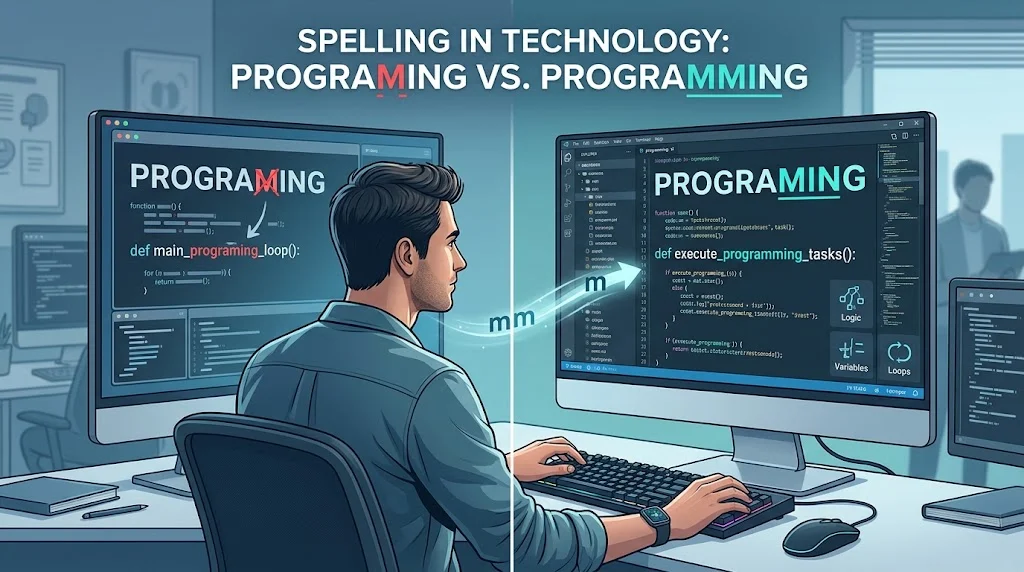
Programing or programming is a common spelling confusion, but in modern standard English, programming is the correct spelling when you mean writing, testing, and maintaining computer code. Programing is generally considered an incorrect spelling in contemporary usage. The extra “m” follows the standard rule for doubling the final consonant before adding “ing” to “program.”
Programing or Programming | What’s the Difference?
The main difference is simple: programming is the standard spelling, while programing is generally a misspelling.
The word programming is a noun or present participle formed from the verb program. In technology, it describes the process of creating software, applications, websites, scripts, and other computer instructions. It can also refer more broadly to the planning or scheduling of activities, although the technology meaning is especially common today.
Programing, with only one “m” before “ing,” is not the standard spelling used in modern English for this meaning. Writers sometimes produce it because they assume that the word “program” simply takes the ending “ing” without changing its spelling. That assumption overlooks an important spelling rule.
Here is a quick comparison:
| Term | Part of Speech | Meaning | Standard Usage |
|---|---|---|---|
| Programming | Noun or present participle | The process of writing and developing computer code | Correct and standard |
| Programing | Attempted noun or present participle | Usually intended to mean programming | Generally incorrect |
The correct form is programming.
It contains two “m” letters before the “ing” ending.
If you are writing about software development, coding, applications, or computer science, choose programming.
Why Does Programming Have Two M’s?
The spelling becomes easier to understand when you look at the base word program.
The verb is:
program + ing = programming
The final consonant is doubled before the ending is added. This pattern appears in many English words, especially when a stressed syllable ends in a consonant and the word takes an ending beginning with a vowel.
Compare:
| Base Word | Correct Form |
|---|---|
| run | running |
| stop | stopping |
| begin | beginning |
| plan | planning |
| program | programming |
English spelling rules are not perfectly consistent, but the doubling in programming is well established in standard contemporary English.
Is Programing or Programming a Grammar, Vocabulary or Usage Issue?
This is primarily a spelling and usage issue, rather than a grammar problem.
Both forms may look as though they could function as a noun or participle, but only programming is the normal standard spelling for the modern word. A writer who types “programing” is usually making a spelling mistake rather than choosing an alternative grammatical construction.
The distinction matters because spelling affects clarity, professionalism, search visibility, and credibility. A developer writing a résumé, a student submitting a computer science assignment, or a business publishing a technology article should use the standard spelling.
In academic writing, programming is the expected form. In workplace communication, it is also the correct choice. In casual digital communication, people may occasionally make spelling errors, but that does not make programing an accepted alternative.
There is also an important distinction between programming and the word program itself. Program can function as both a noun and a verb. Programming is the form used to describe the ongoing activity or field.
How to Use Programming Correctly
Programming is used when discussing the process of creating instructions that computers can execute. It is one of the most common terms in software development and computer science.
In a workplace setting, you might write:
Our team is programming a new internal application for customer support.
In an academic setting:
Programming is an important part of introductory computer science courses.
In technology writing:
Modern programming often involves languages such as Python, JavaScript, Java, and C++.
The word can also describe a broader field:
She wants to pursue a career in programming.
It can describe a skill:
Programming requires logical thinking, problem solving, and attention to detail.
It can describe an activity:
He spends several hours programming every day.
Programming Usage Recap
Use programming when you mean the activity, skill, field, or process of creating computer instructions.
It is the standard spelling in professional, academic, technical, and everyday English.
If you are writing about coding or software development, programming is almost certainly the form you need.
How to Use Programing Correctly
For contemporary standard English, there is generally no reason to choose programing when you mean computer programming.
For example, this sentence is incorrect:
She is learning programing at university.
The standard version is:
She is learning programming at university.
The same principle applies in professional and technical contexts:
Incorrect: Our company is hiring a programing instructor.
Correct: Our company is hiring a programming instructor.
Incorrect: Programming skills are important in this position.
Correct: Programming skills are important in this position.
The appearance of programing online does not automatically make it an accepted spelling. Search results, user generated content, social media posts, and informal documents can contain ordinary spelling errors.
Programing Usage Recap
Programing should generally be treated as a misspelling of programming.
When proofreading professional content, replace programing with programming unless there is a specific reason to preserve the original wording, such as quoting an error or reproducing a historical or proper name.
When You Should NOT Use Programing or Programming
Understanding when not to use either form can prevent another type of mistake. The problem is sometimes not spelling but word choice.
- Do not use programming when you simply mean a single computer program. Write program instead.
- Do not use programming when referring to a scheduled television or radio lineup unless the context specifically calls for the broader activity or industry.
- Do not write programing simply because you think the base word should keep one “m.”
- Do not use programming as a replacement for coding in every sentence. The terms overlap, but their meanings can differ depending on context.
- Do not use programming when you mean programming language. In that case, specify the language when necessary.
- Do not assume that a search engine result proves that programing is correct. Online text contains many spelling errors.
- Do not use programing in résumés, academic papers, technical documentation, or professional profiles when you mean software development.
- Do not confuse programming with programmed. Programming describes an ongoing activity, while programmed usually describes something that has already been arranged or instructed.
Common Mistakes and Decision Rules
The most frequent mistake is simply dropping one “m.” A useful proofreading strategy is to remember the base word and then check the ending.
| Correct Sentence | Incorrect Sentence | Explanation |
|---|---|---|
| She enjoys programming. | She enjoys programing. | Programming is the standard spelling. |
| Programming requires practice. | Programing requires practice. | The final consonant is doubled before the -ing ending. |
| He teaches programming. | He teaches programing. | The field is spelled programming. |
| Programming languages change over time. | Programing languages change over time. | Programming is the accepted modern form. |
| I am learning programming. | I am learning programing. | The standard form uses two m letters. |
Decision Rule
If you mean the activity of writing computer instructions, use programming.
If you mean a person who writes software, use programmer.
If you mean the software itself, use program.
If you see programing in ordinary modern technology writing, check whether it should be corrected to programming.
This distinction is more useful than trying to memorize the spelling in isolation.
Programing or Programming in Modern Technology and AI Tools
The word programming has become even more important as software development has expanded into artificial intelligence, cloud computing, automation, mobile applications, and web development.
Developers use programming languages to communicate instructions to computers. Modern programming may involve writing source code manually, using development environments, testing software, reviewing code, debugging errors, and working with application programming interfaces.
Artificial intelligence tools have also changed how people approach programming. AI assistants can generate code, explain functions, suggest corrections, create tests, and help developers understand unfamiliar programming concepts. However, human review remains important because generated code can contain logical errors, security problems, inefficient approaches, or incorrect assumptions.
This makes correct terminology particularly valuable. A technical article that repeatedly uses programing instead of programming can look less polished, even when the underlying information is accurate.
Search engines and AI systems also rely heavily on language patterns. Consistent use of established terminology helps communicate the subject clearly to both readers and machines.
The Etymology Behind Program and Programming
The word program has a long history. It ultimately traces back to Greek roots associated with something written publicly or announced beforehand. It entered English through French and Latin influenced forms and gradually developed broader meanings.
In modern English, program can refer to a planned series of activities, a schedule, or a computer application. The computing sense developed as electronic computers became increasingly important during the twentieth century.
From the verb program, English forms programming, referring to the act or process of creating computer instructions.
The spelling with two “m” letters became the established modern form in standard English.
An Expert Style Perspective
“When a technical term has an established standard spelling, accuracy in that spelling is part of technical clarity. Programming is not merely a familiar form. It is the conventional spelling readers expect.”
This is an original expert style observation, not a quotation attributed to a named linguist.
Two Practical Case Studies
Case Study One: A Computer Science Student
Consider a student preparing a university assignment about software development. Throughout the paper, the student repeatedly writes programing.
The ideas may be correct, but the repeated spelling error can distract the reader and make the paper appear less carefully edited. Correcting the term to programming improves consistency without changing the underlying argument.
The lesson is simple: technical knowledge and language accuracy work together. A student who understands programming should also use its standard written form.
Case Study Two: A Technology Website
Imagine a technology website publishing an article targeting searches related to programming careers. If the page repeatedly uses programing, it creates a mismatch with the spelling used by most readers searching for the topic.
Changing the terminology to programming improves editorial consistency, aligns the article with standard usage, and makes the page more suitable for readers looking for information about software development.
The concrete result is not that changing one spelling automatically produces a ranking increase. Rather, correct terminology strengthens content quality, readability, and topical relevance as part of a broader SEO strategy.
Error Prevention Checklist
Always Use Programming When
[ ] You mean writing or developing computer code.
[ ] You are discussing software development as a field.
[ ] You are referring to programming skills.
[ ] You are writing about programming languages.
[ ] You are creating academic or professional technology content.
Never Use Programing When
[ ] You mean the standard modern spelling of the software development activity.
[ ] You are preparing a résumé or professional profile.
[ ] You are submitting academic work.
[ ] You are publishing technical documentation.
[ ] You are writing an educational article about coding or software development.
A quick proofreading trick is to remember program plus ming. The result is programming, with two m letters.
Related Grammar Confusions You Should Master
Learning one spelling distinction can make it easier to recognize similar English problems. If you regularly write educational, academic, or professional content, these pairs are worth mastering:
- Affect or effect
- Compliment or complement
- Principal or principle
- Practice or practise
- License or licence
- Then or than
- Its or it’s
- Your or you’re
- Who’s or whose
- They’re, their, or there
These pairs demonstrate why spelling, grammar, vocabulary, and usage should not be treated as completely separate areas. A small difference in letters can change meaning, grammatical function, or perceived accuracy.
FAQs
Is programming the correct spelling?
Yes. Programming is the standard modern spelling for the activity of writing computer code, while programing is generally considered a misspelling.
Is programing ever correct in English?
In ordinary contemporary English, programing is generally not the expected spelling when referring to software development, so programming should be used.
Why does programming have two m letters?
The spelling follows the established formation of programming from the verb program, with the final consonant doubled before the ing ending.
What is the difference between programming and coding?
Programming is the broader process of creating and maintaining computer instructions, while coding usually emphasizes the act of writing those instructions.
Should I write programming on my résumé?
Yes. If you are describing software development skills or experience, programming is the standard professional spelling.
Is programing a common spelling mistake?
Yes. People may omit the second m because they apply a simplified spelling pattern when adding ing to program.
Which spelling should students use in academic writing?
Students should use programming when referring to computer programming, particularly in computer science assignments and research.
Does AI programming use the same spelling?
Yes. The standard term remains programming when discussing software development involving artificial intelligence, machine learning, or AI tools.
What is the easiest way to remember programming?
Start with program and remember that the standard form adds ing after doubling the final m, producing programming.
Conclusion
When choosing between programing or programming, the correct modern spelling for the activity of writing computer code is programming. The second “m” is not optional in standard contemporary usage.
Use programming for software development, coding as a professional field, programming skills, programming languages, and computer science discussions. Treat programing as a spelling error unless you have a specific historical, quoted, or proper name context that requires preserving it.
The simplest rule is worth remembering: program + ing becomes programming.
Correct spelling may seem like a small detail, but in educational content, technical documentation, professional communication, and SEO writing, small details contribute to authority. Readers expect established terminology to be written consistently, and programming is the form that meets that expectation.
Discover More Related Articles:
- Dumby or Dummy | Which Form Belongs in Your Sentence In 2026
- Tomato or Tomatoe | Everything You Need to Know In 2026
- Cord or Chord | Meaning, Spelling, Usage & Easy Ways to Remember In 2026