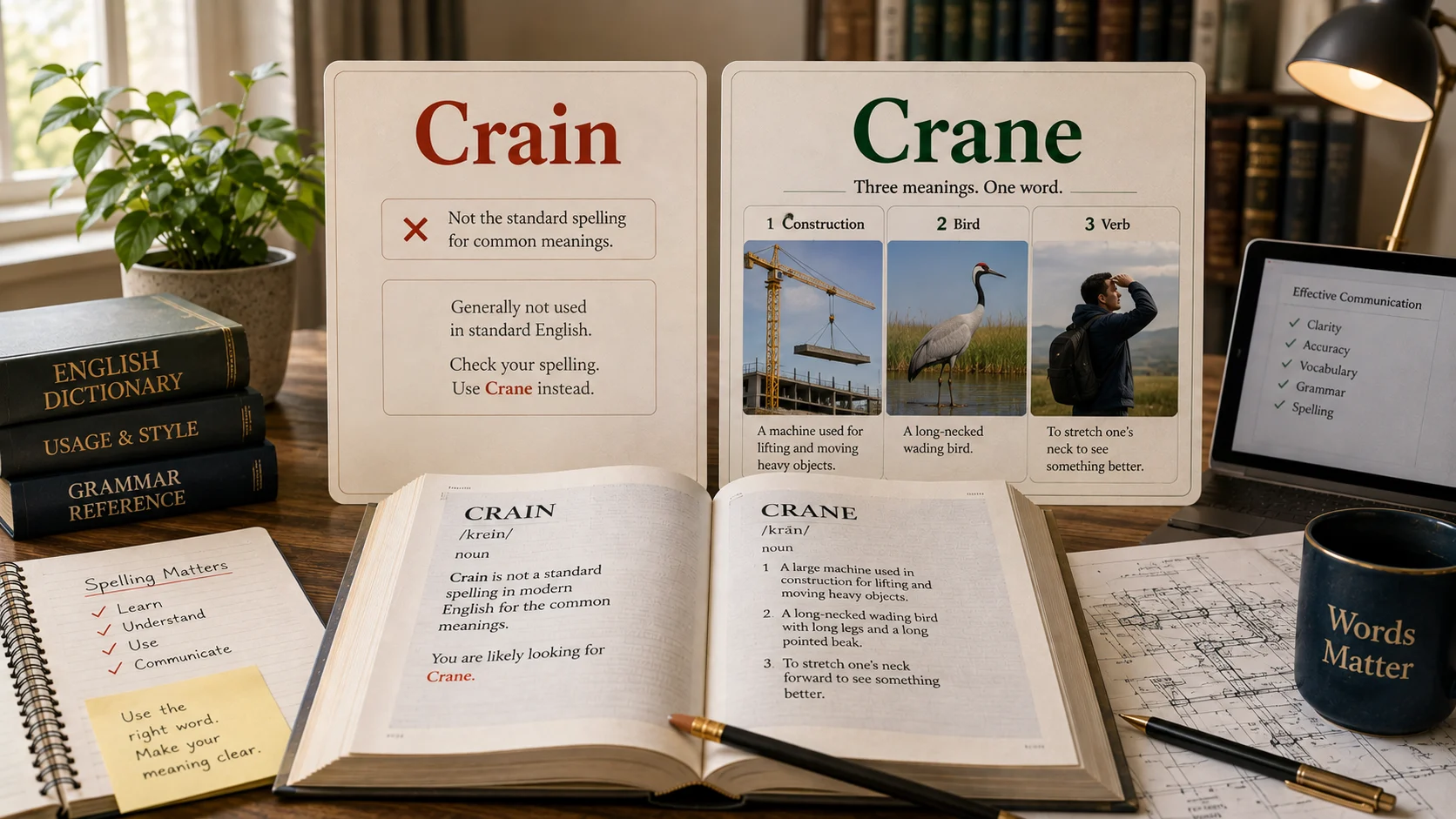
Crain or crane is a common spelling confusion because the two forms look almost identical, but crane is the standard English word. Crane can refer to a large machine used for lifting heavy objects, or to a tall long necked bird. It can also function as a verb meaning to stretch or extend the neck. Crain is generally not the correct spelling for these meanings.
Have you ever typed “crain” when you actually meant “crane”? You are not alone. These words look almost identical, but only one is the standard English word for the large bird, lifting machine, or action of stretching the neck. Understanding crain vs crane is therefore more than a simple spelling check. It helps you choose the right word with confidence.
So, when you search for crane or crain, the answer is straightforward: crane is the correct standard spelling in modern English, while “crain” is generally considered a misspelling. In this guide, we’ll examine crane vs crain through meaning, pronunciation, examples, and common usage. If you have wondered about crain vs crane, this article will give you a clear, practical answer backed by established English usage and reliable dictionary conventions.
Crain or Crane | What’s the Difference?
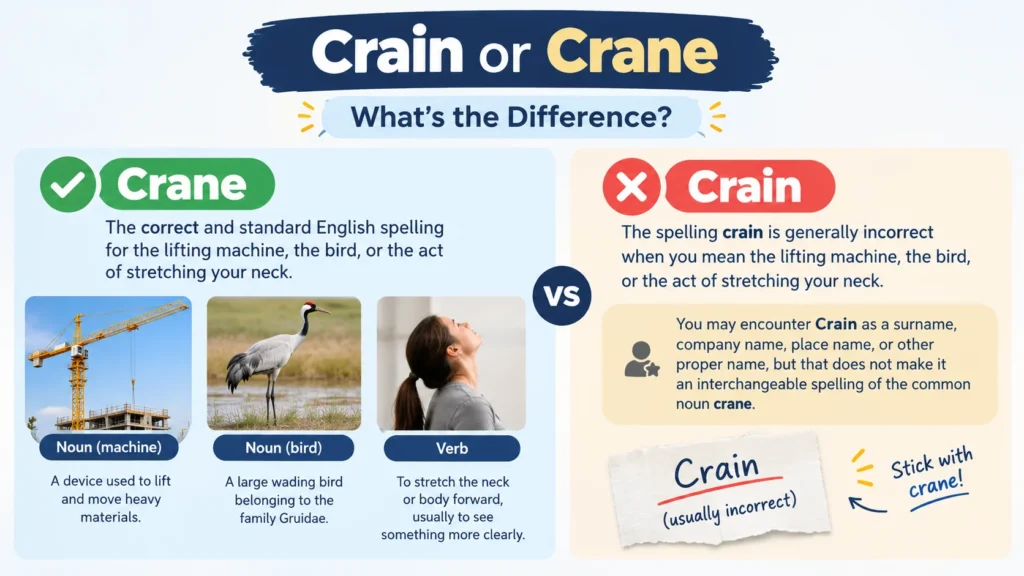
The main difference is simple: crane is the standard English spelling, while crain is generally an incorrect spelling when you mean the lifting machine, the bird, or the act of stretching your neck.
The word crane has several established meanings in modern English. As a noun, it can describe a mechanical device used to lift and move heavy materials. It can also describe a large wading bird belonging to the family Gruidae. As a verb, crane means to stretch the neck or body forward, usually to see something more clearly.
The spelling crain does not normally function as the standard English word for any of these meanings. You may encounter Crain as a surname, company name, place name, or other proper name, but that does not make it an interchangeable spelling of the common noun crane.
| Term | Part of Speech | Meaning | Correct Usage |
|---|---|---|---|
| Crane | Noun | A machine used for lifting heavy objects | Correct |
| Crane | Noun | A tall bird with a long neck and legs | Correct |
| Crane | Verb | To stretch or extend the neck to see better | Correct |
| Crain | Noun | Not the standard spelling for these meanings | Incorrect |
| Crain | Proper noun | May be a surname or specific name | Correct only when referring to that name |
Quick Recap
Crane is the correct spelling for the lifting machine.
Crane is also the correct spelling for the bird.
Crane can be used as both a noun and a verb.
Crain is generally not interchangeable with crane in standard English.
Is Crain or Crane a Grammar, Vocabulary or Usage Issue?
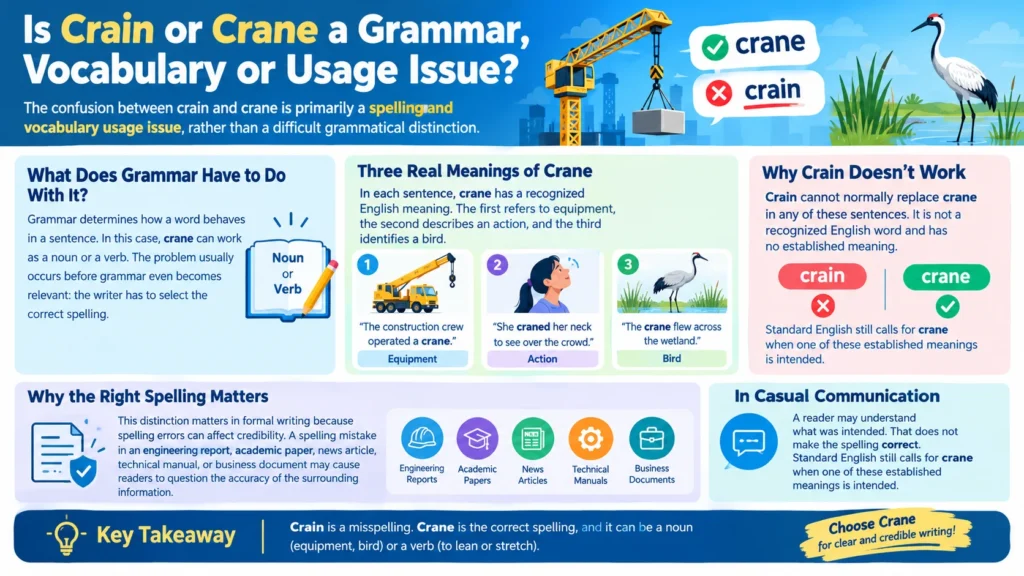
The confusion between crain and crane is primarily a spelling and vocabulary usage issue, rather than a difficult grammatical distinction.
Grammar determines how a word behaves in a sentence. In this case, crane can work as a noun or a verb. The problem usually occurs before grammar even becomes relevant: the writer has to select the correct spelling.
For example, consider these sentences:
“The construction crew operated a crane.”
“She craned her neck to see over the crowd.”
“The crane flew across the wetland.”
In each sentence, crane has a recognized English meaning. The first refers to equipment, the second describes an action, and the third identifies a bird.
Crain cannot normally replace crane in any of these sentences.
This distinction matters in formal writing because spelling errors can affect credibility. A spelling mistake in an engineering report, academic paper, news article, technical manual, or business document may cause readers to question the accuracy of the surrounding information.
In casual communication, a reader may understand what was intended. That does not make the spelling correct. Standard English still calls for crane when one of these established meanings is intended.
Crane | Meaning and Correct Usage
Crane is a versatile English word with several meanings. One of the most familiar is the large mechanical structure used for lifting, lowering, and moving heavy loads.
Construction sites commonly use cranes to move steel beams, concrete sections, machinery, containers, and other heavy materials. Depending on the type of crane, the equipment may operate from a fixed position or move around a worksite.
A workplace example is:
“The project manager inspected the crane before the lifting operation began.”
Here, crane is a noun referring to a piece of industrial equipment.
An academic example might be:
“The study examined how tower crane placement affects construction site efficiency.”
Again, crane is a noun. The sentence would be incorrect if crain were substituted for crane.
The word also appears frequently in technology and engineering contexts. Technical documents may discuss crane systems, crane controls, crane capacity, crane operation, or automated crane systems.
For example:
“The automated crane uses sensors to position materials accurately.”
In this sentence, crane identifies a machine that performs a physical lifting task.
Crane has another important noun meaning. It is the name of a tall bird characterized by its long legs, long neck, and distinctive appearance. Cranes occur in many parts of the world and are frequently mentioned in wildlife writing, ecology, conservation, and zoology.
For example:
“The researchers observed several cranes near the wetlands.”
The meaning is clear from the surrounding context.
Crane Usage Recap
Use crane when referring to lifting equipment.
Use crane when referring to the long necked bird.
Use crane as a verb when describing the act of stretching the neck or body.
Do not substitute crain for crane in standard English.
Crane as a Verb | What Does It Mean?
Crane is not limited to noun usage. It can also function as a verb.
When someone cranes their neck, they stretch or extend it, usually because they are trying to see something that is blocked, distant, or difficult to observe.
For example:
“She craned her neck to watch the parade.”
“He craned forward to read the small sign.”
“They craned their heads toward the sound.”
The verb often suggests an effort to gain a better view. It can describe a physical movement rather than a machine or animal.
This is an important point because writers sometimes assume that crane always refers to construction equipment or a bird. Context determines the meaning.
The verb can also appear in academic and literary writing:
“The observers craned their necks to see the rare bird.”
The word remains spelled crane even when it changes grammatical function.
When You Should NOT Use Crain or Crane

There are several situations in which writers need to be especially careful.
First, do not write crain when referring to construction equipment. The standard spelling is crane.
Second, do not write crain when referring to the bird. The established English spelling is crane.
Third, do not use crain when describing someone stretching their neck. The correct verb is crane.
Fourth, do not assume that a pronunciation based on another word determines the spelling. English spelling often cannot be predicted perfectly from pronunciation.
Fifth, do not change crane to crain simply because another word contains the letter combination “ai.” Spelling patterns must be learned according to the individual word.
Sixth, do not treat Crain as a standard alternative spelling merely because you have seen it used as a surname or proper name.
Seventh, do not replace crane with crain in technical documents, academic writing, safety instructions, or professional communication.
Common Mistakes and Decision Rules
| Correct Sentence | Incorrect Sentence | Explanation |
|---|---|---|
| The crane lifted the steel beam. | The crain lifted the steel beam. | Crane is the correct spelling for lifting equipment. |
| We saw a crane near the wetland. | We saw a crain near the wetland. | Crane is the correct spelling for the bird. |
| She craned her neck to see the stage. | She crained her neck to see the stage. | The past tense of crane is craned. |
| The engineer inspected the crane. | The engineer inspected the crain. | Technical writing requires the standard spelling crane. |
| Several cranes were flying overhead. | Several crains were flying overhead. | The plural of crane is cranes. |
Decision Rule
If you mean the standard English word for the lifting machine, the bird, or the action of stretching your neck, use crane. If you see Crain as a surname, company name, or other proper name, preserve that spelling when it is genuinely the name being referenced.
This rule is more accurate than a simple action versus person distinction because crane itself can represent both an object and an action.
Crain or Crane in Modern Technology and AI Tools
The spelling distinction also matters in digital environments.
Search engines, grammar checkers, word processors, speech recognition systems, and AI writing tools use contextual information to determine what a writer probably means. A sentence such as “The crane lifted the container” strongly indicates the machinery meaning. A sentence such as “The crane crossed the wetland” suggests the bird.
However, automated tools should not be treated as a substitute for language knowledge. A system may recognize Crain as a proper name, while another system may interpret it as a misspelling.
This is particularly important for technical content. A construction article, engineering document, or equipment manual needs consistent terminology because spelling errors can reduce clarity and professional trust.
The same principle applies to AI generated content. If an AI system produces crain when crane is intended, the writer should correct the spelling rather than assuming that the generated form is acceptable.
Etymology of Crane
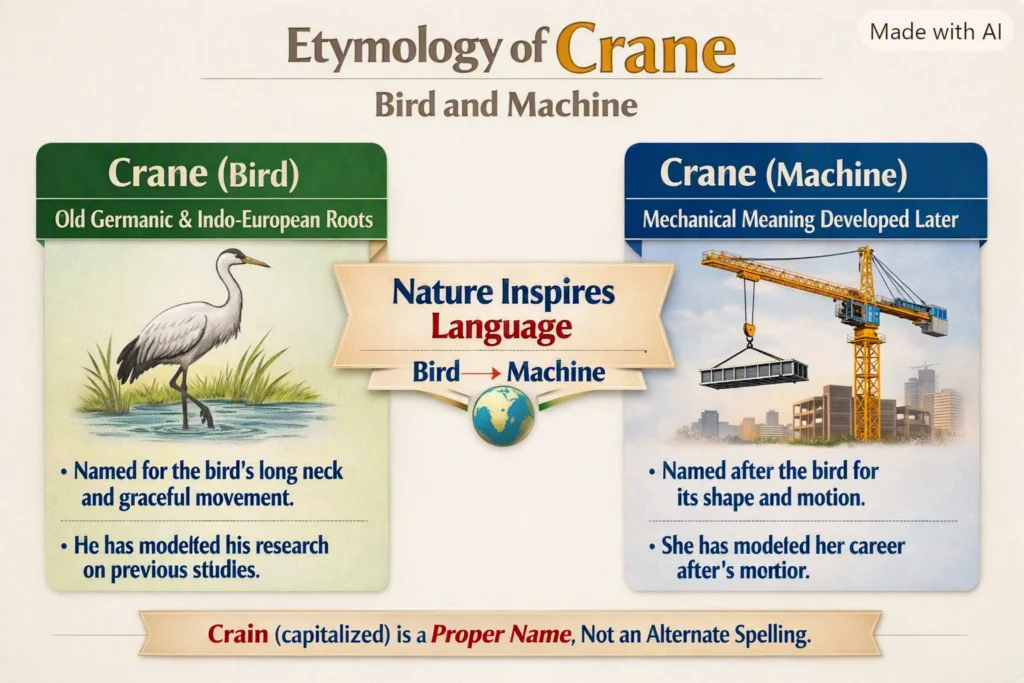
The history of crane helps explain why the word has multiple meanings.
The English word crane ultimately has roots connected with older Germanic and Indo European forms associated with the bird. The mechanical sense developed later because the lifting device was named after the bird, particularly because of the visual resemblance between the machine’s extended structure and a crane’s long neck.
This kind of naming is not unusual in English. Objects are sometimes given names based on their shape, movement, or resemblance to something familiar in nature.
The connection between the bird and the machine is therefore more than a coincidence. Both meanings belong to the established history of the word crane.
Crain, by contrast, should not be presented as an ordinary alternative spelling of this English word. When it appears with a capital letter, it may represent a proper name rather than the common noun.
What Linguistic Experts Would Say
A useful principle in professional language editing is that a spelling variant should not be treated as interchangeable merely because readers can infer the intended meaning.
In practical terms, that means writers should distinguish between a genuine alternative spelling and a simple spelling error. Crane belongs to the first category of standard English vocabulary. Crain generally does not belong to the second category when the intended meaning is the bird, machine, or verb.
Two Practical Case Studies
Case Study One: Construction Documentation
Imagine a construction company preparing a safety document describing heavy lifting operations. The document repeatedly uses crain instead of crane.
Even if workers understand the intended meaning, the spelling problem can make the document appear poorly edited. In a regulated or professional environment, that can reduce confidence in the document’s quality.
After replacing each incorrect instance with crane and checking related terms such as cranes and craned, the document becomes more consistent and easier to review.
The concrete result is straightforward: one standardized spelling eliminates an avoidable source of ambiguity and improves professional presentation.
Case Study Two: Wildlife Education
Consider a school website publishing an article about wetland birds. If the article repeatedly refers to crains, students may incorrectly learn that the bird’s name is spelled that way.
Correcting the terminology to crane and cranes gives students a reliable spelling model. The result is especially valuable in educational content because readers often remember vocabulary directly from the material they study.
In both cases, the solution is not complicated. The writer simply needs to identify the intended meaning and use the established spelling.
Error Prevention Checklist
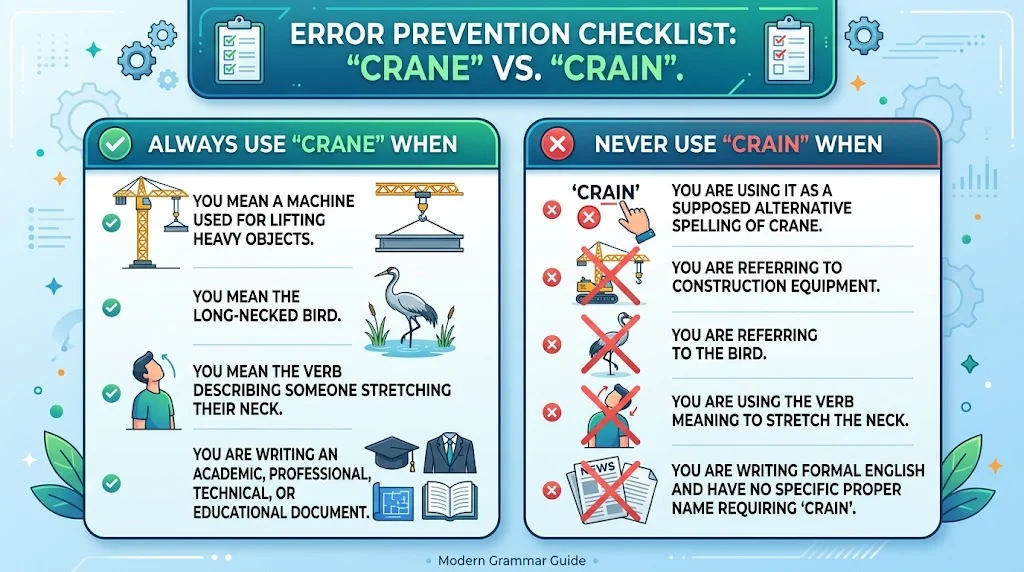
Always use crane when
You mean a machine used for lifting heavy objects.
You mean the long necked bird.
You mean the verb describing someone stretching or extending their neck.
You are writing an academic, professional, technical, or educational document.
Never use crain when
You are using it as a supposed alternative spelling of crane.
You are referring to construction equipment.
You are referring to the bird.
You are using the verb meaning to stretch the neck.
You are writing formal English and have no specific proper name requiring the spelling Crain.
Related Grammar Confusions You Should Master
Learning crane versus crain is useful, but it belongs to a much larger group of spelling and word choice problems in English. Writers should also study rain or reign, plain or plane, brake or break, principal or principle, stationary or stationery, affect or effect, complement or compliment, capital or capitol, dessert or desert, and weather or whether.
These pairs demonstrate an important feature of English: words can sound similar, look similar, or differ by only one letter while having completely different meanings.
Understanding the underlying meaning is therefore more reliable than trying to memorize isolated spellings without context.
FAQs
Is crane the correct spelling or is crain correct?
Crane is the correct standard spelling for the bird, lifting machine, and verb meaning to stretch the neck. Crain is generally not an interchangeable spelling.
What is the difference between crain and crane?
Crane is an established English word with noun and verb meanings, while crain is generally not the standard spelling for those meanings and may instead appear as a proper name.
Is crain a word in the English dictionary?
Crain can occur as a proper name or specialized name, but it should not normally be used as the common English spelling of crane.
How do you spell the machine that lifts heavy objects?
The correct spelling is crane. For example, “The crane lifted the heavy container.”
How do you spell the bird with a long neck and long legs?
The correct spelling is crane. Its plural form is cranes.
What does crane mean as a verb?
As a verb, crane means to stretch or extend the neck or body, usually to see something more clearly.
Is crained the correct past tense of crane?
No. The correct past tense is craned. For example, “She craned her neck to see the stage.”
Why do people spell crane as crain?
The error usually results from confusion about English vowel patterns or from spelling the word according to an incorrect pronunciation based on similar words.
Can Crain ever be spelled correctly?
Yes. Crain can be correct when it is part of a genuine proper name, such as a surname or organization name. It is not normally correct as a substitute for the common noun crane.
Conclusion
The answer to crain or crane is clear in standard English: crane is the correct spelling when you mean the lifting machine, the long necked bird, or the verb meaning to stretch your neck or body. Crain should not be used as an ordinary alternative spelling.
Remember the three major uses. A crane can lift heavy materials, a crane can be a bird, and someone can crane their neck to see better. Once these meanings are connected with the correct spelling, the confusion becomes easy to avoid.
For professional, academic, technical, and educational writing, choosing crane consistently helps maintain accuracy and credibility. If Crain appears as a proper name, however, retain the spelling when that name is genuinely intended.
Discover More Related Articles:
- Effective or Affective | Clear Up This Tricky English Confusion In 2026
- Pancakes or Waffles | Which Breakfast Choice Is Better for You In 2026
- Blanky or Blankie | Which Spelling Is Correct & When Should You Use Each In 2026