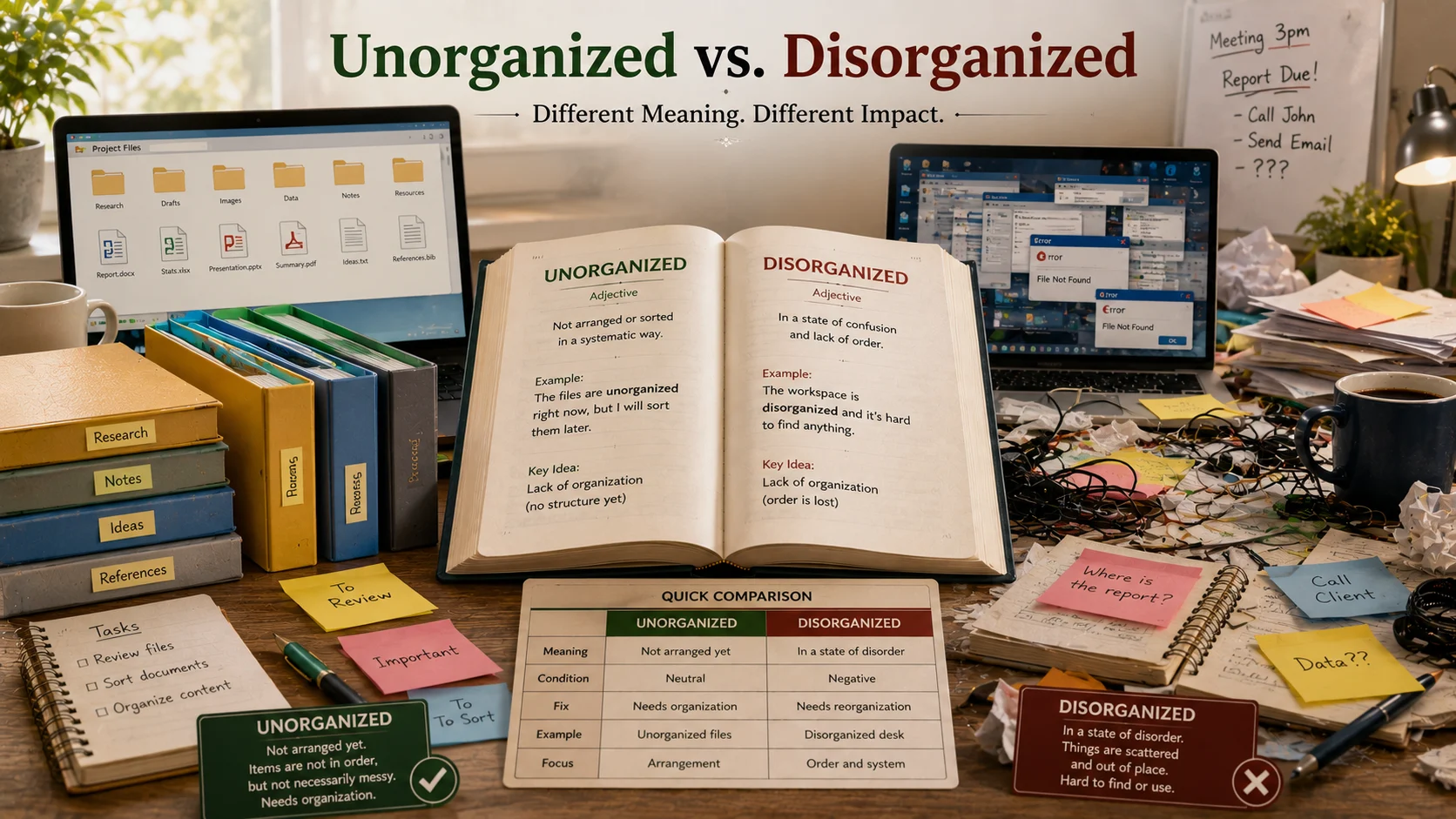
Unorganized or disorganized both describe a lack of order, but they are not always interchangeable. Unorganized usually refers to something that has never been arranged properly, while disorganized often describes something that was once organized but has become messy or confused. Choosing the correct word improves clarity and prevents misunderstandings in writing and speech.
Many English learners and even native speakers hesitate when choosing between unorganized or disorganized because both words seem to describe disorder. However, they carry slightly different meanings that can change the tone and accuracy of a sentence.
Unorganized generally refers to something that has not yet been arranged or planned, whereas disorganized describes something that lacks order because it has become confused or chaotic. Understanding this distinction helps you communicate more precisely in academic writing, professional settings, and everyday conversations.
Unorganized or Disorganized | What’s the Difference?
Both words are adjectives that describe a lack of organization, but they emphasize different situations.
| Feature | Unorganized | Disorganized |
|---|---|---|
| Part of speech | Adjective | Adjective |
| Main meaning | Not arranged or planned | Lacking order because it became messy or confused |
| Typical use | Tasks, events, collections, plans | People, workplaces, systems, thoughts, documents |
| Suggests previous organization | Usually no | Often yes |
| Tone | Neutral | Slightly stronger and more negative |
| Common contexts | Planning, scheduling, preparation | Behavior, management, work, education |
In simple terms, unorganized often describes something that has not yet been put into order. Disorganized usually suggests that order has been lost or that confusion is affecting people or systems. While many speakers use them interchangeably, understanding the subtle distinction makes your writing sound more precise and professional.
Is Unorganized or Disorganized a Grammar, Vocabulary or Usage Issue?
This confusion is primarily a vocabulary and usage issue, not a grammar mistake. Both words are grammatically correct adjectives, but choosing the wrong one can slightly alter your intended meaning.
In everyday conversation, many people treat them as synonyms because both indicate a lack of order. In formal writing, however, editors and language professionals often prefer the word that best reflects the specific situation.
For example, a newly started project with no structure is usually unorganized because organization has not yet been created. A project that began with a clear structure but later became chaotic is better described as disorganized.
Academic writing also tends to favor precise word choice. Selecting the appropriate adjective helps readers understand something simply lacks planning or has deteriorated from an organized state.
Casual conversations are more forgiving, but using the correct word still improves clarity and demonstrates a stronger command of English vocabulary.
Understanding Unorganized
The adjective unorganized describes something that has not yet been arranged, classified, or planned. It does not necessarily imply confusion. Instead, it often indicates that organization has simply not happened yet.
Imagine moving into a new office. Boxes are stacked around the room because nothing has been unpacked. The space is unorganized, but not necessarily chaotic. It is simply awaiting organization.
Workplace Example
The project files remained unorganized until the new filing system was introduced.
Academic Example
The student’s research notes were unorganized, making it difficult to begin writing the paper.
Technology Example
The downloaded images stayed unorganized because they had not yet been sorted into folders.
Usage Recap
Use unorganized when something has never been properly arranged or planned. The word often emphasizes the absence of preparation rather than confusion.
Understanding Disorganized
The adjective disorganized describes someone or something that lacks order because structure has been lost or confusion has developed. It often suggests ongoing difficulty with managing information, tasks, or physical spaces.
Unlike unorganized, this word frequently refers to behavior, thinking, or systems that are functioning poorly because of disorder.
Workplace Example
The department became disorganized after several managers left the company.
Academic Example
The essay appeared disorganized because the ideas were presented without a logical sequence.
Technology Example
The database became disorganized after multiple files were imported incorrectly.
Usage Recap
Choose disorganized when order has broken down or when confusion affects efficiency, communication, or performance.
When You Should NOT Use Unorganized or Disorganized
Although these words are closely related, there are situations where one is clearly better than the other.
| Situation | Better Choice | Reason |
|---|---|---|
| A newly created folder with unsorted files | Unorganized | It has not been arranged yet. |
| A filing cabinet that became messy over time | Disorganized | It lost its original structure. |
| A student who struggles to plan assignments | Disorganized | It describes behavior and habits. |
| A conference that has not yet been planned | Unorganized | Planning has not started. |
| A business process that no longer works efficiently | Disorganized | Order has broken down. |
| A collection waiting to be sorted | Unorganized | Organization has not yet occurred. |
| A report with confusing ideas | Disorganized | The information lacks logical flow. |
| A room full of unopened moving boxes | Unorganized | Nothing has been arranged yet. |
Recognizing these situations helps you choose the word that best matches the intended meaning instead of relying on both terms as exact synonyms.
Common Mistakes and Decision Rules
| Correct Sentence | Incorrect Sentence | Explanation |
|---|---|---|
| The event was unorganized because planning never started. | The event was disorganized because planning never started. | No organization existed yet. |
| The office became disorganized after the renovation. | The office became unorganized after the renovation. | It was organized before the changes. |
| My digital photos are still unorganized. | My digital photos are disorganized before sorting. | They simply have not been organized yet. |
| The presentation looked disorganized because the ideas jumped around. | The presentation looked unorganized because the ideas jumped around. | The issue is poor structure, not missing preparation. |
| The archive remained unorganized until volunteers arrived. | The archive became disorganized before any work began. | Nothing had been arranged in the first place. |
| His schedule became disorganized after several meetings were added. | His schedule became unorganized after several meetings were added. | The schedule lost its previous order. |
Decision Rule
If you mean something has not yet been arranged or planned, use unorganized.
If you mean something has become confused, chaotic, or has lost its structure, use disorganized.
Understanding this simple distinction will help you choose the right word in professional writing, academic assignments, business communication, and everyday English with greater confidence.
Unorganized or Disorganized in Modern Technology and AI Tools
As digital workplaces continue to grow, the distinction between unorganized and disorganized has become even more important. Project management platforms, cloud storage systems, and artificial intelligence tools rely on clear organization to deliver accurate results.
For example, an unorganized collection of files may simply need to be sorted into folders before an AI assistant can retrieve information efficiently. In contrast, a disorganized database may contain duplicated records, misplaced information, or inconsistent naming conventions that reduce search accuracy and increase processing errors.
Modern AI systems perform best when data is logically structured. Businesses that maintain organized digital records often experience faster workflows, improved collaboration, and more reliable automated insights.
The Origins of Unorganized and Disorganized
Both words ultimately trace their roots to the Greek word meaning tool or instrument, which developed into the concept of an organ and later organization in Latin and French.
The prefix un simply means not, creating unorganized, which literally means not organized.
The prefix dis means apart, away, or reversed. As a result, disorganized suggests that existing order has been broken apart or disrupted.
Although the two adjectives developed from the same linguistic family, their prefixes give them distinct shades of meaning that remain useful in modern English.
Language experts often note that precise vocabulary does more than improve grammar. It helps readers understand exactly what happened, order never existed or it was lost over time.
Case Studies
Case Study One: Improving Workplace Productivity
A marketing agency discovered that its shared document library contained thousands of files with inconsistent folder names. The content had never been properly categorized, making it unorganized rather than disorganized.
After introducing a standardized filing system and naming convention, employees reduced document search time by 35 percent within three months and reported noticeably smoother collaboration.
Case Study Two: Restoring an Academic Research Database
A university research department experienced repeated errors while compiling study results. The database had originally been well structured, but years of inconsistent updates caused records to become disorganized.
After reorganizing the database and removing duplicate entries, researchers reduced data retrieval errors by 40 percent and completed literature reviews significantly faster.
Error Prevention Checklist
Always Use Unorganized When
| Situation | Reason |
|---|---|
| Something has never been arranged | No previous organization existed. |
| A project has not yet been planned | Preparation has not started. |
| Files are waiting to be sorted | Organization has not yet happened. |
| Materials are awaiting classification | The process has not begun. |
Never Use Disorganized When
| Situation | Reason |
|---|---|
| Nothing has ever been organized | There is no previous order to lose. |
| Referring to an unfinished plan | The issue is incomplete planning, not confusion. |
| Describing newly collected materials | They simply have not been organized yet. |
| Talking about unsorted downloads | They require organization rather than restoration. |
Related Grammar Confusions You Should Master
Expanding your vocabulary knowledge becomes much easier when you study similar word pairs that are frequently confused.
| Common Confusion | Main Difference |
|---|---|
| Organized or Organised | American and British spelling |
| Affect or Effect | Verb versus noun in most contexts |
| Complement or Compliment | Complete versus praise |
| Among or Amongst | Modern versus traditional preference |
| Farther or Further | Physical distance versus broader extension |
| Stationary or Stationery | Still versus writing materials |
| Principal or Principle | Person versus rule |
| Historic or Historical | Significant versus relating to history |
| Ensure or Insure | Guarantee versus provide insurance |
| Imply or Infer | Speaker suggests versus listener concludes |
FAQs
Is unorganized or disorganized more common in everyday English?
Both are common, but disorganized appears more frequently when describing people, workplaces, and systems, while unorganized is often used for items or tasks that have not yet been arranged.
Can unorganized and disorganized be used interchangeably?
They can sometimes be used interchangeably in casual conversation, but careful writing benefits from choosing the word that matches the specific situation.
Is unorganized a real English word?
Yes. Unorganized is a standard English adjective meaning something has not been organized or arranged.
Why is disorganized considered stronger than unorganized?
Because disorganized usually suggests confusion, inefficiency, or the loss of an existing structure rather than simply the absence of organization.
Which word should I use in academic writing?
Use the word that accurately reflects the context. Precision is valued in academic writing, so choose unorganized for something not yet arranged and disorganized for something lacking logical structure.
Can a person be described as unorganized?
Yes, but disorganized is generally the more natural choice because it refers to habits, planning, and the ability to maintain order.
What is the easiest way to remember the difference?
Think of unorganized as not yet organized and disorganized as once organized but now lacking order. This simple rule works in most situations.
Do American and British English use these words differently?
No. Both varieties of English recognize the same distinction, although individual writers may occasionally use the terms interchangeably.
Conclusion
Understanding the difference between unorganized or disorganized allows you to communicate with greater precision and confidence. While both words describe a lack of order, they emphasize different situations. Unorganized usually refers to something that has not yet been arranged, whereas disorganized describes something that has lost structure or become confused over time.
This distinction may seem subtle, but it improves the quality of academic writing, workplace communication, technical documentation, and everyday conversation. By considering order never existed or it disappeared, you can consistently choose the word that best fits your intended meaning.
Discover More Related Articles:
- Yes or No | Meaning, Differences & When to Use Each Correctly In 2026
- Gopher or Gofer | What’s the Difference & Which One Should You Use In 2026
- Fishes or Fish | Which Form Do Dictionaries Recommend In 2026