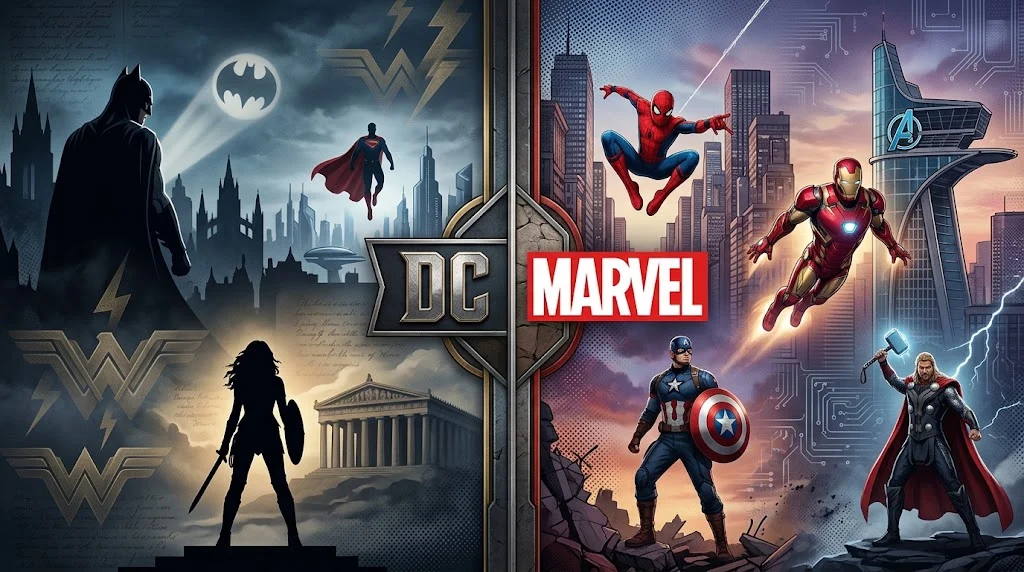
DC and Marvel are two of the most influential comic book universes in popular culture. DC is home to characters such as Superman, Batman, and Wonder Woman, while Marvel is known for Spider Man, Iron Man, and the Avengers. The choice between DC or Marvel usually reflects differences in storytelling, characters, themes, and cinematic style rather than a simple question of which company is better.
DC vs Marvel | What’s the Difference?
DC and Marvel are both major American comic book publishers, but they developed distinctive fictional universes, characters, storytelling traditions, and fan cultures.
DC refers to DC Comics, a publisher whose history includes some of the earliest and most recognizable superheroes in the industry. Superman, Batman, Wonder Woman, The Flash, Green Lantern, Aquaman, and many other characters belong to DC.
Marvel refers to Marvel Comics, another major comic book publisher whose characters include Spider Man, Iron Man, Captain America, Thor, Hulk, Black Panther, and the X Men.
The important distinction is that DC and Marvel are proper nouns used as names of entertainment and publishing brands, while their superhero universes contain fictional characters, locations, teams, and stories.
| Feature | DC | Marvel |
|---|---|---|
| Company | DC Comics | Marvel Comics |
| Major heroes | Superman, Batman, Wonder Woman | Spider Man, Iron Man, Captain America |
| Common themes | Mythology, symbolism, legacy, morality | Identity, responsibility, relationships, personal struggle |
| Famous team | Justice League | Avengers |
| Well known villain | Joker | Thanos |
| Storytelling reputation | Often larger than life and mythic | Often character driven and grounded |
Quick recap
DC often presents superheroes as legendary figures who represent ideals or symbols.
Marvel frequently focuses on heroes dealing with personal problems alongside extraordinary abilities.
Both publishers have complex histories, different eras, and many exceptions to these broad patterns.
Neither universe can be judged fairly by looking at only one movie, character, or comic series.
Is DC vs Marvel a Grammar, Vocabulary, or Usage Issue?
The comparison between DC and Marvel isn’t really a grammar problem. It is primarily a vocabulary, usage, and cultural knowledge issue.
Someone asking DC or Marvel is better isn’t choosing between two grammatical forms of the same word. They are comparing two distinct entertainment universes and the companies behind them.
The terms are not interchangeable. Saying that Batman is a Marvel character is factually incorrect, just as saying that Spider Man belongs to DC is incorrect. The confusion can happen because both companies publish superhero stories, use similar genres, and have characters with overlapping abilities.
In formal writing, academic discussions, journalism, or media analysis, writers should identify the publisher or fictional universe precisely. In casual conversation, fans may simply say that they prefer DC or Marvel.
For example, a media studies paper might discuss how DC and Marvel represent heroism differently. A casual conversation might be as simple as, “I’m more of a Marvel fan.”
The distinction matters whenever accuracy is important.
DC: Characters, Themes and Storytelling
DC has one of the deepest superhero histories in popular culture. Its best known characters are often portrayed as symbols of particular ideals.
Superman can represent hope, responsibility, and moral strength. Batman frequently represents determination, preparation, justice, and the consequences of trauma. Wonder Woman has traditionally been associated with compassion, courage, truth, and warrior strength.
This symbolic quality gives many DC stories a mythological atmosphere. Characters can feel larger than ordinary human beings, even when their stories focus on personal struggles.
Workplace example
Imagine a marketing team discussing a superhero themed campaign. A manager might say, “The concept feels more DC because it uses a darker visual identity and emphasizes iconic symbolism.”
That statement uses DC as a cultural reference rather than a grammatical category.
Academic example
A university student researching superhero mythology might compare Superman with ancient heroic figures. The student could argue that DC frequently presents superheroes as modern myths.
This is a legitimate academic use because the term identifies a particular body of popular culture.
Technology example
A technology company could create a presentation comparing superhero inspired artificial intelligence assistants. Referring to a virtual assistant as “DC inspired” could indicate that the visual design draws on characters or themes associated with DC.
Usage recap
Use DC when referring to DC Comics, its characters, stories, adaptations, or fictional universe.
Don’t use DC as a synonym for all superhero entertainment. Marvel, Image Comics, Dark Horse, and other publishers have their own identities.
Marvel: Characters, Themes and Storytelling
Marvel has developed a particularly strong reputation for portraying superheroes with recognizable human problems.
Spider Man is a classic example. Peter Parker has extraordinary abilities, but his stories often involve school, work, relationships, family responsibilities, and difficult moral decisions.
Iron Man provides another example. Tony Stark is wealthy, intelligent, flawed, confident, and vulnerable. His personality is often as important to the story as his technology.
Captain America, Black Panther, Thor, Hulk, and the X Men demonstrate the range of Marvel storytelling. Some stories are grounded in social issues, while others involve cosmic worlds, advanced technology, magic, or alternate realities.
Workplace example
A creative director might describe a campaign as “very Marvel” when the concept combines humor, personality, technology, and a group of characters with different backgrounds.
Academic example
A media studies researcher could analyze Marvel stories through themes such as identity, social responsibility, family, discrimination, or technological power.
Technology example
Marvel is particularly associated with technology through characters such as Iron Man. Discussions about robotics, wearable devices, artificial intelligence, and futuristic engineering sometimes use Iron Man as a popular cultural reference.
Usage recap
Use Marvel when discussing Marvel Comics, its characters, its fictional settings, or adaptations based on Marvel properties.
Don’t use Marvel as a general word for every superhero story.
When You Should NOT Use DC or Marvel
Understanding when not to use these terms prevents factual mistakes.
1. Don’t call Batman a Marvel character. Batman is associated with DC.
2. Don’t call Spider Man a DC character. Spider Man is a Marvel character.
3. Don’t use DC to describe superhero movies in general. Many superhero movies are unrelated to DC.
4. Don’t use Marvel to describe every comic book publisher. Marvel is one specific company and fictional universe.
5. Don’t assume every character in a superhero crossover belongs to the same publisher. Publishing rights, adaptations, and collaborations can make superhero media complicated.
6. Don’t treat movie studios and comic publishers as identical concepts. A film adaptation can involve different corporate entities from the original comic publisher.
7. Don’t judge an entire universe from one movie. Both DC and Marvel have decades of comics and numerous adaptations.
8. Don’t assume one storytelling style applies to every story. Both publishers have experimented with comedy, horror, science fiction, fantasy, political themes, romance, and darker narratives.
Common Mistakes and Decision Rules
| Correct sentence | Incorrect sentence | Explanation |
|---|---|---|
| Batman is a DC character. | Batman is a Marvel character. | Batman was created for DC Comics. |
| Spider Man is a Marvel character. | Spider Man is a DC character. | Spider Man is one of Marvel’s most recognizable heroes. |
| The Justice League is a DC team. | The Justice League is a Marvel team. | The Justice League is associated with DC. |
| The Avengers are a Marvel team. | The Avengers are a DC team. | The Avengers are one of Marvel’s signature superhero teams. |
| Wonder Woman belongs to DC. | Wonder Woman belongs to Marvel. | Wonder Woman is a major DC character. |
Decision Rule: If you mean DC Comics and its fictional universe, use DC. If you mean Marvel Comics and its fictional universe, use Marvel.
The simplest practical rule is to connect famous characters with their correct universe before writing. Batman, Superman, and Wonder Woman point toward DC. Spider Man, Iron Man, and Captain America point toward Marvel.
DC or Marvel in Modern Technology and AI Tools
Modern technology has made the DC and Marvel comparison even more visible.
Artificial intelligence tools can generate superhero inspired artwork, analyze fictional characters, create alternate universe concepts, and produce explanations of comic book histories. Search engines and conversational AI systems can also answer questions comparing characters, publishers, movies, and fictional universes.
However, AI can sometimes confuse characters when prompts are vague. A prompt such as “create a superhero similar to a famous comic character” may produce a result that blends characteristics from multiple universes.
For accurate research, users should specify the character, publisher, publication era, and adaptation when necessary.
AI also makes it easier to compare enormous amounts of fictional material. A researcher could examine how DC and Marvel approach leadership, morality, identity, technology, family, or sacrifice across hundreds of stories.
Technology therefore changes how people explore these universes, but the basic distinction remains the same.
A Short History and Etymology of DC and Marvel
The history of DC begins with the development of major superhero publishing during the early twentieth century. Superman’s arrival in 1938 helped establish the modern superhero model and contributed enormously to the popularity of comic books.
The name DC developed from the company’s historical association with the comic series Detective Comics. The initials eventually became strongly identified with the publisher.
Marvel’s history is rooted in Timely Publications, which later became associated with Atlas Comics before developing into Marvel Comics. Characters created during the company’s influential 1960s period helped establish a different approach to superhero storytelling.
Marvel’s creators increasingly emphasized heroes with recognizable flaws and everyday concerns. That creative philosophy helped distinguish Marvel from some of the more idealized superhero archetypes associated with earlier DC storytelling.
An expert style way to summarize the distinction is:
“DC often asks what a hero represents, while Marvel often asks what it costs to be one.”
This isn’t a historical quotation from a specific individual. It is a concise interpretive framework that captures a common critical distinction while recognizing that both publishers contain many exceptions.
Two Case Studies: DC and Marvel in Popular Culture
Case Study 1: The Batman
The Batman became a major example of DC’s ability to build a serious superhero film around a single iconic character.
The film earned more than $770 million worldwide, demonstrating substantial international audience demand for a character whose appeal extends beyond traditional comic book readers.
Its success also showed that audiences can respond strongly to superhero stories built around detective work, atmosphere, moral ambiguity, and character psychology rather than depending entirely on large scale ensemble storytelling.
Case Study 2: Spider Man: No Way Home
Marvel’s Spider Man: No Way Home demonstrated the commercial power of character recognition, nostalgia, and interconnected superhero storytelling.
The film earned more than $1.9 billion worldwide. Its performance showed how established characters and previous versions of the same character can create enormous audience interest when combined within a carefully constructed cinematic story.
Together, these examples demonstrate that both DC and Marvel can produce commercially successful stories through very different creative approaches.
Authority and Trust: How to Compare DC and Marvel Correctly
A trustworthy comparison should separate three things: the comic book publishers, the fictional universes, and their film or television adaptations.
A movie is not automatically a perfect representation of decades of comic book history. Characters change between writers, publishers revise continuity, and adaptations reinterpret stories for new audiences.
This is especially important when discussing character origins. Some characters have complicated publication histories involving different creators, retcons, alternate universes, and revised continuities.
For reliable writing, identify the specific version being discussed. Saying “Batman” may refer to a comic version, animated version, television version, or film interpretation. The same applies to Marvel characters.
Error Prevention Checklist
Always use DC when
• You are referring to Batman, Superman, Wonder Woman, The Flash, or the Justice League.
• You are discussing DC Comics or stories published under its brand.
• You are describing a fictional universe, character, or adaptation specifically associated with DC.
Never use Marvel when
• You are identifying Batman as a character.
• You are describing the Justice League.
• You are discussing Superman or Wonder Woman as Marvel characters.
Always use Marvel when
• You are referring to Spider Man, Iron Man, Captain America, Thor, Hulk, or the Avengers.
• You are discussing Marvel Comics and its associated stories.
• You are analyzing Marvel’s fictional universe or adaptations.
Never use DC when
• You are identifying Spider Man as a DC character.
• You are describing the Avengers as a DC team.
• You are discussing Marvel characters and stories specifically.
Related Grammar Confusions You Should Master
The DC and Marvel comparison isn’t a traditional grammar confusion, but it belongs to a wider group of language and terminology problems where precision matters.
Readers should also understand:
- Affect vs effect
- Compliment vs complement
- Principal vs principle
- Advice vs advise
- Practice vs practise
- License vs licence
- Whose vs who’s
- Everyday vs every day
- Its vs it’s
- Then vs than
Learning these distinctions improves clarity because accurate writing depends not only on grammar but also on choosing the correct term for the intended meaning.
FAQs
Is DC better than Marvel?
Neither is objectively better. DC and Marvel have different characters, themes, storytelling traditions, and adaptations, so the better choice depends on personal preference.
What is the main difference between DC and Marvel?
DC and Marvel are separate comic book publishers with different characters and fictional universes. DC is known for Superman and Batman, while Marvel is known for Spider Man and the Avengers.
Is Batman DC or Marvel?
Batman is a DC character. He is one of the most recognizable superheroes associated with DC Comics.
Is Spider Man DC or Marvel?
Spider Man is a Marvel character. He was created for Marvel Comics and became one of the company’s most recognizable superheroes.
Which came first, DC or Marvel?
The companies have different historical origins, but DC’s publishing history predates the formation of Marvel Comics under that name.
Why are DC and Marvel often compared?
They are compared because both are major superhero publishers with famous characters, large fictional universes, comic books, films, television productions, merchandise, and global fan communities.
Are DC and Marvel the same company?
No. DC Comics and Marvel Comics are separate publishing brands with different histories, characters, properties, and creative traditions.
Which has more popular superheroes, DC or Marvel?
Popularity depends on the character, country, generation, and medium. Both companies have produced globally recognized superheroes with enormous fan bases.
Can DC and Marvel characters appear together?
Official crossover stories have existed, but DC and Marvel remain separate fictional universes and publishing brands.
Conclusion
The question of DC or Marvel is ultimately a comparison between two distinct superhero traditions. DC is strongly associated with legendary figures such as Superman, Batman, and Wonder Woman, while Marvel is recognized for characters such as Spider Man, Iron Man, and Captain America.
The biggest mistake is treating the two names as interchangeable. They represent separate publishers, histories, characters, and fictional universes. Once that distinction is clear, comparisons about storytelling, movies, comics, technology, character development, and cultural influence become much easier to understand.
There is no universal winner in the DC or Marvel debate. The strongest choice depends on what a reader values most, that’s mythology and symbolism, personal character development, humor, darker storytelling, technology, team dynamics, or cinematic spectacle.
Discover More Related Articles:
- Alter or Altar | Spelling, Usage & Easy Ways to Remember the Difference In 2026
- Tase or Taze | Which Spelling Is Correct & When to Use Each In 2026
- Cue or Que | Meaning, Usage & the Correct Spelling In 2026