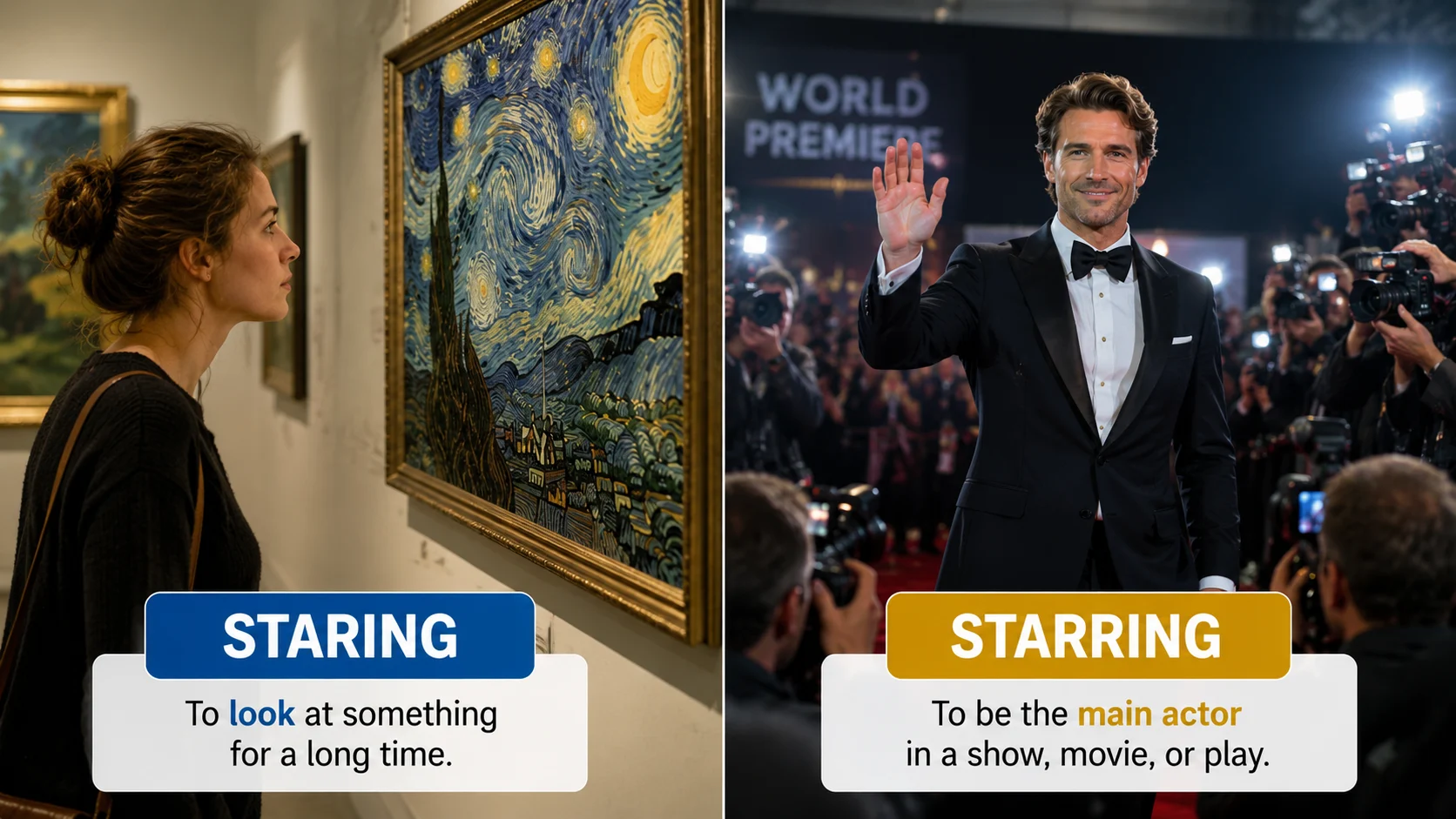
Staring or starring are commonly confused because they look almost identical, yet they have entirely different meanings. Staring describes the act of looking at someone or something for a long time, while starring means playing the main role in a movie, television show or performance.
Have you ever wondered it is staring or starring when you mean looking at something for a long time? You are not alone. These two words sound similar but have completely different meanings, which makes staring vs starring a common English spelling confusion. Staring means looking at someone or something continuously, while starring usually means appearing as a main actor in a movie, show, or performance.
This guide explains the staring vs starring meaning with simple examples so you can confidently choose the right word. If you are searching for staring meaning in movies, remember that “starring” is normally the word used to identify the main performers. So, is it starring or staring? It depends on what you mean.
If you want to know how to spell starring as in looking, the answer is actually “staring” when you mean looking. Likewise, starring as in looking is incorrect. Let’s clear up the difference.
Staring or Starring | What’s the Difference?
Although the words look alike, they belong to different contexts and should never be used interchangeably. One relates to vision and observation, while the other belongs to entertainment and performance.
| Feature | Staring | Starring |
|---|---|---|
| Part of speech | Verb, present participle | Verb, present participle |
| Base verb | Stare | Star |
| Primary meaning | Looking fixedly at someone or something | Playing the leading role in a production |
| Common context | Daily conversation, education, workplace | Movies, television, theatre, streaming content |
| Example | She kept staring at the painting. | She is starring in a new drama series. |
In simple terms, staring involves your eyes, while starring involves being the main performer. Even though both words end in ing, their meanings have no connection. Remembering the context is often enough to choose the correct word without hesitation.
Is Staring or Starring a Grammar, Vocabulary or Usage Issue?
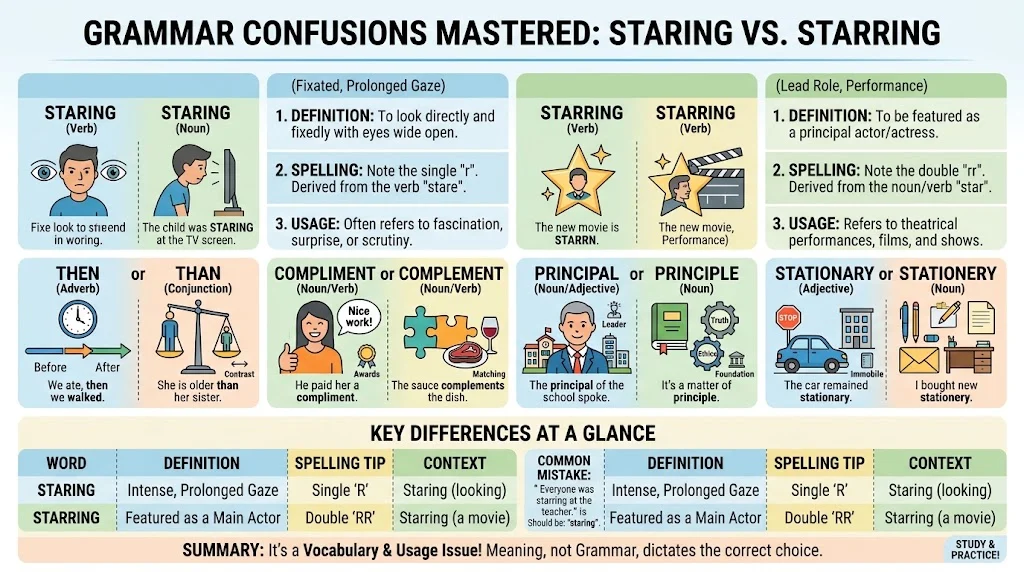
The confusion between staring or starring is primarily a vocabulary and usage issue, not a grammar mistake. Both words are grammatically correct, but they express different ideas.
Because they are pronounced similarly and differ by only one letter, writers sometimes type the wrong form without noticing. Spell checkers may not catch the error because both words exist in English.
The distinction remains the same in formal writing, casual conversation, academic assignments, business communication, and journalism. There is no formal or informal version between the two. Instead, the correct choice depends entirely on what you want to express.
For example, writing The actor was staring in a new film changes the meaning completely and sounds incorrect. Likewise, saying Everyone was starring at the teacher creates an obvious usage error because people look at teachers, they do not perform in them.
Understanding the intended meaning before you write is the simplest way to avoid confusion.
By the end of this guide, you’ll be able to recognize the correct word instantly, use each one naturally in different situations, and avoid one of the most common English vocabulary mix ups.
Understanding Staring
The word staring is the present participle of the verb stare. It means looking at someone or something steadily, fixedly, or for an unusually long time. Depending on the situation, staring can show curiosity, surprise, admiration, confusion, fear, or even rudeness. Unlike a quick glance, a stare usually lasts longer and attracts attention.
In everyday English, people often use staring when describing visual focus. The action is intentional, even if the person does not realize they are doing it.
Workplace Examples
A manager noticed an employee staring at the presentation screen, trying to understand the latest sales figures.
During the meeting, everyone stopped speaking because one participant kept staring out of the window instead of paying attention.
The security officer spent several minutes staring at the surveillance monitor after noticing unusual movement.
Academic Examples
The student was staring at the exam paper because one question seemed especially difficult.
Several children were staring at the science experiment as the chemical reaction changed color.
The professor paused after noticing a few students staring at their phones during the lecture.
Technology Examples
The gamer spent hours staring at the computer monitor while testing the latest graphics settings.
Many people experience eye strain after staring at a smartphone screen for long periods.
The software engineer was staring at lines of code until the programming error finally became obvious.
Everyday Examples
The little boy stood quietly, staring at the rainbow after the rain stopped.
Everyone in the restaurant was staring at the celebrity who had just walked in.
She caught her cat staring at the empty food bowl, hoping for another meal.
After hearing the unexpected news, he remained silent, staring into the distance.
Why People Confuse Staring
The confusion usually happens because staring and starring sound almost identical when spoken quickly. Since both are present participles ending in ing, many writers rely on sound instead of meaning. As a result, they accidentally write starring when talking about looking at something.
A helpful memory trick is to connect staring with eyes. If someone is looking carefully or continuously, staring is always the correct choice.
Usage Recap
Whenever the sentence involves looking, watching, gazing, observing, or fixing your eyes on something, choose staring. The word has nothing to do with movies, television, actors, or performances.
Understanding Starring
Starring is the present participle of the verb star. It means performing as the main actor, featured performer, or leading participant in a movie, television show, stage production, advertisement, or similar work. The word can also describe someone or something receiving the greatest attention or playing the most important role.
Whenever you read movie posters, streaming platforms, entertainment news, or theatre programs, you’ll frequently see the word starring before the names of the leading performers.
Workplace Examples
The company’s promotional video is starring several employees who volunteered to demonstrate the new product.
The marketing team produced a training film starring the chief executive to introduce the organization’s updated policies.
An internal awareness campaign was launched starring staff members from different departments.
Academic Examples
The university drama club is starring its most experienced student in this year’s annual theatre production.
Media studies students created a short documentary starring local community volunteers.
The film project received high marks because it featured an excellent script starring talented student actors.
Technology Examples
A technology company released a commercial starring a well known software developer explaining its newest artificial intelligence platform.
The virtual reality demonstration is starring digital characters created entirely through computer graphics.
A streaming service promoted its latest science fiction series starring award winning actors.
Everyday Examples
She is starring in a historical drama that will be released later this year.
The famous actor is starring alongside several rising performers in the new adventure film.
The local theatre is presenting a musical starring young performers from the community.
The advertisement is starring an international athlete to promote the new product line.
Why People Confuse Starring
Many people mistakenly write staring because they associate the pronunciation with the act of seeing. However, if the sentence is about acting, performing, appearing in a production, or being the featured person, starring is the only correct choice.
An easy way to remember this is to think of a star. A leading actor is often called a star, so someone who is starring is performing as the star of the production.
Usage Recap
Use starring whenever the sentence refers to acting, entertainment, featured performers, leading roles, films, television series, theatre productions, advertisements, or digital media. If the person is performing instead of looking, starring is the correct word.
When You Should NOT Use Staring or Starring
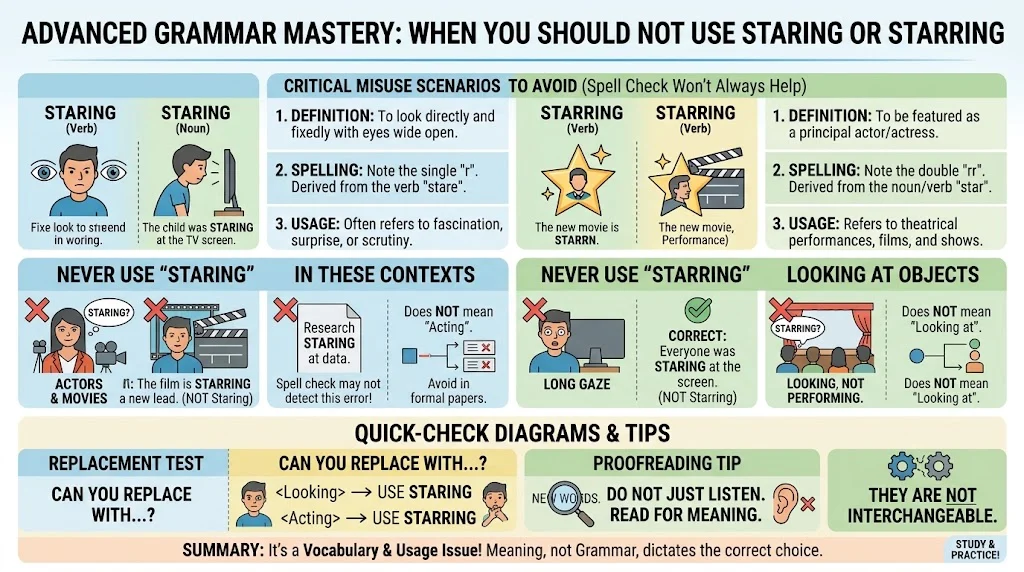
Even though staring and starring are valid English words, each belongs to a specific context. Mixing them up can confuse readers and make your writing appear careless. Before choosing either word, ask yourself the sentence is about looking at something or performing in a production.
Here are some of the most common misuse scenarios.
- Do not use staring when talking about actors appearing in a film or television show. In that situation, starring is always correct.
- Do not use starring when someone is simply looking at another person or object for an extended period. The correct choice is staring.
- Avoid replacing staring with starring in academic writing. Spell check may not detect the mistake because both words are correctly spelled.
- Do not assume the words are interchangeable because they sound alike. Their meanings are completely unrelated.
- Never write starring at the screen when you mean someone is looking at it. The correct phrase is staring at the screen.
- Avoid writing staring in a movie when referring to an actor’s role. The correct phrase is starring in a movie.
- Do not rely only on pronunciation when proofreading. Read the sentence for meaning instead.
- If replacing the word with looking makes sense, use staring. If replacing it with acting makes sense, use starring.
Common Mistakes and Decision Rules
The easiest way to avoid confusion is to compare correct and incorrect examples side by side.
| Correct Sentence | Incorrect Sentence | Explanation |
|---|---|---|
| She was staring at the painting for several minutes. | She was starring at the painting for several minutes. | Looking at something requires staring. |
| The actor is starring in a new action film. | The actor is staring in a new action film. | Performing in a film requires starring. |
| I caught him staring out of the window. | I caught him starring out of the window. | The sentence describes looking, not acting. |
| The series is starring several award winning performers. | The series is staring several award winning performers. | Entertainment contexts require starring. |
| Everyone was staring at the unusual artwork. | Everyone was starring at the unusual artwork. | The action involves watching or observing. |
| She is starring in her first television drama. | She is staring in her first television drama. | A leading role always uses starring. |
Decision Rule Box
If you mean the action of looking fixedly at someone or something, use staring.
If you mean the action of performing as the main actor or featured person, use starring.
This simple rule works in almost every situation and can prevent nearly all errors involving these two words.
Staring and Starring in Modern Technology and AI Tools
Modern technology has made writing easier, but it has not completely eliminated vocabulary mistakes. Grammar checkers and AI writing assistants can sometimes miss errors involving staring and starring because both words are legitimate English spellings.
For example, an AI tool may accept the sentence The actress is staring in a new film because the grammar is technically correct, even though the vocabulary choice is wrong. Human proofreading is still essential for ensuring that the intended meaning matches the chosen word.
Search engines, voice typing applications, and automatic transcription software can also confuse these words because they sound almost identical when spoken. Reading your work aloud before publishing often helps identify mistakes that automated tools overlook.
The Origin of the Words
Understanding where these words come from makes their meanings easier to remember.
The verb stare comes from Old English and has been associated with looking fixedly or intensely for centuries. Its meaning has remained remarkably consistent throughout the history of the language.
The verb star developed from the noun referring to a bright celestial object. Over time, outstanding performers came to be called stars because they stood out from others. From this idea came the verb to star, meaning to appear as the leading performer in a production.
Although the words now look similar, they developed through completely different historical paths.
“Strong writing depends as much on choosing the correct word as it does on correct grammar. Precision builds credibility.”
Real World Case Studies
Case Study One: Student Essay Improvement
A university writing center reviewed essays submitted by first year students and found that several confused staring and starring in narrative assignments. After a short vocabulary workshop with contextual examples, students significantly reduced word choice errors in later submissions. The exercise showed that understanding meaning is more effective than memorizing spelling alone.
Case Study Two: Business Content Editing
A marketing agency preparing promotional material for an independent film discovered repeated uses of staring instead of starring throughout a client’s website. After correcting the vocabulary and proofreading the content, the company published clearer promotional copy that reflected greater professionalism and improved reader confidence.
Error Prevention Checklist
Choosing between staring or starring becomes much easier when you follow a few simple habits. Before you publish an email, article, assignment, or social media post, take a moment to check the word matches your intended meaning.
Always Use Staring When
☑ You are describing someone looking fixedly at a person or object.
☑ The sentence could be rewritten using the word looking without changing the meaning.
☑ You are talking about eye contact, observation, or visual attention.
☑ The context involves curiosity, surprise, admiration, or concentration.
☑ Someone is watching something for longer than usual.
Never Use Starring When
☑ The sentence is only about looking at something.
☑ You mean watching, gazing, observing, or staring.
☑ There is no movie, television show, theatre production, advertisement, or performance involved.
☑ Replacing the word with acting would make no sense.
☑ The subject is not the featured performer or main participant.
If you remember these checks while proofreading, you’ll avoid nearly every mistake involving these commonly confused words.
Related Grammar Confusions You Should Master
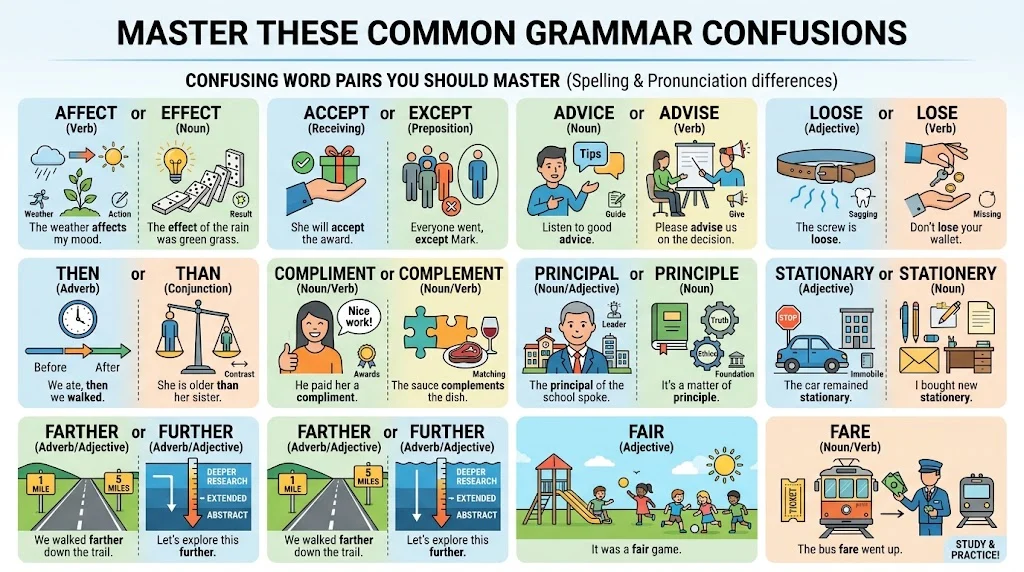
If you often confuse staring or starring, you may also benefit from learning other English word pairs that are similar in spelling or pronunciation but different in meaning.
Affect or Effect
Learn when to use the verb affect and the noun effect in everyday and professional writing.
Accept or Except
Understand the difference between receiving something and excluding something.
Advice or Advise
Discover why one is a noun and the other is a verb.
Loose or Lose
Avoid one of the most common spelling mistakes in English.
Then or Than
Know when to compare ideas and when to refer to time.
Compliment or Complement
Recognize the difference between praise and something that completes another thing.
Principal or Principle
Understand when to refer to a school leader and when to describe a rule or belief.
Stationary or Stationery
Learn the difference between something that does not move and writing materials.
Farther or Further
Choose the correct word for physical distance and figurative extension.
Fair or Fare
Master another frequently confused word pair involving price, travel, and justice.
Learning these commonly confused words together strengthens your vocabulary and helps you write with greater accuracy and confidence.
FAQs
What is the difference between staring and starring?
The difference is simple once you understand the context. Staring means looking at someone or something for an extended period, while starring means performing as the main actor or featured person in a film, television show, play, or similar production.
Is staring or starring a grammar mistake?
Not exactly. The confusion is a vocabulary and usage mistake rather than a grammar mistake. Both words are grammatically correct, but only one fits the intended meaning. Choosing the wrong one changes what the sentence communicates.
How can I remember when to use staring?
Associate staring with your eyes. If someone is looking carefully, watching intently, or focusing on an object, the correct word is staring. Thinking about eye contact makes the distinction much easier to remember.
How can I remember when to use starring?
Think of a movie star. If someone is acting, performing, or appearing as the leading person in a production, the correct choice is starring. Remembering the noun star provides an easy memory aid.
Can spell check detect staring and starring mistakes?
Not always. Since both words are correctly spelled English words, many spell checkers will not flag them. Reading the sentence for meaning rather than spelling is the most reliable way to catch the error.
Can staring and starring ever be used interchangeably?
No. These words have different meanings and should never replace each other. One relates to looking, while the other relates to acting or performing. Using the wrong one creates confusion for readers.
Why do people confuse staring and starring so often?
The confusion comes from their similar spelling and pronunciation. Because only one letter separates them, writers sometimes choose the wrong word without realizing it, especially when typing quickly or relying on voice input.
Is starring only used for movies?
No. Although it is common in films and television, starring can also refer to theatre productions, advertisements, documentaries, online videos, podcasts, promotional campaigns, and any situation where someone is the featured performer or participant.
Which word should I use in academic writing?
Use the word that matches the intended meaning. Academic writing values precision, so staring should describe looking, while starring should describe leading roles in performances or media. Proofreading for context is especially important in formal writing.
Conclusion
Understanding staring or starring is easier once you focus on meaning instead of spelling. Staring describes the act of looking fixedly at someone or something, whereas starring refers to performing as the leading actor or featured participant. Even though they differ by only one letter, using the wrong word can completely change your message.
A practical way to remember the difference is to connect staring with eyes and starring with a star performer. Whenever you proofread your writing, ask yourself the sentence is about looking or acting. This simple habit will help you choose the correct word every time and communicate with greater clarity and confidence.
Discover More Related Articles:
- Artic or Arctic | What Is the Difference and Which Spelling Is Correct In 2026
- Hitmonlee or Hitmonchan | Which Pokémon Should You Choose In 2026
- Let’s or Lets | What’s the Difference & When to Use Each Correctly In 2026