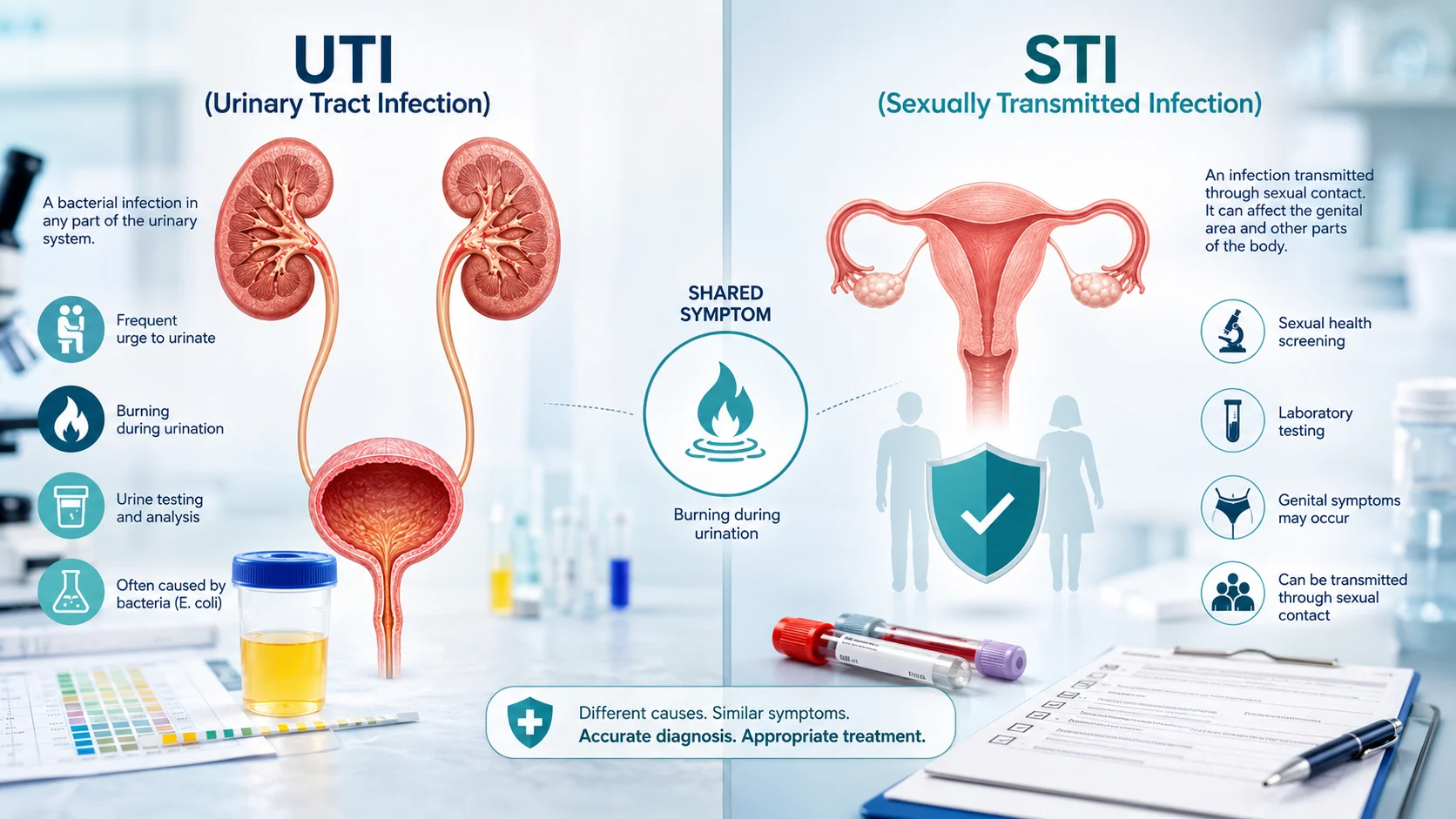
UTI or STD can be difficult to distinguish because both may cause burning during urination, pelvic discomfort, or genital symptoms. A UTI is an infection affecting the urinary tract, while an STD, more commonly called an STI, is an infection transmitted through sexual contact. The symptoms can overlap, so testing may be necessary to identify the cause accurately.
UTI vs STD | What’s the Difference?
A urinary tract infection, commonly called a UTI, is an infection affecting part of the urinary system, including the urethra, bladder, ureters, or kidneys. Bladder infections are the most common type of UTI and are often caused by bacteria entering and multiplying in the bladder.
An STD is a sexually transmitted disease. Modern medical sources increasingly use the term sexually transmitted infection, or STI, because a person can have an infection without developing noticeable disease or symptoms. STIs can be caused by bacteria, viruses, or parasites and may spread through vaginal, anal, or oral sexual contact, as well as certain forms of skin to skin contact.
| Feature | UTI | STD or STI |
|---|---|---|
| Full term | Urinary tract infection | Sexually transmitted disease or infection |
| Main area affected | Urinary tract | Genitals, reproductive system, rectum, throat, or other body areas depending on the infection |
| Typical causes | Usually bacteria entering the urinary tract | Bacteria, viruses, or parasites transmitted through sexual contact |
| Common symptoms | Burning urination, frequent urination, urgency, lower abdominal discomfort | Discharge, genital sores, burning urination, pelvic symptoms, rash, or no symptoms |
| Sexual transmission required | No | Sexual contact is a major route for transmission |
| Common testing | Urinalysis and urine culture when appropriate | Urine, swab, blood, or other tests depending on the infection |
| Treatment | Depends on the cause and may involve antibiotics | Depends on the specific infection |
| Can have no symptoms? | Some urinary infections can occur without symptoms | Yes, many STIs can be asymptomatic |
Quick Recap
A UTI and an STD are not the same condition.
A UTI primarily involves the urinary tract, while an STD involves an infection acquired through sexual transmission.
Burning while urinating can occur with both, which is one reason symptoms alone cannot always provide a reliable diagnosis.
Sexual exposure, genital discharge, sores, or an affected partner can make STI testing particularly important.
Is UTI vs STD a Grammar, Vocabulary or Usage Issue?
This is not a grammar question. It is a medical terminology and health information distinction.
The terms describe different categories of infection, although their symptoms can overlap. Calling every case of painful urination a UTI can lead to a missed STI diagnosis. Conversely, assuming that every urinary symptom must be sexually transmitted can create unnecessary worry.
The terminology can also be confusing because STD and STI are sometimes used interchangeably in everyday conversation. STI is generally preferred in modern health communication because infection may exist without obvious disease. For example, chlamydia frequently causes no symptoms, yet it can still lead to serious complications if untreated.
In formal medical, academic, and public health writing, it is better to identify the specific infection whenever possible. In casual conversation, people may simply say STD, STI, or UTI.
The important distinction is not which abbreviation sounds more familiar. It is the symptoms and exposure history point toward a urinary infection, a sexually transmitted infection, another condition, or more than one condition at the same time.
UTI Symptoms and Practical Examples
UTI symptoms often center around urination. A bladder infection may cause burning or pain during urination, a frequent or urgent need to urinate, lower abdominal discomfort, and urine that appears cloudy, bloody, or unusually strong smelling.
Workplace Example
Imagine an employee who suddenly needs to use the bathroom every few minutes during a workday and experiences burning when urinating. The person might assume the problem is caused by dehydration, stress, or a temporary irritation.
However, frequent urination combined with burning can be consistent with a bladder infection. Rather than relying on assumptions, medical evaluation can determine a UTI is present and another cause needs to be considered.
Academic Example
In a health sciences assignment, a student might describe dysuria, which means painful or burning urination, as evidence of a UTI. That conclusion would be incomplete because dysuria can also occur with some STIs.
A stronger academic explanation would state that dysuria is a symptom shared by several conditions and that diagnosis requires consideration of the patient’s symptoms, medical history, exposure risks, and appropriate laboratory testing.
Technology Example
Modern telehealth platforms and symptom checking tools can help organize information about urinary symptoms, but they should not be treated as definitive diagnostic systems. A digital questionnaire may recognize patterns such as urinary frequency and burning, yet it cannot necessarily determine those symptoms result from a UTI, STI, irritation, kidney stone, or another condition.
UTI usage recap: Urinary frequency, urgency, burning, and lower abdominal discomfort can suggest a urinary infection, but overlapping symptoms mean that testing and professional evaluation may sometimes be necessary.
STD and STI Symptoms and Practical Examples
STIs vary considerably. Some produce obvious symptoms, while others remain silent. Depending on the infection, symptoms can include genital discharge, sores, pain or burning during urination, rectal discomfort, bleeding, itching, or pelvic symptoms.
Chlamydia is an especially important example because it often produces no symptoms. When symptoms do occur, they may include abnormal discharge or burning during urination. Untreated infection can cause serious reproductive complications, including pelvic inflammatory disease, ectopic pregnancy, and infertility in some women.
Workplace Example
Suppose someone develops burning while urinating after a new sexual relationship and assumes the problem is simply a bladder infection. If there is also unusual genital discharge or a partner has been diagnosed with an STI, STI testing becomes important.
The workplace setting itself does not cause the infection. The relevant information is the person’s symptoms and possible exposure history.
Academic Example
In a medical writing assignment, it would be inaccurate to state that painful urination automatically proves a UTI. A better explanation would acknowledge that infections such as chlamydia or gonorrhea can also cause urinary burning.
This distinction demonstrates clinical reasoning rather than symptom matching.
Technology Example
A laboratory ordering system may offer different test categories for urine culture and STI testing. These tests answer different diagnostic questions. A urine culture designed to identify common urinary bacteria is not automatically equivalent to a comprehensive STI test.
STD and STI usage recap: Sexual exposure does not prove that symptoms are caused by an STI, but symptoms following sexual exposure can justify appropriate STI evaluation. Many infections have no symptoms, so testing can be important even when a person feels healthy.
When You Should NOT Use UTI or STD Interchangeably
Using the terms as though they mean the same thing is one of the most common sources of confusion.
| Situation | Why the terms should not be treated as interchangeable |
|---|---|
| Burning during urination alone | Both urinary infections and some STIs can cause burning |
| Frequent urination | This pattern can occur with a UTI but does not establish a diagnosis |
| Genital discharge | Discharge can suggest an STI or another genital condition and needs evaluation |
| Genital sores | Sores are not a typical defining feature of a simple bladder infection |
| Recent unprotected sexual contact | This history can make STI testing relevant |
| Cloudy or bloody urine | These findings can occur with urinary conditions and do not automatically indicate an STI |
| A partner has an STI | Exposure history makes appropriate STI testing important |
| Symptoms continue after UTI treatment | Persistent symptoms require reassessment rather than automatically repeating the same assumption |
A particularly important point is that sexual activity can increase the risk of bladder infections without making the UTI itself an STD. NIDDK notes that being sexually active can increase the likelihood of bladder infection.
That distinction explains why someone can develop urinary symptoms after sexual activity without having acquired an STI.
Common Mistakes and Decision Rules
| Correct sentence | Incorrect sentence | Explanation |
|---|---|---|
| Burning urination can occur with a UTI or an STI. | Burning urination always means a UTI. | Several conditions can produce the same symptom. |
| A urine culture can help diagnose certain urinary infections. | A urine culture automatically rules out every STI. | STI testing may require different tests. |
| Chlamydia can occur without symptoms. | An STI always causes obvious symptoms. | Many STIs can be asymptomatic. |
| Sexual activity can increase UTI risk. | Every UTI is sexually transmitted. | A UTI is not automatically an STI. |
| STI testing may be appropriate after a relevant sexual exposure. | No symptoms means STI testing is never necessary. | Some STIs have few or no symptoms. |
| Fever and back pain can indicate a more serious urinary infection. | All urinary infections are minor. | A kidney infection can require prompt medical attention. |
| A healthcare professional can determine appropriate testing. | Symptoms alone always identify the infection. | Overlapping symptoms make clinical assessment important. |
Decision Rule Box
If symptoms are mainly urinary, such as frequent urination, urgency, and burning, a UTI may be one possibility, but testing can be needed.
If symptoms occur with genital discharge, sores, a relevant sexual exposure, or a partner with an STI, STI testing may also be appropriate.
If symptoms overlap, do not choose between the two based only on symptoms. A healthcare professional can determine which tests are appropriate.
UTI and STD in Modern Technology and AI Tools
Artificial intelligence and digital health tools can make health information easier to access, but symptom based technology has an important limitation: similar symptoms can belong to different medical conditions.
An AI tool might identify burning urination as a possible symptom of a UTI, chlamydia, gonorrhea, or another condition. That does not mean the tool has diagnosed the user.
Laboratory technology is more useful for distinguishing conditions because different tests investigate different biological evidence. For urinary infections, healthcare professionals may use urinalysis, urine culture, blood tests, or other investigations depending on the situation.
STI diagnosis can involve urine testing, swabs, blood tests, or other methods depending on the infection and exposure site.
The best use of technology is therefore to support communication, education, appointment preparation, and access to testing rather than replacing professional diagnosis.
Why the Difference Matters for Health and Safety
The distinction between a UTI and an STI matters because the consequences of missing the correct diagnosis can be very different.
An untreated bladder infection can spread to the kidneys. Kidney infection symptoms can include fever, chills, nausea, vomiting, and pain in the back, side, or groin. NIDDK recommends prompt medical attention when these symptoms occur because kidney infections can become serious.
STIs can also have consequences when left untreated. Chlamydia, for example, can cause pelvic inflammatory disease and reproductive complications while remaining unnoticed.
This is why the safest approach is not to diagnose yourself from a single symptom.
Etymology and Medical Terminology
The term urinary tract infection describes an infection involving the urinary tract. The word urinary relates to urine and the organs involved in producing and eliminating it.
STD stands for sexually transmitted disease. In contemporary public health communication, STI, meaning sexually transmitted infection, is increasingly preferred because infection can exist without recognizable disease. The CDC uses both terminology in its public health materials, while many modern resources emphasize STI.
The terminology reflects an important medical concept: symptoms are not always necessary for an infection to be present.
Expert Perspective
NIDDK gives a straightforward clinical message: “Contact a health care professional if you have symptoms.”
That principle is particularly useful when urinary and sexual health symptoms overlap.
Two Evidence Based Case Studies
Case Study 1: Recognizing the Importance of UTI Evaluation
Consider a patient with burning urination, urinary frequency, and lower abdominal discomfort but no genital discharge or sores. These symptoms fit a common bladder infection pattern. NIDDK identifies burning urination, frequent urges, lower abdominal discomfort, and changes in urine as typical bladder infection symptoms.
The important result is not that symptoms alone prove a UTI. The useful clinical outcome is that appropriate evaluation can identify a urinary infection is present and help prevent progression toward kidney infection.
Case Study 2: Recognizing Silent STI Risk
Consider a sexually active person who feels completely healthy after a new sexual partnership. Assuming that no symptoms means no infection would be unsafe because chlamydia frequently has no symptoms.
CDC guidance notes that asymptomatic chlamydial infection is common and that screening is used to identify infections that symptoms alone would miss.
The concrete result is that testing can identify an infection before complications develop and can provide an opportunity for appropriate treatment and partner management.
When Symptoms Require Prompt Medical Attention
Some symptoms deserve more urgent attention than ordinary mild urinary discomfort.
Seek prompt medical care if urinary symptoms occur with fever, chills, vomiting, or significant pain in the back, side, or groin because these can be signs of kidney involvement.
Blood in the urine, inability to urinate, severe pain, pregnancy with concerning urinary symptoms, or rapidly worsening symptoms should also be discussed with a healthcare professional.
For possible STI exposure, genital sores, unusual discharge, bleeding, pelvic pain, or a partner diagnosed with an STI should not be ignored. Some infections can cause complications even when symptoms are mild or absent.
This article provides educational information and cannot determine the cause of an individual’s symptoms.
Testing: UTI Test vs STI Test
Testing is where the distinction becomes especially practical.
For suspected bladder infection, healthcare professionals may use urinalysis and urine culture. A urinalysis can look for findings such as blood and white blood cells, while urine culture can identify certain bacteria and help guide treatment.
STI testing depends on the suspected infection. Testing may involve urine, genital or other site swabs, blood tests, or combinations of these approaches.
One test should not automatically be assumed to cover every possible infection. If someone has urinary symptoms plus a relevant sexual exposure, telling the healthcare professional about both is important because it can affect which tests are considered.
Pregnancy is another important situation. The USPSTF recommends screening for asymptomatic bacteriuria during pregnancy using urine culture because urinary infections during pregnancy can have important consequences.
Error Prevention Checklist
Always consider a UTI when
- Burning or painful urination is accompanied by frequent or urgent urination.
- There is lower abdominal discomfort along with urinary symptoms.
- Urine becomes cloudy, bloody, or unusually strong smelling.
- Symptoms suggest a urinary infection and need clinical evaluation.
Never assume an STI is impossible when
- There has been a relevant sexual exposure.
- A sexual partner has an STI.
- There is unusual genital discharge.
- There are genital or rectal sores.
- Symptoms continue despite treatment for a presumed UTI.
- There are no symptoms but testing is recommended because of age, exposure, or other risk factors.
The central error to avoid is treating a symptom as a diagnosis.
Related Grammar Confusions You Should Master
For broader health terminology literacy, readers may also benefit from understanding these commonly confused terms:
- Symptom vs sign
- Infection vs disease
- Bacteria vs virus
- Antibiotic vs antiviral
- Diagnosis vs screening
- Treatment vs prevention
- STI vs STD
- Urethra vs ureter
- Bladder infection vs kidney infection
- Screening test vs diagnostic test
These distinctions improve both everyday health communication and academic medical writing.
FAQs
Can a UTI feel like an STD?
Yes. Burning urination and pelvic or genital discomfort can occur with both, so symptoms alone may not distinguish them.
How can you tell the difference between a UTI and an STD?
A healthcare professional may consider symptoms, sexual exposure, physical findings, and laboratory tests because the two conditions can share symptoms.
Does burning when you pee always mean a UTI?
No. Burning during urination can also occur with some STIs, including chlamydia.
Can an STD cause frequent urination?
Some sexually transmitted infections can cause urinary or genital symptoms, but frequent urination is also a common symptom of bladder infection. Testing may be needed.
Can you have an STD without symptoms?
Yes. Chlamydia frequently causes no symptoms, which is why appropriate screening can be important for people at increased risk.
Can sex cause a UTI without causing an STD?
Yes. Sexual activity can increase the risk of bladder infection, while a UTI itself is not automatically sexually transmitted.
Will a UTI test detect an STD?
Not necessarily. Urinary infection testing and STI testing are designed to answer different diagnostic questions, so the appropriate tests depend on the suspected condition.
When should I see a doctor for urinary burning?
Seek medical evaluation when burning is persistent, severe, recurrent, associated with concerning symptoms, or accompanied by possible STI exposure. Fever, chills, vomiting, or back and side pain require prompt attention.
Is STD or STI the better term?
STI is increasingly preferred in health communication because a person can have an infection without noticeable disease or symptoms.
Conclusion
The key to understanding UTI or STD is recognizing that similar symptoms do not necessarily mean the same infection. A UTI affects the urinary tract and commonly produces urinary frequency, urgency, and burning, while an STI can produce genital, urinary, rectal, or systemic symptoms and may also remain completely silent.
The safest approach is to avoid self diagnosis based on one symptom. When urinary symptoms overlap with sexual exposure, discharge, sores, or partner risk, appropriate testing can provide a much clearer answer. Prompt evaluation is especially important when symptoms suggest kidney involvement or another serious complication.
Discover More Related Articles:
- Alter or Altar | Spelling, Usage & Easy Ways to Remember the Difference In 2026
- Tase or Taze | Which Spelling Is Correct & When to Use Each In 2026
- Cue or Que | Meaning, Usage & the Correct Spelling In 2026