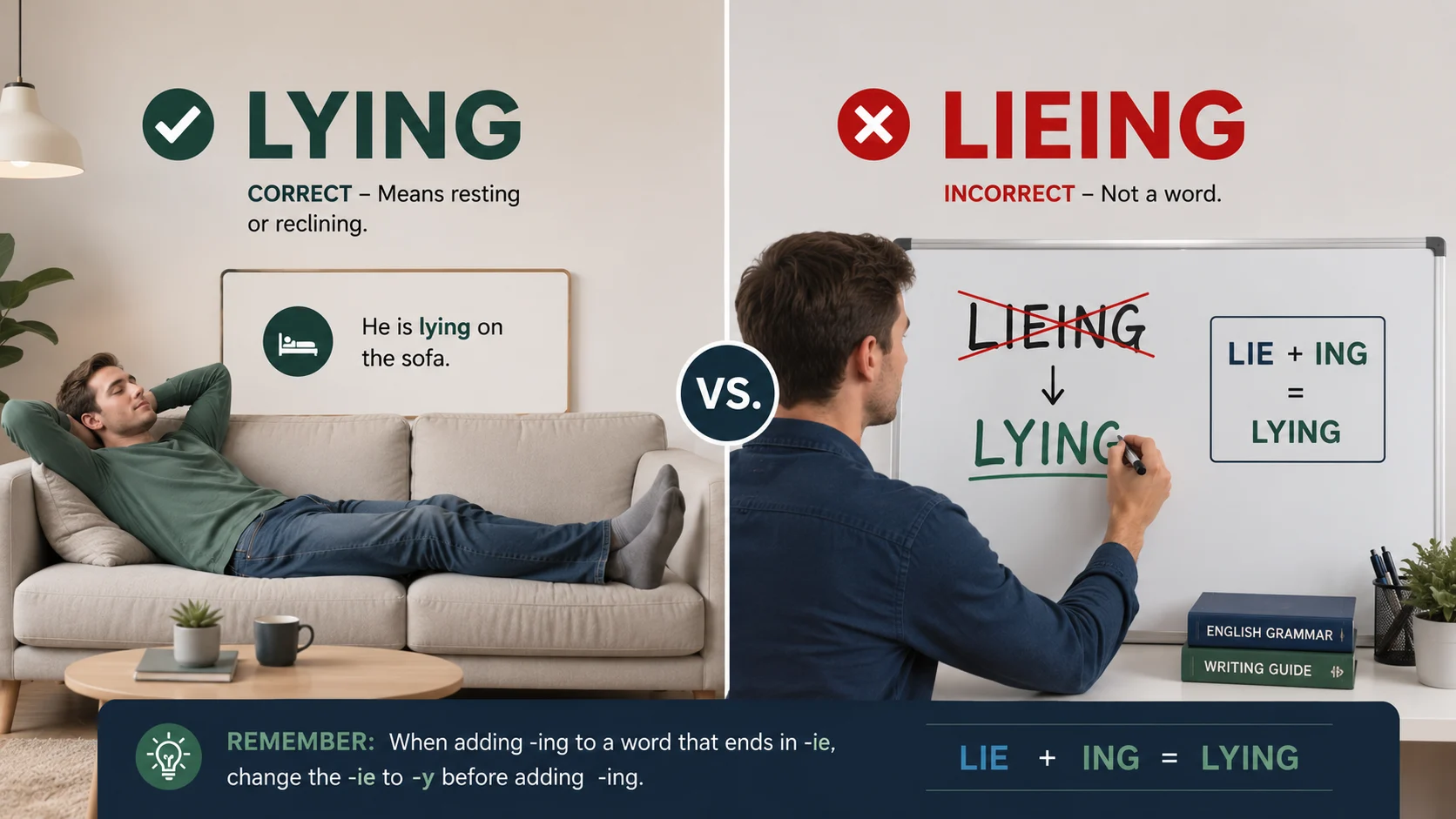
The correct spelling is lying, not lieing. Lying is the present participle and gerund form of the verb lie, while lieing is an incorrect spelling that does not follow standard English spelling rules. The confusion usually occurs because many verbs simply add ing, but lie changes its ending before the suffix is added.
The confusion between lying or lieing is common because many English verbs form their present participle simply by adding ing. However, the correct spelling is lying, while lieing is incorrect. The word lying can mean resting in a particular position or telling something that is not true.
Understanding this spelling rule can help you avoid mistakes in academic writing, workplace communication, and everyday English. When the verb lie takes ing, the final ie changes to y, giving us lying, not lieing.
Lying or Lieing | What Is the Correct Spelling?
If you are wondering to write lying or lieing, the answer is straightforward: lying is correct, and lieing is incorrect in standard English.
The word lying comes from the verb lie. Depending on context, lie can mean to rest in a horizontal position or to say something that is not true. In both meanings, the present participle is spelled lying.
For example:
The cat is lying on the sofa.
Here, lying means resting in a particular position.
Consider another example:
He is lying about what happened.
Here, lying means telling something untrue.
The spelling lieing may look logical at first because many English verbs form their present participle by adding ing. However, English spelling has several important exceptions. When lie becomes a form ending in ing, the final ie changes to y before ing is added.
Therefore:
lie + ing = lying
Not:
lie + ing = lieing
This small spelling change is responsible for one of the most common errors involving present participles.
Lying vs Lieing| What’s the Difference?
The difference is simple. Lying is the standard and correct English spelling. Lieing is a misspelling.
| Term | Part of Speech | Meaning | Standard Usage |
|---|---|---|---|
| Lying | Present participle and gerund | Resting, reclining, or telling something untrue | Correct and standard |
| Lieing | Incorrect verb form | Intended to represent the present participle of lie | Incorrect |
The key point is that lying is the only standard spelling for the present participle of lie.
You should use lying in formal writing, academic work, workplace communication, websites, reports, emails, and everyday conversation.
The form lieing should be avoided because dictionaries and standard English usage do not recognize it as the correct present participle of lie.
Mini Recap
Lying is the correct spelling.
Lieing is an incorrect spelling.
The change happens because the final ie in lie becomes y before ing.
The same spelling pattern appears in words such as tying and dying.
Is Lying vs Lieing a Grammar, Vocabulary or Usage Issue?
The distinction between lying and lieing is primarily a spelling and word formation issue, although grammar is involved because the discussion concerns the formation of a verb form.
The base verb is lie. When English creates the present participle, the spelling changes.
lie → lying
This is not a situation where both words are interchangeable. Only lying is accepted in standard English.
The issue is also not primarily about formal versus informal language. You should not use lieing in casual writing while using lying in formal writing. The spelling is incorrect regardless of the level of formality.
In academic writing, the correct form is always lying.
In workplace communication, the correct form is always lying.
In casual messages, social media posts, and conversations, lying is still the standard spelling.
For example:
She is lying on the floor.
This sentence is correct in every context.
She is lieing on the floor.
This sentence contains a spelling error.
The important lesson is that correctness does not depend on the writing is academic or casual. The form of the word itself must be spelled correctly.
Why Does Lie Become Lying?
The spelling change becomes easier to remember when you understand the pattern.
Some English verbs ending in ie change that ending to y before the present participle ending ing is added.
Examples include:
| Base Verb | Correct Present Participle | Incorrect Form |
|---|---|---|
| Lie | Lying | Lieing |
| Tie | Tying | Tieing |
| Die | Dying | Dieing |
| Vie | Vying | Vieing |
This spelling pattern prevents awkward combinations of letters and follows an established convention in English orthography.
Notice the transformation:
lie → lying
The ie disappears and becomes y.
The same principle applies to:
tie → tying
and:
die → dying
This is why simply attaching ing to the original spelling does not work.
How to Use Lying Correctly
The word lying has two major meanings. Understanding both makes it much easier to use the word naturally.
Lying as Resting or Reclining
The first meaning comes from the verb lie, meaning to rest or be positioned horizontally.
Examples include:
The baby is lying in the crib.
My phone is lying on the desk.
She was lying on the beach.
The books are lying beside the computer.
In these sentences, lying describes a physical position.
The form changes according to the tense and grammatical structure:
I lie down every afternoon.
I am lying down now.
I lay down yesterday.
I have lain down before.
This verb can be confusing because its past forms are irregular. However, that does not change the spelling of the present participle.
Workplace Example
The documents are lying on the manager’s desk.
Here, lying means that the documents are positioned on the desk.
A professional email might say:
The signed forms are lying in the folder beside your computer.
The spelling remains lying.
Academic Example
The evidence is lying within the boundaries of the study area.
This usage describes location or position.
Technology Example
The backup files are lying on the external storage device.
Again, lying describes where something is positioned.
Usage Recap
Use lying when something is resting, positioned, or reclining.
Never replace it with lieing.
The spelling remains the same the context is casual, academic, professional, or technical.
How to Use Lying When Someone Is Not Telling the Truth
Lying can also mean deliberately saying something false.
For example:
He is lying to his parents.
She was lying about her qualifications.
They are lying about the results.
In this sense, lying is the present participle of the verb lie meaning to make a false statement.
The same spelling rule applies.
lie → lying
Not:
lie → lieing
Workplace Example
The employee was accused of lying about the report.
This sentence is grammatically correct, although in a professional setting, accusations about dishonesty should normally be expressed carefully and supported by evidence.
Academic Example
The researcher was concerned that the participant might be lying.
The word lying describes the possibility that the participant is giving false information.
Technology Example
The system cannot determine a user is lying about their identity.
Here, lying refers to providing false information.
Usage Recap
When lying means telling something untrue, the spelling is still lying.
The meaning changes according to context, but the spelling does not.
When You Should NOT Use Lying or Lieing
There are several situations where writers commonly make mistakes involving this word.
- Do not write lieing when you mean the present participle of lie.
- Do not assume that every verb ending in ie simply receives ing.
- Do not use lying when you actually mean laying, which comes from the verb lay.
- Do not confuse lying with laying down an object.
- Do not spell the word according to pronunciation alone.
- Do not treat lieing as an acceptable casual alternative.
- Do not assume spell check is unnecessary just because the word sounds familiar.
- Do not use an incorrect spelling in professional or academic documents.
One especially important distinction is between lying and laying.
The child is lying on the bed.
The child is reclining.
The mother is laying the blanket on the bed.
The mother is placing something somewhere.
Understanding this difference prevents a much larger category of grammar mistakes.
Common Mistakes and Decision Rules
| Correct Sentence | Incorrect Sentence | Explanation |
|---|---|---|
| She is lying on the sofa. | She is lieing on the sofa. | Lying is the correct present participle of lie. |
| He is lying about the incident. | He is lieing about the incident. | The spelling remains lying when lie means telling something false. |
| The dog is lying under the table. | The dog is lieing under the table. | The final ie changes to y before ing. |
| They were lying on the grass. | They were lieing on the grass. | Lying is required after were in this progressive construction. |
| The child is lying down. | The child is lieing down. | Lying is the correct spelling of the present participle of lie. |
Decision Rule Box
If you mean the action of resting, reclining, or telling something untrue, use lying.
If you are tempted to write lieing, stop and change it to lying.
There is no standard English situation in which lieing is the correct present participle of lie.
Lying and Lieing in Modern Technology and AI Tools
Modern writing tools make spelling mistakes easier to detect, but they do not eliminate the need to understand the underlying rule.
Spell checkers, grammar applications, word processors, search engines, and AI writing tools generally recognize lying as the standard form and identify lieing as an error.
This distinction matters because technology sometimes predicts what a writer intends rather than explaining why a particular form is correct.
For students, editors, teachers, content creators, and professional writers, understanding the rule remains more valuable than simply accepting an automated correction.
An AI tool may correct:
He is lieing on the couch.
to:
He is lying on the couch.
But knowing why the correction is necessary helps prevent the error in future writing.
The correct transformation is:
lie + ing → lying
Why People Write Lieing
The spelling mistake is understandable because English has a strong and common pattern in which verbs receive ing without a major spelling change.
For example:
walk → walking
talk → talking
read → reading
help → helping
Because this pattern is so common, writers may naturally assume:
lie → lieing
However, English contains many spelling conventions that must be learned individually.
The ie to y transformation is one of them.
The pronunciation can also contribute to confusion. When people hear the word rather than see it, the distinction between lying and an imagined spelling such as lieing may not be obvious.
That is why visual memory can be useful.
Remember:
Lie has IE. Lying changes IE to Y.
Lying or Lieing: Etymology and Word History
The modern verb lie has a long history in English and is related to older Germanic forms meaning to rest or recline.
The spelling of the present participle developed according to established English orthographic conventions. The modern form lying reflects the historical spelling pattern in which words ending in ie often change to y before the addition of ing.
The spelling is therefore not a random exception. It belongs to a recognizable pattern in English word formation.
A useful expert style principle is:
“Good spelling becomes easier when you remember the transformation, not merely the finished word.”
That principle is particularly useful with words such as lying, tying, dying, and vying.
Two Practical Case Studies
Case Study 1: Academic Editing
Imagine a student writing a research paper with the sentence:
The participant was lieing about the results.
The error is immediately visible to an editor because lieing is not the accepted form.
The corrected sentence is:
The participant was lying about the results.
The practical result is improved grammatical accuracy and a more professional appearance.
The example also demonstrates that the correction does not depend on the meaning of lie. The person is lying about research results, an event, or a personal detail, the present participle is always spelled lying.
Case Study 2: Workplace Communication
Consider a workplace report containing:
Several documents were lieing on the conference table.
The corrected version is:
Several documents were lying on the conference table.
The change involves only one spelling decision, but it improves the credibility and polish of the report.
These are illustrative editing case studies rather than claims about a measured external study. Their value is practical: they show how a small spelling error can affect the perceived quality of otherwise clear writing.
Error Prevention Checklist
Always Use Lying When
- You mean resting or reclining.
- You mean telling something that is not true.
- You are using the present participle of lie.
- The verb follows is, am, are, was, or were in a progressive construction.
- You are writing academic, professional, technical, or formal content.
Never Use Lieing When
- You mean the present participle of lie.
- You are describing someone resting on a surface.
- You are describing someone making a false statement.
- You are writing a formal document.
- You are preparing content for publication.
Related Grammar Confusions You Should Master
Mastering lying is useful, but it is only one part of learning difficult English verb forms.
Other commonly confused topics include:
- Lie vs lay
- Lain vs laid
- Lay vs lie
- Rise vs raise
- Sit vs set
- Affect vs effect
- Then vs than
- Their vs there vs they’re
- Who vs whom
- Its vs it’s
The confusion between lie and lay deserves special attention because it involves different verbs and several irregular forms.
For example:
I am lying on the bed.
but:
I am laying the book on the bed.
Once this distinction becomes familiar, many related sentences become easier to construct correctly.
FAQs
Is lying the correct spelling?
Yes. Lying is the standard spelling of the present participle of lie. Lieing is incorrect.
Why is lieing wrong?
Lieing is wrong because verbs ending in ie generally change ie to y before ing is added in this pattern. Therefore lie becomes lying.
Is lieing ever correct in English?
No. Lieing is not the standard spelling of the present participle of lie and should not be used in standard English.
What is the difference between lying and lieing?
Lying is the correct word, while lieing is a misspelling. They are not alternative forms with different meanings.
Is lying a verb or an adjective?
Lying is primarily the present participle of the verb lie. It can also function as a gerund or appear in constructions where participles describe a state or action.
Is lying correct for both meanings of lie?
Yes. Lie means resting in a position or saying something untrue, its present participle is lying.
Is lying the same as laying?
No. Lying comes from lie and generally means resting or telling something untrue. Laying comes from lay and means placing something somewhere.
How do you remember the spelling of lying?
Remember the pattern lie becomes lying. The final ie changes to y before ing is added.
Should I use lying in academic writing?
Yes. Lying is the correct standard form and is appropriate for academic writing when the meaning fits the sentence.
Conclusion
The correct spelling is lying, not lieing. The word lying is used when someone is resting, reclining, or saying something untrue. The spelling changes because the final ie in lie becomes y before adding ing.
Remember the simple rule: lie → lying. Once you understand this pattern, you can easily avoid this common spelling mistake in academic, professional, and everyday writing.
Discover More Related Articles:
- Crain or Crane | Correct Spelling, Meaning & Usage Guide In 2026
- Leary or Leery | Learn the Difference with Easy Examples In 2026
- Afterwards or Afterward | Which Is Correct & When Should You Use Each In 2026