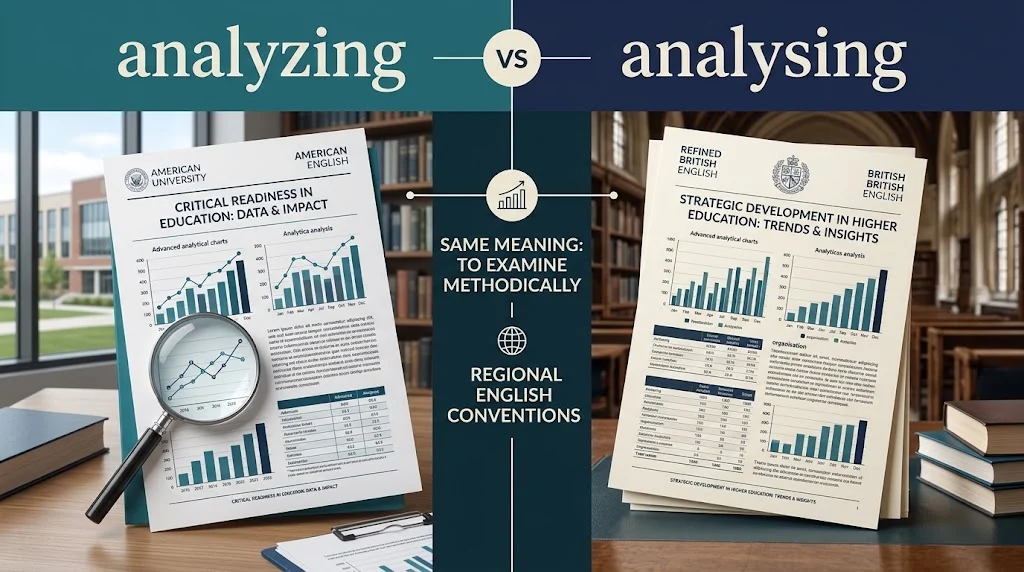
Analyzing or analysing are both correct spellings of the verb meaning to examine something carefully and understand its parts, meaning, or structure. The difference is regional rather than grammatical. Analyzing is the standard spelling in American English, while analysing is standard in British English and many other varieties, including Australian and Canadian English.
Analyzing or Analysing | What Is the Difference?
The main difference between analyzing and analysing is the spelling convention used by different English varieties. Both words come from the verb analyze, meaning to examine something closely and systematically.
In American English, the preferred form is analyzing. American English generally keeps the letter z in words such as analyze, analyzing, organize, and organizing.
In British English, the preferred form is analysing. British English commonly uses s in words such as analyse, analysing, organise, and organising.
Neither spelling is inherently more correct. The important point is consistency. If you are writing for an American audience, use analyzing. If your audience follows British English conventions, use analysing.
| Word | Part of Speech | English Variety | Meaning | Example |
|---|---|---|---|---|
| Analyzing | Verb, present participle | American English | Examining something carefully | She is analyzing the survey results. |
| Analysing | Verb, present participle | British English | Examining something carefully | She is analysing the survey results. |
The meaning does not change between the two forms.
The pronunciation is essentially the same in standard usage.
The spelling changes because of regional English conventions.
For professional writing, follow the spelling system expected by your readers.
Analyzing or Analysing in American and British English
The easiest way to remember the difference is to look at the base verb.
American English uses analyze.
British English uses analyse.
Consequently, the present participle becomes analyzing in American English and analysing in British English.
This pattern appears in many related words. American English commonly uses organize, while British English commonly uses organise. American English uses recognize, while British English commonly uses recognise.
There are exceptions within British usage, particularly where a word has a different historical or technical origin, so writers should not assume that every word containing a similar sound follows exactly the same pattern.
For the specific word discussed here, however, the distinction is straightforward.
American English vs British English
| American English | British English |
|---|---|
| analyze | analyse |
| analyzing | analysing |
| analyzed | analysed |
| analyzer | analyser |
The important lesson is that these forms are spelling variants rather than different words with different meanings.
Is Analyzing or Analysing a Grammar, Vocabulary, or Usage Issue?
This is primarily a spelling and usage issue, not a difference in grammar or vocabulary.
Both forms function as the present participle of the corresponding verb. For example, in American English, you can write, “The researcher is analyzing the data.” In British English, you can write, “The researcher is analysing the data.”
The grammatical structure remains the same.
The distinction becomes important when you are writing for a particular audience. An American university paper normally follows American spelling conventions. A British academic journal normally expects British spelling conventions.
The same principle applies to websites, business documents, software interfaces, reports, textbooks, and educational materials.
The words are therefore interchangeable in meaning, but they should not be mixed casually within a single document.
A report that begins with analyzing and later switches repeatedly to analysing may look inconsistent even though both forms are legitimate.
Formal Versus Informal Usage
Both spellings can appear in formal and informal writing. The choice does not depend on the writing is formal.
What matters is the English variety being followed.
An American legal report can use analyzing. A British legal report can use analysing.
Likewise, an informal British email may use analysing, while an informal American message may use analyzing.
Academic Versus Casual Usage
Academic writers should pay particular attention to consistency because universities, journals, publishers, and style guides often specify a preferred English variety.
If an American institution asks students to use American English, analyzing is appropriate.
If a British institution requires British English, analysing is appropriate.
The same principle applies to academic publishing. Always check the publication’s style requirements before deciding which spelling to use.
How to Use Analyzing Correctly
Analyzing is the standard American English spelling of the present participle of analyze.
It describes the process of examining information, evidence, language, behavior, data, or another subject in detail.
Workplace Example
A manager might write:
“We are analyzing customer feedback to identify recurring service problems.”
Here, analyzing describes an ongoing process. The team is examining customer feedback and looking for meaningful patterns.
Another workplace example is:
“The finance department is analyzing quarterly sales figures.”
This sentence is natural in American English.
Academic Example
A university student might write:
“The researcher is analyzing historical documents to understand changes in public opinion.”
The word describes systematic examination, which makes it especially common in academic research.
Technology Example
A technology company might say:
“The software is analyzing user activity to detect unusual behavior.”
Here, the software performs an analytical process rather than a person.
Usage Recap
Use analyzing when your writing follows American English.
It is appropriate in professional, academic, technical, and casual contexts.
It has the same meaning as analysing.
How to Use Analysing Correctly
Analysing is the standard British English spelling of the present participle of analyse.
It has exactly the same basic meaning as analyzing. The difference lies in the spelling convention.
Workplace Example
A British company might write:
“Our team is analysing customer feedback before preparing the annual report.”
This is completely standard British English.
Another example is:
“The department is analysing the latest sales figures.”
Academic Example
A British academic paper might state:
“The study focuses on analysing patterns in language use.”
The spelling fits British academic conventions.
Technology Example
A British technology company might write:
“The system is analysing network activity in real time.”
The technological context does not change the spelling rule.
Usage Recap
Use analysing when following British English conventions.
It works in formal and informal writing.
Its meaning is identical to analyzing.
When You Should NOT Use Analyzing or Analysing
There are several situations in which writers make avoidable mistakes with these spellings.
1. Do Not Mix English Varieties Without a Reason
If the rest of your American English article uses analyze, organize, and recognize, switching to analysing creates inconsistency.
2. Do Not Assume British Spelling Is More Formal
The letter s does not automatically make a word more professional. Analysing is British English, while analyzing is American English.
3. Do Not Assume American Spelling Is Always Correct
The spelling analyzing is correct in American English, but a British publication may expect analysing.
4. Do Not Change the Spelling Because of the Audience’s Accent
Pronunciation does not determine which written form you should use. Follow the spelling convention of the publication or institution.
5. Do Not Mix Both Forms in One Professional Document
Using both spellings without a clear reason can make your writing appear poorly edited.
6. Do Not Treat the Words as Different Meanings
There is no meaningful difference in what the two words communicate.
7. Do Not Change the Form in the Middle of a Style Guide
If a project has established American or British English rules, follow them throughout the document.
8. Do Not Let Automated Software Make the Final Decision
Spell checkers may use different regional dictionaries. A red underline does not necessarily mean the word itself is wrong.
Common Mistakes and Decision Rules
The following examples show how regional spelling affects correctness.
| Correct sentence | Incorrect sentence | Explanation |
|---|---|---|
| The scientist is analyzing the results. | The scientist is analysing the results. | The first sentence follows American English. The second is correct in British English, so it is incorrect only when American spelling is required. |
| The researcher is analysing the evidence. | The researcher is analyzing the evidence. | The first sentence follows British English. The second is the American form. |
| We are analyzing customer behavior. | We are analysing customer behavior. | American English uses analyzing in this context. |
| We are analysing customer behaviour. | We are analyzing customer behaviour. | The first sentence consistently follows British spelling conventions. |
Decision Rule
If you are writing in American English, use analyzing.
If you are writing in British English, use analysing.
The simplest method is to check other spelling choices in the same document. If you use color, organize, and center, American English is likely the appropriate system. If you use colour, organise, and centre, British English is likely the better choice.
Analyzing and Analysing in Modern Technology and AI Tools
Modern technology has made analytical language extremely common.
Software can analyze large datasets, artificial intelligence systems can analyze text, and security platforms can analyze network traffic. In American English documentation, these descriptions normally use analyzing.
British English documentation uses analysing.
For example, an American software manual might state:
“The application is analyzing incoming data.”
A British software manual might state:
“The application is analysing incoming data.”
AI writing tools can sometimes create regional inconsistencies because their output depends on training data, prompts, language settings, and editing rules.
For businesses publishing internationally, establishing an English style guide is therefore useful. A style guide can specify the organization uses American English or British English.
This is especially important for websites that publish large amounts of educational, technical, or commercial content.
Why Consistency Matters in Professional Writing
Readers rarely stop to think about the spelling of a common word. However, inconsistent spelling can affect their perception of a document.
Imagine a website using analyze on one page and analyse on another page without any regional explanation. A reader may wonder the inconsistency reflects an editing mistake.
Consistency improves editorial quality.
For content teams, the best approach is to select a regional standard before writing begins. The decision can be based on the target market, organization, publication requirements, or dominant audience.
For an American audience, use American English consistently.
For a British audience, use British English consistently.
For international audiences, choose one standard and state it in the editorial style guide when necessary.
Etymology of Analyze and Analyse
The words analyze and analyse ultimately trace back through Latin and Greek linguistic history.
The English verb is connected with Greek analyein, carrying the idea of breaking something up or examining it by separating it into parts.
That original concept remains visible in modern usage. When you analyze an argument, you examine its components. When you analyze data, you examine individual values and patterns. When you analyze a literary work, you investigate its structure, language, themes, and meaning.
The spelling difference developed through English usage traditions. American English generally adopted the z spelling in this family of words, while British English commonly retained the s spelling.
An Expert Style Rule for Writers
“The strongest choice is not the spelling that looks most familiar. It is the spelling that consistently matches the English variety of your audience.”
This principle is useful beyond this single word. Professional editing is not simply about finding words that look correct. It is about making deliberate choices that fit the audience, publication, and established style.
Case Study: An American Research Report
Consider a research team preparing a report for an American university.
The report uses color, organization, and analyze throughout the document. During final editing, one sentence contains:
“The researchers are analysing the responses.”
The editor changes it to:
“The researchers are analyzing the responses.”
The concrete result is consistency across the document. The meaning does not change, but the spelling now matches the American English standard already used throughout the report.
Case Study: A British Technology Website
Now consider a British technology website that consistently uses colour, organisation, and analyse.
An article contains the sentence:
“The platform is analyzing user behavior.”
The editor changes it to:
“The platform is analysing user behaviour.”
The concrete result is regional consistency. The wording now matches the site’s established British English style.
These examples demonstrate why the choice is not about one spelling being universally correct. It is about matching the spelling to the selected English variety.
Error Prevention Checklist
Always Use Analyzing When
• Your document follows American English.
• Your publication uses American spelling.
• Your audience primarily uses American English.
• Your style guide specifies analyze and related forms with z.
Always Use Analysing When
• Your document follows British English.
• Your publication uses British spelling.
• Your institution specifies British English.
• Your style guide specifies analyse and related forms with s.
Never Use the Wrong Regional Form Without Checking
• Do not switch between American and British spelling randomly.
• Do not assume one spelling is universally correct.
• Do not judge correctness only by your spell checker.
• Do not change the spelling merely because another writer uses a different regional convention.
Related Grammar Confusions You Should Master
Understanding regional spelling can help you recognize other common English differences.
- Color or colour
- Center or centre
- Organize or organise
- Recognize or recognise
- License or licence
- Practice or practise
- Traveler or traveller
- Canceled or cancelled
- Labeled or labelled
- Toward or towards
Learning these distinctions makes it easier to maintain a consistent English style across an entire article or website.
FAQs
Is analyzing or analysing correct?
Both are correct. Analyzing is standard American English, while analysing is standard British English.
Is analyzing American or British English?
Analyzing is the standard American English spelling of the present participle of analyze.
Is analysing the British spelling?
Yes. Analysing is the standard British English spelling of the present participle of analyse.
Does analyzing mean the same as analysing?
Yes. Both forms mean examining something carefully to understand its parts, meaning, or structure.
Should I use analyzing in an American essay?
Yes. Analyzing is normally the preferred spelling when an essay follows American English conventions.
Should I use analysing in a British essay?
Yes. Analysing is normally preferred when the essay follows British English conventions.
Why does American English use analyzing instead of analysing?
American English commonly uses z in this word family, while British English commonly uses s.
Can I use analyzing and analysing in the same article?
You should normally avoid switching between them unless the context requires different regional quotations or sources.
Is analyzing a verb?
Yes. Analyzing is the present participle and gerund form of the American English verb analyze.
How can I remember the difference between analyzing and analysing?
Remember the base forms: American English uses analyze, while British English uses analyse.
Conclusion
The choice between analyzing or analysing depends on the English variety you are using, not on a difference in meaning. Analyzing is the standard American English form, while analysing is the standard British English form.
For accurate professional and academic writing, choose one regional convention and apply it consistently. Once you identify your audience follows American or British English, the decision becomes simple.
If your audience is American, choose analyzing. If your audience is British, choose analysing. Both forms communicate the same idea, so consistency is the real key to polished writing.
Discover More Related Articles:
- Neighbor or Neighbour | Which Version Is Right for Your Audience In 2026
- Plandid or Candid | Meaning, Differences, Usage & Examples In 2026
- Cowlick or Balding | How to Tell the Difference & When to Worry In 2026