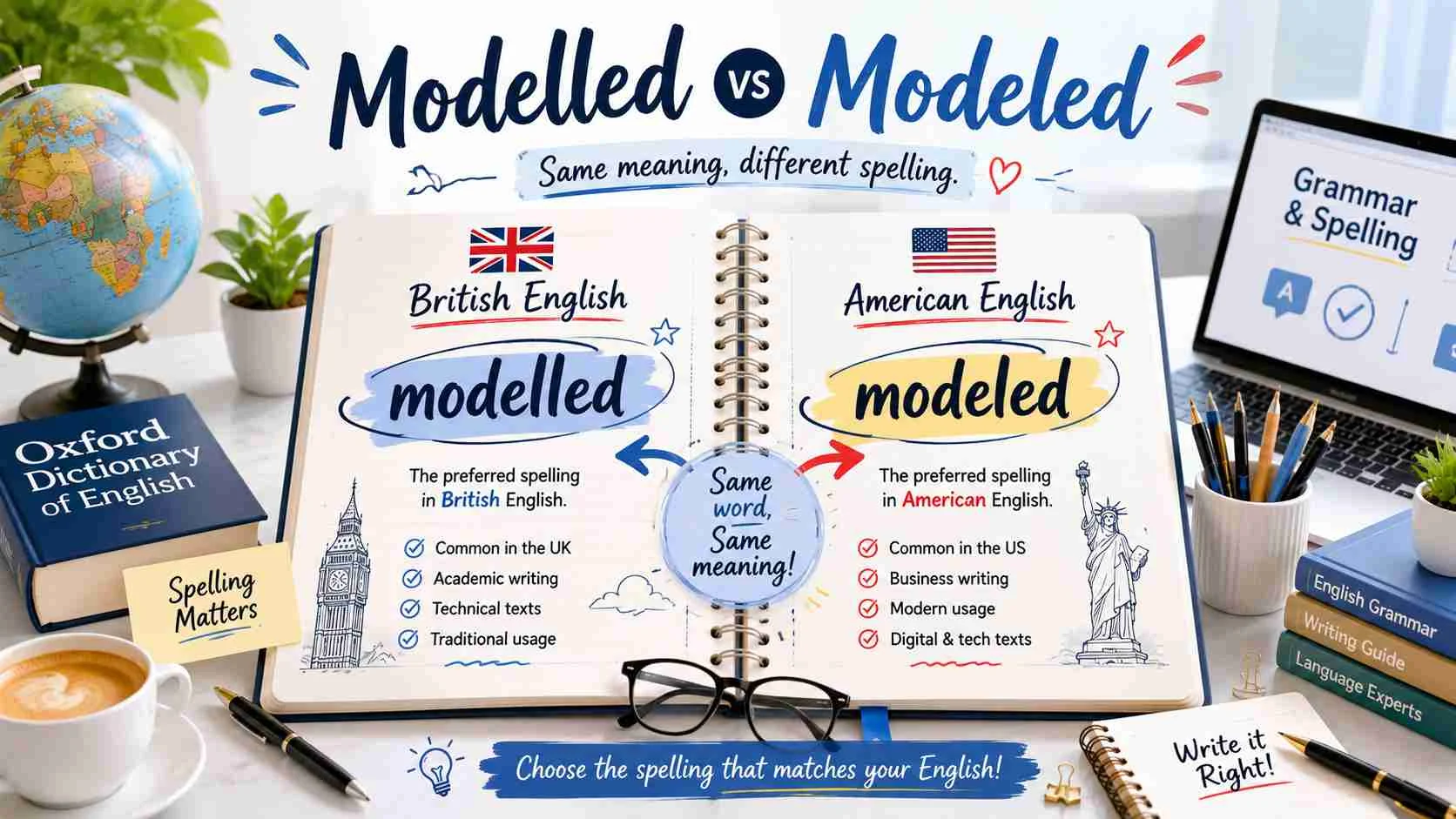
Modelled or modeled are both correct spellings of the past tense and past participle of the verb model. The difference depends on the variety of English you use. Modelled is the preferred spelling in British English, while modeled is standard in American English. Neither is more grammatically correct than the other.
A single extra l can make British and American English look different, even when the meaning stays exactly the same. That is the case with Modelled or Modeled, a common spelling question in formal and everyday writing.
Both forms are correct, but your choice depends mainly on the variety of English you are using. Modeled is the standard American English form, while modelled is preferred in British English and many other varieties. If you’re wondering about the modeled or modelled difference, it is primarily a spelling convention rather than a difference in meaning.
Understanding the modelled meaning and the correct modeled form can help you write consistently. This guide explains modeled, modelled, and the relationship between modelled modeled and modeled modelled, with clear examples so you can confidently choose the right spelling for your audience.
Modelled or Modeled | What’s the Difference?
At first glance, these spellings appear different, but their meaning and grammatical function are exactly the same. The only distinction is the version of English being used.
| Feature | Modelled | Modeled |
|---|---|---|
| Part of speech | Verb | Verb |
| Verb form | Past tense and past participle | Past tense and past participle |
| Preferred in | British English | American English |
| Meaning | Created, demonstrated, represented, or served as an example | Created, demonstrated, represented, or served as an example |
| Grammatically correct | Yes | Yes |
Quick recap
Both spellings communicate the same idea.
British English usually doubles the final letter before adding the ending.
American English usually keeps a single final letter in this situation.
Choose one spelling style and use it consistently throughout your writing.
Is Modelled or Modeled a Grammar, Vocabulary or Usage Issue?
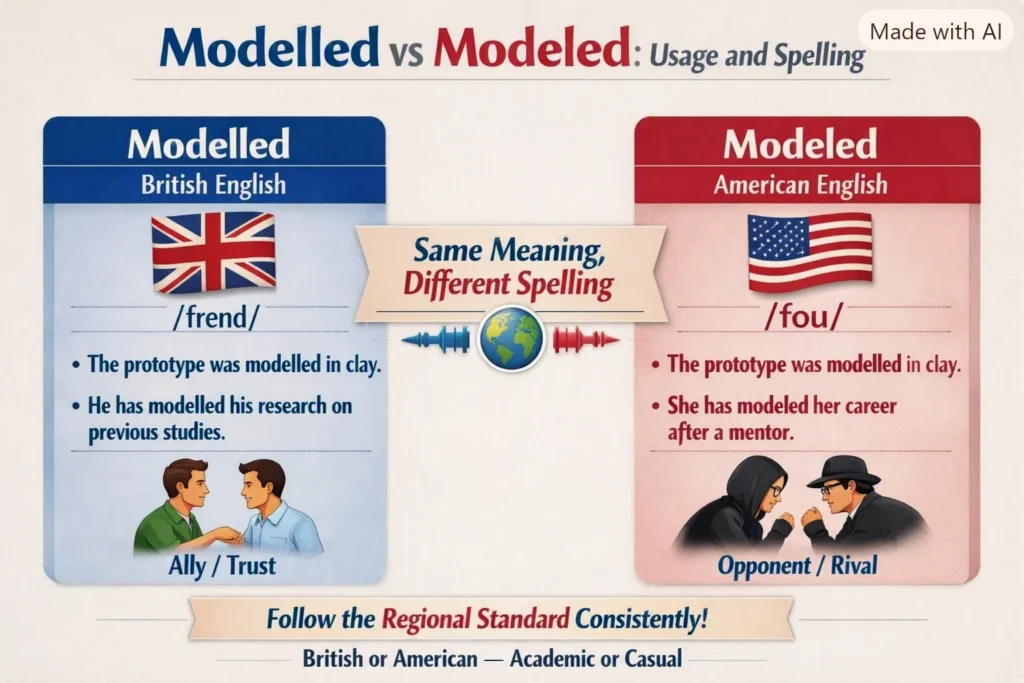
This question is primarily a usage and spelling issue rather than a grammar problem.
The verb itself does not change meaning. Instead, the spelling changes according to regional writing conventions.
Are they interchangeable?
Yes, provided you stay consistent with the variety of English you are using.
For example, an article written for readers in the United Kingdom should normally use modelled. An article intended for readers in the United States should consistently use modeled.
Mixing both spellings within the same document may appear careless, especially in professional or academic writing.
Formal versus informal writing
The spelling difference applies equally in formal and informal contexts.
A university dissertation written in British English should use modelled.
A casual blog aimed at an American audience should use modeled.
The level of formality does not determine which spelling is correct. Regional language standards do.
Academic versus casual writing
Academic publishers often specify submissions should follow British or American English.
Casual writing offers more flexibility, but consistency still improves readability and professionalism.
Understanding the Rule Behind the Spellings
The difference comes from a broader spelling pattern.
British English often doubles the final consonant before adding endings such as ed or ing when the stress pattern supports it.
Examples include:
- travelled
- cancelled
- labelled
- modelled
American English typically simplifies these spellings.
Examples include:
- traveled
- canceled
- labeled
- modeled
This pattern explains why you see both spellings in books, websites, and official publications from different countries.
Using Modelled Correctly
If you write for audiences in the United Kingdom, Australia, New Zealand, Ireland, or many Commonwealth countries, modelled is generally the preferred spelling.
Workplace example
The design team modelled several prototypes before presenting the final concept.
Academic example
Researchers modelled climate patterns over a fifty year period.
Technology example
The software engineers modelled the network architecture before deployment.
Usage recap
Use modelled when following British English spelling conventions.
Its meaning remains identical to modeled.
It is appropriate in professional, educational, scientific, and everyday writing.
Using Modeled Correctly
American English writers almost always use modeled.
The spelling appears in newspapers, textbooks, business reports, and government publications throughout the United States.
Workplace example
The finance department modeled different investment scenarios before approving the budget.
Academic example
The professor modeled the statistical relationship using historical data.
Technology example
Developers modeled user behavior to improve the application experience.
Usage recap
Use modeled whenever your document follows American English.
Maintain this spelling consistently across the entire document.
Readers in the United States expect this version.
When You Should NOT Use Modelled or Modeled
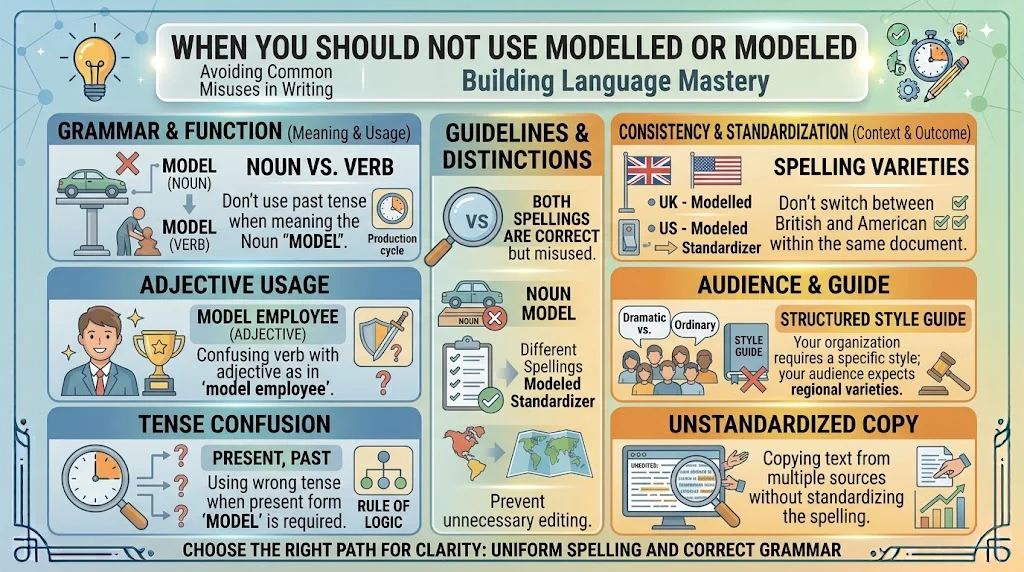
Although both spellings are correct, there are situations where writers commonly misuse them.
Do not use either spelling when:
- You are referring to the noun model rather than the verb.
- You switch between British and American spelling within the same document.
- Your organization requires a specific style guide and you ignore it.
- You confuse the verb with the adjective model as in model employee.
- You use the wrong tense when the present form model is required.
- You assume one spelling is more correct worldwide.
- You copy text from multiple sources without standardizing the spelling.
- Your audience expects a different regional variety of English.
Following these simple rules prevents unnecessary editing later.
Common Mistakes and Decision Rules
| Correct sentence | Incorrect sentence | Explanation |
|---|---|---|
| The engineers modeled the bridge before construction. | The engineers modelled the bridge in an American report. | American English prefers modeled. |
| The researchers modelled the experiment carefully. | The researchers modeled the experiment in a British journal. | British publications usually prefer modelled. |
| The teacher modeled good behavior for the class. | The teacher modelled good behavior in an American textbook. | Follow the regional spelling standard. |
| The architect modelled several designs. | The architect modeled several designs in a British government report. | Match the spelling to the intended audience. |
Decision Rule
If you are writing in British English, use modelled.
If you are writing in American English, use modeled.
If your organization has a style guide, always follow that guide rather than personal preference.
Why Consistency Matters
Readers rarely object to either spelling by itself. What they notice is inconsistency.
Imagine reading an article that begins with modelled, switches to modeled halfway through, and finishes with modelled again. Even though each spelling is individually correct, the inconsistency reduces credibility.
Professional editors routinely check documents for this exact issue because consistent spelling creates a smoother reading experience and demonstrates attention to detail.
Etymology
The verb model entered English through French and ultimately traces back to the Latin word modulus, meaning a small measure or standard.
As English evolved into different regional forms, spelling conventions also developed. British English retained more doubled consonants in many words, while American English adopted simplified spellings in numerous cases.
This historical development explains why both modelled and modeled remain accepted today rather than one replacing the other entirely.
Modelled or Modeled in Modern Technology and AI Tools
Artificial intelligence, machine learning, and data science have made the verb model more common than ever. You are discussing predictive analytics, language processing, or computer simulations, the spelling rule remains the same.
An American software company is likely to write:
“The system modeled customer behavior using historical purchase data.”
A British research institute would naturally write:
“The algorithm modelled traffic patterns to improve urban planning.”
The underlying technology does not change. Only the regional spelling convention changes.
Many AI writing assistants can automatically switch between British and American English. However, they are not perfect. If content from multiple sources is combined, inconsistent spelling may appear. A careful proofreading pass is still essential before publishing.
What Language Experts Recommend
Professional editors generally agree on one principle:
“Choose the variety of English that matches your audience and apply it consistently throughout your document.”
This advice appears in many editorial style guides because consistency improves readability, professionalism, and reader trust.
Instead of worrying about which spelling is universally correct, focus on it fits your intended audience.
Real World Case Study One
International Business Report
A multinational consulting company prepared an annual report for clients in both the United Kingdom and the United States.
Initially, the document contained both modelled and modeled because several regional teams contributed content.
Editors standardized the spelling before publication.
The British edition consistently used modelled.
The American edition consistently used modeled.
The result was a polished report that matched each audience’s expectations and reduced editorial revisions.
Real World Case Study Two
University Research Publication
A graduate student submitted a research paper to a British academic journal.
Although the research quality was excellent, reviewers noted inconsistent spelling throughout the manuscript.
The student had copied references from American sources while writing in British English.
After changing every instance of modeled to modelled, the paper aligned with the journal’s style requirements and moved smoothly through the editing process.
The lesson is simple. Consistency matters as much as correctness.
Error Prevention Checklist
Before publishing any document, ask yourself the following questions.
Always use modelled when
- Your document follows British English.
- Your audience is primarily in the United Kingdom or other Commonwealth countries.
- Your publisher requires British spelling.
- The rest of your document uses British conventions such as colour and organisation.
Never use modelled when
- Your style guide requires American English.
- Your document consistently uses American spellings.
Always use modeled when
- Your audience is based in the United States.
- You follow American editorial standards.
- Your organization publishes in American English.
Never use modeled when
- You are writing entirely in British English.
- Your academic institution specifies British spelling.
A final proofreading pass focused on spelling consistency can eliminate nearly all regional spelling errors.
Related Grammar Confusions You Should Master
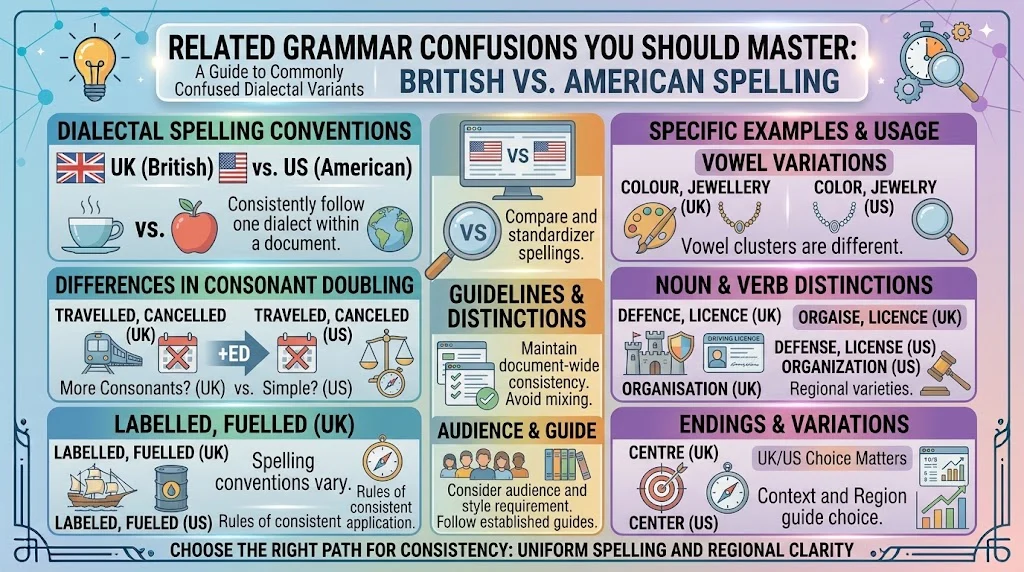
If you found this comparison helpful, you may also want to learn about other commonly confused British and American spellings.
- Travelled or traveled
- Cancelled or canceled
- Labelled or labeled
- Fuelled or fueled
- Jewellery or jewelry
- Colour or color
- Organisation or organization
- Defence or defense
- Licence or license
- Centre or center
Mastering these differences will make your writing more polished and appropriate for international audiences.
FAQs
Is modelled or modeled correct?
Both are correct. Modelled is the preferred spelling in British English, while modeled is the standard spelling in American English.
Why does British English use modelled?
British English commonly doubles the final consonant before adding certain endings. This spelling pattern also appears in words such as travelled and labelled.
Why does American English use modeled?
American English generally simplifies many spellings by avoiding the doubled consonant in words like modeled, traveled, and labeled.
Is there a difference in meaning between modelled and modeled?
No. Both words have exactly the same meaning. Only the spelling differs according to regional English conventions.
Which spelling should I use in academic writing?
Use the spelling required by your university, publisher, or journal. Most institutions specify either British or American English.
Can I use both spellings in the same article?
It is strongly discouraged. Mixing regional spellings makes writing appear inconsistent and less professional.
Which spelling is better for SEO?
Neither spelling is inherently better. Choose the version that matches your target audience. If your readers are primarily American, use modeled consistently. If they are primarily British, use modelled throughout.
Do grammar checkers recognize both spellings?
Yes. Most modern grammar and spelling tools recognize both forms. However, they may flag one as incorrect if your language settings are configured for a different variety of English.
Does Google treat modelled and modeled differently?
Search engines understand that both spellings refer to the same concept. However, using the spelling your audience naturally searches for can improve user experience and relevance.
Conclusion
Understanding modelled or modeled is much easier once you know the rule behind the spelling difference. Both forms are grammatically correct, both carry the same meaning, and both function as the past tense and past participle of the verb model.
The only real distinction is regional preference. British English favors modelled, while American English prefers modeled. Rather than searching for a universally correct option, focus on your audience, follow the appropriate style guide, and remain consistent from beginning to end. Doing so will make your writing more professional, credible, and easier for readers to trust.
Discover More Related Articles:
- Effective or Affective | Clear Up This Tricky English Confusion In 2026
- Pancakes or Waffles | Which Breakfast Choice Is Better for You In 2026
- Blanky or Blankie | Which Spelling Is Correct & When Should You Use Each In 2026