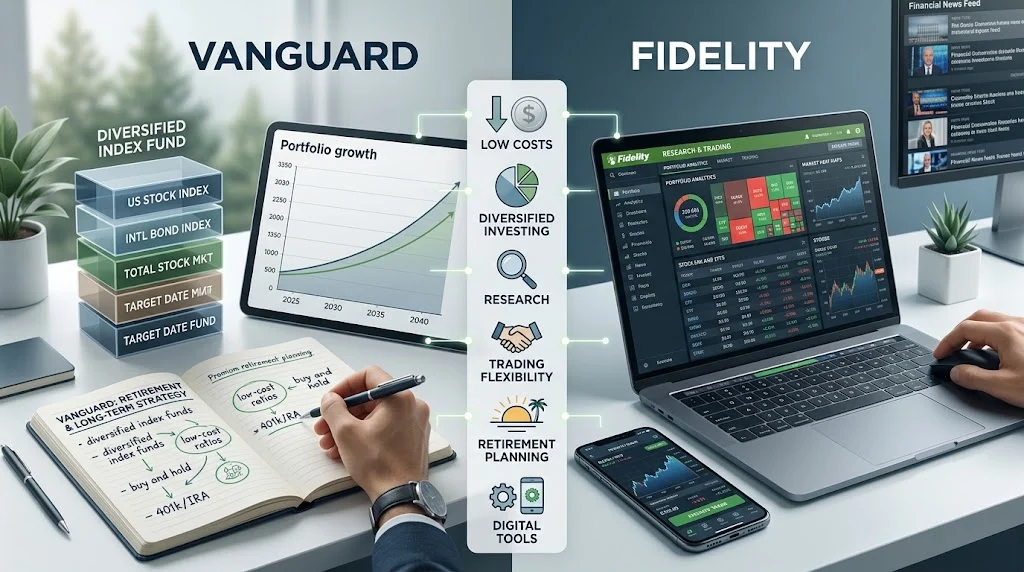
Vanguard or Fidelity refers to a comparison between two major US investment firms that offer brokerage accounts, retirement accounts, mutual funds, ETFs, and investment management services. Vanguard is especially known for low cost index investing, while Fidelity offers a broader trading platform, extensive research tools, and a wide selection of investments. Choosing between them depends on your goals, costs, and preferred investing style.
Vanguard or Fidelity | What’s the Difference?
Vanguard and Fidelity are both established investment companies, but they developed with somewhat different strengths. Vanguard built its reputation around low cost mutual funds, index investing, and long term portfolio construction. Fidelity has a broader emphasis on brokerage services, active trading, research, financial planning, retirement accounts, and investment choices.
The important point is that neither company is automatically better for every investor. The better choice depends on what you want to do with your money, how often you expect to trade, which funds you prefer, and you want sophisticated research or a simple long term investment approach.
| Feature | Vanguard | Fidelity |
|---|---|---|
| Primary strength | Low cost index investing and long term investing | Brokerage services, research, trading, and broad investment choice |
| Brokerage account | Available with no opening investment minimum | Available with no account minimum |
| Stocks | Available | Available |
| ETFs | Broad selection, including Vanguard ETFs | Broad selection with online ETF trades at zero commission |
| Mutual funds | Strong selection of Vanguard funds | Large selection, including thousands of no transaction fee funds |
| Retirement accounts | IRAs and other retirement options | IRAs and a wide range of retirement options |
| Research and trading tools | Designed strongly around long term investing | Extensive research and trading tools |
| Automated investing | Vanguard Digital Advisor | Fidelity Go |
| Best suited to | Long term, cost conscious investors | Investors wanting flexibility and extensive tools |
Vanguard says its brokerage account can be opened with no fee or minimum investment, although specific investments can have their own minimums. Its current brokerage information also lists a $25 annual account service fee that can generally be avoided through electronic delivery.
Fidelity states that its retail brokerage account has no account minimum and no account fee. It also offers zero commission online trades for US stocks, ETFs, and options, although options contracts and certain other transactions can involve separate costs.
Quick Recap
Vanguard is particularly attractive for investors who prefer a straightforward, long term strategy.
Fidelity is particularly attractive for investors who want more trading flexibility and research tools.
Both companies offer brokerage and retirement accounts.
Your investment choices and the fees attached to specific investments matter more than the company name alone.
Is Vanguard or Fidelity a Grammar, Vocabulary or Usage Issue?
The phrase Vanguard or Fidelity is not a grammar problem. It is a comparison between proper nouns representing financial institutions.
Vanguard is the name of an investment management company, while Fidelity refers to Fidelity Investments, another major financial services company. Because both names can appear in discussions about brokerage accounts, mutual funds, retirement planning, ETFs, and investing, people frequently search for them together when trying to decide which platform fits their needs.
The distinction is therefore practical and financial rather than grammatical.
In formal financial writing, you should identify the exact product or service being compared. Saying that one company is cheaper without specifying you mean brokerage fees, fund expense ratios, advisory fees, or another cost can create a misleading comparison.
In casual conversation, someone might simply ask, “Should I use Vanguard or Fidelity?” In an academic or professional setting, a more precise question would be, “Which brokerage platform offers the investment features and costs that best match this investor’s objectives?”
Vanguard | Who Is It Best For?
Vanguard is widely associated with index investing and low cost funds. The company was founded around the principle that investment costs matter and that broad market exposure can be a practical foundation for long term portfolios.
Its current information highlights low cost mutual funds and ETFs, and Vanguard reports that its average ETF and mutual fund expense ratio was 0.07 percent as of December 31, 2025, compared with an industry average of 0.44 percent.
That difference can matter over many years because investment expenses reduce the amount of money that remains invested.
Workplace Example
Imagine an employee receives a new retirement plan rollover and wants a simple portfolio rather than frequent trading. A Vanguard focused strategy could appeal to that investor because the emphasis can remain on diversified funds, asset allocation, costs, and long term discipline.
Academic Example
A finance student researching passive investing might examine Vanguard index funds as an example of how broad market exposure can be delivered through diversified investment products.
Technology Example
An investor using Vanguard Digital Advisor can receive automated portfolio management based on goals and risk considerations. Vanguard currently lists a $100 minimum to qualify and an approximate annual cost of $15 to $16 per $10,000 invested for its digital advisory service, although the actual fee structure depends on the portfolio and circumstances.
Vanguard Usage Recap
Choose Vanguard when low cost investing and long term portfolio construction are central priorities.
It can be especially appealing to investors who do not need an extensive active trading environment.
Fidelity | Who Is It Best For?
Fidelity has a broader brokerage orientation and provides access to stocks, ETFs, mutual funds, bonds, CDs, options, retirement accounts, research tools, and other financial services.
Its brokerage account currently offers access to thousands of mutual funds with no transaction fees, while Fidelity also provides online trading for US stocks, ETFs, and options at zero commission, subject to applicable conditions and contract fees.
Fidelity also offers its own ZERO index mutual funds, which have zero expense ratios for the listed funds.
Workplace Example
Consider an employee who wants a retirement account but also wants access to detailed research tools for evaluating individual stocks and ETFs. Fidelity may be attractive because its platform combines retirement services with broader brokerage functionality.
Academic Example
A finance student studying asset allocation could use Fidelity’s educational resources to compare stocks, bonds, mutual funds, ETFs, and different portfolio approaches.
Technology Example
Fidelity provides digital investing and trading tools through its website and mobile application. Investors can monitor portfolios, research securities, create watchlists, and place trades through its technology platform.
Fidelity Usage Recap
Choose Fidelity when you want a broad investment platform with extensive research and trading capabilities.
It can be especially useful for investors who expect their needs to expand beyond simple index fund investing.
Vanguard or Fidelity | Which Is Better for Beginners?
For a beginner, the answer depends on what “better” means.
Someone who wants to invest regularly in diversified index funds may prefer Vanguard’s straightforward investing philosophy. Someone who wants educational material, research tools, flexible investment choices, and the ability to explore individual securities may prefer Fidelity.
A beginner should not choose a platform simply because one company has a famous fund. The account experience, investment costs, available products, tax considerations, and the investor’s own behavior all matter.
The best beginner platform is usually the one that makes it easier to maintain a sensible strategy without unnecessary trading.
When You Should NOT Use Vanguard or Fidelity
There are several situations in which comparing these two companies alone may not answer the real question.
- Do not choose either platform solely because someone says it is “the cheapest.” Different funds and services have different costs.
- Do not compare an investment fund’s expense ratio with a brokerage account fee as though they were the same charge.
- Do not assume that zero commission means zero investment cost. Funds can still have expense ratios and other costs.
- Do not select a platform only because it has a popular app. Your investment strategy matters more than interface design.
- Do not move retirement assets without understanding potential tax consequences and account rules.
- Do not choose a fund merely because its past performance was impressive.
- Do not assume that all mutual funds available through a brokerage have identical fees.
- Do not use a brokerage comparison as a substitute for understanding diversification, risk tolerance, taxes, and investment objectives.
Fidelity itself explains that mutual fund costs can include management expenses, transaction fees, loads, and other charges depending on the fund.
Common Mistakes and Decision Rules
| Correct sentence | Incorrect sentence | Explanation |
|---|---|---|
| Vanguard may suit a long term index investor. | Vanguard is always the cheapest choice. | Costs vary by account, fund, and service. |
| Fidelity offers a broad range of investment choices. | Fidelity only provides stock trading. | Fidelity offers stocks, ETFs, mutual funds, bonds, CDs, options, and other services. |
| Compare fund expense ratios before investing. | Compare only trading commissions. | Investment costs include more than trading commissions. |
| Choose based on your investment objectives. | Choose based only on brand popularity. | A well known company is not automatically the right fit. |
| Check the current fee schedule. | Assume fees never change. | Brokerage pricing and service terms can change. |
Decision Rule Box
If you prioritize low cost index investing and long term portfolio simplicity, Vanguard may be the stronger fit.
If you prioritize research, trading flexibility, and a broad brokerage ecosystem, Fidelity may be the stronger fit.
If costs are your main concern, compare the exact funds and services rather than comparing company names alone.
Vanguard or Fidelity in Modern Technology and AI Tools
Modern investing increasingly combines traditional brokerage services with digital tools.
Both companies provide online account management, portfolio information, investment research, and automated investment services. This means investors no longer need to view a brokerage purely as a place where trades happen.
AI and automation can help investors organize information, analyze financial concepts, and understand investment terminology. However, an AI tool should not be treated as a replacement for reviewing fund documents, fee schedules, tax rules, or personalized financial advice.
Technology can make investing easier, but it cannot remove investment risk.
Fidelity emphasizes digital research and trading tools, while Vanguard’s Digital Advisor focuses on automated investment management and personalized portfolio construction.
Vanguard or Fidelity | Fees, Funds and Investment Costs
One of the most important differences between platforms is not simply the brokerage commission. Investors should consider the total cost of owning an investment.
This can include an expense ratio, transaction costs, advisory fees, account service fees, and other charges.
Fidelity currently advertises zero commission online trades for US stocks, ETFs, and options. It also states that its retail brokerage accounts have no account minimums.
Vanguard currently states that there is no fee to open an account and that its brokerage account can be held without the annual service fee when customers meet the applicable electronic delivery requirement.
The practical lesson is simple: compare the complete cost of the specific investment strategy you plan to use.
Etymology and Brand Background
Vanguard’s name is associated with the idea of being at the forefront of a movement. That concept fits the company’s historical association with the growth of index investing and low cost fund ownership.
Fidelity comes from the English word “fidelity,” meaning faithfulness, loyalty, or trustworthiness. The name reflects a concept commonly associated with financial relationships, where investors place substantial trust in an institution to manage and safeguard assets.
Expert Style Insight
A useful investing principle is that the best platform is not necessarily the one with the most features. It is the one whose costs, tools, and investment choices help you consistently follow an appropriate strategy.
Two Practical Case Studies
Case Study One: The Long Term Index Investor
Suppose an investor has $10,000 and wants a diversified index based portfolio. The investor expects to hold the investments for many years and does not plan to trade frequently.
Vanguard’s low cost investment philosophy may be particularly appealing in this situation. Vanguard reports an average ETF and mutual fund expense ratio of 0.07 percent as of the end of 2025.
At 0.07 percent, an illustrative $10,000 investment would have an annual fund expense of about $7 before considering changes in the investment value. The actual cost depends on the funds selected.
The result is a strategy focused on keeping ongoing investment costs low while maintaining diversified market exposure.
Case Study Two: The Flexible Brokerage Investor
Now consider an investor who wants to hold ETFs but also research individual companies, bonds, CDs, options, and mutual funds.
Fidelity’s brokerage platform offers access to these categories and provides advanced research and trading tools.
For this investor, platform flexibility can be more important than choosing a company solely for its index fund reputation.
The concrete advantage is breadth. The investor can use one brokerage relationship for several investment activities rather than choosing a platform designed mainly around one investing philosophy.
Error Prevention Checklist
Always Use Vanguard When
• Your priority is a long term, cost conscious investment approach.
• You prefer a strong focus on index funds and diversified investing.
• You want Vanguard’s specific investment products or advisory services.
• You value simplicity over frequent trading.
Never Use Fidelity When
This should not be interpreted literally as a universal rule. Fidelity can be an excellent choice for many investors. Instead, avoid choosing Fidelity solely because of zero commission advertising without checking the actual investment costs and products involved.
Likewise, never assume Vanguard is automatically superior simply because of its reputation for low costs.
Related Investment Confusions You Should Master
Understanding Vanguard and Fidelity becomes easier when you also understand related investing concepts.
- ETF vs mutual fund
- Index fund vs actively managed fund
- Expense ratio vs management fee
- Brokerage account vs retirement account
- Traditional IRA vs Roth IRA
- Stocks vs bonds
- Market order vs limit order
- Capital gains vs dividends
- Passive investing vs active investing
- Commission vs expense ratio
These distinctions can prevent costly misunderstandings because investment terminology often sounds similar even when the financial consequences are very different.
FAQs
Is Vanguard or Fidelity better for beginners?
Both can work well, but Vanguard may appeal to simple long term investors while Fidelity may appeal to beginners who want more research and trading tools.
Is Vanguard cheaper than Fidelity?
Neither is universally cheaper because costs depend on the account, fund, service, and transaction involved.
Is Fidelity better for active traders?
Fidelity may be more suitable for investors who want extensive research, trading functionality, and access to many investment categories.
Is Vanguard better for index funds?
Vanguard is especially well known for low cost index investing and offers a broad range of index focused mutual funds and ETFs.
Can I buy Vanguard funds through Fidelity?
Many Vanguard securities can be available through other brokerages, but investors should check the current availability and transaction terms before purchasing.
Can I buy Fidelity funds through Vanguard?
Availability and transaction costs vary by fund and brokerage, so investors should check the current brokerage and fund terms.
Does Fidelity have zero expense ratio funds?
Yes. Fidelity offers several ZERO index mutual funds with zero expense ratios, subject to the terms of each specific fund.
Does Vanguard have a robo advisor?
Yes. Vanguard Digital Advisor provides automated investment management and currently requires $100 in assets to qualify.
Should I move my investments from Vanguard to Fidelity?
Not automatically. A transfer should be based on investment choices, costs, services, taxes, account features, and your long term objectives.
Conclusion
The Vanguard or Fidelity decision is best understood as a choice between two strong investment platforms with different areas of emphasis.
Vanguard is particularly compelling for investors who value low cost funds, index investing, diversification, and a long term approach. Fidelity stands out for investors who want broad brokerage functionality, research resources, flexible investment choices, and sophisticated digital tools.
Neither company is universally better. The right decision comes from matching the platform to your actual investment behavior.
Before choosing, compare the specific funds you expect to buy, their expense ratios, account costs, trading requirements, available services, and tax implications. A thoughtful comparison of Vanguard or Fidelity should focus on the total investing experience rather than a single advertised feature.
Discover More Related Articles:
- Dumby or Dummy | Which Form Belongs in Your Sentence In 2026
- Tomato or Tomatoe | Everything You Need to Know In 2026
- Cord or Chord | Meaning, Spelling, Usage & Easy Ways to Remember In 2026