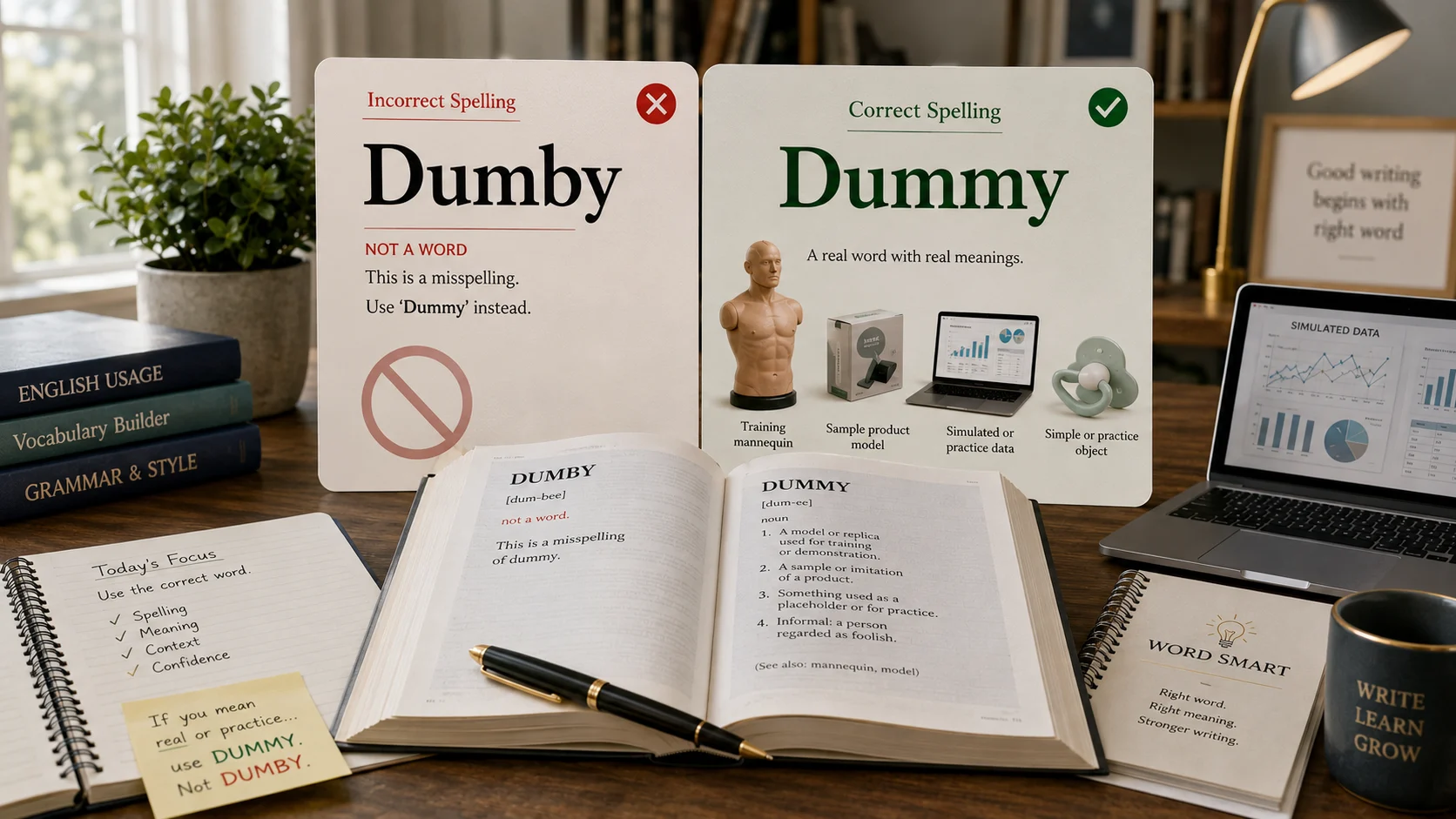
The correct spelling is dummy. Dumby is a common misspelling that is not accepted as the standard English form. Dummy can function as a noun, adjective or verb and may describe a model, imitation, practice object, simulated item or foolish person. Using the wrong spelling can make otherwise polished writing appear careless.
Have you ever paused while writing and wondered “dumby” or “dummy” is the correct spelling? Although these words may look similar, choosing the right one matters when you want your writing to appear clear, professional, and trustworthy. The correct standard English spelling is “dummy,” which can refer to a model, an imitation, a practice object, or a person perceived as foolish, depending on the context. By contrast, “dumby” is generally considered a misspelling rather than an accepted alternative in standard English. This small spelling difference can easily cause confusion, especially when writing quickly or relying on pronunciation.
In this guide, you will learn the difference between dumby and dummy, explore practical examples, and understand why the correct spelling matters in everyday and professional communication. you are writing an academic assignment, preparing a business document, or creating online content, knowing when to use “dummy” will help you avoid common spelling mistakes and communicate your ideas more confidently.
Dumby or Dummy | What’s the Difference?
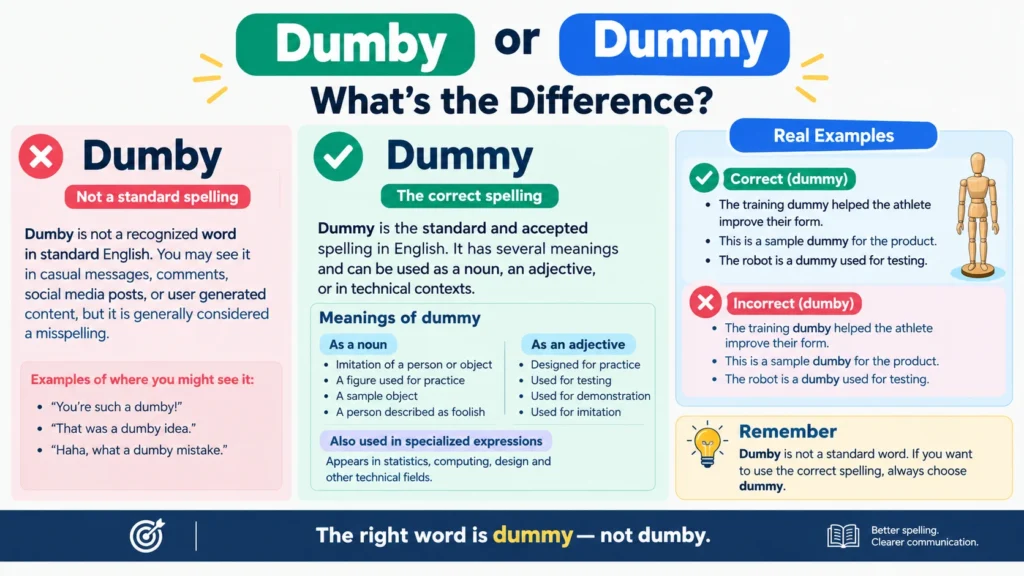
When people search for dumby or dummy, they are usually trying to determine the word should contain the letter b before the final y. The answer is simple: dummy is the correct spelling in standard English, while dumby is generally a misspelling.
The word dummy has several meanings. As a noun, it can refer to an imitation of a person or object, a figure used for practice, a sample object, or a person described as foolish. As an adjective, dummy can describe something designed for practice, testing, demonstration, or imitation. It also appears in specialized expressions used in statistics, computing, design, and other technical fields.
Dumby does not have the same status. You may encounter it in casual messages, comments, social media posts, or user generated content, but its appearance in those places does not make it a standard spelling.
Quick Recap
Dummy is the correct spelling in standard English.
Dumby is normally an incorrect spelling of dummy.
Dummy can function as a noun, adjective, or verb.
Formal, academic, and professional writing should use dummy.
Is Dumby or Dummy a Grammar, Vocabulary or Usage Issue?
The question is mainly a spelling and vocabulary issue rather than a grammar problem. Grammar determines how a word functions in a sentence, while spelling determines how that word is written. Dummy can perform different grammatical roles, but its standard spelling remains the same.
The two forms are not interchangeable in standard English. If you write dumby when you mean the established English word, readers will generally interpret it as a spelling mistake rather than as an alternative form.
In casual communication, spelling mistakes are sometimes overlooked. A friend may understand a sentence containing dumby immediately, but understanding the intended meaning does not make the spelling correct.
Academic and professional writing requires greater precision. A single spelling error will not necessarily weaken an argument, but repeated errors can affect a reader’s perception of the writer’s attention to detail.
This distinction is especially important in technical writing. Terms such as dummy data and dummy variable are established expressions. Changing the spelling can make the terminology look unfamiliar or incorrectly written.
The confusion often comes from pronunciation. The ending of dummy sounds simple when spoken, so writers may incorrectly insert b before y. English contains many spelling patterns that cannot be predicted perfectly from pronunciation. The best solution is to remember the established written form.
How to Use Dummy Correctly
Dummy is a flexible English word, which explains why it appears in many different contexts.
As a noun, dummy can refer to a model or imitation. A store may display a dummy product to show customers what a real product looks like. A medical training program may use a dummy to represent a patient during practice. The word can also describe a person who is being called foolish, although that use may sound insulting depending on the situation.
As an adjective, dummy modifies another noun. Common examples include dummy account, dummy variable, dummy data, dummy text, and dummy ticket. In these expressions, the word usually indicates something temporary, simulated, nonfunctional, or intended for demonstration.
Dummy also has a specialized verb use in some technical contexts. The exact meaning depends on the field and the sentence, so writers should consider their audience when using less common meanings.
Workplace Example
A software company might create a dummy account while testing a registration system. The account lets employees check the registration process without using a real customer account.
A training department could also prepare a dummy form so employees can practice completing paperwork before working with genuine documents.
In both cases, dummy identifies something that represents a real item without being the real item itself.
Academic Example
A student studying statistics may encounter dummy variables. These variables allow categories to be represented numerically in statistical analysis.
A science student might also work with a dummy sample during a demonstration. The sample can illustrate a procedure without requiring the use of valuable or sensitive material.
Because these are recognized academic concepts, spelling the word as dumby would be incorrect.
Technology Example
Technology provides many examples of dummy in everyday professional language. Developers may use dummy data while testing an application. Designers may use dummy text while evaluating a page layout. Testers may create dummy users or dummy transactions to examine how software behaves.
These examples demonstrate why spelling consistency matters. Technical readers expect familiar terminology, and an unusual spelling can create unnecessary confusion.
Usage Recap
Use dummy when you mean a model, imitation, practice object, sample, placeholder, or established technical concept. The spelling remains dummy the word functions as a noun, adjective, or verb.
How Dumby Is Commonly Misused
Dumby is usually not a separate English word with a distinct meaning. It is most often an accidental spelling of dummy.
The error may happen because writers rely on pronunciation instead of remembering the written form. Typing quickly can also cause the mistake, particularly when someone has not frequently encountered the word in edited writing.
Online content can reinforce spelling errors. If someone repeatedly sees dumby in comments or informal posts, they may assume it is an acceptable variant. Internet frequency, however, does not automatically establish standard English usage.
For example, a writer might produce both dummy account and dumby account within the same document. This inconsistency is particularly noticeable in technical documentation.
If you encounter dumby in an informal message, its meaning will usually be obvious from context. When preparing an article, report, assignment, business document, or professional email, however, it should be corrected to dummy.
When You Should NOT Use Dumby or Dummy
There are circumstances in which neither spelling is the best choice because the word itself may be too vague, informal, or potentially insensitive.
The broader lesson is that correct spelling is only one part of effective communication. Writers should also select vocabulary that matches the audience, subject, and purpose.
Common Mistakes and Decision Rules
Writers make several predictable mistakes with this word. The most obvious is adding b before the final y. Another mistake is assuming that dummy always carries the same meaning.
Decision Rule Box
If you mean a model, imitation, practice object, placeholder, or established technical concept, use dummy. If you are considering dumby, check the spelling because it is normally a misspelling rather than a standard alternative.
A useful memory trick is to remember the double m in dummy. The spelling is d u m m y, not d u m b y.
Dumby or Dummy in Modern Technology and AI Tools
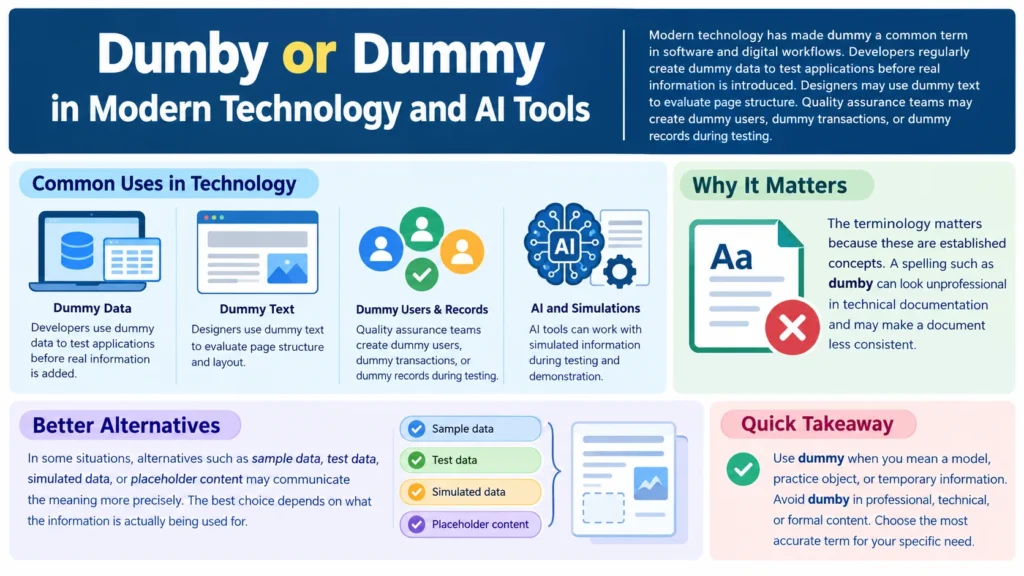
Modern technology has made dummy a common term in software and digital workflows. Developers regularly create dummy data to test applications before real information is introduced. Designers may use dummy text to evaluate page structure. Quality assurance teams may create dummy users, dummy transactions, or dummy records during testing.
AI tools can also work with simulated information during testing and demonstration. A development team might prepare dummy examples to evaluate a workflow without exposing genuine customer information.
The terminology matters because these are established concepts. A spelling such as dumby can look unprofessional in technical documentation and may make a document less consistent.
In some situations, alternatives such as sample data, test data, simulated data, or placeholder content may communicate the meaning more precisely. The best choice depends on what the information is actually being used for.
The Etymology and History of Dummy
Dummy has a long history in English. It developed from the older word dumb, which historically referred to someone who could not speak. Over time, its meaning expanded beyond people.
The word came to describe something that was mute, nonfunctional, imitative, or used as a representation. Later meanings included figures used for display and training, sample objects, and representations used in practical exercises.
Modern technology expanded the vocabulary further with expressions such as dummy data and dummy variables.
The spelling dummy reflects the established development of the word. Dumby is not a recognized standard spelling that developed alongside it.
An Expert View of Standard Usage
“Standard spelling is not merely cosmetic; it helps readers recognize established vocabulary quickly and accurately.”
This principle is particularly important in academic and technical writing. Readers should not have to wonder an unfamiliar spelling is intentional. When a standard form exists, using it consistently improves clarity and credibility.
Two Practical Case Studies
Case Study One: Software Documentation
Imagine a software company preparing documentation for a testing environment. Early drafts contain both dummy account and dumby account. During editing, the team standardizes every occurrence as dummy account.
The correction creates consistent terminology throughout the documentation. Readers can immediately recognize the established term, while editors no longer need to flag the same spelling problem.
Case Study Two: Academic Statistics
Consider a student writing a statistics paper about dummy variables. The first draft contains dumby variables several times. During language review, every occurrence is changed to dummy variables.
The statistical argument remains unchanged, but the terminology becomes academically appropriate and consistent. This illustrates an important point: spelling accuracy may not change the underlying idea, but it can strongly influence the quality and credibility of its presentation.
Error Prevention Checklist
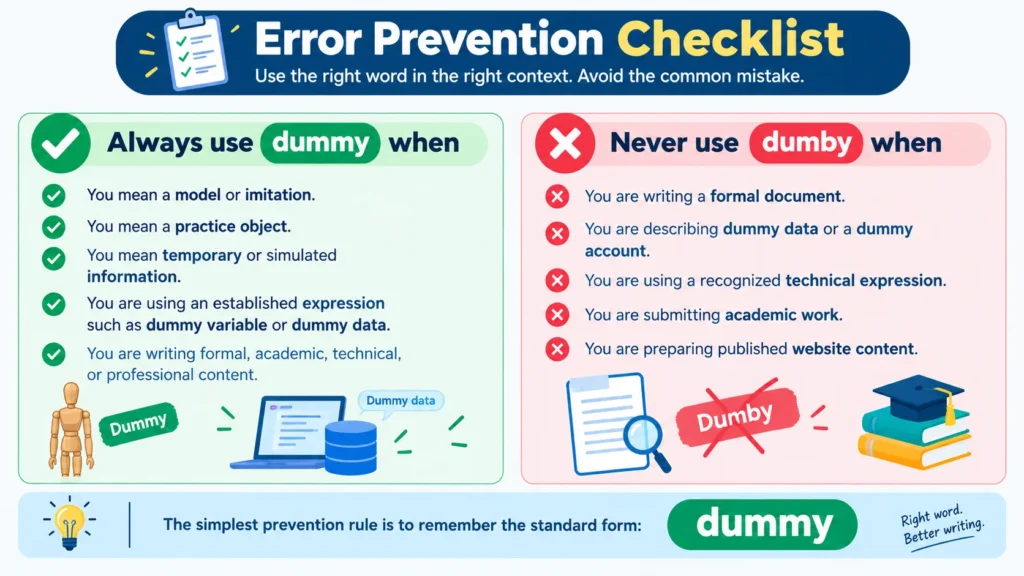
Always use dummy when
• You mean a model or imitation.
• You mean a practice object.
• You mean temporary or simulated information.
• You are using an established expression such as dummy variable or dummy data.
• You are writing formal, academic, technical, or professional content.
Never use dumby when
• You are writing a formal document.
• You are describing dummy data or a dummy account.
• You are using a recognized technical expression.
• You are submitting academic work.
• You are preparing published website content.
The simplest prevention rule is to remember the standard form: dummy.
Related Grammar Confusions You Should Master
Learning one spelling distinction can reveal other common English uncertainties. Writers who frequently confuse dummy and dumby may also benefit from studying similar word pairs.
Studying these distinctions builds a stronger editing instinct. Instead of memorizing isolated corrections, you begin to recognize how English spelling, meaning, and grammatical function work together.
FAQs
Is dumby a correct spelling?
No. Dummy is the standard spelling in English, while dumby is generally a misspelling.
Why do people spell dummy as dumby?
The mistake usually comes from pronunciation, typing habits, or confusion about English spelling patterns.
What is the meaning of dummy?
Dummy can mean a model, imitation, practice object, placeholder, or simulated item, and it also has specialized technical meanings.
Is dummy a noun or an adjective?
Dummy can be a noun, adjective, or verb, depending on how it functions in a sentence.
Is dummy data correct English?
Yes. Dummy data is a standard technical expression for simulated information used for testing, development, or demonstration.
Is dumby an acceptable informal spelling?
It may appear in informal writing, but it is not the standard spelling. Professional and academic writing should use dummy.
How do you remember the spelling of dummy?
Remember the double m in dummy. The standard spelling is d u m m y.
Should I use dummy in academic writing?
Yes, when the word accurately describes the intended concept. Define specialized meanings when your audience may not know them.
What is the difference between dummy and placeholder?
Dummy can describe a simulated or nonfunctional representation, while placeholder usually refers to something temporarily occupying a position until final content is available.
Conclusion
When deciding between dumby or dummy, choose dummy. It is the established spelling and works across everyday, academic, workplace, and technical contexts. Dumby is generally a misspelling, not a recognized alternative form.
Remembering the double m gives you a simple way to avoid the error and keep your writing polished, consistent, and credible.
Discover More Related Articles:
- Color or Die | Roblox Game Guide, Gameplay, Tips & Survival Strategies In 2026
- True or Flase | Challenge Yourself with These Tricky Questions In 2026
- Weather or Keizer | One Describes the Sky, the Other a Choice In 2026