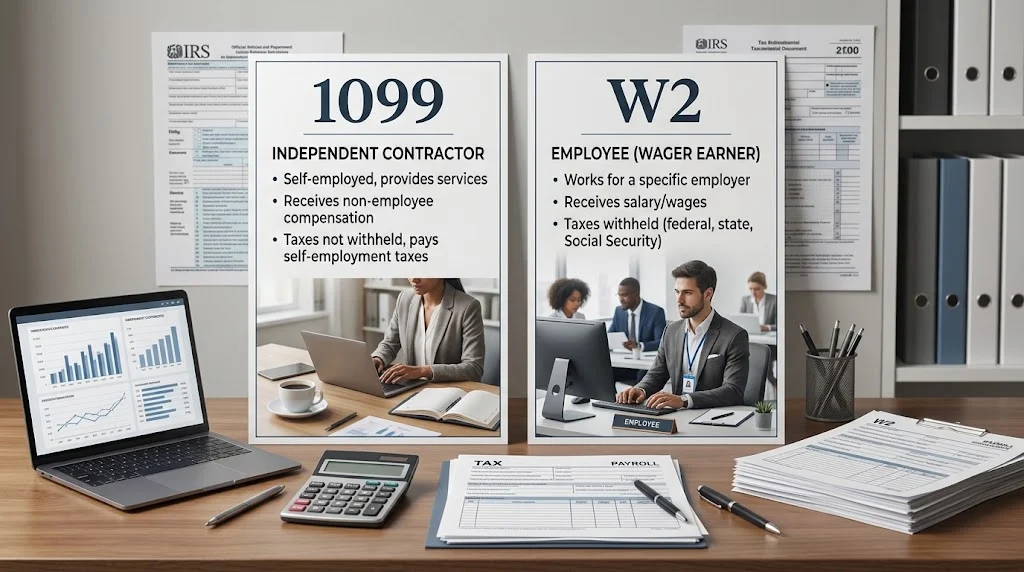
A 1099 is generally used to report income paid to an independent contractor, while a W2 reports wages paid to an employee. Choosing between them depends mainly on the worker’s relationship with the business, not simply on how the person is paid. Misclassification can create tax, payroll, and compliance problems.
The question of 1099 or W2 comes up whenever a business hires someone to perform work. Although both forms report income to the Internal Revenue Service, they represent two very different working relationships. A W2 generally applies when someone is treated as an employee. A 1099 is commonly associated with independent contractors and other forms of nonemployee compensation.
The distinction matters because the tax responsibilities are different. An employee usually has federal income tax and applicable Social Security and Medicare taxes withheld from each paycheck. The employer also has payroll responsibilities and generally contributes the employer portion of Social Security and Medicare taxes.
An independent contractor generally receives payment without the same type of payroll withholding. Instead, the contractor is responsible for handling applicable taxes on the income received.
That difference makes the choice more important than simply asking someone works full time, part time, remotely, or receives a regular payment. The actual working relationship is what matters.
For businesses, getting the classification wrong can lead to additional taxes, penalties, interest, and administrative complications. For workers, misunderstanding the distinction can result in unexpected tax bills or confusion about benefits and workplace rights.
1099 or W2: What’s the Difference?
A W2 is a tax information form used by employers to report wages, salary, tips, and certain other compensation paid to employees during the year. The employee receives the form after the end of the tax year and uses the information when preparing a tax return.
A 1099 is a member of a broader family of information returns. Different 1099 forms report different types of payments. For independent contractors, the most relevant form is generally Form 1099 NEC, which is used to report certain nonemployee compensation.
It is important not to assume that every 1099 form relates to an independent contractor. Different 1099 forms are used to report various types of income, including interest, dividends, retirement distributions, certain real estate transactions, and other payments.
| Feature | W2 Employee | 1099 Independent Contractor |
|---|---|---|
| Worker classification | Employee | Independent contractor |
| Common tax form | Form W2 | Often Form 1099 NEC |
| Income tax withholding | Generally handled through payroll | Generally not withheld by the client |
| Social Security and Medicare taxes | Employee and employer generally share applicable taxes | Contractor generally handles applicable self employment taxes |
| Benefits | May qualify for employer benefits | Generally does not receive employee benefits from the client |
| Work arrangement | Employer generally controls important aspects of the work | Worker generally has greater independence |
| Business expenses | Handled according to employee and employer rules | Contractor may have deductible business expenses when eligible |
| Payroll relationship | Included in employer payroll | Generally outside regular employee payroll |
In simple terms, a W2 usually points to an employee relationship.
A 1099 commonly points to an independent business relationship.
The form itself does not determine the worker’s classification. The underlying facts of the relationship matter.
That distinction is one of the most important concepts to understand before deciding which form applies.
Is 1099 or W2 a Grammar, Vocabulary, or Usage Issue?
The phrase 1099 or W2 is not really a grammar problem. It is primarily a tax terminology and employment classification question.
People often use the terms as shorthand for two different working arrangements. Someone might say, “Should I hire her as a 1099 or W2?” Technically, the question is the person should be classified as an independent contractor or an employee, and which information reporting and payroll obligations follow from that classification.
The terms aren’t interchangeable.
A W2 is connected with employee compensation reporting. A 1099 is a broader category of information reporting forms, with Form 1099 NEC commonly associated with independent contractor compensation.
Formal Versus Casual Usage
In casual workplace conversations, people frequently say “1099 worker” or “W2 worker.” These expressions are widely understood, but formal tax discussions should use more precise language.
Instead of saying:
“Is this person a 1099?”
A more precise question would be:
“Is this person properly classified as an independent contractor?”
Similarly, instead of saying:
“She is W2.”
It is clearer to say:
“She is an employee and will receive a W2 reporting her wages.”
Academic and Professional Usage
In academic writing, accounting documents, legal discussions, and professional tax communication, classification terminology is preferable. Words such as employee, independent contractor, employee classification, worker classification, payroll withholding, and nonemployee compensation make the explanation more precise.
When a W2 Applies
A W2 generally applies when a worker is an employee. An employee typically works within an employment relationship where the business has significant authority over how the work is performed.
That control can involve instructions about schedules, procedures, tools, supervision, training, and other aspects of the work.
However, there isn’t one single factor that automatically determines employee status in every situation. Worker classification depends on the facts and circumstances.
Workplace Example
Imagine a company hires a marketing specialist who works according to company procedures, attends required meetings, receives ongoing supervision, and performs continuing duties that are integrated into the company’s operations.
Those facts may point toward an employee relationship.
If the person is properly classified as an employee, the business generally handles payroll reporting and applicable withholding.
Academic Example
A university might employ an administrative assistant who works specified hours, follows university procedures, reports to a supervisor, and performs recurring administrative duties.
That arrangement has characteristics commonly associated with employment.
Technology Example
Consider a software company that hires a developer as an employee. The company may provide the developer with equipment, assign projects, establish internal procedures, supervise work, and integrate the developer into its normal operations.
Those circumstances can be consistent with an employee relationship.
W2 Usage Recap
Use W2 when discussing the tax form generally provided to employees.
Remember that the form follows the employment relationship. The worker should not simply be labeled an employee because the company prefers the W2 option.
When a 1099 Applies
A 1099 can be associated with several types of payments, but independent contractors are one of the most common contexts in everyday business discussions.
An independent contractor generally operates with greater independence and may control important aspects of how the work is performed. The contractor may serve multiple clients, advertise services, negotiate projects, maintain a separate business, and determine how professional services are delivered.
Again, these are indicators rather than automatic rules.
Workplace Example
A business hires an independent graphic designer for a specific branding project. The designer operates a separate business, works for several clients, uses their own equipment, negotiates project fees, and determines how the design work will be completed.
Those facts may support independent contractor treatment.
Academic Example
A company might engage a specialist to conduct a limited research project. The specialist could establish the research methodology, work independently, submit a completed project, and provide services to other organizations.
Depending on the full circumstances, those characteristics may support contractor classification.
Technology Example
A startup might hire an independent cybersecurity consultant to evaluate its systems. The consultant could operate an established consulting business, serve several clients, use their own tools, and provide recommendations without becoming part of the startup’s regular workforce.
That arrangement may have characteristics of an independent contractor relationship.
1099 Usage Recap
A 1099 is not simply another version of a W2.
It generally reflects a different type of payment or reporting relationship.
For contractor compensation, Form 1099 NEC is especially important.
The classification should be determined from the working relationship rather than the name printed on a contract.
When You Should NOT Use 1099 or W2
One of the easiest mistakes is assuming that the business can choose whichever form is more convenient. Tax reporting forms are not simply options selected according to preference.
Here are several situations where extra caution is necessary.
Do Not Use 1099 Simply Because Someone Works Remotely
Remote work does not automatically make someone an independent contractor. Employees can work entirely from home.
Do Not Use W2 Simply Because Someone Works Full Time
Full time status does not by itself determine employee classification. Independent contractors can work substantial hours on projects.
Do Not Use 1099 Merely to Avoid Payroll Taxes
A business cannot generally turn an employee into an independent contractor simply to avoid payroll obligations.
Do Not Use W2 Merely Because Payments Are Regular
Receiving a predictable weekly or monthly payment does not automatically establish employee status.
Do Not Assume a Written Contract Settles Everything
A contract calling someone an independent contractor is relevant, but the actual relationship and working conditions can also matter.
Do Not Assume Remote Contractors Are Always 1099
A remote worker can still be an employee if the facts support an employment relationship.
Do Not Treat Every 1099 as Contractor Income
There are numerous 1099 forms. The correct form depends on the type of payment being reported.
Do Not Confuse Payment Method With Worker Classification
Being paid by check, bank transfer, payment platform, or another method does not independently determine The following examples show how casual terminology can create confusion around W 2 employees and 1099 contractors.
| Correct sentence | Incorrect sentence | Explanation |
|---|---|---|
| The company classified Maria as an employee and will report her wages on Form W 2. | The company made Maria W2 because she works from home. | Remote work alone does not determine employee classification. |
| The consultant may receive Form 1099 NEC for qualifying nonemployee compensation. | Every contractor automatically gets a 1099. | The type and amount of payment, along with applicable reporting rules, matter. |
| The business should determine worker classification from the facts of the relationship. | The company can choose whichever form costs less. | Worker classification is not simply a matter of cost preference. |
| An employee generally has applicable payroll withholding. | A W 2 is just a receipt for salary. | Form W 2 reports important wage and tax information. |
| An independent contractor generally handles applicable tax obligations on contractor income. | A 1099 means no taxes are owed. | Contractor income can create federal and state tax obligations. |
someone is an employee or contractor.
Common Mistakes and Decision Rules
Decision Rule
If the worker is an employee, Form W2 generally reports the employee’s wages.
If the worker is an independent contractor receiving qualifying nonemployee compensation, Form 1099 NEC may apply.
The key decision is therefore not “Which form do I prefer?” The better question is “What is the worker’s correct classification based on the actual relationship?”
1099 or W2 in Modern Technology and AI Tools
Modern payroll platforms, accounting applications, human resources systems, and AI powered business tools increasingly help organizations organize worker information and prepare tax documents.
These tools can make administration easier, but technology does not automatically determine legal classification.
An AI system can help compare facts, organize documentation, explain terminology, and identify questions that deserve professional review. It should not be treated as a substitute for authoritative tax guidance when classification is uncertain.
This is particularly important for businesses using freelancers, consultants, remote professionals, gig workers, and project based specialists.
Technology can improve documentation. It cannot turn an employee into an independent contractor simply by selecting a different option in software.
Why Worker Classification Matters
The difference between an employee and an independent contractor affects much more than the form received at tax time.
For employees, employers generally have payroll responsibilities involving wage reporting and applicable withholding. Employees may also have access to benefits depending on the employer and applicable rules.
Independent contractors generally operate differently. They may be responsible for estimated tax payments, self employment tax obligations, business records, and eligible business expenses.
For businesses, correct classification can help prevent expensive compliance problems.
For workers, understanding classification can help prevent unpleasant surprises when preparing a tax return.
The strongest approach is to think about the entire working relationship rather than focusing on the form alone.
Etymology and Terminology
The term employee comes through legal and historical English associated with a person engaged for service or work.
The term contractor comes from the idea of entering into a contract. In modern business usage, an independent contractor is generally a person or business engaged to provide services independently rather than functioning as an employee.
The word wage has a long history connected with payment for work, while compensation refers more broadly to payment or remuneration.
The terminology has therefore developed around the underlying economic relationship, not simply around tax paperwork.
Expert Style Explanation
A useful professional principle is this:
“The tax form reports the relationship. It does not create the relationship.”
That principle captures why businesses should evaluate the actual circumstances before deciding how a worker should be treated.
Two Practical Case Studies
Case Study One: The Long Term Marketing Specialist
A small company hires a marketing specialist who works only for the company, follows an assigned schedule, attends internal meetings, receives instructions from management, uses company systems, and performs ongoing marketing duties.
The business considers paying the specialist as a contractor because doing so appears simpler.
The problem is that the actual relationship may contain substantial characteristics of employment. The company should evaluate the classification carefully rather than assuming a contractor label solves the issue.
The practical result is that the business avoids making the decision based solely on convenience and instead reviews the complete working arrangement.
Case Study Two: The Independent Web Consultant
A technology company hires a web consultant for a defined project. The consultant operates an established business, advertises services publicly, serves multiple clients, uses personal equipment, negotiates project fees, and controls the process used to complete the assignment.
Those facts can support independent contractor treatment.
The practical result is a clearer separation between a client relationship and an employee relationship, provided the complete circumstances support that conclusion.
These examples are educational illustrations rather than individual tax determinations.
Error Prevention Checklist
Always Use W2 When
You are referring to wages reported for an employee.
You are discussing employee payroll reporting.
You are explaining information shown on an employee’s Form W2.
You are describing compensation within an established employment relationship.
Never Use 1099 When
You are simply trying to avoid payroll obligations.
You are assuming remote work automatically creates contractor status.
You are treating every nonemployee payment as contractor compensation.
You are using the form name as a substitute for proper worker classification.
Related Grammar Confusions You Should Master
Understanding tax terminology becomes easier when you also recognize common language distinctions that appear in business communication.
- Employee vs contractor: These terms describe different working relationships.
- Salary vs wages: Salary commonly refers to fixed compensation, while wages can refer to compensation based on hours or other payment arrangements.
- Taxable vs nontaxable: These terms describe particular income or benefits are subject to tax under applicable rules.
- Income vs revenue: Income can describe amounts received by an individual, while revenue commonly describes business earnings from operations.
- Deduction vs credit: A deduction generally reduces taxable income, while a credit generally reduces tax liability.
- Gross pay vs net pay: Gross pay is compensation before certain deductions, while net pay is the amount remaining after applicable deductions and withholding.
- Employer vs employee: The employer provides employment, while the employee performs services within the employment relationship.
- Contractor vs consultant: These terms can overlap in ordinary language, although their precise meaning depends on context.
- Withholding vs estimated tax: Withholding is generally collected through payments such as wages, while estimated payments can be made directly by taxpayers.
- Form vs tax return: An information form reports specific financial information, while a tax return is used to calculate and report tax obligations.
FAQs
Is a 1099 better than a W2?
Neither is automatically better because the appropriate classification depends on the actual working relationship and applicable tax rules.
Is it better to be a 1099 contractor or W2 employee?
It depends on the person’s circumstances, including taxes, benefits, business expenses, independence, income stability, and workplace protections.
What is the main difference between a 1099 and W2?
A W2 generally reports employee wages, while a 1099 form can report various types of payments, including qualifying nonemployee compensation.
Do 1099 workers pay more taxes than W2 workers?
A contractor can have different tax responsibilities because self employment taxes and income tax obligations may apply differently from employee payroll withholding.
Can an employee choose to receive a 1099 instead of a W2?
Generally, a worker cannot simply choose the form they prefer when the facts establish an employment relationship.
Does working remotely make someone a 1099 contractor?
No. Remote work by itself does not determine a worker is an employee or independent contractor.
Can a full time worker receive a 1099?
Hours or full time status alone do not determine classification. The complete working relationship must be considered.
What 1099 form do independent contractors usually receive?
Form 1099 NEC is commonly used to report qualifying nonemployee compensation.
Does receiving a 1099 mean I do not owe taxes?
No. Receiving a 1099 does not mean the income is tax free. Applicable federal, state, and local tax obligations may still apply.
Conclusion
The difference between 1099 or W2 is fundamentally about the relationship between the worker and the business. A W2 generally belongs to an employee relationship, while Form 1099 NEC is commonly associated with qualifying nonemployee compensation paid to independent contractors.
The most important lesson is that businesses should not choose a form first and classification second. The facts of the working relationship should guide the classification and the resulting reporting requirements.
For workers, understanding the distinction can make taxes, payroll, benefits, and business expenses much easier to understand. For employers, careful classification can help reduce costly compliance problems.
When there is genuine uncertainty, consulting authoritative tax guidance or a qualified tax professional is the safest approach.
Discover More Related Articles:
- Cant or Can’t | How One Apostrophe Changes Everything In 2026
- Sew or Sow | Meaning, Difference & Correct Usage In 2026
- Short or Tall | Understanding Height Terms & Correct Usage In 2026