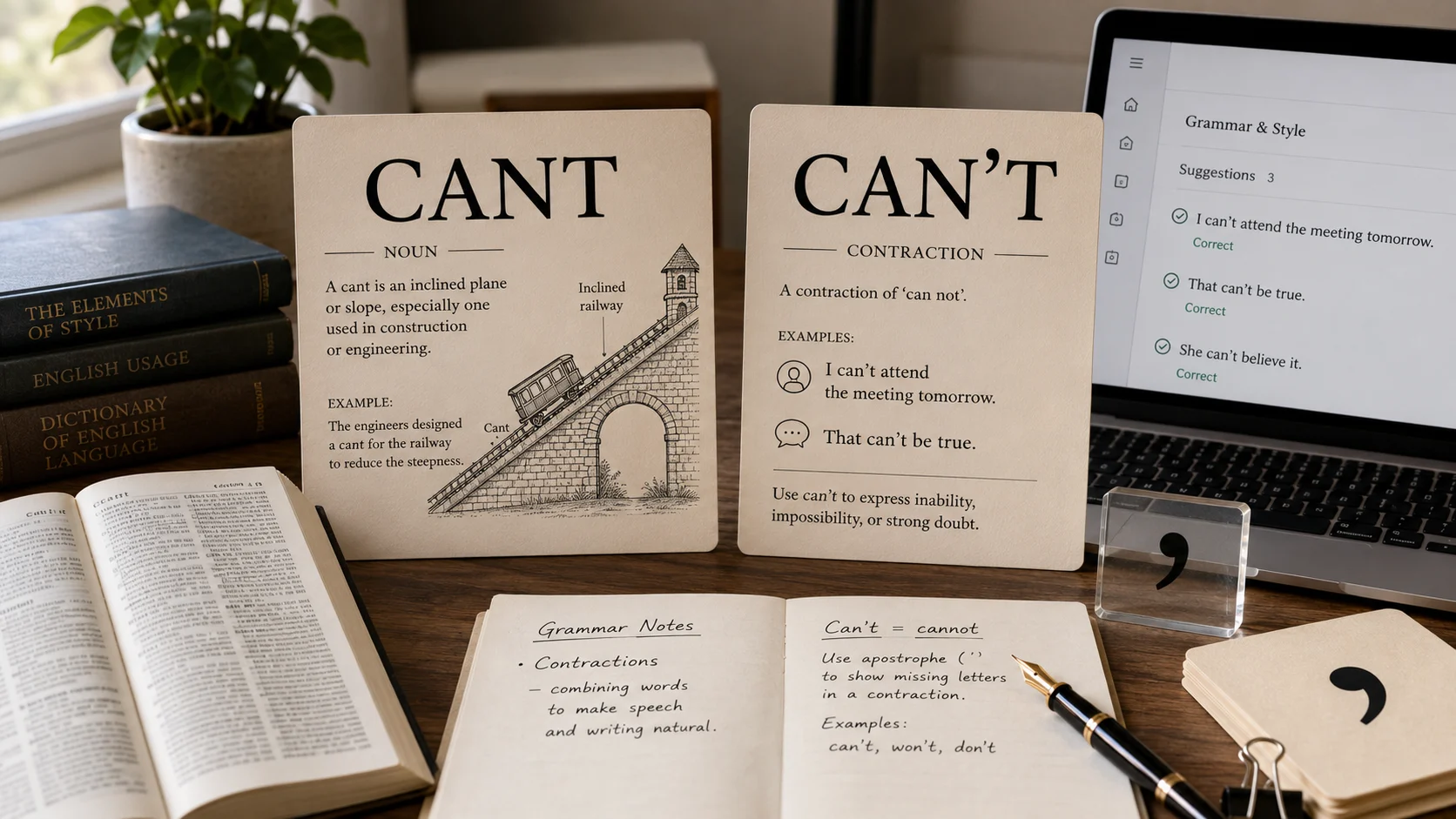
The correct choice depends on meaning. “Can’t” is the contraction of “cannot,” used to express inability, impossibility, or prohibition. “Cant” is a separate noun meaning specialized or insincere language, and it can also refer to a slant or tilt. They are not interchangeable, so confusing them can change the meaning of a sentence.
Have you ever wondered to write cant or can’t? Although these words look almost identical, that tiny apostrophe changes their meaning significantly. Can’t is the contraction of “cannot” and expresses inability, impossibility, or refusal. In contrast, cant is a separate word that can refer to insincere or hypocritical language, specialized jargon, or a particular way of speaking. Confusing these terms can affect the clarity and accuracy of your writing, especially in professional, academic, or everyday communication.
In this guide, we’ll explore the difference between cant vs. can’t, explain their meanings and grammatical roles, and provide practical examples to help you use each word correctly. You’ll also learn when the apostrophe is necessary, which spelling fits formal writing, and how to avoid common mistakes. By understanding these distinctions, you can strengthen your vocabulary, improve your editing skills, and choose the right word with confidence.
Cant vs Can’t | What’s the Difference?
“Can’t” is a contraction and functions as a modal verb phrase meaning “cannot.” It expresses inability, impossibility, refusal, or lack of permission depending on context.
“Cant” is normally a noun. It has several less common meanings. It can describe specialized vocabulary associated with a particular group, especially language that outsiders may find difficult to understand. It can also mean hypocritical or insincere talk. In technical contexts, it may describe a slope or inclination.
| Word | Part of speech | Main meaning | Example |
|---|---|---|---|
| can’t | Contraction | Short form of cannot | I can’t attend the meeting. |
| cant | Noun | Specialized language | The thieves used their own cant. |
| cant | Noun | Insincere or hypocritical speech | The politician’s speech sounded like empty cant. |
| cant | Noun | A slope or inclination | The railway track has a noticeable cant. |
The most important distinction is grammatical. “Can’t” belongs to a verb construction, whereas “cant” is generally a noun.
If you want to say that someone is unable to do something, “can’t” is the correct form.
If you are referring to specialized language, insincere talk, or a technical inclination, “cant” may be correct.
Quick Recap
“Can’t” means “cannot” and contains an apostrophe.
“Cant” is a separate noun with specialized meanings.
The two words are not interchangeable.
In ordinary sentences about ability, possibility, or permission, use “can’t.”
Is Cant vs Can’t a Grammar, Vocabulary or Usage Issue?
This is primarily a grammar and usage distinction, although spelling also plays an important role.
The two forms are not interchangeable. The apostrophe in “can’t” is not decorative. It identifies the word as a contraction. Remove the apostrophe and you no longer have the standard contraction of “cannot.”
In casual communication, contractions such as “can’t,” “won’t,” “don’t,” and “isn’t” are completely normal. They appear frequently in conversation, emails, messages, articles, and general online writing.
Formal academic writing can also use contractions, depending on the style guide and discipline. However, some instructors or institutions prefer expanded forms such as “cannot” rather than “can’t.” In particularly formal documents, “cannot” can sound more deliberate and professional.
“Cant,” meanwhile, is uncommon in everyday English. Most readers encounter it only in specialized contexts, historical writing, literary discussions, or technical descriptions.
That difference in frequency is useful. If you are writing an ordinary sentence about not being able to do something, you almost certainly need “can’t” or “cannot.”
When to Use Can’t
Use “can’t” when you mean “cannot.”
The word can express physical or mental inability:
I can’t lift this box by myself.
It can express impossibility:
That can’t be the correct answer.
It can express lack of permission:
You can’t enter this area without identification.
It can also express a strong conclusion:
She can’t be serious.
The context determines the exact interpretation, but the grammatical function remains the same. “Can’t” is built from the modal verb “can” and the negative element represented by “not.”
Workplace Example
I can’t attend the meeting this afternoon because I have another appointment.
This is natural professional English. In a more formal message, you could write:
I cannot attend the meeting this afternoon.
Both forms are grammatically correct.
Academic Example
The results can’t be considered conclusive without additional evidence.
Depending on the required academic style, “cannot” may be preferred:
The results cannot be considered conclusive without additional evidence.
Technology Example
I can’t access my account after changing the password.
This is a standard way to describe an inability to perform an action.
A software interface might instead use the more formal:
You cannot access this feature with your current permissions.
Usage Recap
Use “can’t” when the intended meaning is “cannot.”
It is appropriate for inability, impossibility, prohibition, and certain conclusions.
Use “cannot” instead when a more formal tone is desirable.
When to Use Cant
“Cant” is much less common than “can’t,” but it is a legitimate English word.
One meaning refers to specialized language used by a particular social group. Historical writing may discuss the cant of criminals, beggars, or other communities whose vocabulary developed separately from mainstream speech.
Another meaning refers to insincere or hypocritical language.
For example:
The speech was filled with moralistic cant.
Here, “cant” refers to language that sounds morally impressive but is considered insincere.
A third meaning occurs in technical contexts. “Cant” can describe a slope or inclination, particularly in engineering, architecture, transportation, or construction.
Workplace Example
The report criticized the company’s public statements as empty cant.
This is possible in sophisticated analytical writing, although the word is relatively uncommon.
Academic Example
The novel satirizes the religious cant of its period.
Here, “cant” describes insincere or formulaic moral or religious language.
Technology Example
In specialized engineering discussions, “cant” can refer to an inclination or difference in elevation. For example:
Engineers calculated the required cant for the curved railway section.
This usage is technical rather than conversational.
Usage Recap
Use “cant” only when one of its specific noun meanings fits the context.
It does not mean “cannot.”
If you are talking about inability, prohibition, or impossibility, “can’t” is the correct choice.
When You Should NOT Use Cant or Can’t
There are several situations in which writers commonly choose the wrong form.
| Situation | Correct choice | Why |
| Saying you are unable to attend | can’t | It means cannot. |
| Saying something is impossible | can’t | It expresses impossibility. |
| Saying an action is prohibited | can’t | It expresses lack of permission. |
| Discussing specialized group language | cant | It is a noun referring to specialized language. |
| Describing hypocritical speech | cant | It can mean insincere or formulaic talk. |
| Discussing an engineering inclination | cant | It has a technical meaning involving slope or tilt. |
| Writing a normal casual sentence about inability | can’t | Cant does not mean cannot. |
| Replacing “cannot” with “cant” | can’t | The contraction requires the apostrophe. |
A useful test is to replace “can’t” with “cannot.” If the sentence still makes sense, “can’t” is probably what you need.
For example:
I can’t finish the report today.
Becomes:
I cannot finish the report today.
The meaning remains intact.
Common Mistakes and Decision Rules
| Correct sentence | Incorrect sentence | Explanation |
| I can’t come today. | I cant come today. | The contraction of cannot requires the apostrophe. |
| She can’t find the document. | She cant find the document. | The intended meaning is inability. |
| That can’t be true. | That cant be true. | The sentence expresses impossibility. |
| The essay discusses criminal cant. | The essay discusses criminal can’t. | Here, cant is a noun referring to specialized language. |
| The track requires additional cant. | The track requires additional can’t. | Here, cant refers to an inclination or slope. |
| He criticized the speech as cant. | He criticized the speech as can’t. | Cant can mean insincere or hypocritical language. |
Decision Rule Box
If you mean “cannot,” use “can’t.”
If you mean specialized language, insincere speech, or a slope or inclination, use “cant.”
The easiest practical rule is to ask “cannot” can replace the word. If it can, choose “can’t.”
Cant and Can’t in Modern Technology and AI Tools
Modern technology creates countless opportunities for contraction errors because people communicate quickly through messaging apps, search queries, code comments, customer support systems, and AI tools.
A user might type:
I cant log in.
The intended sentence is:
I can’t log in.
AI writing systems can usually infer the intended meaning from context, but inference does not make incorrect spelling acceptable in polished content.
In software interfaces, “cannot” is often preferred because system messages benefit from clarity and consistency. For example:
You cannot complete this action.
In conversational interfaces, however, “can’t” may sound more natural:
I can’t access that file.
The distinction also matters in language models and automated grammar systems. Apostrophes can carry grammatical information, so punctuation is sometimes necessary for accurate interpretation.
Etymology and Language History
“Can’t” developed as a contraction of “cannot,” which itself combines the modal verb “can” with the negative word “not.” Contractions became increasingly common in English as spoken language evolved toward shorter, more efficient forms.
“Cant” has a separate history. It has been associated with specialized or secret language and later developed meanings involving insincere or formulaic speech. Its technical meaning involving an angle or inclination also developed independently.
This separate history explains why the words look nearly identical but have unrelated functions in ordinary modern English.
An Expert Style Explanation
A useful linguistic principle is this: An apostrophe can signal grammatical structure, not merely missing letters.
In “can’t,” the apostrophe identifies a contraction. In “cant,” there is no contraction at all.
Two Practical Case Studies
Case Study 1: Professional Email
Consider an employee writing:
I cant attend the client meeting because of a scheduling conflict.
The reader will probably understand the intended meaning, but the spelling is incorrect in standard English.
Correcting it to:
I can’t attend the client meeting because of a scheduling conflict.
immediately restores standard grammar and professional presentation.
The concrete result is greater grammatical accuracy and a more polished impression.
Case Study 2: Literary Analysis
Now consider:
The author attacks the cant of respectable society.
Replacing “cant” with “can’t” would completely destroy the meaning. The sentence is discussing hypocritical or formulaic speech, so “cant” is the correct noun.
The concrete result of identifying the part of speech is that the sentence retains its intended literary meaning.
Error Prevention Checklist
Always use “can’t” when
- You mean “cannot.”
- You are describing inability.
- You are describing impossibility.
- You are expressing a prohibition.
- You are making a conclusion such as “That can’t be right.”
Never use “cant” when
- You simply mean “cannot.”
- You are writing about an inability to perform an action.
- You are saying that something is impossible.
- You are describing a lack of permission.
- You are writing an ordinary sentence that requires the negative form of “can.”
Related Grammar Confusions You Should Master
Once you understand cant and can’t, several other commonly confused forms become easier to recognize.
| Confusion | Key distinction |
| its vs it’s | Possessive form vs contraction |
| your vs you’re | Possessive form vs contraction |
| whose vs who’s | Possessive form vs contraction |
| were vs we’re | Past tense vs contraction |
| lets vs let’s | Verb form vs contraction |
| wont vs won’t | Rare noun vs contraction |
| dont vs don’t | Incorrect spelling vs contraction |
| cannot vs can’t | Full form vs contraction |
| their vs they’re | Possessive form vs contraction |
| then vs than | Time or sequence vs comparison |
The broader lesson is that apostrophes often distinguish contractions from separate words. Learning the underlying grammar is more reliable than memorizing isolated spelling rules.
FAQs
What is the difference between cant and can’t?
Can’t means cannot, while cant is a noun referring to specialized language, insincere speech, or an inclination.
Is cant a real English word?
Yes. Cant is a legitimate noun, although its meanings are much less common in everyday English than the contraction can’t.
Is can’t short for cannot?
Yes. Can’t is the standard contraction of cannot and is commonly used in both spoken and written English.
Can I write cant instead of can’t?
No. If you mean cannot, the standard contraction is can’t, with an apostrophe.
Is cant formal or informal?
Cant is a legitimate vocabulary word and can appear in formal writing, especially in literary, historical, or technical contexts.
Why does can’t need an apostrophe?
The apostrophe marks the omitted letters in the contraction of cannot.
What does cant mean in literature?
In literary contexts, cant can refer to insincere, hypocritical, formulaic, or socially conventional language.
What does cant mean in engineering?
In engineering and transportation contexts, cant can refer to an inclination or difference in elevation, particularly on curved railway tracks.
Which is more common, cant or can’t?
Can’t is vastly more common in ordinary English because people frequently need to express inability, impossibility, or prohibition.
Conclusion
The distinction between cant or can’t becomes straightforward when you focus on meaning and grammar. Use “can’t” when you mean “cannot.” Use “cant” only when you mean specialized language, insincere speech, or a technical inclination.
The apostrophe is therefore meaningful, not optional. Whenever you are unsure, replace “can’t” with “cannot.” If the sentence still expresses exactly what you intend, you have found the correct form.
Mastering this small distinction can improve grammar, professional writing, academic work, and everyday digital communication.
Discover More Related Articles:
- Truth or Scare | Meaning, Usage & How It Differs From Truth or Dare In 2026
- Babies or Baby’s | One Means More Than One, the Other Shows Possession In 2026
- Aide or Aid | Meaning, Usage, Examples & Easy Rules In 2026