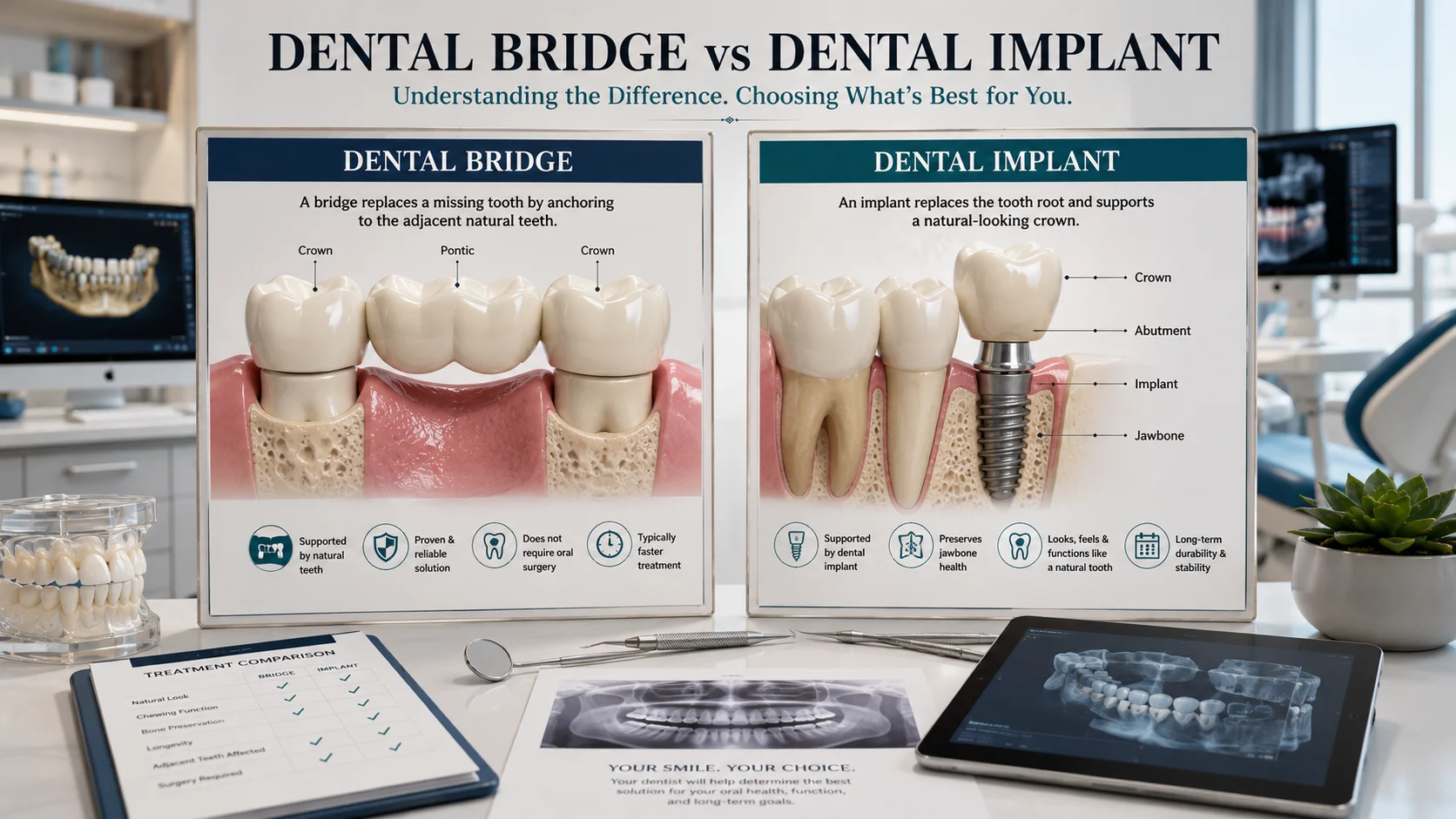
A dental bridge replaces a missing tooth by using nearby teeth or implants for support, while a dental implant replaces the tooth root with a titanium fixture placed in the jawbone. Choosing between bridge or implant depends on bone health, neighboring teeth, oral hygiene, treatment time, cost, and long term dental goals.
Losing a tooth creates more than a cosmetic concern. A missing tooth can affect chewing, speech, confidence, and the way surrounding teeth interact. Fortunately, modern dentistry offers several reliable ways to restore the missing tooth, with a dental bridge and dental implant being two of the most common choices.
The terms are sometimes treated as though they describe the same treatment, but they do not. A dental bridge fills the space left by a missing tooth and is supported by neighboring teeth or, in some cases, dental implants. A dental implant replaces the missing tooth root with an implant fixture that is surgically placed into the jawbone and later supports a crown.
This distinction matters because the treatments involve different procedures, healing periods, maintenance requirements, costs, and long term considerations.
Someone with healthy neighboring teeth may have very different priorities from someone who already has heavily restored teeth or has experienced bone loss. Likewise, a person seeking a faster restoration may approach the decision differently from someone primarily interested in preserving jawbone structure.
The right choice is therefore not simply about which option sounds more modern. It is about which restoration suits the condition of your mouth and your long term dental needs.
Bridge vs Implant: What’s the Difference?
A bridge is a noun referring to a dental restoration that replaces one or more missing teeth by spanning the space between existing teeth or other supports. A dental implant is also a noun, referring to a fixture placed into the jawbone to provide support for a replacement tooth.
The key difference is how the replacement tooth is supported. A conventional dental bridge generally relies on neighboring teeth, while a dental implant is designed to replace the missing tooth root and gain support from the jawbone.
| Feature | Dental Bridge | Dental Implant |
|---|---|---|
| Primary purpose | Replaces a missing tooth by spanning the gap | Replaces the tooth root and supports a replacement tooth |
| Main support | Usually neighboring teeth | Jawbone through an implant fixture |
| Surgery | Usually does not require implant surgery | Requires surgical placement of the implant |
| Effect on neighboring teeth | Traditional bridges generally require preparation of supporting teeth | Adjacent healthy teeth can usually remain independent |
| Bone preservation | Does not replace the missing root | Can help maintain bone in the area through functional stimulation |
| Treatment timeline | Often completed relatively quickly | Usually requires a healing period before final restoration |
| Maintenance | Requires careful cleaning around and beneath the bridge | Requires excellent oral hygiene around the implant and crown |
| Best suited to | People who want a fixed restoration and have suitable supporting teeth | People with adequate bone and suitable overall oral health |
In simple terms, a bridge fills the space by connecting the replacement tooth to a support structure.
An implant takes a different approach by replacing the missing root and supporting a crown independently.
Neither option is automatically better for every patient.
The condition of the gums, jawbone, remaining teeth, bite, hygiene habits, budget, and treatment preferences all influence the decision.
Is Bridge vs Implant a Grammar, Vocabulary, or Usage Issue?
Unlike common language questions involving similar sounding words, bridge and implant are not interchangeable vocabulary choices. They are different dental terms describing different restoration methods.
In professional dentistry, dental bridge and dental implant have specific meanings. A dentist would not normally use the two expressions as casual alternatives for the same procedure.
In everyday conversation, however, patients may say that they need a new tooth without knowing exactly which restoration is appropriate. This is where confusion can occur. A patient might assume that an implant simply means an artificial tooth, when the implant itself actually refers to the fixture placed in the jawbone.
The distinction is particularly important in academic and professional writing. Dental education materials, treatment plans, insurance documents, and clinical discussions need precise terminology because each treatment involves different biological and mechanical considerations.
Casual language can be less precise. Someone might say, “I got a tooth implant,” when they actually mean the complete restoration, including the implant, abutment, and crown. That expression may be understandable, but technically the implant is only one component of the finished restoration.
Dental Bridge: How It Works and When It Makes Sense
A dental bridge is designed to close the space created by one or more missing teeth. In a conventional bridge, the artificial tooth is connected to crowns that fit over prepared neighboring teeth.
There are several types of dental bridges, including traditional bridges, cantilever bridges, Maryland bridges, and implant supported bridges. The appropriate type depends on the location of the missing tooth, the condition of surrounding teeth, and the forces created by the patient’s bite.
A major attraction of a bridge is that treatment can often be completed more quickly than implant treatment. There is generally no implant integration period because the restoration does not depend on a dental implant becoming integrated with the jawbone.
Workplace example
A person who has lost a visible front tooth may want a fixed restoration without waiting through a lengthy healing process. If the surrounding teeth are suitable supports, a bridge may provide a practical way to restore appearance and function.
Academic example
In dental education, a bridge is described as a fixed prosthetic restoration used to replace missing teeth by connecting an artificial tooth to supporting structures. This terminology is more precise than simply calling it a replacement tooth.
Technology example
Modern digital dentistry can improve the planning and fabrication of bridges. Digital scans can help dentists and laboratories create highly accurate restorations while reducing the need for traditional impression materials in many cases.
Bridge usage recap
A bridge is especially useful when a patient has suitable supporting teeth and wants a fixed restoration.
It can provide an effective solution without implant surgery.
However, traditional bridges generally involve preparing the supporting teeth, which is an important consideration when those teeth are otherwise healthy.
Dental Implant: How It Works and When It Makes Sense
A dental implant is a small fixture, commonly made from titanium or another biocompatible material, that is placed into the jawbone. After healing and integration with the surrounding bone, the implant can support an abutment and dental crown.
This approach attempts to replace both the visible tooth and the root structure that was lost with the natural tooth.
One of the major advantages of implant dentistry is that a single missing tooth can often be replaced without preparing the neighboring healthy teeth as bridge supports.
Implants may also help maintain the bone around the missing tooth area because the implant transfers functional forces to the jawbone. However, successful implant treatment depends on adequate bone, healthy gums, appropriate treatment planning, and good oral hygiene.
Workplace example
For someone who regularly speaks with clients or works in a public facing role, replacing a missing visible tooth with an implant supported crown can provide a stable and natural looking restoration after the treatment has been completed.
Academic example
In academic dentistry, implant treatment is studied as a method of replacing missing tooth roots and supporting prosthetic restorations. It combines surgical, biological, and restorative principles.
Technology example
Modern implant planning may use digital scans and three dimensional imaging to evaluate bone anatomy and determine an appropriate implant position. Digital workflows can also assist in designing the final crown.
Implant usage recap
An implant is a root replacement rather than simply another name for an artificial tooth.
It can preserve independence between the replacement tooth and neighboring teeth.
The treatment usually takes longer than a conventional bridge because the implant needs time to heal and integrate with the bone.
When You Should NOT Use a Bridge or Implant
Not every missing tooth situation should immediately be treated with either option. A dentist needs to evaluate the mouth before recommending a restoration.
Here are common situations that require particular caution.
- Do not choose a bridge simply because it seems faster. If healthy neighboring teeth would need substantial preparation, another option may deserve consideration.
- Do not assume an implant is suitable without evaluating bone. Insufficient bone may require additional treatment before implant placement can be considered.
- Do not select either restoration while ignoring active gum disease. Healthy gums are important for long term treatment success.
- Do not treat cost as the only deciding factor. The initial price does not always reflect maintenance and replacement considerations over many years.
- Do not assume an implant is automatically superior. An implant can be an excellent option, but suitability depends on individual circumstances.
- Do not choose a bridge without considering cleaning requirements. Food and plaque can collect around and underneath the restoration if oral hygiene is inadequate.
- Do not delay professional evaluation after tooth loss. Changes in surrounding teeth and jawbone can occur over time.
- Do not copy another person’s treatment decision. Two people with apparently similar missing teeth may have completely different dental conditions.
Common Mistakes When Choosing Bridge or Implant
| Correct statement | Incorrect assumption | Explanation |
|---|---|---|
| An implant replaces the missing tooth root | An implant is simply another word for a crown | The implant is a fixture that supports the final restoration |
| A traditional bridge can use neighboring teeth for support | Every bridge requires an implant | Traditional bridges can be supported by natural teeth |
| Implants usually require healing time | An implant provides an immediate final tooth in every case | Implant treatment often includes a period of healing before final restoration |
| A bridge can be a fixed restoration | A bridge is always removable | Many dental bridges are permanently fixed |
| Healthy neighboring teeth can influence the decision | Neighboring teeth do not matter | Their strength and condition are important when planning a bridge |
| Bone health matters for implants | Anyone can automatically receive an implant | Bone quantity and quality can affect implant planning |
Decision Rule: Bridge or Implant
If you mean a replacement tooth supported by neighboring teeth or another supporting structure, think bridge. If you mean a replacement root placed into the jawbone to support a restoration, think implant.
This simple distinction prevents one of the most common misunderstandings surrounding tooth replacement terminology.
Bridge or Implant: Which One Lasts Longer?
Longevity depends heavily on oral hygiene, bite forces, smoking status, gum health, restoration quality, regular dental care, and the condition of the supporting structures.
A well maintained bridge can remain functional for many years. Dental implants can also provide long lasting service, but the crown, abutment, and implant itself are separate components with different maintenance considerations.
It is therefore misleading to promise that one option will last a specific number of years for every patient.
The most important factor is often not simply the restoration selected, but how well the entire treatment is planned and maintained.
Bridge or Implant Cost: What Should You Consider?
Cost varies significantly according to location, materials, the number of teeth being replaced, laboratory fees, diagnostic procedures, and the complexity of treatment.
A conventional bridge may have a lower initial treatment cost than an implant restoration. However, comparing prices without comparing the entire treatment plan can be misleading.
An implant may involve several stages, such as imaging, implant placement, healing, abutment placement, and crown fabrication. In some patients, additional procedures may be required.
A useful cost comparison should therefore ask:
- What is included in the quoted price?
- Are diagnostic scans included?
- Is the final crown included?
- Are additional procedures included?
- What maintenance may be needed later?
- What happens if the restoration needs repair or replacement?
The cheapest initial option is not necessarily the least expensive long term solution.
Dental Bridge vs Dental Implant for Appearance
Both treatments can produce highly natural looking results when properly designed and fitted.
Modern crowns and bridges can be matched to the color, shape, and proportions of surrounding teeth. Implant supported restorations can also provide excellent cosmetic results because the replacement tooth is independently supported.
For front teeth, appearance becomes particularly important. Factors such as gum position, tooth proportions, shade, and the relationship between the restoration and surrounding tissues can influence the final result.
A qualified dentist should therefore evaluate aesthetics as well as function.
Dental Bridge vs Implant for Bone Health
One major biological difference concerns the missing tooth root.
When a natural tooth is lost, the bone that once supported its root may gradually change because it is no longer receiving the same type of stimulation. A traditional bridge replaces the visible tooth but does not replace the natural root.
An implant is placed within the jawbone and can provide functional stimulation through the implant structure.
This does not mean that every patient needs an implant. It means bone preservation is one factor worth discussing when comparing long term tooth replacement options.
Bridge or Implant in Modern Technology and AI Tools
Modern dentistry increasingly combines digital scanning, computer aided design, three dimensional imaging, and advanced laboratory technology.
Digital impressions can create detailed representations of the teeth and gums. Three dimensional imaging can help clinicians evaluate the anatomy around potential implant sites. Computer based planning can assist with implant positioning and restorative design.
Artificial intelligence is also becoming increasingly relevant to dentistry, particularly in areas such as image analysis, diagnostic support, treatment planning, and pattern recognition.
However, AI tools should support professional clinical judgment rather than replace a dentist’s examination. A software system cannot independently account for every factor affecting a patient’s treatment choice.
Etymology and Dental Terminology
The word bridge comes from the ordinary concept of something that spans a gap between two sides. Dentistry adopted the term because a dental bridge spans the space created by missing teeth.
The word implant comes from the idea of placing something into a living structure. In dentistry, the term describes the placement of a fixture into the jawbone to provide support for a replacement tooth.
This terminology explains why the words describe different concepts rather than interchangeable treatments.
“The best restoration is the one that fits the patient’s biology, function, aesthetics, and long term needs.”
That principle captures the central issue. Dental treatment should be individualized rather than selected according to popularity alone.
Two Practical Case Studies
Case Study 1: A Missing Tooth With Strong Neighboring Teeth
Consider a patient who loses one tooth and has strong neighboring teeth that already contain large restorations. A conventional bridge may be considered because the supporting teeth can provide the necessary foundation.
The final decision would depend on clinical examination, bite, gum condition, and the patient’s priorities.
Case Study 2: A Single Missing Tooth With Healthy Neighbors
Now consider a patient with one missing tooth, healthy neighboring teeth, and sufficient bone for implant placement.
An implant supported crown may allow the dentist to replace the missing tooth without preparing the adjacent healthy teeth. The treatment takes longer, but it provides independent support for the restoration.
These examples demonstrate why there is no universal winner in the bridge versus implant discussion.
Error Prevention Checklist
Always consider a bridge when
The neighboring teeth are suitable for support.
A fixed restoration is desired.
The patient prefers a treatment that generally avoids implant surgery.
The overall dental condition supports bridge treatment.
Never assume an implant is appropriate when
Bone health has not been evaluated.
Active gum problems have not been addressed.
Oral hygiene is inadequate.
The patient has not received a complete dental examination.
The decision is being made solely because implants are considered more modern.
Related Dental Confusions You Should Understand
Understanding related dental terms can make treatment discussions much easier.
- Bridge vs crown: A crown generally covers or restores an individual tooth, while a bridge replaces a missing tooth by spanning a gap.
- Implant vs crown: An implant replaces the root structure, while the crown is the visible replacement tooth.
- Bridge vs partial denture: A bridge is generally fixed, while a conventional partial denture is removable.
- Implant vs implant crown: The implant and crown are different components of the completed restoration.
- Natural tooth vs implant: A natural tooth has its own root and supporting tissues, while an implant is an artificial root replacement.
- Traditional bridge vs implant supported bridge: The first generally relies on natural teeth, while the second uses implants as support.
- Tooth replacement vs tooth restoration: Replacement deals with a missing tooth, while restoration commonly refers to repairing or rebuilding an existing tooth.
- Bone loss vs gum disease: These conditions can be related but are not identical and require professional assessment.
- Fixed vs removable dentistry: Fixed restorations remain attached in the mouth, while removable appliances can be taken out.
- Temporary vs permanent restoration: A temporary restoration is used during treatment, while the final restoration is designed for longer term use.
FAQs
What is better, a bridge or an implant?
The better choice depends on bone health, neighboring teeth, gum condition, treatment time, cost, aesthetics, and long term goals rather than a universal ranking.
Is an implant stronger than a dental bridge?
An implant can provide strong independent support because it is anchored in the jawbone, but overall performance depends on treatment planning, bone health, bite, and maintenance.
Is a bridge cheaper than an implant?
A conventional bridge often has a lower initial cost, but the complete financial comparison depends on materials, procedures, maintenance, and future replacement needs.
How long does a dental bridge last compared with an implant?
Both can provide many years of service when properly planned and maintained, but longevity varies considerably between patients and restorations.
Does a dental bridge damage surrounding teeth?
A traditional bridge generally requires preparation of supporting teeth, which is an important consideration when those teeth are otherwise healthy.
Does an implant prevent bone loss?
An implant can help maintain bone around the implant site by providing functional stimulation, although existing bone loss may affect implant treatment is possible.
Is getting an implant more painful than getting a bridge?
Implant placement involves a surgical procedure, while conventional bridge treatment usually does not involve implant surgery, but discomfort varies between individuals.
Can you replace one missing tooth with a bridge or implant?
Yes. Both can replace a single missing tooth, although the supporting structures and clinical circumstances are different.
Which looks more natural, a bridge or an implant?
Both can look highly natural when properly designed, but the final appearance depends on tooth shape, color, gum position, materials, and the skill of the dental team.
Conclusion
The choice between bridge or implant should never be reduced to a simple question of which treatment is better. A bridge and an implant solve the same broad problem, but they do so through fundamentally different designs.
A bridge spans the space created by a missing tooth and generally relies on neighboring teeth or other supporting structures. An implant replaces the missing root and provides independent support for a crown.
For some patients, a bridge offers a practical and efficient solution. For others, an implant may provide important advantages, particularly when preserving the independence of healthy neighboring teeth and supporting the missing tooth area are priorities.
The most reliable decision comes from a complete dental assessment that considers bone, gums, neighboring teeth, bite, aesthetics, oral hygiene, treatment timeline, and long term expectations.
If you’re comparing bridge or implant, focus less on which treatment is more popular and more on which restoration is appropriate for your individual dental condition.
Discover More Related Articles:
- Cant or Can’t | How One Apostrophe Changes Everything In 2026
- Sew or Sow | Meaning, Difference & Correct Usage In 2026
- Short or Tall | Understanding Height Terms & Correct Usage In 2026