Sew or sow are not interchangeable. Sew is a verb meaning to join, repair or decorate fabric with thread and a needle, while sow means to plant seeds or scatter something. The words sound alike in many varieties of English but their meanings, spellings and contexts are completely different.
Have you ever confused sew or sow because they sound exactly alike but have completely different meanings? You’re not alone! These commonly confused words can easily lead to spelling mistakes, especially when writing quickly. However, knowing the difference is simple once you understand how each word is used. Sew means to join or repair fabric using a needle and thread, while sow means to plant seeds in the ground so they can grow. Although their pronunciation is identical, choosing the wrong spelling can change the entire meaning of your sentence.
In this guide, we’ll explore sew vs. sow, including their definitions, parts of speech, practical examples, and common usage mistakes. You’ll also learn how to remember each spelling with simple tips that make the distinction easier to understand. You’re writing a school assignment, creating professional content, or improving your everyday English vocabulary, this clear comparison will help you use sew and sow accurately and confidently.
Sew or Sow | What’s the Difference?
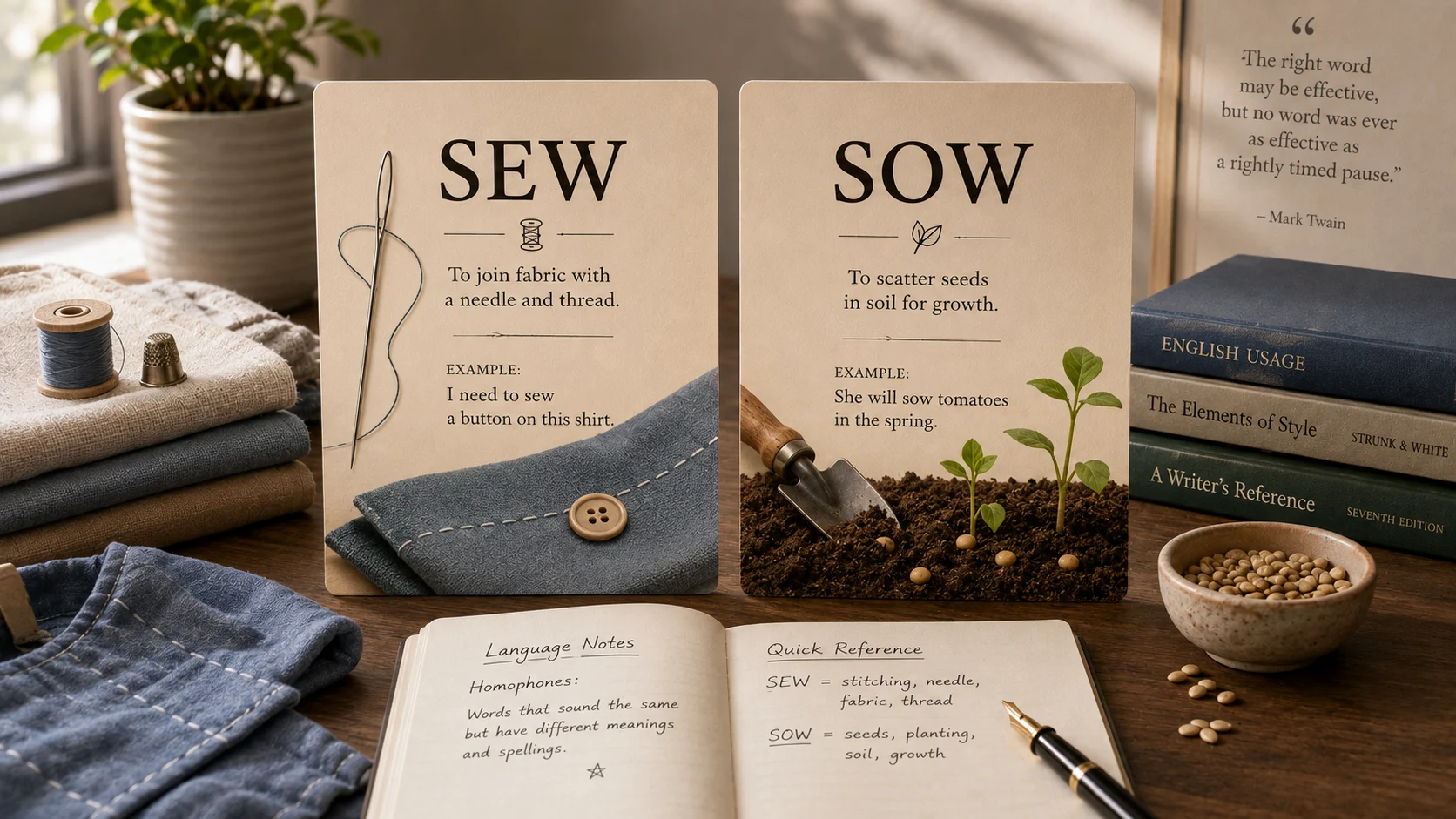
The simplest distinction is this: sew means to join or repair something with thread, while sow means to plant seeds or scatter something.
Sew is a verb. It describes the process of using a needle and thread to join pieces of cloth, repair clothing, create decorative stitches, or make garments. The past tense is usually sewed, while the past participle can be sewn or sewed, depending on the construction and variety of English.
Sow is also a verb. Its most familiar meaning is to put seeds into the ground so that plants can grow. It can also mean to scatter or spread something, particularly an idea, feeling, influence, or belief.
| Word | Part of speech | Main meaning | Typical context | Example |
|---|---|---|---|---|
| Sew | Verb | To join or repair fabric with thread | Clothing, tailoring, crafts | I learned to sew a button onto my shirt. |
| Sow | Verb | To plant seeds or scatter something | Gardening, farming, figurative language | We will sow the seeds in early spring. |
| Sew | Verb | To create something using stitches | Fashion, quilting, embroidery | She likes to sew her own dresses. |
| Sow | Verb | To spread or introduce something | Literature, speech, abstract ideas | His comments sowed doubt among the team. |
The pronunciation is the main reason these words cause trouble. In standard English, sew is pronounced like “so,” not like the word “few.” Sow, when it means planting seeds, is also commonly pronounced like “so.” This makes the distinction particularly important in writing.
There is an important exception worth knowing. Sow has another pronunciation when it refers to an adult female pig. In that meaning, it is pronounced like “sou,” which is different from the pronunciation used for planting seeds.
Mini Recap
Sew is connected with needles, thread, fabric, stitches, and clothing.
Sow is connected with seeds, soil, planting, and scattering.
Both words can sound alike when they refer to their main verb meanings.
The spelling should therefore be chosen according to the meaning of the sentence.
Is Sew or Sow a Grammar, Vocabulary or Usage Issue?
The difference between these words is primarily a vocabulary and usage issue, rather than a complicated grammar rule.
Both sew and sow are verbs, so their grammatical role can be identical. The problem occurs because they represent completely different actions. A writer who knows the grammar of a sentence perfectly can still choose the wrong word.
For example:
She will sew the seeds tomorrow.
The sentence is grammatically structured correctly, but the vocabulary is wrong if the intended meaning is planting seeds.
The correct sentence is:
She will sow the seeds tomorrow.
Likewise:
He knows how to sow a button onto a shirt.
The structure looks acceptable, but the verb is incorrect because joining a button to clothing requires sewing.
The distinction remains the same in formal and informal English. There is no situation in academic writing where sow can replace sew simply because the writing is formal. Likewise, casual speech does not make the two words interchangeable.
In academic writing, agriculture texts use sow when discussing seeds, crops, cultivation, and planting. Textile studies use sew when discussing garments, stitching, tailoring, and construction.
In casual conversation, you might hear:
Can you sew this tear?
Or:
When should we sow these seeds?
Both are ordinary and natural uses.
How to Use Sew Correctly
Use sew when the action involves a needle, thread, stitches, fabric, clothing, or another material being joined through stitching.
The word appears in everyday situations as well as specialized fields such as tailoring, fashion design, quilting, embroidery, upholstery, and textile production.
Workplace Example
The tailor will sew the loose seam before the customer arrives.
Here, sew describes the physical process of repairing the garment with thread.
Another example is:
Our production team can sew the labels into the inside of each jacket.
The action involves stitching a label to clothing, so sew is the correct verb.
Academic Example
Students in the textile course learn how to sew different types of seams.
This sentence discusses a practical skill involving fabric and stitching. The correct verb is therefore sew.
In an academic paper, you might also see:
The researchers examined how traditional artisans sew decorative patterns into ceremonial clothing.
Again, the meaning is directly connected to stitching.
Technology Example
Modern technology has also influenced sewing. Computer controlled sewing machines, automated embroidery equipment, and digital pattern systems are common in modern textile production.
For example:
The automated machine can sew several layers of fabric with consistent tension.
The machine performs a stitching action, so sew remains correct even though the work is automated.
Usage Recap
Think of sew whenever you can associate the action with a needle, thread, stitches, fabric, clothing, or textile construction.
If something is being physically joined through stitching, sew is almost certainly the word you need.
How to Use Sow Correctly
Use sow when you mean to plant seeds in the ground or distribute seeds over an area.
The word is especially common in farming, gardening, horticulture, agriculture, and environmental writing.
For example:
We should sow the vegetable seeds after preparing the soil.
Here, sow means to put seeds into the ground.
The word also has a broader figurative meaning. Someone can sow doubt, sow confusion, sow fear, or sow discord. In these expressions, the person is not literally planting anything. The idea is that something is being introduced or spread, just as seeds are scattered across soil.
Workplace Example
The company hopes to sow new ideas among employees through its innovation program.
This is figurative. The company is not planting literal seeds. It is encouraging ideas to spread.
Academic Example
Farmers traditionally sow wheat before the winter season.
This is a literal agricultural use.
Academic writing may also use the word figuratively:
Early education can sow the seeds of lifelong curiosity.
The expression connects education with planting an idea that may develop later.
Technology Example
Technology companies and artificial intelligence systems can also appear in discussions involving the figurative use of sow.
For example:
Poorly designed recommendations can sow confusion among users.
The technology is not literally planting seeds. Instead, its effects can spread uncertainty or misunderstanding.
Usage Recap
Think of sow when seeds are being planted or when something abstract is being spread.
Common combinations include sow seeds, sow crops, sow doubt, sow confusion, and sow discord.
When You Should NOT Use Sew or Sow
Understanding when a word does not belong can be just as useful as memorizing its definition.
- Do not use sew when you mean planting seeds.
Incorrect:
We need to sew the tomato seeds.
Correct:
We need to sow the tomato seeds.
- Do not use sow when you mean repairing clothing.
Incorrect:
She will sow the ripped sleeve.
Correct:
She will sew the ripped sleeve.
- Do not use sew in expressions such as “sow doubt.”
Incorrect:
His comments sewed doubt among the employees.
Correct:
His comments sowed doubt among the employees.
- Do not use sow when discussing stitching.
Incorrect:
My grandmother taught me how to sow a dress.
Correct:
My grandmother taught me how to sew a dress.
- Do not choose the spelling based only on pronunciation.
Both words can sound like “so” in their relevant meanings. Listening carefully therefore isn’t always enough.
- Do not assume formal writing changes the distinction.
Academic and professional writing still requires sew for stitching and sow for planting or spreading.
- Do not confuse sow with sewing simply because the words look visually related.
Their spellings have different histories and meanings. They are not alternate forms of the same verb.
- Do not replace sow with sew in figurative expressions.
Phrases such as sow fear and sow resentment use the planting metaphor and therefore require sow.
Common Mistakes and Decision Rules
The following examples show how easily a single letter can change the meaning of a sentence.
| Correct sentence | Incorrect sentence | Explanation |
|---|---|---|
| She knows how to sew a dress. | She knows how to sow a dress. | A dress is made by stitching fabric, so use sew. |
| The farmer will sow the seeds. | The farmer will sew the seeds. | Seeds are planted, so use sow. |
| I need to sew this button back on. | I need to sow this button back on. | A button is attached with thread and a needle. |
| His remarks sowed doubt. | His remarks sewed doubt. | Doubt can be spread figuratively, so use sowed. |
| She sewed the torn pocket. | She sowed the torn pocket. | Repairing a pocket involves stitching. |
| They sowed the field with wheat. | They sewed the field with wheat. | Seeds are planted in a field. |
Decision Rule Box
If you mean joining or repairing fabric with thread, use SEW.
If you mean planting seeds or spreading something figuratively, use SOW.
A useful memory trick is to associate sew with stitches and sow with seeds. The first letters of stitches and sew can help reinforce the connection, while seeds and sow naturally belong together.
Sew and Sow in Modern Technology and AI Tools
Technology has not changed the meanings of these words, but it has created new contexts in which writers may encounter them.
Modern sewing machines can automatically stitch fabric, follow programmed patterns, and perform highly precise embroidery. Even when a machine performs the action, the correct verb is still sew.
Artificial intelligence can also generate or process agricultural information. An AI system might recommend when to sow seeds based on soil conditions, temperature, rainfall, or crop requirements.
The figurative meaning of sow appears in discussions about information as well. Digital content can sow confusion, encourage curiosity, or spread uncertainty. In such sentences, sow retains its metaphorical connection to planting something that later grows.
Etymology and Language History
The two words have different historical roots despite their similar pronunciation.
Sew comes from Old English siwian, meaning to sew or stitch. Over centuries, pronunciation and spelling changed, eventually producing the modern spelling sew. The unusual spelling is one reason learners sometimes find the word difficult.
Sow, in the sense of planting seeds, comes from Old English sāwan. It is related to words found in other Germanic languages and has preserved its connection with planting and scattering.
Their similar modern pronunciation is therefore a classic example of a pair of English words that can sound alike while having different origins and meanings.
Expert Style Explanation
A useful linguistic principle is this: When two words sound alike but carry different meanings, pronunciation cannot determine spelling. Meaning must determine spelling.
That principle applies especially well to sew and sow. If you identify the action first, the correct spelling becomes much easier to choose.
Two Practical Case Studies
Case Study One: Textile Instructions
Imagine a beginner following a clothing tutorial that says:
First, sow the side seam.
A learner unfamiliar with the distinction could interpret this as an agricultural instruction or simply become confused.
Changing the sentence to:
First, sew the side seam.
immediately clarifies the process. The concrete result is that the reader understands that the fabric pieces need to be joined with stitches.
Case Study Two: Gardening Instructions
Now consider a gardening guide that says:
Sew the lettuce seeds directly into the soil.
The reader can probably infer the intended meaning from context, but the spelling is still wrong.
The corrected version is:
Sow the lettuce seeds directly into the soil.
The concrete result is greater accuracy and professional credibility, particularly in educational, agricultural, or instructional content.
These examples demonstrate an important lesson: spelling errors involving homophones can change the apparent action even when the reader can guess what the writer intended.
Error Prevention Checklist
Always use SEW when
- You mean joining fabric with thread.
- You mean repairing clothing.
- You mean making garments with stitches.
- You mean attaching buttons or decorative elements with thread.
- You are discussing tailoring, quilting, embroidery, or textile construction.
Never use SOW when
- You are talking about stitching fabric.
- You are repairing a garment.
- You are attaching a button with thread.
- You are making a dress through stitching.
- You are describing needle and thread work.
Always use SOW when
- You mean planting seeds.
- You are discussing agricultural planting.
- You mean scattering seeds across soil.
- You are using the figurative expression sow doubt.
- You mean spreading something such as fear, confusion, or discord.
Related Grammar Confusions You Should Master
Learning sew and sow becomes easier when you also understand other commonly confused English words.
- Their and there: ownership versus location.
- Your and you’re: possession versus the contraction of you are.
- Its and it’s: possession versus the contraction of it is.
- To and too: direction or infinitive use versus excessive meaning or agreement.
- Then and than: time or sequence versus comparison.
- Affect and effect: commonly associated with influence and result, although both words have multiple grammatical uses.
- Principle and principal: a rule or belief versus a person in charge or something of primary importance.
- Compliment and complement: praise versus something that completes or enhances another thing.
- Weather and whether: atmospheric conditions versus a conjunction expressing alternatives or uncertainty.
- Stationary and stationery: remaining in one place versus writing materials.
Studying these pairs together builds a broader understanding of homophones and commonly confused vocabulary.
FAQs
What is the difference between sew and sow?
Sew means to join or repair something with thread, while sow means to plant seeds or spread something figuratively.
Is sew pronounced the same as sow?
When sow means to plant seeds, both words are commonly pronounced like “so,” which is why their spellings are often confused.
Do you sew seeds or sow seeds?
You sow seeds because sow means to place seeds in the ground so they can grow.
Do you sew clothes or sow clothes?
You sew clothes because sewing involves joining fabric with thread, usually with a needle or sewing machine.
What does sow mean besides planting seeds?
Sow can also mean to spread or introduce something, as in the expressions “sow doubt,” “sow fear,” and “sow confusion.”
What is the past tense of sew?
The usual simple past form is sewed, while sewn and sewed can both function as past participles in different constructions.
What is the past tense of sow?
The usual simple past form is sowed, while sown is commonly used as a past participle, especially in traditional or literary contexts.
How can I remember sew versus sow?
Connect sew with stitches and sewing, and connect sow with seeds and soil. Thinking about the meaning before spelling prevents most mistakes.
Conclusion
The difference between sew or sow becomes straightforward once you focus on meaning instead of sound. Sew refers to stitching, repairing, joining, or creating something with thread. Sow refers to planting seeds or spreading something, either literally or figuratively.
A quick mental test can solve most cases. If you can picture a needle, thread, stitches, or fabric, choose sew. If you can picture seeds, soil, planting, or something being spread metaphorically, choose sow.
The words may sound alike, but they are not interchangeable. Choosing the correct one makes your writing clearer, more precise, and more professional.
Discover More Related Articles:
- Truth or Scare | Meaning, Usage & How It Differs From Truth or Dare In 2026
- Babies or Baby’s | One Means More Than One, the Other Shows Possession In 2026
- Aide or Aid | Meaning, Usage, Examples & Easy Rules In 2026