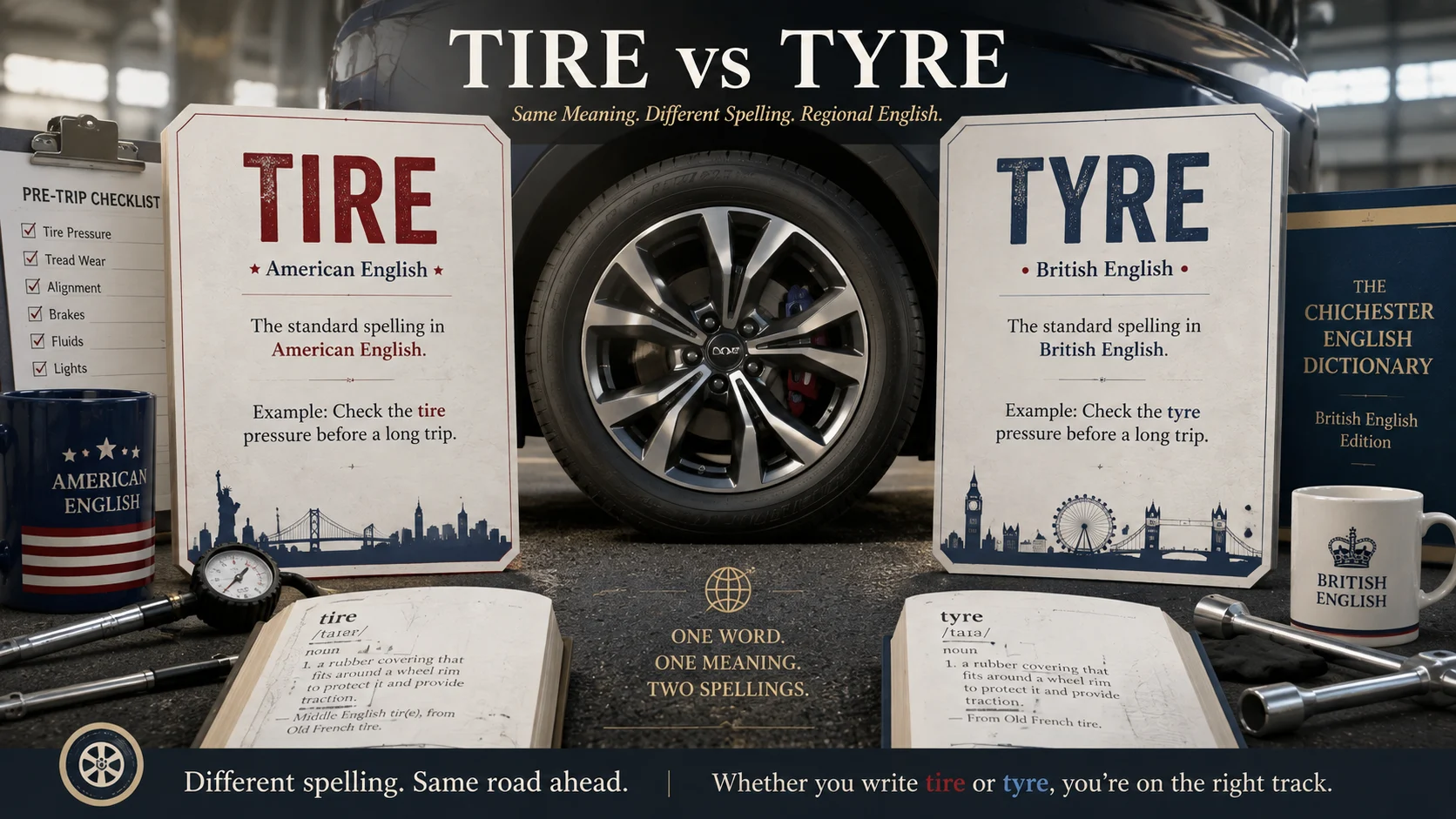
Tire or tyre are both correct spellings for the rubber covering fitted around a vehicle wheel. Tire is the standard spelling in American English, while tyre is standard in British English and many other varieties influenced by British usage. The meaning is the same, so the choice depends mainly on the English variety you are using.
If you are writing for an American audience, use tire. If your audience follows British English, use tyre.
This small spelling difference can matter in professional writing, educational content, product descriptions, automotive documentation, and international publishing because inconsistent regional spelling can make otherwise polished writing look careless.
Tire vs Tyre: What’s the Difference?
The simplest answer is that there is no difference in meaning when the word refers to the rubber covering of a wheel. The difference is regional spelling.
Tire is the standard North American form. Tyre is the standard British form. Major dictionaries, including Oxford and Cambridge, identify this distinction clearly. Oxford defines tire as a North American English noun and gives tyre as the British English equivalent. Cambridge likewise identifies tyre as the UK spelling of tire.
| Word | Part of speech | Main English variety | Meaning | Example |
|---|---|---|---|---|
| Tire | Noun | American English | Rubber covering around a vehicle wheel | I need a new tire. |
| Tyre | Noun | British English | Rubber covering around a vehicle wheel | I need a new tyre. |
| Tire | Verb | American English | To become tired or make someone tired | The long walk began to tire him. |
| Tyre | Verb | British English | Regional form related to becoming tired | The long walk began to tyre him. |
The noun forms refer to exactly the same vehicle component.
American readers normally expect tire, while British readers normally expect tyre.
Neither spelling is inherently more correct than the other.
The important rule is consistency with your chosen variety of English.
Is Tire vs Tyre a Grammar, Vocabulary or Usage Issue?
The difference between tire and tyre is primarily a spelling and regional usage issue, not a difference in grammar or meaning.
If an American newspaper writes, “The car has a flat tyre,” readers will generally understand it, but the spelling looks distinctly British. Likewise, a British publication using “flat tire” will be understood immediately, but the spelling looks American.
This distinction is especially important in formal writing. Academic papers, business websites, government documents, technical manuals, and professional publications usually follow a defined style guide. Once that style is selected, regional spelling should remain consistent throughout the document.
For example, an American automotive website would naturally write:
Check your tire pressure before a long journey.
A British automotive website would normally write:
Check your tyre pressure before a long journey.
Both sentences communicate the same idea.
Formal vs Casual Usage
There is no meaningful difference in formality between the two spellings. Tire is not more informal than tyre, and tyre is not more formal than tire.
The difference is geographical.
American English uses tire.
British English uses tyre.
This also affects related expressions. Oxford lists “spare tyre” as British English and “spare tire” as North American English.
Academic vs Casual Usage
In academic writing, the correct choice depends on the English variety required by the institution, publisher, journal, or instructor.
A British university assignment may use:
The vehicle requires replacement tyres after extensive use.
An American academic paper may use:
The vehicle requires replacement tires after extensive use.
The important point is not choosing one spelling universally. It is choosing the appropriate regional standard and applying it consistently.
When to Use Tire
Use tire when you are writing in American English or targeting readers who expect American spelling.
This is the preferred form in American automotive writing, American journalism, American educational material, and most American product documentation.
Workplace Example
Imagine an American company sending maintenance instructions to its employees:
Employees should inspect each tire before operating a company vehicle.
Using tire fits the regional writing standard.
Academic Example
A student writing an American English research paper might write:
Tire pressure can influence vehicle handling and fuel efficiency.
The spelling is appropriate because the paper follows American English conventions.
Technology Example
A vehicle diagnostic application designed primarily for the United States might display:
Low tire pressure detected.
The wording is short, clear, and consistent with the language expectations of its target market.
Usage Recap
Use tire for American English.
Use it in American automotive content, manuals, software interfaces, educational resources, and professional documents.
If your entire document follows American spelling, keep tire consistent throughout.
When to Use Tyre
Use tyre when writing in British English.
This spelling is particularly common in the United Kingdom and is also found in many English varieties influenced by British conventions.
For example:
The car needs four new tyres.
That sentence is completely natural in British English.
Workplace Example
A British fleet management company might write:
Drivers must check their tyres before starting a long journey.
The spelling matches British English conventions.
Academic Example
A British engineering student could write:
Tyre pressure should be maintained according to the manufacturer’s recommendations.
Again, the spelling reflects British English.
Technology Example
A vehicle interface designed for British users might display:
Check tyre pressure.
The wording is natural for the intended audience.
Usage Recap
Use tyre for British English.
It is particularly suitable for British automotive writing, educational material, technical documents, and websites aimed at British readers.
The meaning is exactly the same as tire when referring to a vehicle wheel covering.
Why Do American and British English Spell It Differently?
English developed through centuries of linguistic change, regional variation, and differences in spelling conventions.
The history of the word is particularly interesting. Oxford traces the noun tyre to the late fifteenth century, where it referred to curved pieces of iron fitted around carriage wheels. Oxford notes that the word may have developed as a variant connected with the idea of the wheel’s “clothing.”
The modern spelling distinction developed as American English established its own spelling conventions.
Today, the difference is stable enough that dictionaries explicitly label the forms by region.
Cambridge identifies tyre as the UK spelling and tire as the US spelling.
This is similar to other well known British and American spelling differences, such as colour and color or centre and center.
When You Should NOT Use Tire or Tyre
The biggest mistake is not choosing the “wrong” spelling. It is mixing regional standards without a reason.
Here are common situations where you should be careful.
| Situation | Better choice | Why |
|---|---|---|
| American English article | Tire | Matches US spelling |
| British English article | Tyre | Matches UK spelling |
| American automotive product page | Tire | Fits the target market |
| British automotive manual | Tyre | Fits British conventions |
| American academic paper | Tire | Consistent with US English |
| British academic paper | Tyre | Consistent with UK English |
| Mixed audience website | Choose one style | Consistency improves clarity |
| Quoting an original source | Preserve original spelling | Accuracy matters |
1. Do Not Mix Styles Randomly
Avoid writing “tire” in one paragraph and “tyre” in the next unless you are deliberately comparing American and British English.
2. Do Not Assume Tyre Is More Correct
British spelling is not more correct than American spelling.
3. Do Not Assume Tire Is More Modern
American spelling is not inherently newer or better.
4. Do Not Change a Direct Quote
If an original British source says “tyre,” do not silently change it to “tire” when accuracy requires the original wording.
5. Do Not Ignore Your Style Guide
Professional publications often specify which English variety should be used.
6. Do Not Mix Regional Automotive Terminology
If your website is specifically aimed at British motorists, consistency should extend beyond spelling to terms such as motorway and bonnet where appropriate.
7. Do Not Treat the Difference as a Meaning Difference
When discussing vehicle wheels, tire and tyre mean the same thing.
Common Mistakes and Decision Rules
| Correct sentence | Incorrect sentence | Explanation |
|---|---|---|
| I need to replace my tire. | I need to replace my tyre. | The second spelling is British rather than American. |
| I need to replace my tyre. | I need to replace my tire. | The second spelling is American rather than British. |
| Check your tire pressure. | Check your tyre pressure. | Use the first form in American English. |
| Check your tyre pressure. | Check your tire pressure. | Use the first form in British English. |
| The tire is damaged. | The tyre is damaged. | American English uses tire. |
| The tyre is damaged. | The tire is damaged. | British English uses tyre. |
Decision Rule
If you are writing American English, use tire. If you are writing British English, use tyre.
Unlike some commonly confused word pairs, this is not a situation where one spelling represents an action and the other represents an object. Both forms can function as the noun for the vehicle component.
There is also a verb tire, meaning to become tired or make someone tired. Oxford lists tire as a verb meaning to become tired or cause someone to become tired.
Tire and Tyre in Modern Technology and AI Tools
Modern technology makes regional spelling even more visible.
Automotive software, navigation systems, vehicle dashboards, repair platforms, online stores, and AI writing tools may produce either tire or tyre, depending on the language setting, training context, location, or requested English variety.
For example, an American English assistant may produce:
Your tire pressure is below the recommended level.
A British English system may produce:
Your tyre pressure is below the recommended level.
Neither output is linguistically wrong.
The important question is which audience the content serves.
This matters for SEO too. Search engines can understand that tire and tyre refer to the same concept, but publishers should still use the terminology expected by their target audience. A British automotive site should not randomly switch to American spelling simply because the American form has substantial search demand.
Authority and Trust: What Dictionaries Confirm
Major English dictionaries agree on the central point.
Oxford identifies tire as North American English and tyre as British English. Cambridge likewise defines tyre as the UK spelling of tire.
An expert style principle can be stated simply:
“The best spelling is the one that consistently matches your intended variety of English.”
That principle is more useful than memorizing one form as universally correct.
Case Study 1: American Automotive Content
Consider an American automotive website publishing an article about vehicle maintenance. If the article repeatedly uses “tyre pressure,” “tyre replacement,” and “tyre damage,” the meaning remains clear, but the content does not sound naturally American.
Changing the terminology to “tire pressure,” “tire replacement,” and “tire damage” creates regional consistency across the article.
The measurable improvement in this type of editorial case is not a change in the dictionary meaning. It is improved consistency, audience alignment, and stylistic credibility.
Case Study 2: British Educational Content
Now consider a British educational website teaching students about road safety. Using “tire” throughout the lesson would not make the information incorrect, but “tyre” better matches the expected British spelling.
The practical result is a more locally natural reading experience and stronger consistency with British educational English.
These examples illustrate an important SEO lesson: language accuracy includes regional appropriateness, not merely dictionary definition.
Error Prevention Checklist
Always Use Tire When
☐ Your content follows American English.
☐ Your audience is primarily in the United States.
☐ Your American style guide specifies US spelling.
☐ Your automotive software uses American English.
☐ Your product documentation targets American customers.
Always Use Tyre When
☐ Your content follows British English.
☐ Your audience is primarily in the United Kingdom.
☐ Your British style guide specifies UK spelling.
☐ Your educational material follows British conventions.
☐ Your automotive website targets British readers.
Never Mix Them Without a Reason
The strongest editorial practice is simple: identify your English variety before writing and maintain that choice throughout the page.
Tire or Tyre in SEO Content
For SEO writers, the choice should be driven by search intent and audience location, not by the assumption that one spelling is universally superior.
A page targeting American readers should naturally use tire in its headings, body copy, examples, image descriptions, and relevant metadata.
A page targeting British readers should naturally use tyre.
You can also mention the alternative spelling naturally when the purpose of the article is to explain the difference. That helps search engines understand the semantic relationship between the two terms while giving readers the answer they came for.
Do not force both spellings into every paragraph. Search optimized content should still sound like natural human writing.
The strongest page answers the searcher’s question quickly, explains the distinction clearly, provides useful examples, and resolves related questions without unnecessary repetition.
Related Grammar Confusions You Should Master
Once you understand this regional spelling difference, several related English confusions are worth studying:
- Color or colour
- Center or centre
- Favorite or favourite
- License or licence
- Practice or practise
- Program or programme
- Traveler or traveller
- Canceled or cancelled
- Catalog or catalogue
- Analyze or analyse
These pairs demonstrate a larger principle: English has multiple established regional standards. Good writing respects the variety being used rather than treating every difference as an error.
FAQs
Is tire or tyre correct?
Both are correct. Tire is standard American English, while tyre is standard British English.
Is tyre British or American English?
Tyre is the standard British English spelling, while American English normally uses tire.
Is tire American or British English?
Tire is the standard American English spelling for the rubber covering around a vehicle wheel.
Do tire and tyre mean the same thing?
Yes. When referring to a vehicle wheel covering, the two spellings have the same meaning.
Should I use tire or tyre in an essay?
Follow the English variety required by your school, university, publisher, or style guide. British English normally uses tyre, while American English uses tire.
Why do British people spell tire as tyre?
Tyre is the established British spelling, while tire became the standard American spelling. The difference is historical and regional rather than semantic.
Does tyre have a different pronunciation from tire?
Usually no. The words are pronounced essentially the same, although pronunciation can vary slightly by regional accent.
Which spelling should an international website use?
Choose the spelling that matches your primary audience and keep it consistent throughout the website.
Can tire also be a verb?
Yes. Tire can mean to become tired or make someone tired, as in “The long journey began to tire him.”
Conclusion
The difference between tire or tyre is straightforward once you identify the English variety you are using. American English normally uses tire, while British English uses tyre. Neither spelling is wrong, and neither changes the meaning when the word refers to a vehicle wheel covering.
For professional writing, the most important rule is consistency. Choose the spelling that matches your audience, style guide, publication, or market, then use it naturally throughout your content. That approach improves readability, regional accuracy, editorial credibility, and overall content quality.
Discover More Related Articles:
- Cant or Can’t | How One Apostrophe Changes Everything In 2026
- Sew or Sow | Meaning, Difference & Correct Usage In 2026
- Short or Tall | Understanding Height Terms & Correct Usage In 2026