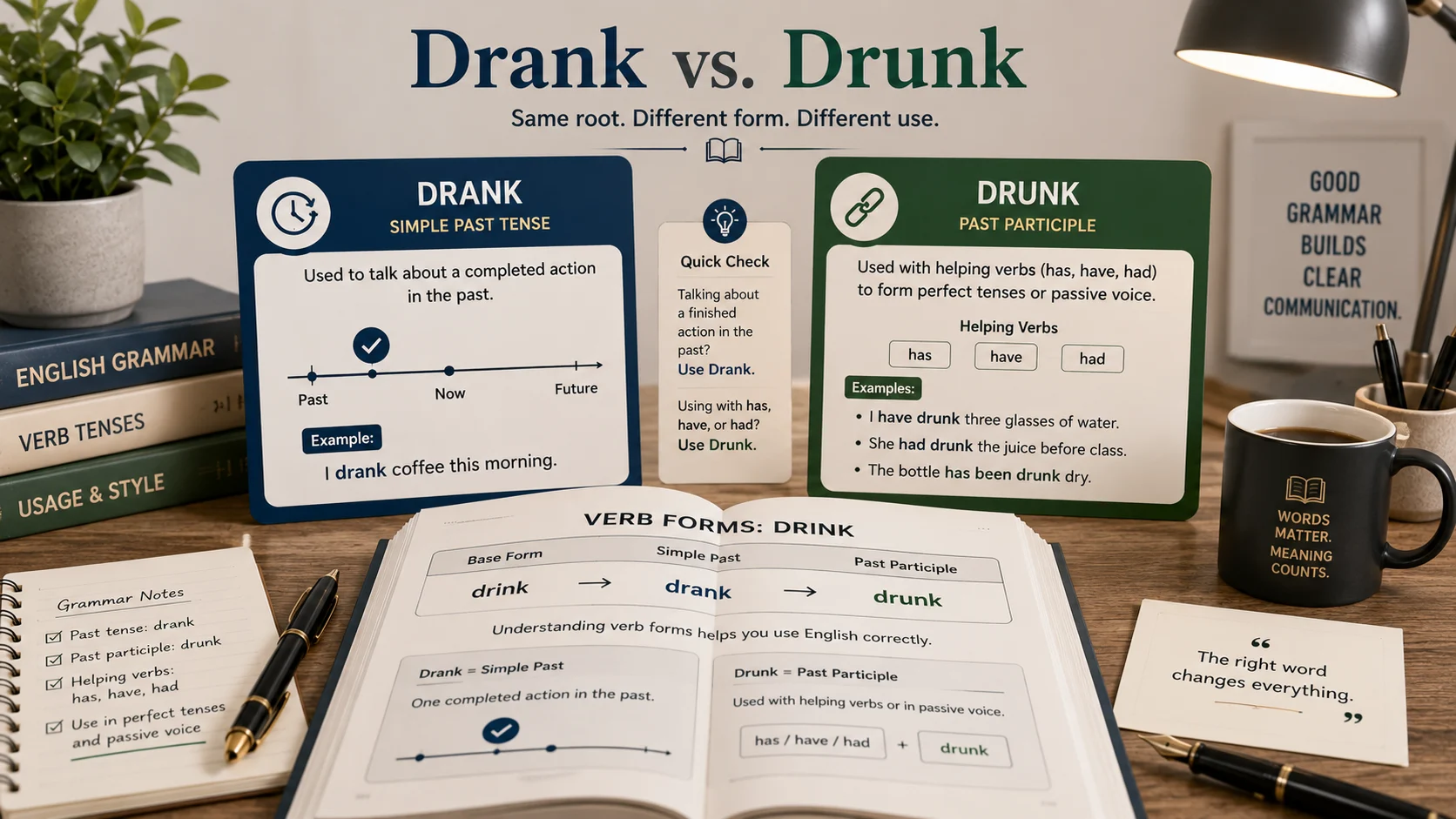
Drank or drunk often confuses English learners because both words come from the same verb, drink. Drank is the simple past tense used to describe an action completed in the past, while drunk is the past participle that must be used with a helping verb such as has, have, or had.
If you’ve ever paused before writing drank or drunk, you’re not alone. These two forms belong to the same verb, yet they serve different grammatical purposes. Choosing the wrong one can make a sentence sound awkward or grammatically incorrect, especially in academic writing, professional communication, and formal English.
The confusion happens because both words describe something that happened in the past. However, drank is the simple past tense of drink, whereas drunk is the past participle used with auxiliary verbs. Understanding this distinction will help you write with greater confidence, avoid common grammar mistakes, and communicate more clearly in every situation.
Drank vs Drunk | What’s the Difference?
Both drank and drunk come from the verb drink, but they are used in different verb tenses.
Drank is the simple past tense. It describes an action that happened and finished in the past.
Drunk is the past participle. It must be used with a helping verb such as has, have, had, is, was, or were when forming perfect or passive constructions.
| Feature | Drank | Drunk |
|---|---|---|
| Part of speech | Verb | Past participle of a verb |
| Verb tense | Simple past | Past participle |
| Used alone | Yes | No, usually needs a helping verb |
| Example | She drank water after class. | She has drunk enough water today. |
| Common helping verbs | Not required | Has, have, had, is, was, were |
| Formal writing | Correct | Correct when paired with a helping verb |
In simple terms, drank tells us that an action happened in the past, while drunk helps build perfect verb tenses. Although they are closely related, they cannot normally replace each other without changing the grammar of a sentence.
Remember this simple idea. If there is no helping verb, drank is usually the correct choice. If a helping verb comes before it, drunk is generally the right form.
Drank or Drunk: Is It a Grammar, Vocabulary or Usage Issue?
This confusion is mainly a grammar issue rather than a vocabulary problem. Both words have the same meaning because they come from the same base verb, but they belong to different grammatical forms.
Many native speakers casually say sentences such as I have drank too much coffee. While this may appear in everyday conversation, it is considered incorrect in standard English. The correct sentence is I have drunk too much coffee.
In formal writing, business communication, academic papers, and examinations, using the correct verb form is essential. Editors, teachers, and recruiters often notice mistakes involving irregular verbs because they affect grammatical accuracy.
In casual speech, people sometimes substitute drank for drunk, especially in regional dialects. Even so, standard English continues to distinguish between the two forms.
You are writing an email, completing an assignment, or creating online content, choosing the proper tense improves both clarity and credibility.
Using Drank Correctly
Drank is used when describing a completed action in the past. It does not require a helping verb.
Here are some common situations where drank is the correct choice.
Workplace Example
The team drank coffee before the morning meeting began.
Academic Example
The students drank water during the science experiment to stay hydrated.
Technology Example
After the fitness app reminded him to hydrate, he drank two bottles of water.
More Example Sentences
- I drank a glass of milk before bed.
- She drank fresh juice with breakfast.
- We drank tea while discussing the project.
- They drank plenty of water after the marathon.
- He drank every drop of the soup.
Notice that every sentence describes an action that started and finished in the past without using a helping verb.
Usage Recap
Use drank whenever you are talking about a completed action in the simple past tense. If the sentence does not include words such as has, have, or had, drank is often the correct choice.
Using Drunk Correctly
Drunk is the past participle of drink. It usually appears with a helping verb to create the present perfect, past perfect, or other perfect verb forms.
Without a helping verb, drunk is generally incorrect as a verb.
Workplace Example
The employees have drunk enough water during the workshop to stay refreshed.
Academic Example
The participants had drunk the solution before recording their observations.
Technology Example
The health tracking application confirmed that she had drunk her daily water goal.
More Example Sentences
- I have drunk enough coffee today.
- She has drunk all the orange juice.
- We had drunk the bottled water before the trip started.
- They have drunk more water this week than last week.
- He has drunk every serving that was offered.
You may also encounter drunk used as an adjective.
Examples include:
- The man was drunk after the celebration.
- She avoided driving because she was drunk.
In these examples, drunk describes a person’s condition rather than functioning as the main verb.
Usage Recap
Use drunk only when it is paired with a helping verb as part of a perfect tense, or when it functions as an adjective describing someone’s state. Using drunk by itself as the main verb is not correct in standard English.
When You Should NOT Use Drank or Drunk
Even though drank and drunk come from the same verb, they are not interchangeable. Using the wrong form can make your writing sound unprofessional or grammatically incorrect. The following situations highlight the most common mistakes.
| Situation | Incorrect Choice | Correct Choice | Why |
|---|---|---|---|
| After has, have, or had | I have drank coffee. | I have drunk coffee. | Perfect tenses require the past participle. |
| Simple past sentence | She drunk water yesterday. | She drank water yesterday. | Simple past uses drank. |
| Without a helping verb | They drunk tea after lunch. | They drank tea after lunch. | Drunk cannot normally stand alone as a verb. |
| Exam or academic writing | We have drank enough. | We have drunk enough. | Formal English requires the correct participle. |
| Business emails | I have drank the samples. | I have drunk the samples. | Professional writing follows standard grammar. |
| Reports or articles | Customers drunk more water last year. | Customers drank more water last year. | Completed past actions require drank. |
| Perfect tense narration | He had drank everything. | He had drunk everything. | Had must be followed by drunk. |
| Passive style expressions | The water was drank quickly. | The water was drunk quickly. | Passive constructions use the past participle. |
Understanding these situations makes it much easier to choose the correct verb form without second guessing yourself.
Common Mistakes and Decision Rules
Many grammar mistakes happen because writers remember that both words relate to the past but forget that they belong to different verb forms. The table below shows some of the most frequent errors.
| Correct Sentence | Incorrect Sentence | Explanation |
|---|---|---|
| I drank coffee this morning. | I drunk coffee this morning. | Simple past requires drank. |
| She has drunk all the milk. | She has drank all the milk. | Present perfect requires drunk. |
| We drank enough water yesterday. | We drunk enough water yesterday. | Completed past action uses drank. |
| They had drunk the juice before dinner. | They had drank the juice before dinner. | Past perfect uses the past participle. |
| He drank tea after work. | He drunk tea after work. | No helping verb means drank. |
| I have never drunk that drink before. | I have never drank that drink before. | Present perfect always needs drunk. |
| She was drunk after the party. | She was drank after the party. | Here drunk is an adjective. |
| The athletes drank plenty of water. | The athletes drunk plenty of water. | Simple past tense requires drank. |
Decision Rule Box
| If your sentence means | Use |
|---|---|
| A completed action in the simple past | Drank |
| A perfect tense with has, have, or had | Drunk |
| A passive construction | Drunk |
| A person’s state after consuming alcohol | Drunk as an adjective |
A simple memory trick can save you from most mistakes. If there is a helping verb before drink, choose drunk. If there is no helping verb and you are talking about a finished action in the past, choose drank.
Drank and Drunk in Modern Technology and AI Tools
Grammar checking software, writing assistants, and AI powered editing tools have become much better at identifying irregular verb errors. Applications used for academic writing and business communication can usually recognize when drank has been used instead of drunk after a helping verb.
For example, if someone writes, She has drank enough water today, most advanced grammar tools recommend changing drank to drunk because the sentence is in the present perfect tense.
Voice assistants and language learning platforms also emphasize this distinction during pronunciation and grammar exercises. As AI becomes more accurate, writers receive instant feedback that helps reinforce proper usage and reduce common mistakes.
The History and Etymology of Drank and Drunk
The verb drink comes from the Old English word drincan, which meant to consume liquid. Like many common English verbs, it developed irregular forms over time instead of following the regular pattern of adding ed.
Throughout the history of English, the simple past evolved into drank, while the past participle became drunk. These forms have remained remarkably stable for centuries and continue to appear in modern English around the world.
Although everyday speech sometimes blurs the distinction, dictionaries and style guides consistently recognize drank as the simple past form and drunk as the past participle.
Expert Insight: Strong writing depends on choosing the correct verb form for the sentence, not simply selecting a word that sounds familiar. Mastering irregular verbs like drink, drank, and drunk is one of the quickest ways to improve grammatical accuracy.
Real World Case Studies
Case Study One| Academic Writing Improvement
A university writing center reviewed essays from first year students and found that irregular verbs were among the most common grammar errors. After a focused lesson on verb forms, students reduced mistakes involving drank and drunk and produced more polished academic writing.
Case Study Two| Business Communication Accuracy
A corporate training program introduced a grammar refresher for employees who regularly wrote reports and client emails. After learning the difference between simple past and perfect tenses, participants made noticeably fewer verb errors, improving both clarity and professionalism in workplace communication.
Error Prevention Checklist
| Always Use Drank When | Never Use Drunk When |
|---|---|
| Talking about a completed action in the simple past | There is no helping verb in the sentence |
| Describing something that happened yesterday or at a specific past time | Writing a simple past statement |
| Referring to a finished event without has, have, or had | Replacing drank in ordinary past tense sentences |
| Writing narrative stories in the simple past | Trying to describe a completed past action by itself |
| Always Use Drunk When | Never Use Drank When |
|---|---|
| Following has, have, or had | After a helping verb in perfect tenses |
| Forming the present perfect or past perfect tense | Building passive constructions |
| Using it as an adjective to describe intoxication | Describing someone’s state after drinking alcohol |
Related Grammar Confusions You Should Master
Expanding your understanding of irregular verbs and commonly confused words will make your English stronger overall. Here are several grammar topics worth learning next.
| Grammar Topic | Why It Matters |
|---|---|
| Ate or Eaten | Understanding simple past versus past participle |
| Began or Begun | Correct use of perfect tenses |
| Broke or Broken | Common irregular verb confusion |
| Went or Gone | Frequently confused verb forms |
| Saw or Seen | Essential grammar for everyday English |
| Lay or Lie | One of the most misunderstood verb pairs |
| Sat or Set | Difference between action and position |
| Chose or Chosen | Mastering irregular verb patterns |
| Was or Were | Subject verb agreement basics |
| Affect or Effect | Distinguishing verbs from nouns |
FAQs
Is it correct to say I have drank or I have drunk?
The correct expression is I have drunk because the present perfect tense always requires the past participle. I have drank is considered incorrect in standard English.
When should I use drank instead of drunk?
Use drank for a completed action in the simple past tense. For example, She drank a glass of water before leaving for work.
Why do people confuse drank and drunk?
The confusion happens because both words come from the same verb and both refer to past events. However, they belong to different grammatical forms and cannot be exchanged freely.
Can drunk be used as an adjective?
Yes. Drunk often functions as an adjective describing someone affected by alcohol. For example, The driver was drunk, where the word describes a condition rather than an action.
Is I drunk water yesterday grammatically correct?
No. The correct sentence is I drank water yesterday because the sentence uses the simple past tense without a helping verb.
Do native English speakers make this mistake?
Yes. In informal conversation and some regional dialects, native speakers sometimes say have drank. However, formal English grammar still recognizes have drunk as the correct form.
How can I remember the difference between drank and drunk?
Think about the helping verb. If your sentence contains has, have, or had, use drunk. If there is no helping verb and the action happened in the past, use drank.
Is drunk always related to alcohol?
No. As a verb form, drunk refers to consuming any liquid in perfect tenses. As an adjective, it usually describes someone who has consumed too much alcohol.
Conclusion
Understanding the difference between drank or drunk becomes much easier once you know how each verb form functions. Drank is the simple past tense used for actions that happened and ended in the past, while drunk is the past participle that follows a helping verb or serves as an adjective.
Although many people mix these forms in everyday conversation, standard English keeps them separate. Using the correct form improves the clarity of your writing, strengthens your grammar, and helps you communicate more professionally in school, at work, and online.
Whenever you are unsure, remember this simple rule. If the sentence includes has, have, or had, choose drunk. If you are simply describing a completed action in the past without a helping verb, choose drank. Mastering this irregular verb will make your English more accurate and more confident.
Discover More Related Articles:
- Bought or Brought | The Grammar Mistake Millions Still Make In 2026
- Champaign or Champagne | What Is the Difference & When to Use Each In 2026
- Pannel or Panel | Which Word Is Correct & What Is the Difference In 2026