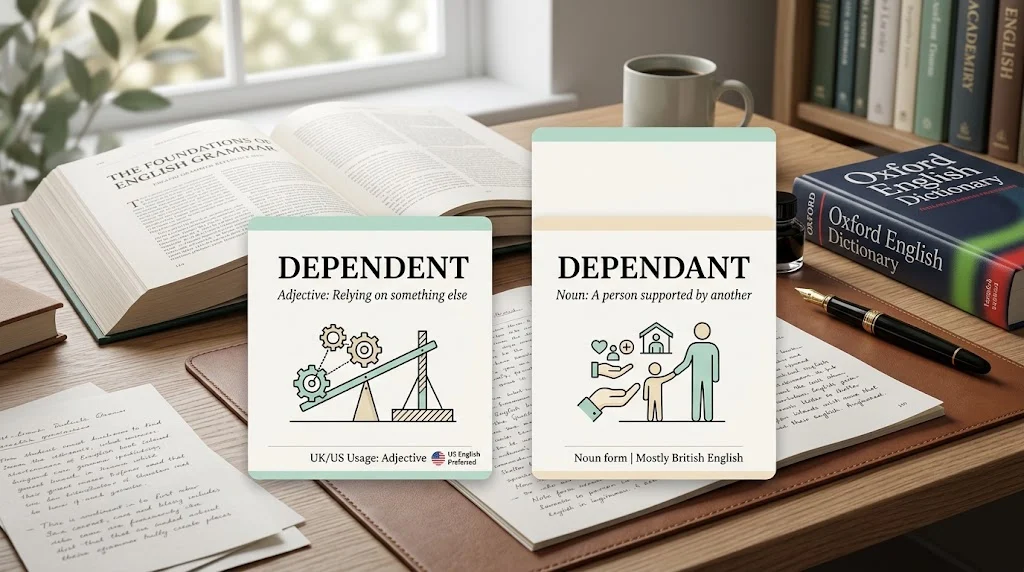
Dependent is the standard spelling in American English and is also widely used in British English, while dependant is mainly a British English noun referring to a person who relies on someone else financially or otherwise. The choice depends on both meaning and regional convention, so using the wrong form can create confusion in formal, academic and professional writing.
Dependent or Dependant | What Is the Difference?
The words dependent and dependant are closely related, but they do not always serve the same grammatical role. The main distinction is especially important in British English, where the two spellings can have different functions.
Dependent is the more widely accepted spelling. It can function as an adjective or noun.
As an adjective, dependent describes someone or something that relies on another person, thing, or condition.
For example:
The child is dependent on her parents.
Here, dependent describes the child’s relationship with her parents.
Dependent can also be a noun, particularly in American English. In that use, it refers to a person who relies on another person for financial support.
The employee added two dependents to the health insurance plan.
Dependant, by contrast, is chiefly used as a noun in British English. It generally refers to a person who relies on another person for financial or personal support.
The visa application asks the applicant has any dependants.
The difference becomes clearer when the terms are placed side by side.
| Feature | Dependent | Dependant |
|---|---|---|
| Main use | Adjective and noun | Mainly noun |
| American English | Standard spelling | Rare |
| British English | Standard adjective and accepted noun | Common noun spelling |
| Meaning as adjective | Relying on someone or something | Usually not used as an adjective |
| Meaning as noun | A person who relies on another | A person who relies on another |
| Common context | Grammar, finance, employment, relationships | British legal, immigration, employment and financial contexts |
| Example | She is dependent on her parents. | Her husband is her dependant. |
The simplest distinction is this: dependent is the versatile spelling and works naturally as an adjective.
Dependant is chiefly a British noun spelling for a person who relies on someone else.
In American English, dependent is normally used for both the adjective and noun.
In British English, writers may choose dependant when the word is specifically a noun referring to a person.
Is Dependent or Dependant a Grammar, Vocabulary or Usage Issue?
The difference between dependent and dependant is primarily a spelling and usage issue rather than a difference in basic meaning.
Both words ultimately express the idea of relying on someone or something. Their distinction developed through English usage conventions rather than because they represent completely different concepts.
The most important question is therefore not simply, “Which word is correct?” Instead, ask what grammatical function the word has and which variety of English you are writing.
In American English, dependent is the normal choice in almost every situation.
My daughter is dependent on me.
I claimed my daughter as a dependent.
The same spelling handles both grammatical functions.
British English allows a more noticeable distinction. Dependent is normally used as an adjective, while dependant can be used as a noun.
The patient remains dependent on medical assistance.
His wife is listed as his dependant.
This distinction is particularly visible in official British documents, employment materials, immigration forms, and financial terminology.
In casual writing, many readers will not consider dependant an error if it is being used as a British noun. However, mixing British and American conventions within the same document can make your writing look inconsistent.
For academic writing, consistency matters more than choosing one variety as universally superior. If your institution follows British English, dependant may be appropriate as a noun. If you are writing for an American audience, dependent is almost always the safer choice.
A useful editorial principle is:
Choose the spelling that matches both the grammatical role and the variety of English used by your audience.
This is why the question is best understood as a usage distinction rather than a simple right versus wrong spelling problem.
How to Use Dependent Correctly
Dependent has a broad range of uses because it can describe relationships involving people, systems, conditions, results, and processes.
Workplace Example
In professional writing, dependent frequently describes employees, family members, benefits, financial obligations, or business conditions.
The employee requested health coverage for her dependent children.
Here, dependent functions as a noun.
It can also function as an adjective:
The company is dependent on international suppliers.
In this sentence, dependent describes the company’s reliance on suppliers.
The word appears frequently in human resources documents because employee benefits often depend on a family member qualifies as a dependent.
Academic Example
Academic writing uses dependent in several specialized ways.
In grammar, a dependent clause is a group of words that contains a subject and verb but cannot normally stand alone as a complete sentence.
Although the experiment was successful, the researchers repeated it.
The opening portion, “Although the experiment was successful,” is a dependent clause.
The word also appears in academic discussions of relationships between variables.
The dependent variable changed when the temperature increased.
Here, dependent has a technical scientific meaning. The dependent variable is the outcome being measured or observed.
Technology Example
Technology writing frequently uses dependent when describing systems that rely on another component.
The application is dependent on a stable internet connection.
Software documentation may also describe dependencies between packages, services, databases, or operating systems.
This feature is dependent on the latest version of the database service.
In both examples, dependent expresses reliance.
Usage recap: Use dependent when you need an adjective meaning reliant on something, when discussing a dependent clause or variable, or when using the noun form in American English.
How to Use Dependant Correctly
Dependant is much narrower in modern usage. It is primarily associated with British English and is generally used as a noun for someone who relies on another person.
Workplace Example
A British employment form might ask an employee to provide information about their dependants.
Employees must report any changes involving their dependants.
Here, dependant refers to people who receive support or benefits through another person.
This usage is especially common in benefits administration, taxation, insurance, and employment documentation.
Academic Example
In British academic or social research writing, dependant may appear when researchers discuss people who rely financially on another individual.
The study examined the effect of employment changes on workers and their dependants.
Because academic institutions differ in their preferred style guides, writers should check British or American English is required.
Technology Example
Dependant is less common in technology writing because technical systems are usually described with dependent rather than dependant.
For example:
The application is dependent on the operating system.
Not:
The application is dependant on the operating system.
The second sentence is inappropriate because dependant is being used as an adjective.
Usage recap: Use dependant mainly as a British English noun referring to a person who relies on another person. Do not use it as the normal adjective for something that relies on something else.
When You Should NOT Use Dependent or Dependant
Understanding when not to use these spellings can prevent many common errors.
| Situation | What to avoid | Better choice | Reason |
|---|---|---|---|
| Describing something that relies on another thing | Dependant | Dependent | The adjective is dependent |
| American English noun | Dependant | Dependent | Dependent is the standard American form |
| British noun referring to a supported person | Dependent in a style that distinguishes nouns | Dependant | Dependant is common British noun usage |
| British adjective | Dependant | Dependent | Dependant is not normally the adjective |
| Scientific writing | Dependant variable | Dependent variable | Dependent is the established technical term |
| Grammar terminology | Dependant clause | Dependent clause | Dependent is the standard grammatical term |
| Software documentation | Dependant package | Dependent package | Technical usage normally uses dependent |
| Mixed style documents | Switching randomly between forms | Follow one style consistently | Consistency improves professional credibility |
A common mistake is assuming that dependant is simply a British version of dependent in every situation. That is not quite right.
British English generally keeps dependent for adjectival uses. The alternate spelling dependant is primarily a noun form.
Common Mistakes and Decision Rules
| Correct sentence | Incorrect sentence | Explanation |
|---|---|---|
| The child is dependent on her parents. | The child is dependant on her parents. | The word is an adjective here. |
| The employee listed two dependants. | The employee listed two dependent in a British style context. | Dependant can function as a British noun. |
| The dependent variable increased. | The dependant variable increased. | Scientific terminology uses dependent. |
| She supports three dependants. | She supports three dependents in a British style document. | Dependant is a common British noun spelling. |
| The system is dependent on the server. | The system is dependant on the server. | Dependent is the adjective. |
| He claimed his son as a dependent. | He claimed his son as a dependant in standard American English. | American English normally uses dependent as the noun. |
Decision Rule Box
If you mean someone or something that relies on another person or thing, use dependent when the word is functioning as an adjective.
If you mean a person who relies on another person and you are following British English noun conventions, dependant can be appropriate.
If you are writing American English, use dependent for both the adjective and noun.
Dependent and Dependant in Modern Technology and AI Tools
Modern technology has made dependent especially common because software systems frequently rely on other systems.
Developers talk about dependent packages, dependent services, dependent applications, and dependent variables. Technical documentation also uses dependency to describe a relationship in which one component requires another.
Artificial intelligence systems create similar terminology.
An AI application may be dependent on a language model, database, application programming interface, cloud service, or external data source. In each case, dependent functions as an adjective.
For example:
The AI assistant is dependent on access to the retrieval system.
The noun dependant would not normally be appropriate in this technical context.
This distinction matters because technical writing values terminology that is consistent across documentation, software interfaces, academic research, and professional communication.
The Etymology of Dependent and Dependant
Both spellings come from the same linguistic family.
Dependent ultimately traces back through French to Latin dependere, meaning “to hang from” or “to rely upon.” The underlying idea is physical or figurative reliance.
English developed dependent as a form describing something that depends on another thing.
The noun spelling dependant emerged as a variant, particularly in British usage, where it became associated with a person who depends on someone else.
This explains why the two forms look almost identical and why their meanings overlap so strongly. They are not unrelated vocabulary items. They are spelling variants shaped by grammatical function and regional convention.
A useful expert style observation is:
The safest spelling is determined by meaning, grammatical function, and audience rather than by appearance alone.
That principle applies to many English spelling differences, particularly those involving British and American conventions.
Two Practical Case Studies
Case Study One: British Employment Documentation
Imagine a British company preparing an employee benefits form. The form asks workers to identify family members who receive qualifying benefits.
A consistent British style might use dependant when referring to the person:
Please provide details of each dependant.
However, the same document could use dependent as an adjective:
Benefits may vary depending on the employee’s dependent family members.
The concrete editorial result is greater consistency because the noun and adjective functions are distinguished instead of treating dependant as a universal replacement.
Case Study Two: American Tax and Benefits Writing
Consider an American benefits document that asks an employee to identify family members covered under a plan.
American English normally uses dependent:
Add a dependent to your health insurance plan.
The same document can say:
The dependent child must meet the eligibility requirements.
Using dependent in both sentences produces a consistent American English style.
The practical result is simple: American readers do not need to interpret two spellings for the same general concept.
Error Prevention Checklist
Always use dependent when
You are writing American English.
You are describing someone or something that relies on another thing.
You are discussing a dependent clause.
You are discussing a dependent variable.
You are writing technical or scientific documentation.
You need the adjective form.
Never use dependant when
You are using it as an adjective.
You are writing about a dependent clause.
You are referring to a dependent variable.
You are describing a software dependency.
You are following standard American English.
You are using British spelling but need an adjective rather than a noun.
Related Grammar Confusions You Should Master
English contains many spelling pairs where regional conventions or grammatical roles create uncertainty. Mastering related distinctions can make your writing considerably more precise.
Advice or Advise: Advice is a noun, while advise is a verb.
Practice or Practise: Practice is the standard noun in British English, while practise is traditionally used as the verb.
Licence or License: British English commonly distinguishes the noun licence from the verb license, while American English generally uses license for both.
Affect or Effect: Affect is commonly a verb meaning to influence, while effect is often a noun meaning a result.
Stationary or Stationery: Stationary relates to remaining still, while stationery refers to writing materials.
Principal or Principle: Principal can refer to a person or something important, while principle means a rule or belief.
Dependent clause or independent clause: A dependent clause cannot normally stand alone as a complete sentence, while an independent clause can.
Further or Farther: Further is widely used for figurative or additional ideas, while farther is often associated with physical distance.
Lay or Lie: Lay normally takes an object, while lie generally describes the position of a person or thing.
Everyday or Every day: Everyday is an adjective meaning ordinary, while every day is an expression referring to each day.
FAQs
Is dependent or dependant correct in English?
Both are correct in specific contexts, but dependent is much more widely used. Dependant is mainly a British English noun for a person who relies on someone else.
Is dependant British or American spelling?
Dependant is primarily British English spelling when it is used as a noun. American English normally uses dependent for the same noun meaning.
Should I use dependent or dependant in British English?
Use dependent as an adjective and dependant as a noun when following the traditional British distinction. Dependent is also accepted as a noun in many British contexts.
Should I use dependent or dependant in American English?
Use dependent for both adjective and noun uses. Dependant is not the normal American English spelling.
Is dependent an adjective or a noun?
Dependent can be either an adjective or a noun. As an adjective it means relying on something, while as a noun it can mean a person who relies on another.
Is dependant an adjective?
In standard modern usage, dependant is primarily a noun in British English. The adjective form is dependent.
Which is correct, dependent variable or dependant variable?
Dependent variable is correct. Dependent is the established term in scientific, mathematical, statistical, and academic writing.
Which is correct, dependent clause or dependant clause?
Dependent clause is correct. Dependent is the established grammatical term for a clause that cannot normally stand alone.
Is a child a dependent or dependant?
In American English, a child can be called a dependent. In British English, dependant can be used as a noun for a person who relies on another.
Conclusion
The difference between dependent and dependant becomes much easier once you consider grammatical function and regional English.
Dependent is the safest general choice. It works as an adjective in expressions such as dependent child, dependent variable, and dependent clause, and it also functions as a noun in American English.
Dependant has a narrower role. It is chiefly a British English noun referring to a person who relies on another person.
Therefore, if you are writing for an international audience and need one broadly understood form, dependent is usually the best choice. If you are following British English conventions and referring specifically to a person as a noun, dependant may be appropriate.
The key is not to treat the two spellings as completely interchangeable. Think about what the word is doing in the sentence, identify your target variety of English, and then choose the spelling that matches both.
Discover More Related Articles:
- Cozy or Cosy | Which Spelling Works in Formal Writing In 2026
- W2 or W4 | What Is the Difference & Which Form Do You Need In 2026
- Rock or Something | Everything You Need to Know In 2026