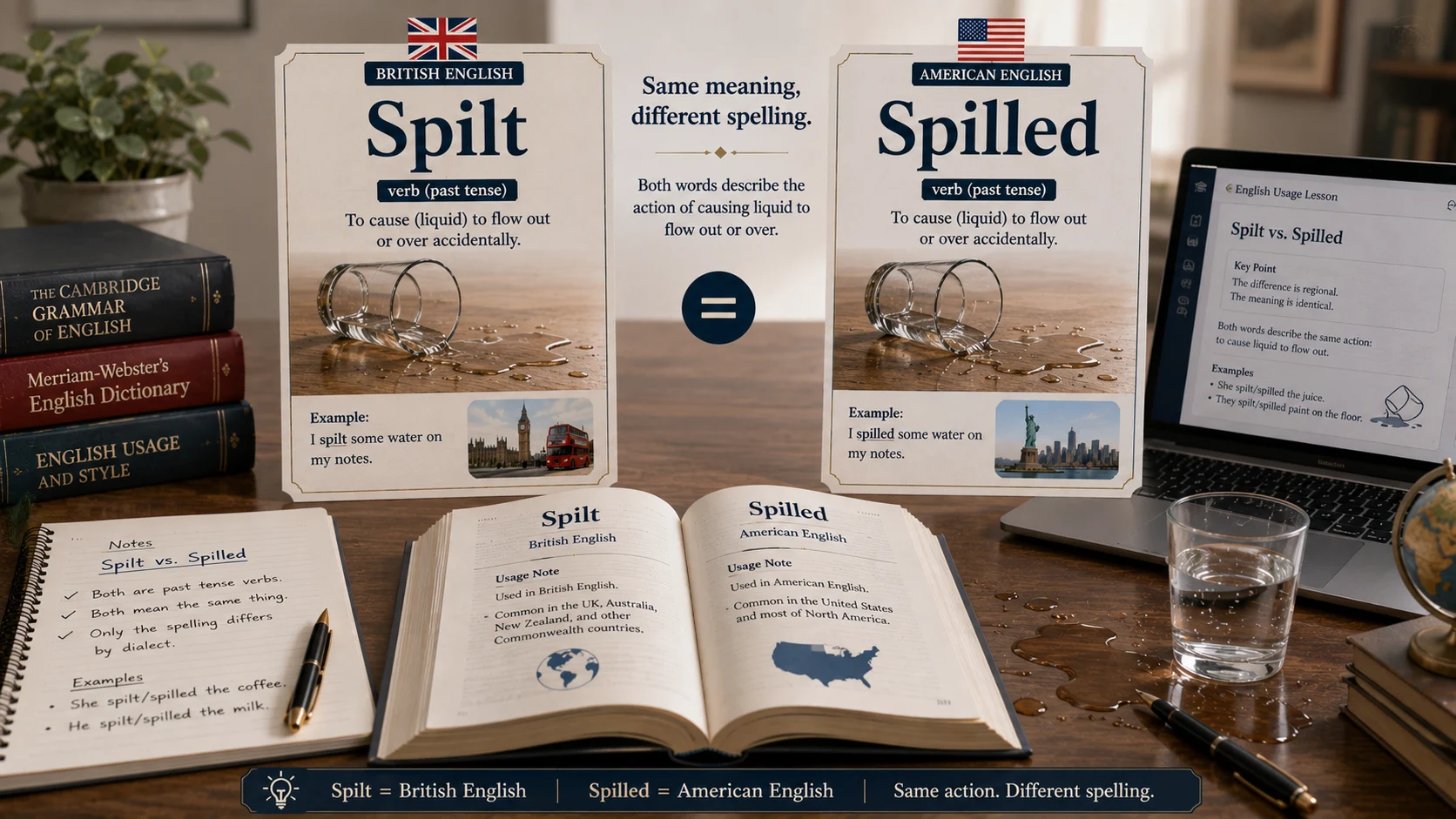
Both spilt or spilled are correct forms of the verb spill, but their use depends mainly on English variety and context. Spilled is the standard past tense and past participle in American English, while spilt remains common in British English and some other varieties. Understanding the distinction helps prevent spelling errors in formal, academic and professional writing.
Have you ever paused while writing and wondered “spilt” or “spilled” is the correct word? You are not alone. These two spellings often confuse writers because both are accepted forms of the past tense and past participle of “spill.” The difference mainly comes down to regional preferences and writing conventions. “Spilled” is more common in American English, while “spilt” is frequently used in British English, although both forms appear in different varieties of English. You are describing spilled coffee, spilt milk, or an accidental mess, choosing the right form can make your writing clearer and more consistent.
In this guide, you will discover the meanings of spilt and spilled, understand their grammatical uses, and explore practical examples that show how each word works in a sentence. you are writing an academic assignment, a professional email, or an everyday message, this simple comparison will help you choose the appropriate spelling for your audience and avoid unnecessary confusion.
Spilt or Spilled | What’s the Difference?
The words spilt and spilled have the same basic meaning. Both are forms of the verb spill, which means to cause or allow a liquid, substance, or collection of things to fall or flow out of its container or original position.
The important distinction is not meaning but regional usage and style.
Spilled is the regular past tense and past participle form most commonly preferred in American English. It is also widely understood and used internationally.
Spilt is an alternative form that is particularly associated with British English. It is perfectly grammatical and is still found frequently in British writing, although spilled is also acceptable in British English.
Here is the distinction at a glance.
Quick recap: Spilt and spilled mean the same thing.
Spilled is especially common in American English.
Spilt is strongly associated with British English.
Neither form is inherently incorrect.
Spilt or Spilled | Is This a Grammar, Vocabulary or Usage Issue?
The question of spilt or spilled is primarily a usage and regional spelling issue, rather than a difference in meaning or a major grammatical distinction.
Both forms belong to the same verb. The base form is spill. Its forms can include spills, spilling, spilled, and spilt.
The difference becomes noticeable when writers choose a variety of English.
American English generally favors regular forms of verbs, so spilled is the overwhelmingly natural choice in American writing.
British English allows both spilled and spilt. The form spilt has a long history and remains familiar in British usage, particularly in everyday speech and writing.
For example:
She spilled coffee on the report.
This sounds completely natural in American English and is also perfectly understandable elsewhere.
She spilt coffee on the report.
This is also correct, particularly in British English.
The same principle applies to formal writing. A British academic paper can use spilt, while an American academic paper would normally use spilled.
Formal Versus Informal Usage
Neither form is inherently informal. Spilt should not be dismissed as slang, and spilled should not be considered exclusively American in every context.
However, consistency matters.
If a document follows American spelling conventions, spilled is the safest choice. If a document follows British spelling conventions, either form may work, but the writer should follow the style preferred by the publication, institution, or editor.
Academic Versus Casual Usage
Academic writing benefits from consistency more than from choosing one form as universally correct.
An American university assignment would normally use spilled. A British publication may use spilt. Neither choice changes the underlying grammatical meaning.
The real mistake occurs when a writer treats one regional form as though it were the only correct spelling everywhere.
Spilt: Meaning, Examples and Correct Usage
Spilt is the past tense and past participle form of spill. It is especially common in British English.
Consider the sentence:
Someone spilt water across the laboratory floor.
The sentence means that someone caused water to flow onto the floor at some point in the past.
The word can describe liquids, powders, substances, objects, or information.
She spilt the milk.
He spilt flour across the kitchen counter.
The children spilt the beads onto the carpet.
It can also appear in figurative expressions.
She accidentally spilt the secret.
In this context, spilt means revealed information that was supposed to remain confidential.
Workplace Example
A British employee might write:
I noticed that the customer had spilt coffee beside the equipment.
The wording is grammatically correct and natural in British English.
In an American workplace, the equivalent would usually be:
I noticed that the customer had spilled coffee beside the equipment.
Academic Example
A British research paper might state:
The solution was spilt onto the surface during preparation.
An American paper would normally use:
The solution was spilled onto the surface during preparation.
The scientific meaning remains identical.
Technology Example
Technical documentation written in British English might say:
If liquid is spilt onto the keyboard, disconnect the device immediately.
American documentation would generally prefer:
If liquid is spilled onto the keyboard, disconnect the device immediately.
Usage Recap for Spilt
Use spilt when you are following British English conventions or when the style of your publication specifically favors it. It is a legitimate form, not a spelling mistake.
Spilled: Meaning, Examples and Correct Usage
Spilled is the regular past tense and past participle of spill. It is particularly dominant in American English and is also widely used in British English.
For example:
I spilled coffee on my shirt this morning.
The bottle fell and spilled water everywhere.
She has spilled the paint.
The word can describe physical substances as well as figurative information.
He spilled the secret during the interview.
She spilled everything she knew.
The figurative sense is especially common in conversational English.
Workplace Example
An American employee might write:
The technician spilled the cleaning solution near the machine.
The form spilled is the natural choice for standard American workplace writing.
Academic Example
A scientific report might say:
The researcher spilled the solution during the transfer process.
Here, spilled functions as the past tense of spill.
Technology Example
A technology safety guide might state:
If water is spilled on the laptop, turn it off immediately.
This form is particularly natural in American technical documentation.
Usage Recap for Spilled
Choose spilled when writing American English. It is also completely acceptable in British English, making it a useful international choice when a publication does not require distinctly British usage.
When You Should NOT Use Spilt or Spilled
Although both forms are legitimate, there are situations where choosing the wrong form can make your writing inconsistent or confusing.
1. Do not treat spilt as an American spelling
American English normally favors spilled. Using spilt in an American style document can make the writing appear inconsistent.
2. Do not assume spilled is grammatically wrong in British English
British English permits spilled. Calling it incorrect simply because spilt is also common is an unnecessary mistake.
3. Do not change the spelling because the meaning changes
The meaning does not change between the two forms. Regional convention changes, not the definition.
4. Do not mix styles randomly
A document should maintain a consistent variety of English. If you are writing in American English, use spilled consistently. If you are following a British style guide, select the form that matches its preferences.
5. Do not use spilt as the base form
The base verb is spill, not spilt.
Correct:
Please do not spill the water.
Incorrect:
Please do not spilt the water.
6. Do not use spilled as a noun
The word functions as a verb form. A noun such as spill describes the event or substance that has been accidentally released.
7. Do not assume every English speaking country follows identical conventions
English varies across countries and institutions. Regional dictionaries and editorial style guides can influence preferred forms.
Common Mistakes and Decision Rules
The following examples show where writers commonly make errors.
Decision Rule
If you are writing American English, use spilled. If you are writing British English, spilt and spilled can both be correct, subject to the preferred style of your publication.
This rule is more accurate than trying to assign different meanings to the two words.
Spilt or Spilled in Modern Technology and AI Tools
Digital writing tools increasingly recognize both spilt and spilled as valid English forms. However, grammar checkers may make different recommendations depending on the selected language variant.
For example, a writing application configured for American English may recommend spilled. A British English configuration may accept spilt without correction.
AI writing assistants can also produce either form depending on the context supplied by the user. If you ask an AI tool to write in American English, spilled will generally be the safer choice. If you specify British English, spilt may appear naturally.
This illustrates an important point about modern grammar technology: a correction tool does not always identify a word as simply right or wrong. It may be checking against a particular regional variety of English.
The Etymology of Spilt and Spilled
The verb spill has deep Germanic roots and has been part of English for centuries. Earlier forms of the verb developed into the modern English word used for accidentally releasing liquids, substances, objects, and information.
The coexistence of spilt and spilled reflects a broader pattern in English verb development. English has retained many older irregular or alternative forms while also developing regular forms ending in ed.
This explains why both spilt and spilled can survive in modern English. The language did not simply replace one with the other.
An Expert Style Perspective
“Regional variation does not make a grammatical form incorrect; context and consistency determine it is appropriate.”
This principle is useful beyond this particular pair. English contains many legitimate forms that differ according to geography, historical development, or editorial preference.
Two Practical Case Studies
Case Study One: American Workplace Communication
Imagine an American company preparing a workplace safety manual. The manual repeatedly describes incidents involving liquids.
An editor changes every instance of spilt to spilled.
The result is stylistically consistent with American English. The change does not improve the underlying grammar because spilt is not inherently ungrammatical. Instead, it aligns the document with the chosen regional variety.
The concrete result is improved consistency across the document and fewer unnecessary style questions during editing.
Case Study Two: British Academic Publishing
Now consider a British university publication that uses spilt throughout its editorial material.
A contributor submits a paper using spilled. The editor does not need to reject the form as grammatically wrong. Instead, the editor can determine the publication’s house style favors spilt.
If the house style requires consistency, the editor may change the form.
The concrete result is a uniform editorial voice without falsely labeling spilled as incorrect British English.
Error Prevention Checklist
Use the following quick review before publishing.
- Always use spilled when following standard American English conventions.
- Always check the publication style before choosing between spilt and spilled.
- Never use spilt as the base form after to or do.
- Never write spillt or spilted as forms of the verb.
- Always consider your audience expects British or American English.
- Never assume that regional variation automatically means grammatical error.
Related Grammar Confusions You Should Master
Once you understand spilt and spilled, several related English usage questions become easier to recognize.
Learnt or learned: Both forms occur in English, with regional preferences affecting usage.
Burnt or burned: Both can function as past forms, although style and meaning can influence the preferred choice.
Dreamt or dreamed: British English often preserves dreamt, while dreamed is especially common in American English.
Leant or leaned: Regional variation affects which form sounds most natural.
Smelt or smelled: Both forms have established uses in different English varieties.
Spelt or spelled: This is particularly similar to the distinction discussed here.
Lit or lighted: Both occur, but their distribution and meanings can differ according to context.
Got or gotten: Regional English varieties use these forms differently, especially in perfect constructions.
Learned or learnt: Understanding regional verb patterns helps writers avoid incorrectly labeling one form as universally wrong.
Practice or practise: This pair demonstrates how British and American English can differ not only in verb forms but also in spelling conventions.
FAQs
Is spilt or spilled correct in English?
Both are correct past forms of spill. Spilled is especially common in American English, while spilt is particularly common in British English.
Is spilt British or American English?
Spilt is strongly associated with British English. American English generally prefers spilled, although readers understand both forms.
Is spilled correct in British English?
Yes. British English accepts spilled, although many British speakers and publications also use spilt.
Should I use spilt or spilled in American English?
Use spilled in standard American English because it is the overwhelmingly common form and fits American spelling conventions.
Should I use spilt or spilled in academic writing?
Choose the form required by your regional English and the institution or publication’s style guide. Consistency matters more than treating either form as universally correct.
Is spilt the past tense of spill?
Yes. Spilt can function as the past tense and past participle of spill, particularly in British English.
Is spilled the past participle of spill?
Yes. Spilled is both the past tense and past participle of spill.
Why do British people say spilt instead of spilled?
Spilt is an established historical form of the verb that remains common in British English, while American English generally favors the regular form spilled.
Is spilted a word?
No. Spilted is not a standard form of spill. The accepted forms include spilt and spilled.
Conclusion
The choice between spilt or spilled is mainly a matter of regional English and editorial preference rather than meaning. Both forms describe the past action of allowing something to fall or flow out.
American English strongly favors spilled, while British English accepts both spilt and spilled. When in doubt, identify your target variety of English and follow its established style consistently.
Discover More Related Articles:
- Presentor or Presenter | Which Spelling Is Correct & When Should You Use It In 2026
- Skied or Skiied | Which Past Tense Is Correct In 2026
- Sesamoiditis or Gout | How to Tell the Difference and Why Diagnosis Matters In 2026