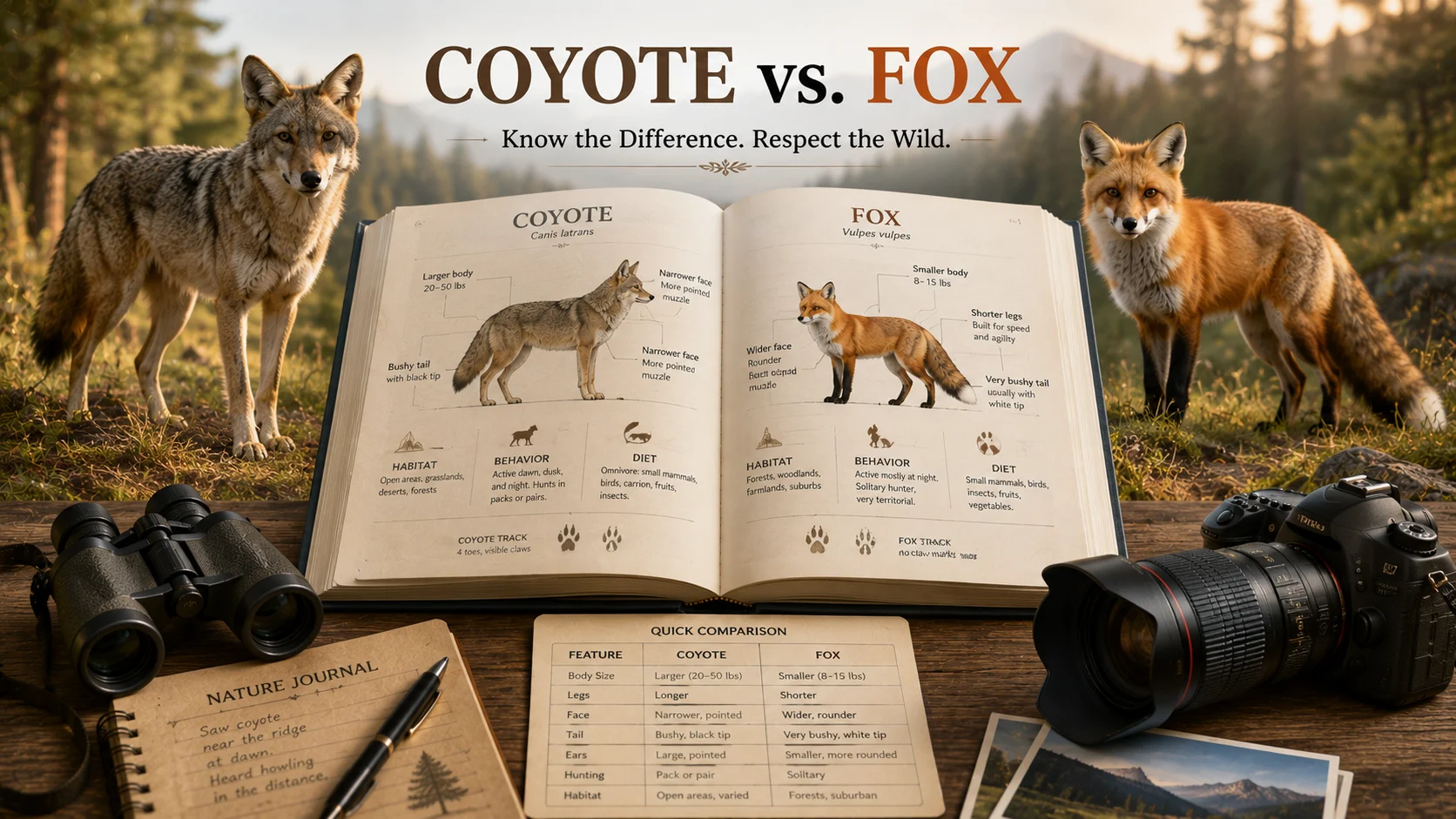
Coyote or fox refers to two different wild members of the canine family. A coyote is a medium sized predator known for its adaptability and social hunting behavior, while a fox is generally smaller, more solitary, and recognized for its bushy tail and agility. Knowing the difference helps avoid factual mistakes in writing, education, and wildlife discussions.
Many people confuse coyote or fox because both animals belong to the dog family and often share similar habitats. At first glance, they can appear alike, especially from a distance. However, they differ in size, behavior, appearance, diet, and ecological role.
Understanding these differences is important for students, nature enthusiasts, travelers, photographers, and anyone writing about wildlife. Referring to a fox as a coyote, or vice versa, can lead to inaccurate descriptions and misunderstandings. This guide explains each animal clearly, highlights their unique characteristics, and provides practical examples so you can confidently tell them apart.
Coyote vs Fox| What’s the Difference?
Both animals belong to the family Canidae, but they represent different species with distinct physical and behavioral traits.
| Feature | Coyote | Fox |
|---|---|---|
| Part of speech | Noun | Noun |
| Scientific example | Canis latrans | Vulpes vulpes (Red Fox) |
| Family | Canidae | Canidae |
| Average size | Medium | Small to medium |
| Weight | Around 20 to 50 pounds | Around 6 to 30 pounds depending on species |
| Build | Long legs and lean body | Compact body with shorter legs |
| Tail | Slim and hangs downward | Thick and bushy, often carried horizontally |
| Ears | Large and pointed | Large, pointed, and proportionally bigger |
| Social behavior | Often lives in pairs or family groups | Usually solitary |
| Hunting style | Hunts larger prey and scavenges | Hunts small animals individually |
| Habitat | Grasslands, forests, deserts, cities | Forests, farmland, mountains, suburbs |
| Main purpose in language | Refers to a specific wild canine | Refers to another distinct wild canine |
Mini Recap
A coyote is larger, longer legged, and more adaptable than a fox. A fox is typically smaller, lighter, and easier to recognize because of its fluffy tail and compact body. Although both belong to the canine family, they are not interchangeable terms. Choosing the correct word improves accuracy in both conversation and writing.
Is Coyote or Fox a Grammar, Vocabulary or Usage Issue?
This is primarily a vocabulary and usage issue, not a grammar problem.
Grammar focuses on sentence structure, while vocabulary concerns choosing the correct word. Since coyote and fox refer to different animals, replacing one with the other changes the meaning of a sentence.
In formal writing, scientific articles, wildlife reports, and educational materials, the distinction is essential. Casual conversations sometimes blur the difference, especially when someone briefly spots a wild canine from afar. However, accurate identification remains the preferred practice.
Using the correct animal name also improves credibility in journalism, environmental studies, and outdoor education.
Understanding the Word Coyote
A coyote is a wild canine native to North America. It is highly adaptable and can survive in deserts, forests, grasslands, farmland, and even large cities. Coyotes are intelligent predators and opportunistic feeders that eat rodents, rabbits, fruits, insects, and carrion.
Compared with wolves, coyotes are smaller and lighter, but they are noticeably larger than foxes. Their long legs, narrow muzzle, and gray brown coat help distinguish them in the wild.
Workplace Example
A wildlife conservation officer reported that several coyotes had been observed near the industrial park during early morning surveys.
Academic Example
The biology class examined how coyotes have expanded their range across North America over the last century.
Technology Example
An artificial intelligence wildlife camera correctly identified a coyote using image recognition software before sending an alert to researchers.
Usage Recap
Use coyote when referring to the medium sized wild canine known for its adaptability, long legs, and broader ecological range. It should never be used as a substitute for fox, even if the animals appear similar from a distance.
Understanding the Word Fox
A fox is a small to medium sized wild canine famous for its bushy tail, pointed face, and remarkable agility. Several fox species exist worldwide, with the red fox being the most widespread.
Foxes usually hunt alone and rely on stealth, speed, and excellent hearing to capture small mammals, birds, insects, and other prey. They are also well adapted to living near human settlements while remaining elusive.
Unlike coyotes, foxes are generally more compact and considerably lighter. Their thick tail, often called a brush, is one of their most recognizable features.
Workplace Example
The nature reserve manager asked staff members to monitor fox activity around the visitor center during the evening.
Academic Example
Students compared the hunting strategies of the red fox with those of larger members of the canine family.
Technology Example
A smart trail camera captured high resolution images of a fox crossing the woodland path shortly after sunset.
Usage Recap
Use fox when referring to the smaller wild canine with a bushy tail and solitary hunting behavior. The word should not replace coyote, since each animal has its own biological identity and ecological role.
Key Physical Differences Between a Coyote and a Fox
Although they share many canine features, several characteristics make identification much easier.
| Characteristic | Coyote | Fox |
|---|---|---|
| Height | Taller | Shorter |
| Legs | Long and slender | Shorter and compact |
| Face | Longer muzzle | Shorter, narrower muzzle |
| Tail | Thin and carried low | Thick and bushy |
| Running style | Long strides | Quick and light movements |
| Typical weight | Heavier | Lighter |
| Social habits | Often seen in pairs or family groups | Commonly seen alone |
| Voice | Howls, yips, and barks | Sharp barks, screams, and short calls |
These physical clues help wildlife observers, photographers, and hikers identify the correct animal even from a moderate distance. In the next part, we will explore common mistakes, decision rules, modern technology, etymology, expert insights, case studies, and practical tips for avoiding confusion.
When You Should NOT Use Coyote or Fox
Although both animals belong to the canine family, their names should never be used interchangeably. Here are the most common situations where writers and speakers make mistakes.
| Incorrect Situation | What You Should Use Instead | Why |
|---|---|---|
| Calling a fox a coyote because both have pointed ears | Identify the correct species | Physical similarities do not make them the same animal |
| Referring to every wild canine as a fox | Use the actual species name | Coyotes, wolves, and foxes are different animals |
| Using coyote when describing a small bushy tailed animal | Use fox | The bushy tail is a classic fox characteristic |
| Calling a large long legged canine a fox | Use coyote | Coyotes are taller and heavier |
| Assuming both animals hunt the same way | Describe each correctly | Coyotes often hunt in pairs while foxes usually hunt alone |
| Treating the names as synonyms | Use the specific animal | The terms represent different species |
| Writing scientific content without checking the species | Verify the identification | Accurate naming improves credibility |
| Identifying animals only by coat color | Consider size and body shape | Coat color alone is unreliable |
Correct identification makes wildlife writing more accurate and helps readers understand the subject without confusion.
Common Mistakes and How to Avoid Them
Many errors happen because people identify animals from a quick glance rather than observing several features together.
| Correct Sentence | Incorrect Sentence | Explanation |
|---|---|---|
| The coyote crossed the open grassland at sunrise. | The fox crossed the open grassland even though it weighed forty pounds. | The description matches a coyote. |
| A fox curled its bushy tail around its body. | A coyote curled its thick bushy tail around its body. | A fox is famous for its bushy tail. |
| Researchers tracked coyote populations across the region. | Researchers tracked fox populations because they were studying coyotes. | The animal name should match the research subject. |
| The red fox hunted alone during the evening. | The red coyote hunted alone during the evening. | The red fox is a distinct species. |
| Coyotes often adapt well to urban environments. | Foxes and coyotes are exactly the same animal. | They belong to the same family but are different species. |
| The wildlife guide explained the difference between both animals. | The wildlife guide said the names could always be exchanged. | The words are not interchangeable. |
Decision Rule Box
If you mean a medium sized wild canine with long legs and remarkable adaptability, use coyote.
If you mean a smaller wild canine with a bushy tail and compact body, use fox.
Coyote and Fox in Modern Technology and AI Tools
Artificial intelligence has transformed wildlife identification. Modern camera traps, drone systems, and image recognition software can distinguish coyotes from foxes by analyzing body size, tail shape, ear position, and movement patterns.
Wildlife researchers also use machine learning to estimate population sizes, monitor migration routes, and detect changes in animal behavior. Accurate species identification improves conservation planning and scientific reporting.
The Origins of the Words
The word coyote entered English through Spanish, which borrowed it from the Nahuatl word coyotl, the language spoken by the Aztecs. The name has been associated with North American wildlife for centuries.
The word fox comes from Old English fox, with related forms appearing across several Germanic languages. It has remained remarkably consistent throughout the history of English.
Understanding these origins highlights that the two words developed independently and have always referred to different animals.
Expert Insight
“Accurate wildlife vocabulary does more than improve writing. It helps readers understand animal behavior, ecological relationships, and conservation issues with greater precision.”
This principle is followed by wildlife educators, field biologists, and environmental journalists who rely on correct species names in every publication.
Case Study One | Improving Wildlife Education
A regional nature center revised its educational displays after visitors repeatedly confused foxes with coyotes.
The updated materials included comparison photographs, size charts, and habitat descriptions. Visitor surveys later showed a significant increase in correct species identification, helping improve the overall learning experience.
Case Study Two | Better AI Wildlife Monitoring
A conservation project used artificial intelligence to analyze thousands of trail camera images.
Initially, many fox photographs were mistakenly labeled as coyotes because the training data contained limited examples. After expanding the image database with correctly identified animals, recognition accuracy improved substantially, allowing researchers to collect more reliable wildlife population data.
Error Prevention Checklist
Always use coyote when:
- Referring to the larger North American wild canine.
- Describing long legs and a lean body.
- Discussing adaptable predators.
- Writing about animals that often live in family groups.
- Referring to the species Canis latrans.
Never use coyote when:
- Describing a small animal with a thick bushy tail.
- Referring to the red fox or other fox species.
- Treating the word as another name for fox.
- Identifying wildlife based only on coat color.
- Writing about a species belonging to the genus Vulpes.
Related Grammar and Vocabulary Confusions You Should Master
If you enjoy improving your language skills, these commonly confused terms are also worth learning.
| Topic | Why It Causes Confusion |
|---|---|
| Alligator or Crocodile | Similar reptiles with different physical features |
| Rabbit or Hare | Related mammals with distinct biology |
| Turtle or Tortoise | Different habitats and lifestyles |
| Frog or Toad | Similar appearance but different characteristics |
| Raven or Crow | Frequently mistaken birds |
| Deer or Antelope | Different animal families |
| Wolf or Coyote | Similar canines with different sizes and behavior |
| Falcon or Hawk | Birds of prey with unique hunting styles |
| Seal or Sea Lion | Marine mammals with noticeable physical differences |
| Bee or Wasp | Common insects with different body structures |
FAQs
Is a coyote the same as a fox?
No. A coyote and a fox are different species of wild canines with distinct sizes, behaviors, and physical characteristics.
Which is bigger, a coyote or a fox?
A coyote is generally much larger and heavier than a fox, with longer legs and a leaner body.
Can a fox and a coyote live in the same habitat?
Yes. In many regions they share similar environments, although they usually occupy different ecological roles.
How can you tell a coyote from a fox?
Look at the size, tail, and body shape. Coyotes are taller with slimmer tails, while foxes are smaller with thick bushy tails.
Are coyotes more dangerous than foxes?
Coyotes are generally larger and more capable of defending themselves, but both animals usually avoid people whenever possible.
Why do people confuse coyotes and foxes?
Both belong to the canine family and have pointed ears and long snouts, making quick sightings misleading.
What does a fox eat compared with a coyote?
Foxes mainly hunt small mammals, birds, and insects, while coyotes eat a wider variety of prey and also scavenge.
Do coyotes and foxes belong to the same family?
Yes. Both belong to the family Canidae, but they are different species with unique characteristics.
Conclusion
Understanding the difference between coyote or fox is more than a matter of wildlife knowledge. These two animals belong to the same canine family, but they differ in size, appearance, behavior, habitat, and ecological role. A coyote is a larger and more adaptable predator that often lives in pairs or family groups, while a fox is generally smaller, more solitary, and easily recognized by its bushy tail.
You are writing a school assignment, identifying wildlife during a hike, creating educational content, or simply satisfying your curiosity, using the correct term improves both accuracy and credibility. By focusing on body size, tail shape, hunting behavior, and habitat, you can confidently distinguish these fascinating animals and avoid one of the most common wildlife vocabulary mistakes.
Discover More Related Articles:
- Geez or Jeez | What Is the Difference & Which One Should You Use In 2026
- Grammer or Grammar | Which Spelling Is Correct & Why It Matters In 2026
- Forgo or Forego | The Small Spelling Difference That Changes Meaning In 2026