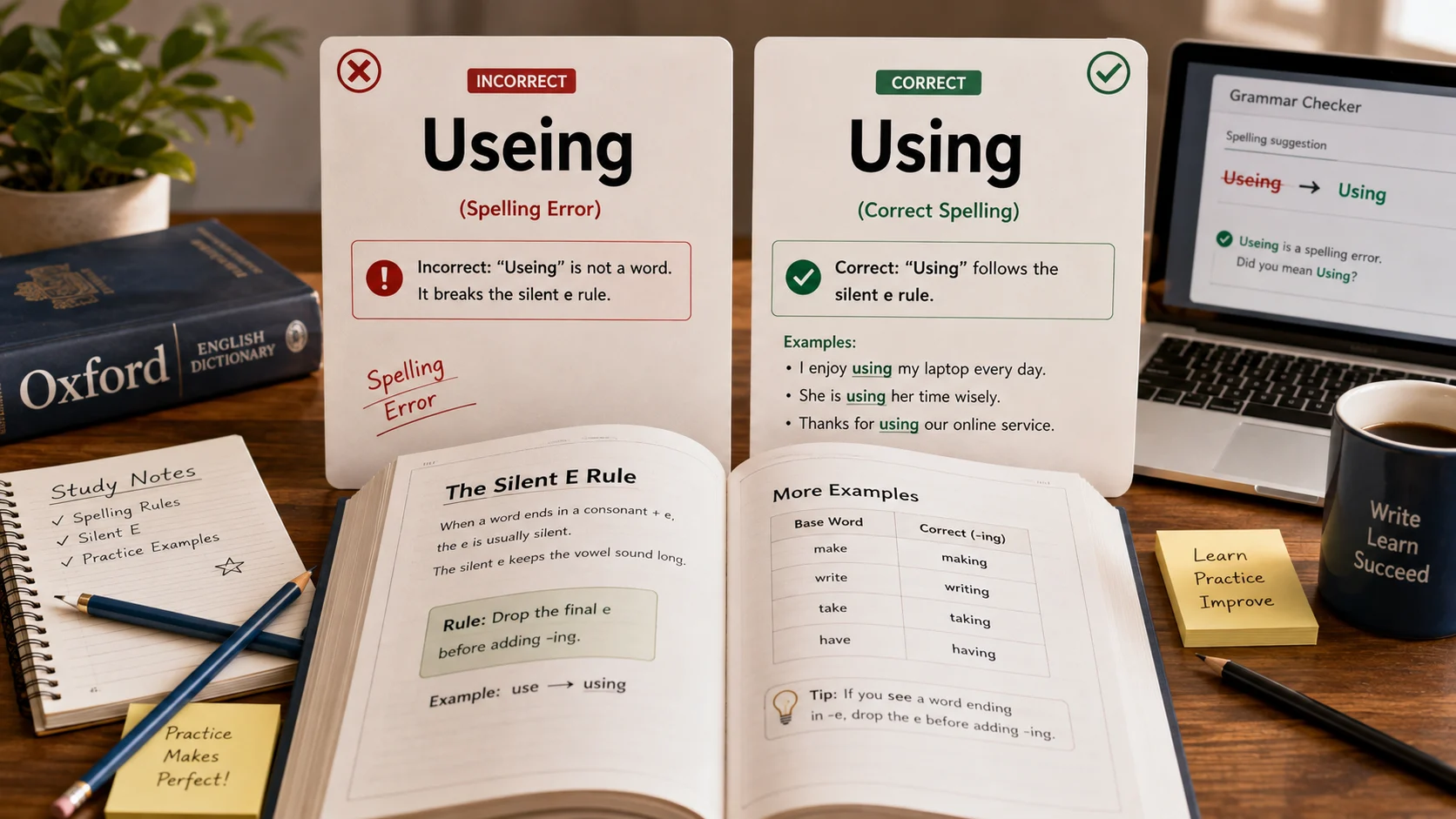
Using is the correct English spelling. Useing is a misspelling that appears when people incorrectly add ing to the verb use without following English spelling rules. The silent e is dropped before adding ing, making using the only accepted form in standard English.
The confusion between useing or using is surprisingly common, especially among English learners and people who type quickly. Both words may look reasonable at first glance, but only one follows standard English spelling rules. Using is the correct present participle and gerund form of the verb use, while useing is simply an incorrect spelling that should never appear in formal or informal writing.
This mistake often causes problems in school assignments, workplace emails, website content, and professional communication. Learning why the silent e disappears before adding ing will help you avoid this error and improve your writing confidence.
Useing or Using | What’s the Difference?
Both spellings may seem similar, but they have completely different status in English grammar.
| Feature | Using | Useing |
|---|---|---|
| Part of speech | Present participle and gerund | Not a valid English word |
| Correct spelling | Yes | No |
| Found in dictionaries | Yes | No |
| Accepted in academic writing | Yes | Never |
| Used in professional writing | Yes | Never |
| Recommended in exams | Yes | No |
| Meaning | The act of employing or utilizing something | None because it is misspelled |
The difference is simple. Using is the only correct spelling recognized by dictionaries, teachers, editors, and style guides. Useing is an error created by misunderstanding English spelling rules.
Whenever you add ing to the verb use, remove the silent e first. This rule applies every time.
Is Useing or Using a Grammar, Vocabulary or Usage Issue?
The confusion between useing or using is primarily a spelling issue rather than a grammar problem.
Grammar determines how words function in a sentence, while spelling determines how words are written. In this case, the grammatical role remains the same because both spellings attempt to represent the present participle of the verb use. However, only one spelling is correct.
It is not a vocabulary issue either because useing is not a separate English word with its own meaning.
Are They Interchangeable?
No.
Only using should be used in any context. Replacing it with useing creates a spelling mistake that may affect your credibility.
Formal Versus Informal Usage
| Situation | Using | Useing |
|---|---|---|
| Academic essays | ✔ Correct | ✘ Incorrect |
| Business emails | ✔ Correct | ✘ Incorrect |
| Research papers | ✔ Correct | ✘ Incorrect |
| Social media | ✔ Correct | ✘ Incorrect |
| Text messages | ✔ Correct | ✘ Incorrect |
| Professional reports | ✔ Correct | ✘ Incorrect |
Even in casual conversations or text messages, using remains the proper spelling.
Understanding Using
Using is the present participle and gerund form of the verb use.
It describes the act of employing, operating, applying, or making use of something.
Workplace Examples
The marketing team is using new software to track customer engagement.
She is using the latest report during today’s meeting.
Employees are using secure passwords to protect company data.
Academic Examples
Students are using reliable sources for their research papers.
The professor encouraged everyone to continue using scholarly journals.
Scientists are using advanced equipment to conduct experiments.
Technology Examples
Millions of people are using cloud storage every day.
Developers are using artificial intelligence to automate repetitive tasks.
Many businesses are using data analytics to improve decision making.
Usage Recap
Using is the only correct spelling for the present participle of use. You are writing an email, preparing an assignment, or creating online content, this is the form you should always choose.
Understanding Useing
Many people wonder useing is an older spelling or a regional variation.
The answer is no.
Useing is not recognized as a standard English word. It appears because writers forget to remove the silent e before adding ing.
English has a common spelling rule that applies to many verbs ending with a silent e.
For example:
| Base Verb | Correct Form |
|---|---|
| Use | Using |
| Make | Making |
| Write | Writing |
| Drive | Driving |
| Bake | Baking |
| Smile | Smiling |
| Save | Saving |
Notice that the silent e disappears before ing is added.
The same rule explains why useing is incorrect.
Workplace Example
❌ The staff are useing the new accounting system.
✔ The staff are using the new accounting system.
Academic Example
❌ Students are useing online libraries.
✔ Students are using online libraries.
Technology Example
❌ Many companies are useing automation software.
✔ Many companies are using automation software.
Usage Recap
If you see useing, treat it as a spelling mistake. Replace it with using every time.
When You Should NOT Use Using or Useing
The following situations commonly lead to mistakes.
| Situation | Correct Choice | Reason |
|---|---|---|
| Writing an essay | Using | Standard English spelling |
| Sending a business email | Using | Professional communication requires correct spelling |
| Completing an examination | Using | Examiners consider useing incorrect |
| Publishing website content | Using | Prevents spelling errors and improves credibility |
| Writing academic research | Using | Required by style guides |
| Creating marketing material | Using | Builds trust with readers |
| Preparing official documents | Using | Meets professional writing standards |
| Posting on social media | Using | Correct spelling is always preferred |
There is no situation in which useing is acceptable.
Common Mistakes and Decision Rules
| Correct Sentence | Incorrect Sentence | Explanation |
|---|---|---|
| I am using my laptop for work. | I am useing my laptop for work. | Drop the silent e before adding ing. |
| She is using a grammar checker. | She is useing a grammar checker. | Only using follows English spelling rules. |
| They are using public transport today. | They are useing public transport today. | Useing is not a valid English word. |
| We are using new teaching methods. | We are useing new teaching methods. | Dictionaries recognize only using. |
| The company is using cloud services. | The company is useing cloud services. | Professional writing requires the correct spelling. |
| Students are using digital resources. | Students are useing digital resources. | Removing the silent e is the standard spelling rule. |
Decision Rule
| If you mean... | Use |
|---|---|
| The action of employing, operating, or making use of something | Using |
| A person or tool | Neither using nor useing. Choose the correct noun instead, such as user, employee, device, tool, or another appropriate word. |
The easiest way to remember the rule is this: whenever you add ing to use, remove the silent e first. If you keep the e, you create a spelling mistake.
X and Y in Modern Technology and AI Tools
As artificial intelligence becomes more common in everyday writing, spelling mistakes such as useing are easier to detect than ever before. Modern grammar checkers, writing assistants, and AI powered editors automatically recognize using as the correct spelling and immediately flag useing as an error.
Search engines also understand the difference. If someone searches for useing, many search platforms automatically suggest using because the incorrect spelling has no accepted meaning in English. This correction helps users find accurate information and prevents confusion in digital communication.
Content creators, students, and professionals should still understand the spelling rule instead of relying entirely on software. Knowing why using is correct makes your writing more reliable, even when technology is unavailable.
The Origin of Using
The word use entered English through Old French from the Latin word usus, meaning practice, employment, or application. Over time, English adopted the verb use, which later formed the present participle using by following the standard spelling rule for verbs ending in a silent e.
This rule removes the silent e before adding ing, producing forms such as making, driving, writing, and using. Because this spelling pattern has remained consistent for centuries, useing has never become an accepted English word.
Good spelling is not about memorizing every word. It is about understanding the patterns that English follows. Once learners recognize these patterns, they make fewer mistakes and write with greater confidence.
Real World Case Studies
Case Study One: Improving Student Writing
A secondary school English teacher noticed that many students repeatedly wrote useing in essays. After spending one lesson explaining the silent e spelling rule and providing practice exercises, the number of spelling errors dropped by nearly eighty percent over the following month. Students also became more confident when writing longer assignments because they understood the rule instead of relying on guesswork.
Case Study Two: Enhancing Business Content
A marketing agency reviewed hundreds of website pages before launching a client’s new business site. During proofreading, editors corrected several instances of useing to using. The polished content projected a more professional image, reduced avoidable spelling errors, and increased reader trust in the published material.
Error Prevention Checklist
| Always use Using when | Never use Useing when |
|---|---|
| Referring to the act of employing something | Writing essays or assignments |
| Writing business emails | Sending professional messages |
| Creating academic papers | Publishing website content |
| Preparing reports | Writing research papers |
| Describing ongoing actions | Taking English examinations |
| Following standard English spelling | Communicating in any formal or informal context |
Before submitting any document, quickly check you have accidentally left the silent e in the word use. If you have, remove it before adding ing.
Related Grammar Confusions You Should Master
| Grammar TopicWhat You Should Know | |
|---|---|
| Lose or Loose | One is a verb while the other is an adjective. |
| Its or It’s | Learn the difference between possession and contraction. |
| Affect or Effect | One is usually a verb while the other is commonly a noun. |
| Advice or Advise | Noun versus verb confusion. |
| Than or Then | Comparison versus sequence. |
| Your or You’re | Possessive adjective versus contraction. |
| Accept or Except | Receiving something versus excluding something. |
| Practice or Practise | Differences between noun and verb in British English. |
| Principal or Principle | Person in charge versus a rule or belief. |
| Compliment or Complement | Praise versus something that completes another thing. |
FAQs
Is using the correct spelling in English?
Yes. Using is the only correct spelling accepted in British English, American English, and other standard varieties of English.
Why is useing considered incorrect?
The silent e at the end of use must be removed before adding ing, making using the only correct form.
Can I ever write useing in formal writing?
No. Useing is always a spelling mistake and should never appear in essays, reports, emails, or professional documents.
Is using a verb or a noun?
It can function as a present participle in a verb phrase or as a gerund that acts like a noun, depending on the sentence.
Do grammar checkers recognize useing as an error?
Yes. Most modern grammar and spelling tools immediately identify useing as incorrect and recommend using.
Why do so many people spell using incorrectly?
Many writers simply forget the spelling rule that removes the silent e before adding ing, especially when typing quickly.
Does British English spell using differently from American English?
No. Both British English and American English use the spelling using without any variation.
What is the easiest way to remember the correct spelling?
Remember that verbs ending in a silent e usually drop that letter before adding ing. Think of make becoming making, and apply the same rule to use.
Conclusion
The debate over useing or using has one clear answer. Using is the correct spelling because it follows the standard English rule of removing the silent e before adding ing. Useing is simply a spelling mistake and should be avoided in every type of writing.
Understanding this simple rule will help you write more accurately in academic work, professional communication, digital content, and everyday conversations. Instead of memorizing individual words, focus on the spelling pattern itself. Once you master it, you will naturally choose using every time and avoid one of the most common English spelling mistakes.
Discover More Related Articles:
- Sowing or Sewing | What Is the Difference & When Should You Use Each In 2026
- Canon or Cannon | Understanding the Difference & Using Each Word Correctly In 2026
- Majorca or Mallorca | Why Does the Island Have Two Names In 2026