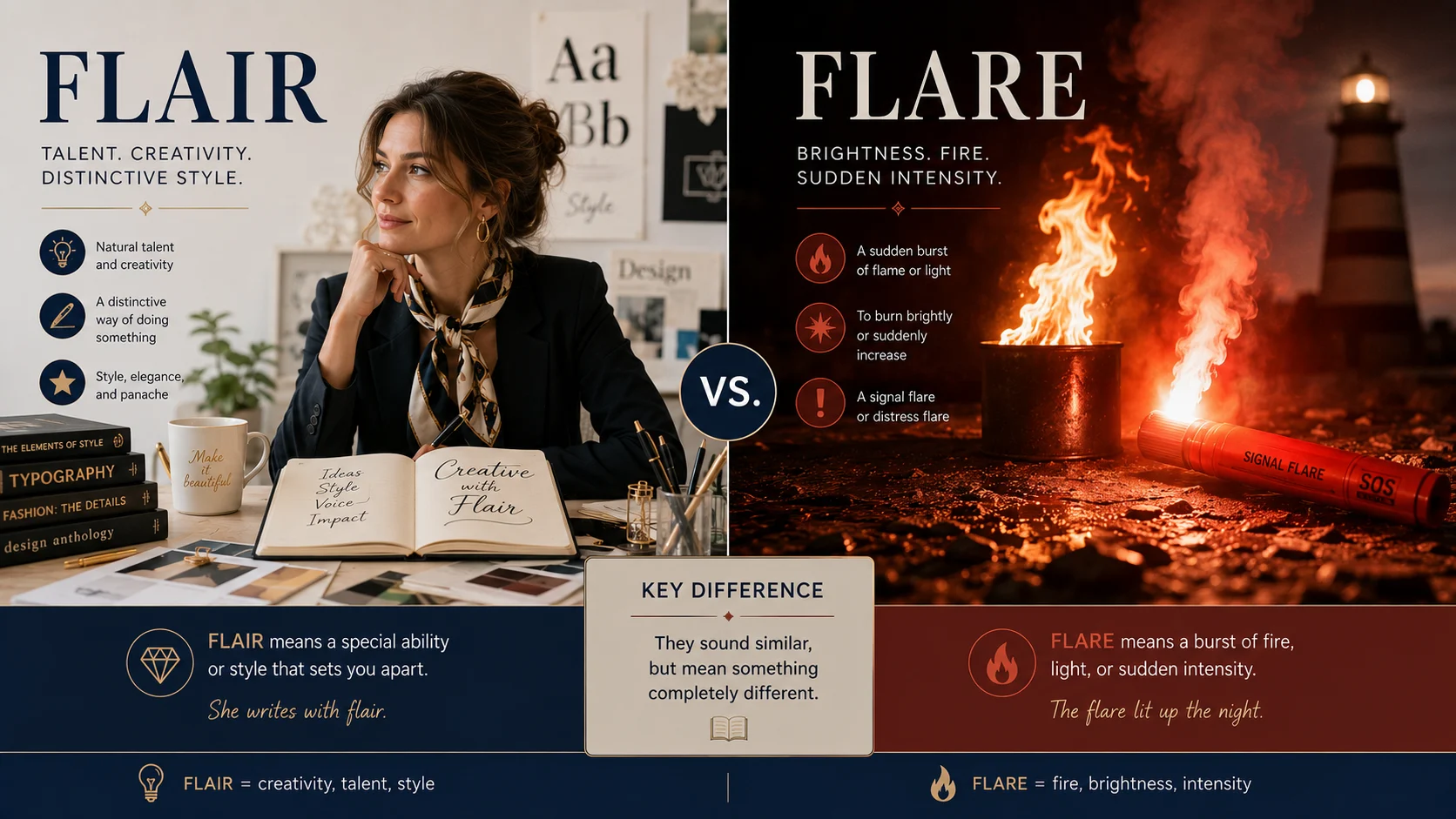
Flair means a natural talent, distinctive style, or special ability, while flare means to spread outward, burn brightly, or suddenly become more intense. Although the words sound alike, they have different meanings and grammatical uses, so choosing the wrong one can change the meaning of a sentence.
Flair vs Flare | What’s the Difference?
The easiest way to remember the distinction is to connect flair with talent and flare with expansion, brightness, or sudden intensity. Both words can function as nouns, and flare can also function as a verb.
Flair is a noun meaning a natural ability to do something well or a distinctive and appealing style. For example, someone might have a flair for writing, fashion, design, or public speaking.
Flare is commonly used for something that spreads outward, shines suddenly, burns brightly, or becomes more severe. It can also describe a signal used to attract attention. As a verb, flare means to suddenly become wider, brighter, hotter, or more intense.
| Feature | Flair | Flare |
|---|---|---|
| Part of speech | Noun | Noun and verb |
| Main meaning | Natural talent or distinctive style | Sudden increase, outward spread, bright flame, or signal |
| Common expression | Flair for writing | Flare up |
| Related idea | Talent, creativity, style | Fire, brightness, expansion, intensity |
| Example | She has a flair for design. | The fire began to flare. |
| Common context | Writing, fashion, art, personality | Fire, conflict, symptoms, clothing, signals |
| Pronunciation | Usually pronounced like “flair” | Usually pronounced like “flare” |
| Memory clue | Think talent or style | Think fire or something spreading |
Quick Recap
Flair describes talent, creativity, or distinctive style.
Flare describes brightness, outward expansion, or sudden intensity.
A writer can have a flair for storytelling.
A flame can flare, and a disagreement can flare up.
Is Flair vs Flare a Grammar, Vocabulary or Usage Issue?
The confusion between these words is primarily a vocabulary and usage issue, rather than a complicated grammar rule. The words are pronounced almost identically in standard English, but their meanings are substantially different.
They aren’t interchangeable. Replacing one with the other can create a spelling error that also changes the meaning of the sentence.
Consider these two examples:
She has a flair for photography.
This means she has a natural talent or distinctive ability in photography.
The candle began to flare.
This means the flame suddenly became larger or brighter.
The difference becomes particularly important in professional writing. A résumé that says someone has a “flare for leadership” contains an incorrect word. Likewise, describing a creative presentation as having “a flare of originality” usually communicates the wrong idea.
In academic writing, flair commonly appears when discussing writing ability, creativity, presentation, or individual style. Flare is more likely to appear in scientific, medical, environmental, or descriptive contexts where something becomes stronger, brighter, wider, or more noticeable.
In casual conversation, the distinction can be overlooked because the words sound the same. In edited writing, however, spelling still matters.
Flair: Meaning, Uses and Examples
Flair is a noun that refers to a natural talent or an appealing and distinctive way of doing something. It often suggests that someone doesn’t merely perform a task competently but brings personality, creativity, or originality to it.
The word frequently appears with for.
Common expressions include:
a flair for writing
a flair for languages
a flair for fashion
a flair for design
a flair for storytelling
a flair for communication
Workplace Example
Maya has a flair for presenting complex ideas in a simple way.
Here, flair indicates a special ability or talent. The sentence suggests that Maya has a natural gift for making difficult information understandable.
Another example is:
The marketing manager has a flair for creating memorable campaigns.
The word works well because the sentence focuses on creative ability and distinctive skill.
Academic Example
The student demonstrated a flair for persuasive writing.
In an academic setting, flair can describe an individual’s noticeable ability to write effectively and creatively.
You might also see:
His essay showed a flair for vivid description.
The emphasis is on writing style and talent rather than a physical event.
Technology Example
The developer has a flair for creating intuitive user interfaces.
This means the developer has a particular talent for designing interfaces that are easy and appealing to use.
The word can therefore appear naturally in technology writing when discussing creativity, design, communication, or presentation.
Usage Recap for Flair
Use flair when you’re talking about talent, creativity, style, or a distinctive ability.
A useful memory association is:
Flair = talent and style.
If someone does something with exceptional creativity or natural ability, flair is usually the word you want.
Flare: Meaning, Uses and Examples
Flare has several meanings, but they share a useful underlying idea: something becomes more visible, spreads outward, burns brightly, or suddenly becomes more intense.
As a noun, a flare can refer to a bright flame or a signal used to attract attention. It can also describe an increase in intensity.
As a verb, flare can mean to burn or shine suddenly, spread outward, or become more severe.
Workplace Example
Tensions began to flare during the meeting.
Here, flare means that tensions suddenly became more intense.
Another example is:
The disagreement flared after the new policy was announced.
Again, the word describes a sudden increase in intensity.
Academic Example
The researchers observed a flare of activity following the introduction of the stimulus.
Here, flare indicates a sudden increase or burst of activity.
The term is also common in scientific contexts involving stars, fires, energy, and other sudden increases.
Technology Example
The system detected a sudden solar flare that could affect satellite communications.
In technology and space science, solar flare is a standard technical expression describing a sudden release of energy from the Sun.
Another example is:
The display showed a brief flare of brightness before returning to normal.
Here, flare refers to a sudden increase in brightness.
Usage Recap for Flare
Use flare when you mean burn brightly, spread outward, become more intense, or act as a signal.
A useful memory association is:
Flare = fire, brightness, expansion, or intensity.
When You Should NOT Use Flair or Flare
Several situations make the distinction especially important.
| Situation | Correct Choice | Why |
|---|---|---|
| Someone has natural writing ability | Flair | It means talent |
| Someone has a distinctive fashion style | Flair | It means style |
| A fire suddenly becomes larger | Flare | It relates to burning |
| A conflict suddenly becomes more intense | Flare | It means intensify |
| A signal burns brightly | Flare | A flare can be a signal |
| A shirt becomes wider toward the bottom | Flare | It describes outward expansion |
| Someone has a special ability for music | Flair | It means natural talent |
| A solar event releases sudden energy | Flare | Solar flare is the established term |
Avoid using flare when you mean someone’s talent. Saying that a person has a “flare for writing” is a common spelling mistake.
Likewise, avoid flair when describing a fire becoming brighter or a conflict becoming more intense.
Common Mistakes and Decision Rules
| Correct Sentence | Incorrect Sentence | Explanation |
|---|---|---|
| She has a flair for writing. | She has a flare for writing. | Flair means natural talent. |
| He has a flair for fashion. | He has a flare for fashion. | Flair describes distinctive style. |
| The flames began to flare. | The flames began to flair. | Flare relates to fire and brightness. |
| Tensions flared during the debate. | Tensions flaired during the debate. | Flared means became more intense. |
| The trousers flare at the bottom. | The trousers flair at the bottom. | Flare describes outward expansion. |
| The team has a flair for innovation. | The team has a flare for innovation. | Flair refers to creative ability. |
Decision Rule Box
If you mean natural talent, creativity, or distinctive style, use “flair.”
If you mean burning, brightness, outward expansion, a signal, or sudden intensity, use “flare.”
This rule handles most everyday spelling decisions.
Flair and Flare in Modern Technology and AI Tools
Modern technology has created even more situations where these words appear naturally.
Flair is useful when describing human creativity in technology. A designer might have a flair for interface design, while a technical writer might have a flair for explaining complicated software.
Flare, meanwhile, appears in technical terminology involving energy, signals, light, and sudden increases. Solar flares, lens flare, and flare detection are examples of established technology or science related expressions.
Artificial intelligence tools can also generate both words correctly when the surrounding context is clear. However, automated writing tools can still confuse homophones and similarly pronounced words, particularly when context is short or ambiguous.
For professional content, don’t rely solely on automated correction. Check the intended meaning yourself.
Etymology and Language History
The history of these words helps explain why they look and sound so similar today.
Flair entered English through French influence and is associated with ideas of instinct, aptitude, and distinctive ability. Its modern meaning developed around natural talent and an individual quality or style.
Flare has a different history and is connected with ideas involving spreading, shining, burning, or becoming more visible. Its meanings developed into the modern uses associated with flames, signals, outward expansion, and sudden increases in intensity.
Although their histories differ, their similar pronunciation makes them a classic spelling trap.
An Expert Style Explanation
A useful linguistic principle is that context determines the intended word when two different spellings share pronunciation. In practical terms, ask what the sentence is describing before deciding how to spell the word.
If the sentence describes what someone can do, think flair.
If it describes what something does suddenly or how something spreads or burns, think flare.
Two Practical Case Studies
Case Study 1: Professional Profile
Imagine a company biography stating:
Daniel has a flare for strategic communication.
The intended meaning is clearly talent. Correcting the sentence to:
Daniel has a flair for strategic communication.
changes the spelling while preserving the intended meaning.
The result is a professional sentence that communicates natural ability accurately.
Case Study 2: Science Article
Consider:
Scientists observed a sudden flair on the surface of the Sun.
The context concerns a solar event, not creativity. The appropriate expression is:
Scientists observed a sudden flare on the surface of the Sun.
The correction restores the established scientific terminology and prevents the reader from interpreting the word as a reference to talent or style.
These examples demonstrate why context should always guide spelling.
Error Prevention Checklist
Always Use Flair When
You mean natural talent.
You mean creative ability.
You mean distinctive personal style.
You describe someone’s special ability in writing, design, fashion, music, or communication.
You use the common construction flair for.
Never Use Flare When
You mean someone’s natural talent.
You mean creative ability.
You mean distinctive style.
You are writing the expression “flair for writing.”
You are describing someone’s ability rather than a physical or sudden event.
Related Grammar Confusions You Should Master
Learning this distinction becomes easier when you recognize other English words that sound alike or look similar.
- Affect and effect
- Advice and advise
- Principal and principle
- Compliment and complement
- Stationary and stationery
- Its and it’s
- Their, there, and they’re
- Your and you’re
- Weather and whether
- Than and then
These pairs demonstrate an important feature of English spelling: pronunciation alone isn’t always enough to determine which written form is correct.
FAQs
What is the difference between flair and flare?
Flair means natural talent or distinctive style, while flare refers to burning, brightness, outward expansion, a signal, or a sudden increase in intensity.
Is it flair for writing or flare for writing?
The correct expression is “flair for writing” because flair means a natural talent or special ability.
Is it a flair for fashion or a flare for fashion?
The correct phrase is “a flair for fashion” because the sentence refers to distinctive taste and style.
What does flare mean as a verb?
Flare can mean to burn or shine suddenly, spread outward, or become more intense, as in “tensions began to flare.”
Is flare a noun or a verb?
Flare can function as both a noun and a verb, while flair is normally used as a noun.
What does flair mean in a sentence?
Flair describes natural ability, creativity, or a distinctive quality, as in “She has a flair for storytelling.”
How can I remember flair and flare?
Associate flair with talent and style, and associate flare with fire, brightness, expansion, or intensity.
Why do flair and flare get confused?
They are pronounced alike in standard English, but they have different meanings and spellings.
Conclusion
The distinction between flair or flare becomes straightforward once you connect each word with its central idea. Flair belongs to the world of talent, creativity, and distinctive style. Flare belongs to the world of fire, brightness, outward expansion, signals, and sudden intensity.
When you mean that someone has a special ability, choose flair. When something burns brightly, spreads outward, or suddenly becomes stronger, choose flare. Remembering those two core ideas will prevent most spelling mistakes and make your professional, academic, and everyday writing more precise.
Discover More Related Articles:
- Pimple or Herpes | How to Tell the Difference & When to Get Medical Advice In 2026
- Cetaphil or CeraVe | Which Is Better for Your Skin Type In 2026
- Innie or Outie | Meaning, Difference & Usage Explained In 2026