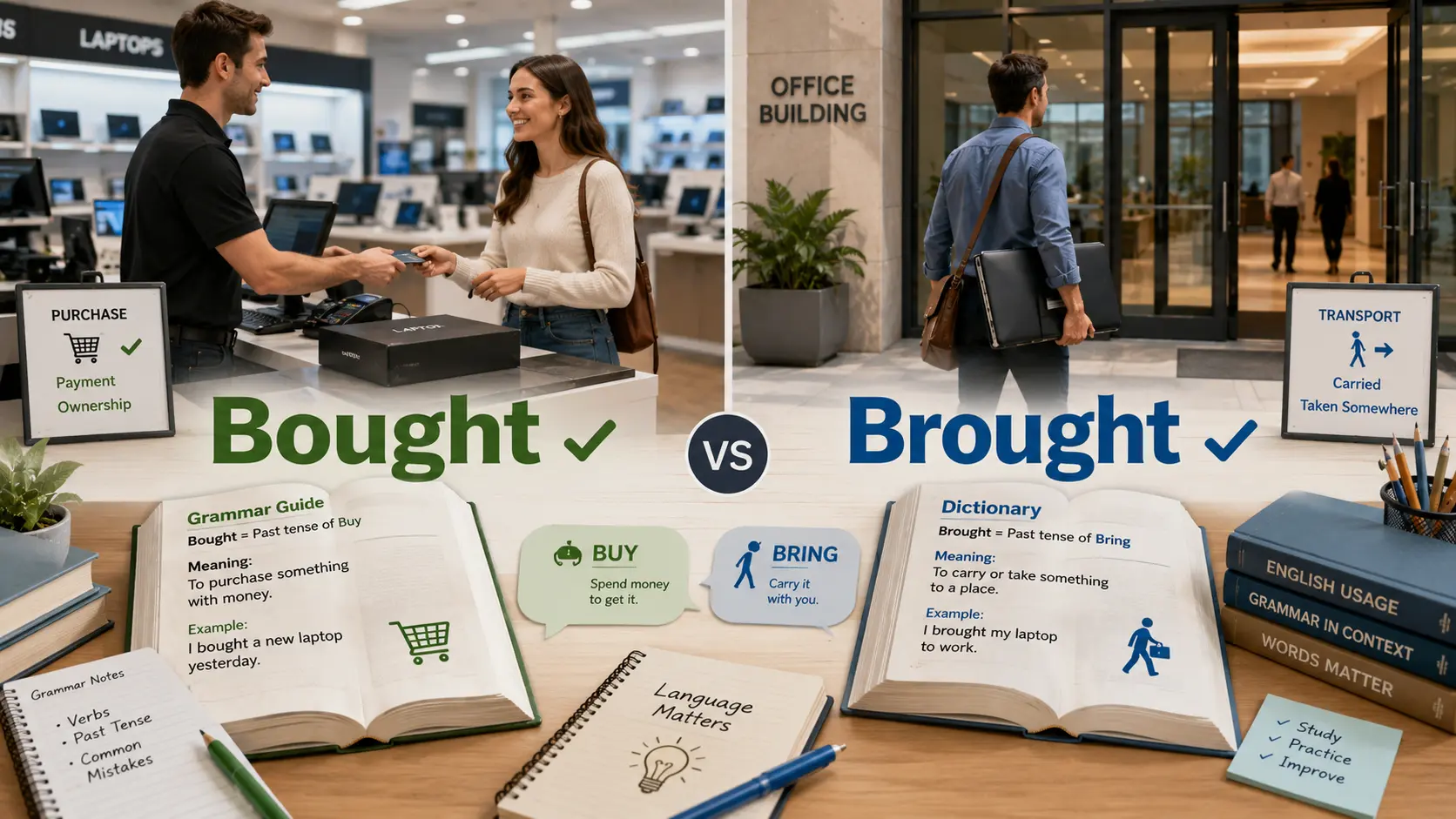
Bought or brought often confuses English learners because both words sound similar and are common in everyday conversation. However, they have completely different meanings. Bought refers to purchasing something with money, while brought means carrying or taking something to a place. Knowing the distinction helps you avoid common writing and speaking mistakes.
The phrase bought or brought is one of the most frequently searched English grammar questions because the two words look and sound alike. Despite their similar pronunciation, they are not interchangeable. Bought is the past tense of buy, meaning to purchase something.
Brought is the past tense of bring, meaning to carry or take something to a person or place. Mixing these words can completely change the meaning of a sentence, especially in academic writing, business communication, and everyday conversations.
you are a student, professional, content writer, or someone improving English skills, understanding this difference will make your writing clearer and more accurate.
Bought or Brought | What Is the Difference?
Both words are verbs, but they come from different base verbs and describe different actions.
| Feature | Bought | Brought |
|---|---|---|
| Base verb | Buy | Bring |
| Part of speech | Verb | Verb |
| Meaning | Purchased something | Carried or took something somewhere |
| Focus | Spending money | Moving an item or person |
| Example | I bought a laptop yesterday. | I brought my laptop to work. |
Quick Recap
The easiest way to remember the difference is to think about the action involved. If money changes hands, the correct word is bought. If an object moves from one place to another, the correct word is brought. Although both are past tense verbs, they describe entirely different actions and should never replace one another.
Is Bought or Brought a Grammar, Vocabulary or Usage Issue?
This confusion is primarily a usage issue rather than a grammar problem. English speakers usually know the grammar rules, but they accidentally choose the wrong word because the pronunciation is similar.
In formal writing, using the wrong word may affect credibility. Imagine writing, “The company brought new software licenses,” when you actually mean they purchased them. The sentence creates confusion because readers expect brought to describe transportation rather than purchasing.
In casual conversation, listeners often understand the intended meaning from context, but in academic essays, professional emails, and published articles, accuracy matters much more.
Therefore, these words are not interchangeable under any circumstance.
Understanding Bought
Bought is the past tense and past participle of the verb buy. It always relates to purchasing something through payment or exchange.
Whenever ownership changes because someone pays for an item or service, bought is the correct choice.
Workplace Example
Our company bought new computers for every employee last month.
This sentence tells us the company purchased the computers.
Academic Example
The university bought several new science textbooks for the library.
Again, the action involves spending money.
Technology Example
I bought a premium software subscription to unlock additional features.
The subscription was purchased, not transported.
Usage Recap
Whenever you think about shopping, purchasing, paying, ordering, or acquiring ownership through payment, bought is always the correct word.
Understanding Brought
Brought is the past tense and past participle of the verb bring. It refers to carrying, delivering, or taking something from one place to another.
No purchase is involved.
Workplace Example
Sarah brought the meeting documents to the conference room before everyone arrived.
The documents were transported.
Academic Example
The student brought her completed assignment to class.
She carried the assignment.
Technology Example
The software update brought several security improvements.
Here, brought means introduced or delivered improvements rather than purchased them.
Usage Recap
Whenever something is carried, delivered, transported, introduced, or taken somewhere, brought is the correct choice.
When You Should NOT Use Bought or Brought
Many mistakes happen because people focus only on pronunciation instead of meaning.
| Incorrect Situation | Correct Choice | Reason |
|---|---|---|
| You purchased groceries | Bought | Money was spent. |
| You carried groceries home | Brought | The groceries were transported. |
| Someone delivered your package | Brought | Delivery involves movement. |
| You paid for a new phone | Bought | Ownership changed through purchase. |
| You carried your phone to school | Brought | The phone was taken somewhere. |
| A company purchased equipment | Bought | Buying involves payment. |
| A technician carried equipment into the office | Brought | Carrying describes movement. |
| A friend arrived with snacks | Brought | The snacks were carried. |
Common Mistakes and Decision Rules
Many learners accidentally replace one word with the other because they remember the sound instead of the meaning.
| Correct Sentence | Incorrect Sentence | Explanation |
|---|---|---|
| I bought a new bicycle yesterday. | I brought a new bicycle yesterday. | Bought means purchasing something. |
| She brought her umbrella to school. | She bought her umbrella to school. | The umbrella was carried, not purchased. |
| They bought fresh vegetables at the market. | They brought fresh vegetables at the market. | The vegetables were purchased. |
| He brought his laptop to the office. | He bought his laptop to the office. | The laptop was transported. |
| We bought tickets online. | We brought tickets online. | Tickets were purchased. |
| My sister brought dessert to dinner. | My sister bought dessert to dinner. | She carried the dessert to dinner. |
Decision Rule
If you mean purchasing something with money, use bought.
If you mean carrying or taking something somewhere, use brought.
Bought or Brought in Modern Technology and AI Tools
Modern writing tools and artificial intelligence assistants can often detect the difference between bought and brought, but they are not perfect. Grammar checkers usually identify obvious mistakes by analyzing the context of a sentence. For example, if a sentence mentions payment, shopping, or a purchase, the software generally recommends bought. If the sentence describes carrying, delivering, or bringing an object to a location, it suggests brought.
Even so, AI tools rely on context rather than human understanding. When a sentence is vague, they may choose the wrong word. That is why writers should always review suggestions instead of accepting every correction automatically.
Etymology
The word bought comes from the Old English verb bycgan, which meant to acquire something through payment or exchange. Over centuries, its spelling and pronunciation changed until it became the modern past tense of buy.
The word brought comes from the Old English verb bringan, meaning to carry, lead, or transport something to another place. Although both words evolved over many centuries, they have always represented different actions.
Expert Insight
“Good writing depends on choosing the precise word for the intended action. Similar sounding words often create confusion, but accuracy comes from understanding meaning rather than pronunciation.”
This principle is especially important in business writing, academic work, and professional communication where a single incorrect word can change the message.
Case Study One | Business Email Accuracy
A customer service team reviewed more than five hundred outgoing emails after receiving complaints about unclear communication. One recurring mistake involved employees writing sentences such as, “We brought new office chairs last week.”
After a short grammar training session explaining the difference between bought and brought, editing errors dropped significantly. Customer feedback also showed improved clarity because purchase related messages became easier to understand.
Case Study Two | Student Writing Improvement
An English teacher asked a class of secondary school students to complete a writing exercise involving shopping and travel experiences. Nearly one third of the students confused bought and brought in their first drafts.
After practicing with real life examples and comparing the meanings of buy and bring, nearly every student used the correct word in the final assignment. The exercise demonstrated that understanding meaning is far more effective than memorizing spelling alone.
Error Prevention Checklist
Use this quick checklist whenever you are unsure which word belongs in your sentence.
Always Use Bought When
- You paid money for something.
- Ownership changed after a purchase.
- You visited a shop or placed an online order.
- The sentence discusses shopping, sales, or purchases.
- You can replace the word with purchased.
Never Use Brought When
- You are talking about buying an item.
- Money changed hands.
- The sentence refers to paying for goods or services.
- You mean purchasing rather than carrying.
- You could naturally replace the word with purchased.
Related Grammar Confusions You Should Master
Improving your English becomes much easier when you learn commonly confused word pairs together.
| Grammar Topic | Main Difference |
|---|---|
| Borrow and Lend | Borrow means to receive something temporarily, while lend means to give something temporarily. |
| Bring and Take | Bring indicates movement toward someone or something, while take indicates movement away. |
| Buy and Purchase | Buy is the everyday term, while purchase is more formal. |
| Lose and Loose | Lose is a verb meaning to misplace or fail to win, while loose is an adjective meaning not tight. |
| Affect and Effect | Affect is usually a verb meaning to influence, while effect is usually a noun meaning a result. |
| Than and Then | Than is used for comparisons, while then refers to time or sequence. |
| Accept and Except | Accept means to receive or agree to something, while except means to exclude. |
| Farther and Further | Farther usually refers to physical distance, while further often means additional or more extensive. |
| Your and You’re | Your shows possession, while you’re is the contraction of you are. |
| Advice and Advise | Advice is a noun, while advise is a verb. |
FAQs
What is the difference between bought and brought?
Bought means purchased with money, while brought means carried or transported something from one place to another. The two words have different meanings and cannot replace each other.
Is it correct to say I bought my bag to school?
No. If you carried the bag to school, the correct sentence is “I brought my bag to school.” Use bought only when talking about purchasing the bag.
Can bought and brought ever mean the same thing?
No. One refers to purchasing and the other refers to carrying or delivering. They describe different actions in every context.
Why do people confuse bought and brought?
The words have similar pronunciation and both are past tense verbs. Their sound causes many learners to choose the wrong one even though their meanings are different.
Which word should I use when talking about shopping?
Use bought whenever you are discussing paying for an item, placing an order, or making a purchase.
Which word is correct for carrying something?
Use brought whenever someone carries, delivers, or takes an object to another place.
How can I remember the difference easily?
Think about money. If payment is involved, choose bought. If movement from one place to another is involved, choose brought.
Do grammar checking tools always detect this mistake?
Most grammar tools identify the correct word using context, but they are not perfect. Reading the sentence carefully remains the best way to avoid errors.
Conclusion
Understanding bought or brought becomes simple once you focus on the action instead of the pronunciation. Bought always relates to purchasing something with money, while brought always refers to carrying or taking something to a person or place. Although the words sound alike, they describe completely different actions and should never be used interchangeably.
The next time you write or speak, ask yourself one simple question. Was something purchased, or was something carried? The answer will immediately tell you which word to use.
Discover More Related Articles:
- Hit or Miss | Meaning, Usage, Examples & When to Use It In 2026
- Or vs Nor | What Is the Difference & When Should You Use Each In 2026
- Seen or Saw | What’s the Difference & When Should You Use Each In 2026