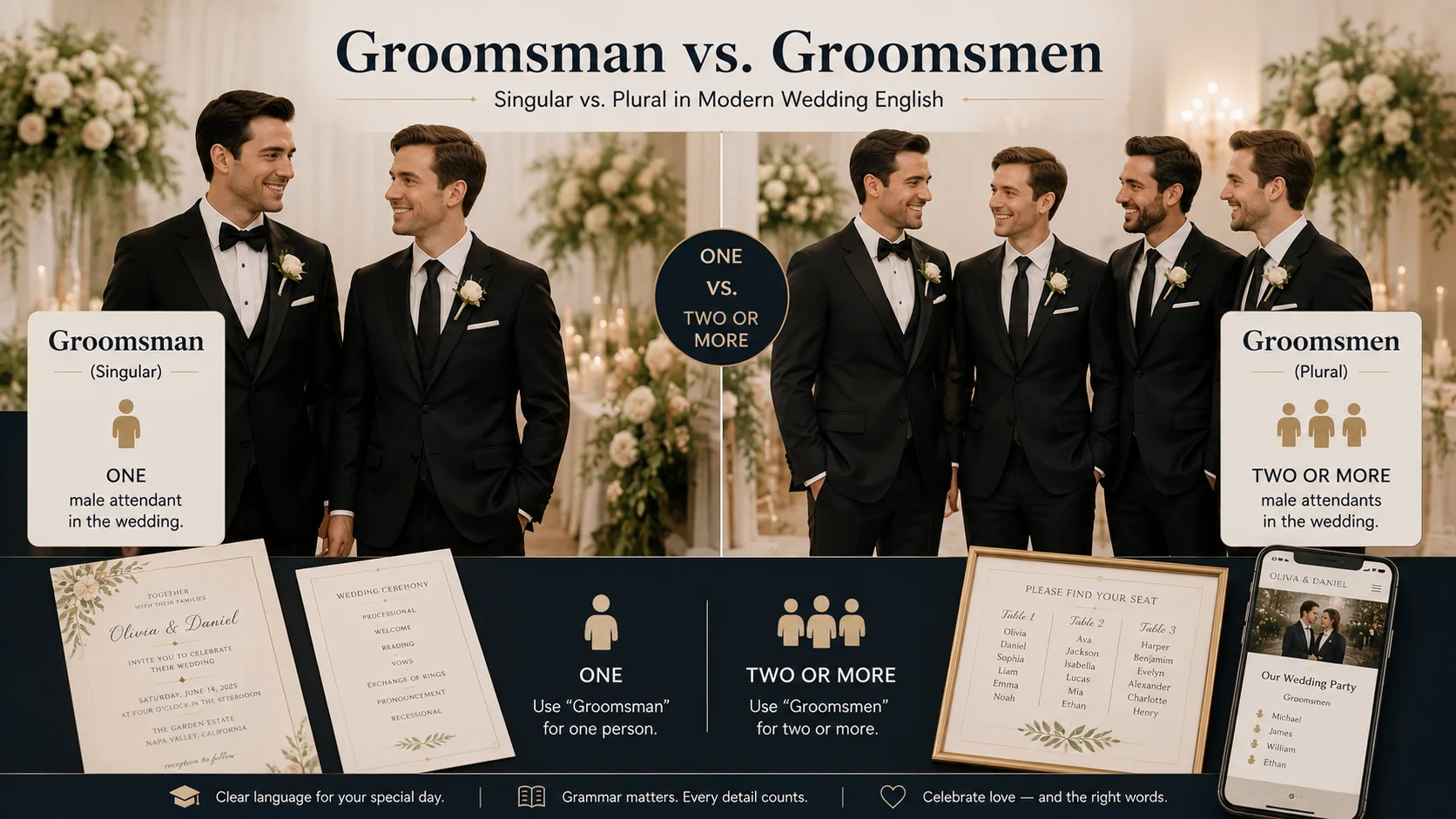
Groomsman is the singular noun for one male member of a wedding party, while groomsmen is its plural form for two or more male attendants. Choosing the right word depends entirely on you are referring to one person or several, which matters in invitations, wedding programs, speeches and formal writing.
Groomsmen or Groomsman | What’s the Difference?
The difference is simple once you understand number in English grammar. Groomsman refers to one male attendant who supports the groom during a wedding. Groomsmen refers to two or more male attendants.
The two words describe the same type of person, but they cannot normally be exchanged because one is singular and the other is plural. This is similar to many English nouns that change their spelling when referring to more than one person.
| Word | Part of Speech | Number | Meaning | Example |
|---|---|---|---|---|
| Groomsman | Noun | Singular | One male member of the wedding party | Daniel is the groom’s groomsman. |
| Groomsmen | Noun | Plural | Two or more male members of the wedding party | Daniel and James are the groom’s groomsmen. |
Quick Recap
Groomsman means one male wedding attendant.
Groomsmen means two or more male wedding attendants.
The spelling changes because the grammatical number changes.
Use the singular form for one person and the plural form for a group.
The distinction becomes especially important when writing wedding invitations, ceremony programs, seating charts, announcements, and speeches.
Is Groomsmen or Groomsman a Grammar, Vocabulary, or Usage Issue?
This is primarily a grammar and usage issue involving singular and plural nouns. Both words belong to the same vocabulary family, but their grammatical number determines when each should appear in a sentence.
If you are talking about one person, use groomsman. If you are talking about several male attendants, use groomsmen.
For example:
Mark is my groomsman.
Here, the sentence identifies one person.
Mark, David, and Thomas are my groomsmen.
Here, the sentence identifies three people.
The distinction also affects the verb that follows the noun. A singular subject takes a singular verb, while a plural subject takes a plural verb.
My groomsman is arriving at noon.
My groomsmen are arriving at noon.
This is why the choice is not merely a matter of style. Using the wrong form can create a genuine grammatical error.
Formal and Informal Usage
Both terms are standard English and can be used in formal or informal contexts. Neither word is slang, outdated, or inappropriate for professional writing.
You might see groomsman in a formal wedding program:
Michael Smith, Groomsman
You could also see groomsmen in a casual social media post:
I’m grateful to have these amazing groomsmen beside me.
The context may change, but the singular and plural distinction remains the same.
Academic and Casual Writing
Academic writing rarely needs these terms unless the subject involves weddings, social traditions, cultural practices, event planning, or language analysis.
In casual writing, the words commonly appear in wedding announcements, captions, messages, and conversations.
Regardless of the setting, the grammatical rule does not change.
How to Use Groomsman Correctly
Groomsman is a singular noun. Use it when you are referring to exactly one male member of the groom’s wedding party.
The word is often used when describing a person’s role, responsibilities, or relationship with the groom.
For example:
James will be my groomsman.
The groomsman helped the groom prepare for the ceremony.
Each groomsman received a personalized gift.
Notice the word each in the third example. Although several people may be involved overall, each refers to one individual at a time, so the singular noun is appropriate.
Workplace Example
Wedding planning often involves workplace communication. Suppose someone sends a message to a colleague:
I’ve asked Daniel to be my groomsman.
That sentence is correct because Daniel is one person.
A wedding coordinator might also write:
Please confirm the name of each groomsman before printing the ceremony program.
Again, the singular form is appropriate because the coordinator is referring to each individual separately.
Academic Example
A researcher discussing wedding traditions could write:
The groomsman traditionally assists the groom during several parts of the wedding ceremony.
The singular noun can be used when describing a general role or an individual representative of that role.
Technology Example
Modern wedding planning frequently uses digital invitations, event management platforms, shared spreadsheets, and wedding websites. A digital form might contain a field such as:
Groomsman Name
This label is appropriate when the form collects the name of one person.
If the form contains multiple entries, the overall section could instead be labeled:
Groomsmen
Usage Recap
Use groomsman when the sentence identifies one male wedding attendant.
It can describe a specific individual, a role, or one member of a larger wedding party.
How to Use Groomsmen Correctly
Groomsmen is the plural form of groomsman. Use it when referring to two or more male members of the groom’s wedding party.
For example:
My groomsmen helped me choose the suits.
The groomsmen arrived before the ceremony.
We thanked all the groomsmen during the reception.
The noun is plural, so it normally takes plural verbs.
The groomsmen are ready.
Not:
The groomsmen is ready.
When you see groomsmen, think of a group rather than a single individual.
Workplace Example
A wedding planner might send this message:
Please send the final measurements for all groomsmen by Friday.
Because the request concerns several people, the plural noun is correct.
A manager discussing a colleague’s wedding could also say:
Several members of our team will be groomsmen at the ceremony.
Academic Example
A study of wedding customs might state:
Groomsmen often perform supportive social and ceremonial roles during modern weddings.
The plural form works because the statement discusses wedding attendants generally rather than one particular individual.
Technology Example
A wedding website might have a section titled:
Meet the Groomsmen
This heading tells visitors that multiple people will be introduced.
Similarly, a wedding planning spreadsheet could have columns for several groomsmen, including names, clothing sizes, contact details, transportation arrangements, and assigned responsibilities.
Usage Recap
Use groomsmen for two or more male wedding attendants.
Because it is plural, it normally takes plural verbs such as are, have, and were.
When You Should NOT Use Groomsmen or Groomsman
Knowing when not to use each form can prevent common mistakes.
| Situation | Correct Choice | Reason |
|---|---|---|
| Referring to one male attendant | Groomsman | Singular |
| Referring to two or more attendants | Groomsmen | Plural |
| Saying “each” before the noun | Groomsman | Each refers to one person |
| Referring to the entire male wedding party | Groomsmen | Refers to a group |
| Introducing one person on a wedding website | Groomsman | One individual |
| Introducing several people | Groomsmen | Multiple individuals |
| Writing “one of the” | Groomsmen | The phrase refers to one member of a plural group |
| Describing several attendants collectively | Groomsmen | Plural meaning |
Here are some common situations where writers make the wrong choice:
1. Using the plural for one person
Incorrect:
John is my groomsmen.
Correct:
John is my groomsman.
2. Using the singular for a group
Incorrect:
My groomsman are wearing black suits.
Correct:
My groomsmen are wearing black suits.
3. Forgetting the verb agreement
Incorrect:
The groomsmen is waiting outside.
Correct:
The groomsmen are waiting outside.
4. Using the singular after “all”
Incorrect:
All of my groomsman attended the rehearsal.
Correct:
All of my groomsmen attended the rehearsal.
5. Confusing “each” with “all”
Correct:
Each groomsman received a gift.
Correct:
All the groomsmen received gifts.
The words each and all create different grammatical structures.
6. Treating groomsmen as a singular collective noun
The word already has a plural form. Do not use it with a singular verb merely because the people are acting as a group.
7. Using the plural when naming one role
A ceremony program listing one person should use the singular form:
Robert Lee, Groomsman
A group listing can use:
Groomsmen: Robert Lee, James Carter, and Michael Brown
Common Mistakes and Decision Rules
The easiest way to master this distinction is to focus on the number of people rather than the spelling.
| Correct Sentence | Incorrect Sentence | Explanation |
|---|---|---|
| John is my groomsman. | John is my groomsmen. | John is one person. |
| My groomsmen are ready. | My groomsman are ready. | The sentence refers to several people. |
| Each groomsman has a boutonniere. | Each groomsmen has a boutonniere. | Each takes a singular noun. |
| All the groomsmen attended. | All the groomsman attended. | All refers to multiple people. |
| One groomsman gave a speech. | One groomsmen gave a speech. | One requires a singular noun. |
| Three groomsmen gave speeches. | Three groomsman gave speeches. | Three requires a plural noun. |
Decision Rule
If you mean one male wedding attendant, use groomsman.
If you mean two or more male wedding attendants, use groomsmen.
A useful memory trick is to associate the ending man with one person and men with more than one person.
Compare:
one man → several men
Therefore:
one groomsman → several groomsmen
This simple pattern makes the spelling much easier to remember.
Groomsmen and Groomsman in Modern Technology and AI Tools
Modern digital tools have made wedding terminology more visible than ever. Couples now create wedding websites, digital invitations, planning dashboards, shared documents, photo galleries, and social media announcements.
These platforms often require users to enter information about the wedding party. Because digital forms frequently use short labels, choosing the correct noun becomes important.
A form asking for one person’s information could use:
Groomsman
A page introducing several members could use:
Groomsmen
AI writing tools can also generate wedding invitations, speeches, announcements, and ceremony programs. However, automated writing does not eliminate the need for basic grammatical review. If an AI tool produces a sentence such as “Sarah and James are the groom’s groomsman,” the user should recognize that the plural subject requires groomsmen.
Technology can assist with wording, but the underlying grammar remains the same.
Etymology and Language Background
The word groomsman combines groom, referring to the man who is getting married, with man, referring to a male person.
Its plural follows the irregular English pattern found in words such as:
man → men
Consequently:
groomsman → groomsmen
This is not formed by simply adding s. The internal vowel changes from a to e, just as it does in the ordinary nouns man and men.
The term reflects the traditional role of male attendants supporting the groom during a wedding. Modern weddings can vary considerably, but the grammatical distinction between the singular and plural forms remains straightforward.
An Expert Style Rule
A practical linguistic principle is:
“Grammatical number should match the number of people being described.”
Applied here, one person requires the singular form, while a group requires the plural form.
Case Study 1: Wedding Invitation
Imagine an invitation that lists the members of a wedding party. If only one male attendant is listed, the heading Groomsman is grammatically precise.
If four male attendants are listed under the same heading, Groomsmen is the appropriate choice.
The practical result is clearer organization and fewer grammatical errors in printed material.
Case Study 2: Wedding Website
Consider a wedding website containing individual biographies.
One profile might say:
Meet our groomsman, Daniel, who has been a close friend of the groom for many years.
A page containing several profiles might say:
Meet our groomsmen.
Using the appropriate form immediately tells visitors the page refers to one person or a group.
Error Prevention Checklist
Always use Groomsman when
☑ You are referring to one male wedding attendant.
☑ The sentence contains one, each, or a before the noun.
☑ You are describing one person’s role.
☑ You are listing one individual in a wedding program.
Always use Groomsmen when
☑ You are referring to two or more male wedding attendants.
☑ The sentence contains all, several, many, or a specific plural number.
☑ You are describing the wedding party as a group.
☑ The noun is followed by a plural verb such as are or have.
Never use Groomsmen when
☒ You clearly mean only one person.
Never use Groomsman when
☒ You clearly mean multiple male wedding attendants.
Related Grammar Confusions You Should Master
Understanding this distinction can help you recognize other singular and plural patterns in English.
- Man or men: Learn the basic singular and plural pattern behind the word.
- Woman or women: Another irregular plural pair that changes internally.
- Person or people: One person becomes multiple people.
- Child or children: The plural does not simply add s.
- Gentleman or gentlemen: Another noun with a similar internal plural change.
- Brother or brothers: A regular plural pattern that behaves differently from man and men.
- Party or parties: Notice how the ending changes in the plural.
- Company or companies: A useful example of changing y to ies.
- Alumnus or alumni: A common formal singular and plural distinction.
- Criterion or criteria: An important distinction in academic writing.
Learning these patterns makes it easier to identify a noun is singular or plural before selecting the correct verb.
FAQs
Is groomsman singular or plural?
Groomsman is singular and refers to one male member of the groom’s wedding party.
What is the plural of groomsman?
The plural is groomsmen, which refers to two or more male wedding attendants.
Should I say one of my groomsman or one of my groomsmen?
The correct phrase is “one of my groomsmen” because the phrase refers to one member of a larger group.
Is it correct to say my groomsman are ready?
No. When referring to several attendants, say “my groomsmen are ready.”
Is groomsmen a proper noun?
No. Groomsmen is normally a common noun and does not require capitalization unless it appears in a title or heading.
Can a wedding have only one groomsman?
Yes. If the groom has one male attendant in that role, groomsman is the appropriate singular term.
What is the difference between groomsman and best man?
A groomsman is generally a male member of the groom’s wedding party, while the best man traditionally holds the primary attendant role.
Do you use groomsman for one person and groomsmen for two?
Yes. Groomsman refers to one person, while groomsmen refers to two or more.
Which word should I use on a wedding invitation?
Use groomsman for one male attendant and groomsmen when the invitation or program refers to multiple male attendants.
Conclusion
The distinction between groomsmen or groomsman is a straightforward matter of grammatical number. Groomsman is singular and identifies one male wedding attendant, while groomsmen is plural and identifies two or more.
The fastest way to choose correctly is to count the people you are describing. One person means groomsman. More than one person means groomsmen. This rule works consistently in wedding invitations, ceremony programs, speeches, social media posts, wedding websites, academic discussions, and everyday communication.
Remember the underlying pattern:
One man → several men
One groomsman → several groomsmen
Once you connect the word to the familiar man and men pattern, the spelling becomes much easier to remember. Accurate word choice also makes wedding communication look polished, professional, and intentional.
Discover More Related Articles:
- Pimple or Herpes | How to Tell the Difference & When to Get Medical Advice In 2026
- Cetaphil or CeraVe | Which Is Better for Your Skin Type In 2026
- Innie or Outie | Meaning, Difference & Usage Explained In 2026