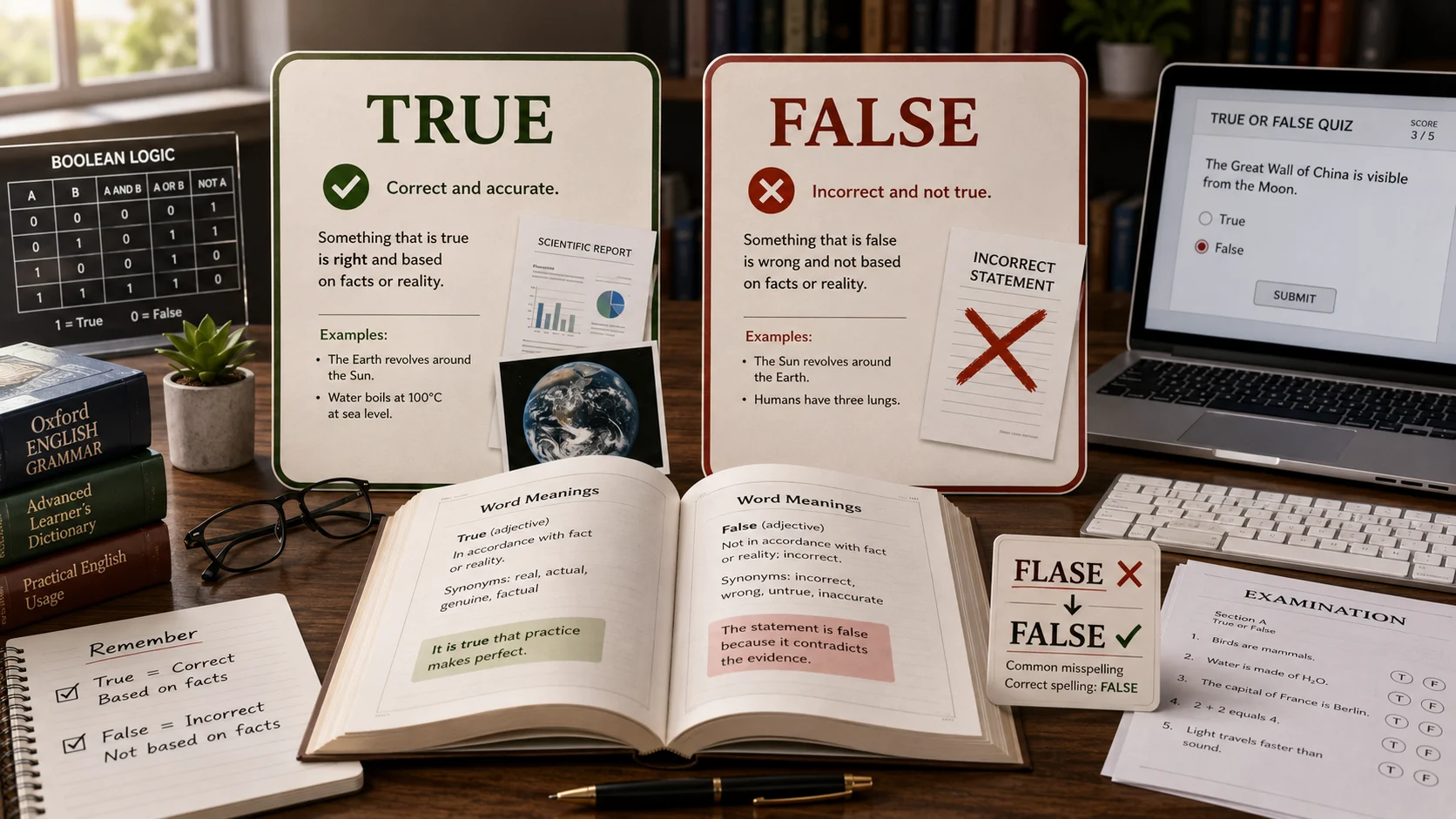
True or flase is a common spelling mistake caused by writing “flase” instead of the correct word “false.” True and false are opposite terms used to describe something is correct, accurate, factual, valid or untrue. The confusion usually comes from typing the letters in “false” in the wrong order, especially when writing quickly.
The phrase true or flase is almost always a spelling error rather than a legitimate English expression. The correct phrase is true or false.
The mistake happens because the letters in false can be easy to rearrange accidentally. Writers may type “flase” instead of “false,” particularly when entering answers into online quizzes, forms, search boxes, worksheets, or educational platforms.
Understanding the difference is simple once the spelling and meanings are separated. True describes something that agrees with facts or reality. False describes something that is incorrect, untrue, or not based on reality.
| Incorrect | Correct |
|---|---|
| True or flase | True or false |
| The statement is flase. | The statement is false. |
| Mark each answer true or flase. | Mark each answer true or false. |
The spelling issue matters because “flase” is not a standard English word. Although readers can usually understand what the writer intended, the error can make an otherwise polished sentence look careless.
True or Flase | What’s the Difference?
There is an important distinction between true, false, and the misspelled form flase.
True is an adjective that means consistent with fact, reality, or a particular standard. It can also describe something that is genuine, faithful, accurate, or sincere depending on the context.
False is also primarily an adjective. It describes something that is not true, not accurate, misleading, artificial, or contrary to fact.
| Word | Part of Speech | Meaning | Correct? | Example |
|---|---|---|---|---|
| True | Adjective | Correct, factual, accurate, or genuine | Yes | The statement is true. |
| False | Adjective | Incorrect, untrue, inaccurate, or misleading | Yes | The statement is false. |
| Flase | None in standard English | Misspelling of false | No | Flase is incorrect. |
Quick recap
True is the correct word when something agrees with reality or fact.
False is the correct opposite of true.
Flase is not a standard English spelling.
The correct expression is always true or false.
Is True or Flase a Grammar, Vocabulary or Usage Issue?
The main problem with true or flase is spelling rather than grammar. The intended words, true and false, are both standard English vocabulary items, while “flase” is simply a typographical or spelling error.
This distinction is useful because a sentence containing “flase” may still have perfectly correct grammar. For example, “The answer is flase” follows a normal grammatical structure, but the spelling of the adjective is wrong. The corrected sentence is “The answer is false.”
True and false are not interchangeable. They represent opposite meanings.
If a statement corresponds with known facts, it can be described as true. If the statement contradicts facts or reality, it can be described as false.
In formal writing, academic work, examinations, reports, and professional communication, false should always be spelled with the letters in the order f a l s e.
In casual digital communication, a person may make the “flase” typo without causing serious confusion. However, being understandable does not make the spelling correct.
Are true and false interchangeable?
No. They have opposite meanings.
| Statement | Evaluation |
|---|---|
| Water freezes at 0°C under standard conditions. | True |
| The Sun revolves around Earth. | False |
| The statement contains the word “Flase.” | Incorrect spelling. False is the correct spelling. |
How to Use True Correctly
True can describe a statement, fact, belief, story, claim, answer, or description that corresponds with reality or accepted information.
Workplace example
A manager might say:
“The information in the report is true and supported by our records.”
Here, true means factually accurate.
Another example is:
“The employee gave a true account of what happened.”
The word can also refer to sincerity or loyalty:
“She has always been a true friend.”
In this context, true means genuine or faithful rather than simply factually accurate.
Academic example
Students frequently encounter true and false questions in examinations.
For example:
“Photosynthesis allows plants to convert light energy into chemical energy.”
The student can select True because the statement is scientifically accurate.
Academic writing also uses true in expressions such as “a true statement,” “a true interpretation,” and “a true historical account.”
Technology example
In programming and computer science, true has a specialized meaning. It is commonly used as a Boolean value.
A condition might evaluate to true when a particular requirement has been satisfied.
For example, a system could determine that:
“User authentication is true.”
The exact syntax varies between programming languages, but the underlying concept remains the same. True represents a positive or affirmative logical value.
Usage recap for true
Use true when describing something factual, accurate, genuine, sincere, or logically affirmative.
Do not use “flase” as its opposite. The correct opposite is false.
How to Use False Correctly
False describes something that is not true. It can refer to an incorrect statement, inaccurate information, misleading claim, fabricated story, or logical value that represents a negative condition.
Workplace example
Consider this sentence:
“The report contains a false claim about the company’s sales figures.”
Here, false means factually incorrect.
A professional might also write:
“The information provided by the supplier was later found to be false.”
This usage is appropriate in formal workplace communication.
Academic example
False is especially common in academic tests.
A teacher may write:
“Mark each statement as true or false.”
This is the standard expression used in true or false questions.
Another example is:
“The student’s answer was false because it contradicted the evidence.”
Here, false identifies the answer as incorrect.
Technology example
In technology, false often functions as a Boolean value.
A program may evaluate a condition as either true or false. For example, if a user has not entered the required information, a validation check may return false.
This technical meaning is closely connected to the ordinary meaning. Both involve determining a proposition or condition is valid.
Usage recap for false
Use false when something is incorrect, untrue, inaccurate, invalid, or logically negative.
Always remember the spelling:
F A L S E
Not:
F L A S E
When You Should NOT Use True or Flase
There are several situations where writers commonly make mistakes with these words.
1. Do not write “flase” in formal documents
A typo in an email, report, assignment, or examination can reduce the perceived quality of the writing.
2. Do not treat “flase” as an alternative spelling
English does not recognize “flase” as a standard variant of false.
3. Do not use true when you mean genuine in every context
True can mean genuine, but context matters. For example, “true information” refers to factual information, while “a true friend” usually refers to a loyal or genuine friend.
4. Do not use false when you simply mean unknown
Something that has not yet been verified is not necessarily false. It may simply be unconfirmed.
5. Do not confuse false with fake
False can describe an incorrect statement, whereas fake often describes something deliberately made to appear genuine.
6. Do not assume a typo becomes correct because people understand it
Readers may understand “flase,” but widespread recognition of a typo does not make it a standard spelling.
7. Do not reverse the letters when typing quickly
The most reliable spelling pattern is fal followed by se.
8. Do not use “true or flase” in quiz instructions
The standard wording is true or false.
Common Mistakes and Decision Rules
| Correct Sentence | Incorrect Sentence | Explanation |
|---|---|---|
| The statement is true. | The statement is flase. | Flase is a misspelling of false. |
| The answer is false. | The answer is flase. | The correct spelling is false. |
| Choose true or false. | Choose true or flase. | True or false is the standard expression. |
| The claim is false. | The claim is flase. | The letters must appear as f, a, l, s, e. |
| Mark the statement as true. | Mark the statement as flase. | True is correct when the statement is factual. |
Decision Rule
The supplied action versus person or tool rule does not accurately apply to this pair. True and false do not differ according to action, person, or tool. Instead, use this more accurate rule:
If the statement agrees with reality or accepted facts, use true.
If the statement contradicts reality or accepted facts, use false.
If you see flase, correct it to false.
True and Flase in Modern Technology and AI Tools
The distinction between true and false has become particularly important in technology and artificial intelligence.
Many digital systems work with Boolean logic, where information is represented using values such as true and false. A program might determine a password is valid, a user is logged in, or a condition has been satisfied.
Artificial intelligence systems also evaluate claims, classify information, and generate answers. However, a statement produced by an AI system should not automatically be considered true merely because it sounds confident.
This makes the traditional distinction between true and false increasingly important. Users should verify important claims against reliable evidence rather than treating fluent language as proof of accuracy.
The spelling “flase” can also appear in code, databases, forms, and search queries when a person makes a typing mistake. In systems that require exact values, spelling errors can create technical problems as well as linguistic ones.
Etymology of True and False
The word true has deep Germanic roots and is related to older words associated with faithfulness, trust, and reliability. Over time, its meanings expanded from ideas of loyalty and sincerity to factual correctness.
False entered English through Old French and ultimately traces back to Latin falsus, meaning deceptive, mistaken, or untrue.
The two words therefore developed along different linguistic paths while eventually becoming one of the most familiar opposites in modern English.
An expert perspective
A useful way to understand the pair is this:
“True describes agreement with reality, while false describes a contradiction of it.”
This distinction is simple, but it explains why the two words appear so frequently in education, journalism, science, law, technology, and everyday communication.
Case study 1: Online assessment
Imagine an online examination containing the instruction “Select true or flase.” Students can usually understand the intended meaning, but the misspelling makes the assessment look less professionally prepared.
Correcting the instruction to “Select true or false” removes the spelling error without changing the question itself.
Case study 2: Software validation
Suppose a software system expects the Boolean values true and false. A developer or user entering “flase” instead of “false” may create an invalid value because the system expects a precise spelling.
The result demonstrates an important principle: a small spelling error can remain harmless in casual conversation but become significant in structured digital environments.
Author expertise
Author bio: Written from a professional linguistics and SEO perspective, with a focus on clear English usage, spelling accuracy, grammar education, and search friendly educational content.
Error Prevention Checklist
Always use true when
☑ A statement agrees with established facts.
☑ Information is accurate or correct.
☑ Something is genuine or sincere in the relevant context.
☑ A Boolean condition has a positive logical value.
Never use flase when
☒ You mean the opposite of true.
☒ You are writing an academic assignment.
☒ You are preparing an examination or quiz.
☒ You are writing professional correspondence.
☒ You are entering an exact Boolean value into a technical system.
☒ You are publishing educational content.
The safest memory trick is to remember that false contains als in the middle:
F A L S E
If you write F L A S E, you have reversed the middle letters.
Related Grammar Confusions You Should Master
Learning the correct spelling of true and false can also help you develop stronger proofreading habits. Other commonly confused terms include:
Your vs you’re: Your shows possession, while you’re means you are.
Their vs there vs they’re: These words have different grammatical functions despite similar pronunciation.
Than vs then: Than is normally used for comparisons, while then relates to time or sequence.
Lose vs loose: Lose means to misplace or fail to win, while loose means not tight.
Affect vs effect: Affect is commonly a verb, while effect is commonly a noun, although both have additional uses.
Advice vs advise: Advice is a noun, while advise is a verb.
Accept vs except: Accept means to receive or agree, while except means excluding.
Principal vs principle: Principal can refer to a person or something primary, while principle means a rule or belief.
Stationary vs stationery: Stationary means not moving, while stationery refers to writing materials.
Practice vs practise: These spellings differ according to English variety and grammatical function.
FAQs
Is “true or flase” correct English?
No. “Flase” is a misspelling of “false,” so the correct phrase is “true or false.”
What is the correct spelling of flase?
The correct spelling is false, with the letters f, a, l, s, and e.
What does true or false mean?
It asks a statement is accurate and agrees with reality or is incorrect and does not agree with reality.
Is false the opposite of true?
Yes. True and false are standard opposites when discussing factual accuracy or logical values.
Why do people spell false as flase?
The mistake usually occurs because the letters a and l are accidentally reversed while typing or writing.
Is flase a word in English?
No. “Flase” is not a standard English word and should be corrected to “false.”
How do you remember the spelling of false?
Remember the sequence F A L S E and avoid switching the a and l.
Are true and false adjectives?
Yes. Both are commonly used as adjectives, although true and false can have additional grammatical uses in particular contexts.
Is true or false used in exams?
Yes. True or false questions ask students to determine individual statements are correct or incorrect.
What is the difference between false and fake?
False commonly describes incorrect information or statements, while fake often describes something deliberately made to appear genuine.
Conclusion
The correct expression is true or false, not true or flase. True describes something that agrees with facts, reality, or a relevant standard, while false describes something that is incorrect, untrue, or inaccurate. The word “flase” is simply a spelling mistake and should not be treated as an alternative form of false.
The easiest way to remember the spelling is F A L S E. Whenever you are writing an examination, article, report, email, quiz, or technical instruction, use false rather than “flase.” Once this simple letter order becomes familiar, this common spelling error is easy to avoid.
Discover more Related Articles:
- Coyote or Fox | What Is the Difference & When Should You Use Each In 2026
- Vulkan or DX12 | Which Graphics API Should You Choose In 2026
- Craigslist or Portland | Complete Guide to Using Craigslist Portland Safely & Effectively In 2026