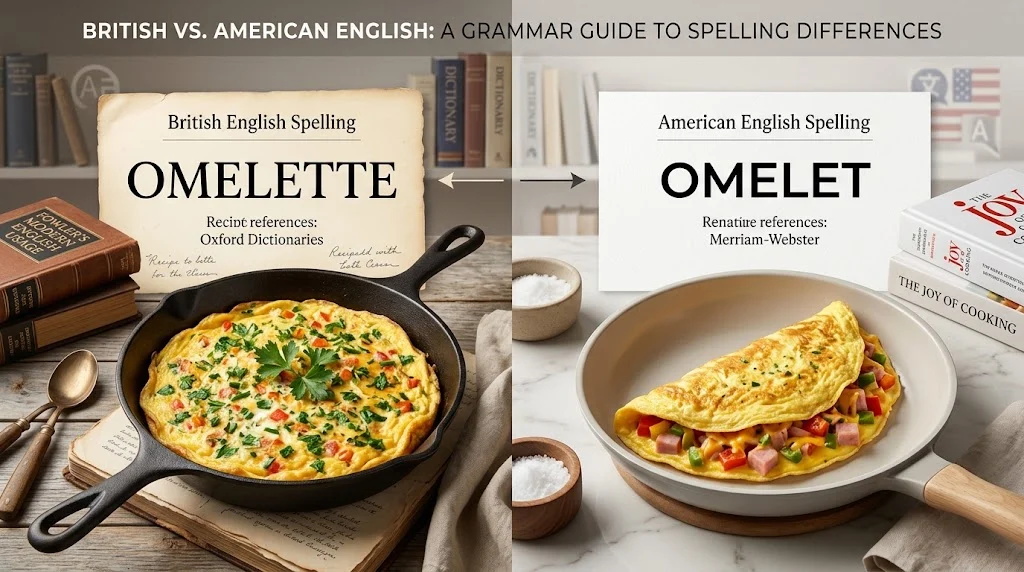
Omelette and omelet are both correct spellings for the same egg dish. Omelette is the traditional British English and international form, while omelet is especially common in American English. The difference is mainly regional spelling, not meaning, grammar, pronunciation, or the food itself.
If you have ever written a recipe, ordered breakfast, edited a menu, or checked a spelling in an English assignment, you may have wondered omelette or omelet is the correct choice. The good news is that both forms are standard English words. They refer to the same dish made from beaten eggs that are cooked in a pan, often with ingredients such as cheese, vegetables, herbs, or meat.
The main distinction is regional. Omelette is strongly associated with British English and is also widely used in many other varieties of English. Omelet is the preferred spelling in American English. Oxford lists omelette as the main British form and identifies omelet as the North American form.
This distinction matters because spelling conventions can signal the variety of English being used. A writer preparing an American style guide may prefer omelet, while a British publication would normally choose omelette. Neither spelling is inherently more correct.
The confusion becomes especially common because the two forms look almost identical and sound essentially the same. Unlike many commonly confused words, there is no meaningful difference in definition. The choice depends primarily on regional English conventions and consistency.
Core Definitions of Omelette and Omelet
Both words function as nouns. They name a prepared food rather than an action, quality, or person.
Omelette is a noun meaning a dish made by beating eggs and cooking them in a pan, often with additional ingredients. It is the spelling commonly associated with British English and is also widely recognized internationally. Oxford describes it as a hot dish of eggs mixed together and fried, often with ingredients such as cheese, meat, or vegetables.
Omelet is also a noun referring to exactly the same type of food. It is especially common in American English. Merriam Webster defines it as beaten eggs cooked without stirring until set and served folded in half, while identifying omelette as a variant.
The important point is simple: the spelling changes, but the basic meaning does not.
Omelette vs Omelet: What’s the Difference?
| Feature | Omelette | Omelet |
|---|---|---|
| Part of speech | Noun | Noun |
| Meaning | A dish made from cooked beaten eggs | A dish made from cooked beaten eggs |
| Primary usage | British English and international English | American English |
| Pronunciation | Essentially the same | Essentially the same |
| Meaning difference | None | None |
| Typical example | She ordered a mushroom omelette. | She ordered a mushroom omelet. |
| Plural | Omelettes | Omelets |
Mini Recap
Both spellings name the same food.
Omelette is preferred in British English.
Omelet is preferred in American English.
The safest choice is to follow the English variety used by your audience.
Is Omelette vs Omelet a Grammar, Vocabulary or Usage Issue?
This is primarily a spelling and usage issue, rather than a grammar problem.
Grammar determines how a word behaves within a sentence. Both omelette and omelet behave as countable nouns. You can write “I ordered an omelet,” “She made two omelettes,” or “The restaurant serves several types of omelet.”
The distinction is therefore not comparable to genuinely different words such as affect and effect. Those words have different grammatical roles and meanings. In this case, the two spellings represent the same lexical item.
They are also not strictly formal versus informal alternatives. Writing omelet does not make a sentence casual, and writing omelette does not automatically make it formal. Instead, the choice reflects regional convention.
For academic writing, the best practice is consistency. An American university paper can naturally use omelet. A British academic publication can naturally use omelette. A writer should not switch between the two without a reason.
The same principle applies to workplace communication, journalism, recipes, menus, websites, and educational material. Choose the spelling that matches the intended variety of English.
How to Use Omelette Correctly
The spelling omelette is particularly natural in British English.
Consider this workplace example:
“Breakfast will be provided during the morning meeting, including a cheese omelette and fresh fruit.”
This sentence would sound completely natural in British workplace communication.
An academic example might be:
“The recipe demonstrates how a traditional French omelette can be prepared using minimal ingredients.”
The spelling fits naturally within British academic prose.
A technology example might appear in a cooking application:
“The meal planner recommends a mushroom omelette based on your selected ingredients.”
| Context | Example with Omelette | Why It Works |
|---|---|---|
| Workplace | The hotel offers a breakfast omelette for conference guests. | Natural for workplace communication that follows British English. |
| Academic | The study examined traditional methods of preparing an omelette. | Appropriate when the academic style follows British spelling conventions. |
| Technology | The cooking app suggests a vegetable omelette. | Correct when the application uses British English throughout its interface and content. |
Usage recap: Use omelette when your audience follows British English or another variety that traditionally retains the French influenced spelling. The word remains a standard noun with the same meaning as omelet.
How to Use Omelet Correctly
The spelling omelet is especially common in American English. It appears frequently in American recipes, restaurant menus, newspapers, educational resources, and everyday conversation.
A workplace example could be:
“The cafeteria will serve a vegetable omelet during the breakfast meeting.”
An academic example could be:
“The researchers recorded the nutritional composition of a standard cheese omelet.”
A technology example could be:
“The recipe application generated a high protein omelet using the ingredients available in the user’s kitchen.”
American English commonly uses the shorter spelling omelet. The spelling omelette is standard in British English and is also widely used internationally. In American writing, omelet is a complete and correct word, not an abbreviation or error.
| Context | Example with Omelet | Why It Works |
|---|---|---|
| Workplace | The cafeteria serves a cheese omelet every Friday. | Natural American English spelling. |
| Academic | The paper compares the nutritional value of an omelet with other breakfast foods. | Appropriate in American academic writing. |
| Technology | The recipe app recommends an omelet based on available ingredients. | Suitable for American English software content. |
Usage recap: Use omelet when writing for an American English audience. It is fully standard and does not represent an informal or shortened version of omelette.
When You Should NOT Use Omelette or Omelet
Although both spellings are correct, there are situations in which one choice may be inappropriate for your particular audience.
- Do not use omelette as the default spelling in American English content if your publication follows a strict American style guide.
- Do not use omelet as the default spelling in British English content when your publication consistently follows British spelling.
- Do not alternate between the two spellings randomly within the same article.
- Do not assume that the extra letters make omelette more formal.
- Do not assume that the shorter spelling makes omelet less sophisticated.
- Do not correct an American writer simply because they wrote omelet.
- Do not correct a British writer simply because they wrote omelette.
- Do not change the spelling of the word solely to make a recipe appear more authentic. Follow the language convention of the publication instead.
Consistency is more important than choosing the form that looks more familiar to you personally.
Common Mistakes and Decision Rules
| Correct sentence | Incorrect sentence | Explanation |
|---|---|---|
| The restaurant serves a cheese omelette. | The restaurant serves a cheese omelet. | The second sentence is not grammatically wrong, but it may conflict with a British English style requirement. |
| The diner serves a cheese omelet. | The diner serves a cheese omelette. | The second sentence is not inherently wrong, but American publications generally prefer the shorter spelling. |
| She ordered two omelets. | She ordered two omelette. | The singular noun must be pluralized when referring to more than one dish. |
| He made an omelette for breakfast. | He made a omelette for breakfast. | The article “an” is required because the word begins with a vowel sound. |
| She made an omelet for breakfast. | She made a omelet for breakfast. | The article “an” is also required before the American spelling. |
Decision Rule Box
If your audience uses British English, choose omelette. If your audience uses American English, choose omelet. If the audience is international, choose one spelling and use it consistently.
This rule is more useful than trying to memorize which spelling is universally correct because neither spelling has exclusive ownership of the word.
Omelette and Omelet in Modern Technology and AI Tools
Modern technology does not create a new meaning for either spelling. Search engines, recipe applications, grammar checkers, word processors, translation systems, and AI writing tools may display either form depending on their language settings, training data, regional preferences, or surrounding context.
For content creators, this creates an important SEO consideration. Search engines generally understand that the two spellings refer to the same food. A page does not need to treat them as completely unrelated keywords.
However, regional intent still matters. A website targeting readers in the United States may naturally favor omelet. A British cooking website may prefer omelette. The most useful approach is to make the regional distinction clear rather than artificially repeating both spellings.
AI tools can also identify the words as variants rather than completely separate concepts. Human editors should still check regional consistency because automated systems may not always follow a publication’s preferred style.
For SEO, semantic relevance matters more than mechanically inserting every spelling. A strong article can naturally discuss terms such as egg dish, breakfast food, French omelette, American English, British English, spelling variant, recipe writing, restaurant menu, and regional spelling.
Etymology: Where Did the Word Come From?
The history of the word is surprisingly interesting.
The English word ultimately traces back to French omelette. Oxford explains that the French form developed from earlier forms connected with alumelle, meaning a knife blade, which ultimately traces to Latin lamella, meaning a thin plate. The connection appears to relate to the thin, flat shape of the dish.
Merriam Webster gives a similar history and records the first known English use of omelet around 1611. It identifies French omelette as the source and explains the connection to the Latin word associated with a thin plate.
The spelling history helps explain why English ended up with more than one accepted form. Language changes through borrowing, pronunciation, regional usage, and spelling conventions. The modern difference is therefore the result of linguistic development rather than a grammatical rule.
What Linguists Would Say About the Difference
A useful linguistic principle here is that spelling variation does not necessarily indicate a difference in meaning. English contains many regional spelling pairs, and readers learn to interpret them according to context.
An expert style explanation can be summarized this way:
The two spellings represent the same noun, with regional convention determining which written form is preferred.
That distinction is important for editors. A good editor should identify a spelling is wrong or simply belongs to another English variety. Treating every regional difference as an error can introduce unnecessary corrections into otherwise accurate writing.
Two Practical Case Studies
Case Study One: A British Recipe Website
Imagine a recipe website aimed at readers in the United Kingdom. Its editorial team uses British spelling throughout its content, including words such as colour, favourite, and centre.
The editors publish:
“Classic Mushroom Omelette Recipe”
This spelling aligns with the site’s established British English style. If the same site repeatedly switched to omelet, readers could perceive the content as inconsistent.
The result is improved editorial consistency because the food term follows the same regional convention as the rest of the site.
Case Study Two: An American Restaurant Website
Now consider an American restaurant whose menu includes breakfast dishes. Its website consistently uses American English.
The menu lists:
“Three Egg Cheese Omelet”
Using omelet fits the site’s regional spelling convention. Replacing it with omelette would not make the menu more correct. It would simply introduce a spelling associated more strongly with British English and international usage.
The practical result is a consistent American English brand voice.
These examples demonstrate an important editorial principle: correctness depends partly on the language standard being followed.
Error Prevention Checklist
Always use Omelette when
You are writing primarily for a British English audience.
Your publication’s style guide follows British spelling.
Your existing content consistently uses British English.
You are maintaining a British restaurant or recipe brand’s established terminology.
Never use Omelet when
Your editorial standard specifically requires the British spelling.
You are deliberately maintaining British spelling consistency.
Your publication has instructed writers to preserve established British terminology.
At the same time, remember that omelet itself is not an error. It becomes inappropriate only when it conflicts with the chosen regional or editorial standard.
Related Grammar Confusions You Should Master
Understanding regional spelling is easier when you recognize similar English distinctions.
- Color or colour: American and British spelling conventions.
- Favorite or favourite: Another common regional spelling difference.
- Center or centre: American English generally prefers center, while British English generally prefers centre.
- Traveler or traveller: A spelling difference involving consonant doubling.
- Canceled or cancelled: A regional difference in past tense spelling.
- Program or programme: Usage depends partly on meaning and regional convention.
- Practice or practise: A distinction involving American and British usage.
- License or licence: A well known American and British spelling distinction.
- Toward or towards: Both forms are accepted, with preferences varying by region.
- Judgment or judgement: Both spellings occur, with American English generally favoring the shorter form.
These examples reinforce the larger lesson: English is not governed by one universal spelling system.
FAQs
Is omelette or omelet the correct spelling?
Both are correct. Omelette is preferred in British English, while omelet is especially common in American English.
Is omelette British or American English?
Omelette is the standard form associated with British English, while American English commonly uses omelet.
Is omelet an American spelling?
Yes. Omelet is the preferred American English spelling, although omelette is also recognized in American dictionaries.
Does omelette mean something different from omelet?
No. The two words refer to the same egg dish, so the difference is spelling rather than meaning.
Why does American English spell omelette as omelet?
American English often favors simplified spellings, and omelet became an established American form rather than merely being an informal abbreviation.
How do you spell omelet in British English?
British English normally spells the word omelette, although readers will generally understand the American spelling omelet.
How do you spell omelette in American English?
American English commonly uses omelet, although omelette is also recognized and understood.
Should I use omelet or omelette in an academic paper?
Use the spelling required by your institution, publication, or selected English variety. Consistency matters more than choosing one form universally.
Which spelling should I use for SEO?
Use the spelling that matches your target audience, then mention the alternative naturally when clarification is useful. Search engines can understand that the two forms refer to the same food.
Conclusion
The choice between omelette or omelet is straightforward once regional English conventions are understood. Both spellings describe the same dish, and neither is inherently more correct than the other.
Choose omelette when following British English or a publication that prefers the traditional international spelling. Choose omelet when writing primarily for an American English audience. Most importantly, remain consistent throughout the same piece of content.
For writers, editors, students, recipe creators, and website owners, the best decision is not to ask which spelling is universally correct. Instead, ask which English variety your audience expects. Once that choice is clear, the correct spelling becomes easy to identify.
The distinction is supported by major dictionaries. Oxford identifies omelette as the British form and omelet as the North American form, while Merriam Webster recognizes omelette as a variant of omelet.
In short, both forms are legitimate. Regional consistency is the real rule.
Discover More Related Articles:
- Jewellery or Jewelry | Which Version Is Right for Your Audience In 2026
- Lisa or Lena | Why Are These Names So Easy to Confuse In 2026
- Si or Sí | The Common Spanish Spelling Confusion Explained In 2026