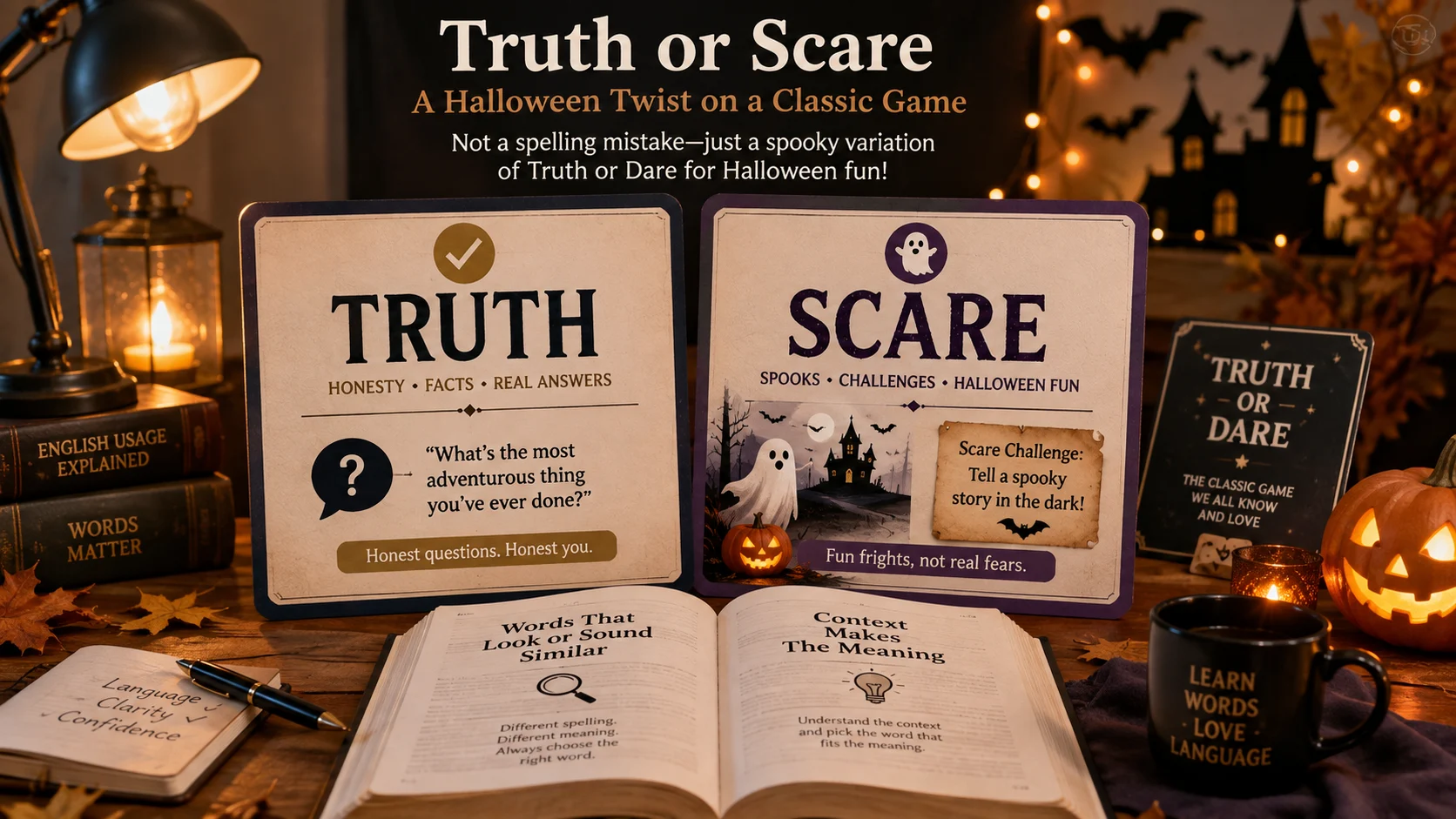
Truth or scare is a Halloween themed expression and party game that adapts the familiar idea of Truth or Dare by replacing the dare element with a spooky scare or challenge. The word truth refers to something that is factual or honest, while scare refers to an experience, action or situation that causes fear. The expression is playful rather than a standard grammar construction.
Have you ever heard the phrase “truth or scare” and wondered it refers to telling the truth or frightening someone? Similar-looking expressions can easily create confusion, especially when a single word changes the meaning of a sentence. Understanding the difference between truth or scare and other familiar phrases helps you communicate more clearly, avoid common writing mistakes, and choose the right expression for your intended message.
In this guide, we’ll explore what truth or scare means, how it is used in everyday English, and it is a standard expression or a possible mix-up with another phrase. You’ll discover practical examples, common mistakes to avoid, and simple tips to use the wording more confidently. You’re writing a casual message, creating content, or improving your English vocabulary, this explanation will help you understand the phrase more accurately.
Truth or Scare | What’s the Difference?
The most important point is that truth and scare have completely different meanings. They are not alternative spellings, grammatical variants, or interchangeable vocabulary choices. They are two separate words deliberately placed together in a playful expression.
The key distinction is simple. Truth describes honesty or factual reality.
Scare describes fear or something intended to frighten.
Truth or Scare combines the two words as a Halloween themed play on a familiar game.
It is therefore better understood as wordplay than as a grammar problem.
What Does Truth Mean?
Truth is primarily a noun. It refers to something that corresponds with reality, a fact that can be accepted as accurate, or an honest account of something.
Consider these examples:
In the Halloween game, truth normally represents the question and answer side. A player might be asked about a favorite Halloween costume, a childhood fear, or the strangest thing they have ever seen.
Truth Usage Recap
Use truth when you are talking about facts, honesty, reality, or an honest answer. In Truth or Scare, it represents the honest question and answer option.
What Does Scare Mean?
Scare has two common grammatical roles.
As a noun, scare means a frightening experience or a moment of fear.
Example: That haunted house gave me a terrible scare.
As a verb, scare means to frighten someone.
Example: The actor tried to scare the audience.
The word is particularly useful in Halloween vocabulary because it naturally connects with ghosts, haunted houses, monsters, frightening stories, and spooky challenges.
Scare Usage Recap
Use scare when referring to fear, a frightening experience, or the act of frightening someone. In Truth or Scare, scare gives the familiar party game its Halloween themed twist.
Is Truth or Scare a Grammar, Vocabulary or Usage Issue?
Truth or Scare is primarily a vocabulary and usage issue rather than a grammar issue.
There is no grammatical rule saying that scare must be used instead of dare or that truth and scare are grammatical alternatives. The phrase works because it deliberately modifies a familiar expression.
Truth or Dare is the established name of the traditional party game. Truth or Scare is a creative Halloween variation. One should not be treated as a correction of the other.
Are Truth and Scare Interchangeable?
No. Truth and scare have different meanings and grammatical functions.
You cannot replace truth with scare in a sentence such as:
She finally admitted the truth.
The replacement would change the meaning completely.
Likewise, scare cannot replace truth in:
I want to know the truth.
These words become connected specifically when someone creates the playful expression Truth or Scare.
Formal Versus Informal Usage
Truth is common in formal and informal English. It appears in journalism, academic writing, business communication, literature, and ordinary conversation.
Scare is also a standard English word, but the phrase Truth or Scare is informal and playful. It is most appropriate for entertainment, Halloween events, party activities, games, promotional content, and casual conversation.
Academic Versus Casual Usage
In academic writing, use truth and scare according to their actual meanings. Do not introduce Truth or Scare as though it were an established academic term unless you are discussing the game, television program, or cultural phrase itself.
In casual writing, however, Truth or Scare can be perfectly appropriate when the subject is a Halloween game or spooky activity.
When You Should NOT Use Truth or Scare
Understanding when not to use the expression is just as important as understanding when it works.
1. When You Mean the Traditional Game
If you are referring to the familiar party game, Truth or Dare is normally the appropriate name.
2. In Formal Business Communication
A workplace report about employee communication should not describe an activity as Truth or Scare unless the activity genuinely has that name.
3. In Academic Writing Without Context
Do not assume readers will automatically recognize Truth or Scare as a standard English expression. Explain the term if it is relevant to your research.
4. When Discussing Factual Accuracy
If you mean factual correctness, use truth rather than scare.
Example:
The journalist wanted to discover the truth.
5. When Describing Fear
If you mean a frightening experience, use scare.
Example:
The unexpected noise gave everyone a scare.
6. When Referring to a Dare
A dare is a challenge someone is asked or encouraged to perform. A scare focuses on fear. They overlap in some Halloween games, but they do not have identical meanings.
7. When the Phrase Could Cause Confusion
If your audience has no Halloween context, Truth or Dare may communicate your intended meaning more clearly.
8. When You Are Correcting Someone’s Spelling
Do not mark Truth or Scare as a spelling mistake simply because the reader expected Truth or Dare. Context determines the expression is intentional.
Common Mistakes and Decision Rules
Decision Rule
If you mean factual information or an honest answer, use truth.
If you mean fear, frightening experiences, or frightening someone, use scare.
If you mean the traditional party game, use Truth or Dare.
If you mean a Halloween themed variation of that game, Truth or Scare can be appropriate.
Truth or Scare in Modern Technology and AI Tools
Modern digital platforms have made creative versions of traditional games easier to produce and share. Printable card generators, online party resources, classroom activity platforms, and AI writing tools can all be used to create Truth or Scare questions and challenges.
For example, an AI tool can generate separate sets of truth questions and Halloween themed scare challenges. A teacher could request age appropriate questions for a classroom party, while a family could create less frightening prompts for younger children.
The important linguistic distinction remains unchanged. AI generated content does not turn Truth or Scare into a standard grammatical alternative to Truth or Dare. It remains a context dependent phrase whose meaning comes from the Halloween theme.
The Etymology and Word History of Truth and Scare
Truth comes from the Old English word associated with faithfulness and being true. Over centuries, its meaning developed around ideas of honesty, reality, accuracy, and conformity with fact.
Scare has Germanic roots and has long been associated with frightening or startling someone. Modern English uses scare as both a noun and a verb, which explains why it can describe either the frightening event itself or the action of causing fear.
The combination Truth or Scare is much more recent in practical usage. It functions as playful word formation based on the established expression Truth or Dare. Halloween themed versions of the game are explicitly described online as a modified form of Truth or Dare.
Why the Phrase Works as Wordplay
The success of Truth or Scare comes from sound pattern and familiarity.
People already recognize the structure of Truth or Dare. When the final word changes, the audience immediately understands the reference while also noticing the Halloween connection.
The replacement creates a new expectation. A dare can involve almost any challenge, whereas a scare suggests something spooky, frightening, or Halloween related.
That makes the expression effective as a party title, classroom activity name, printable game, or seasonal promotional phrase.
Two Real World Examples of the Phrase
One documented Halloween game resource describes Truth or Scare as a Halloween version of Truth or Dare, using truth cards and scare or dare style challenges.
Another Halloween game resource explains a format in which players choose between truth questions and spooky challenges, showing how the phrase has developed into a recognizable seasonal game concept rather than simply being a spelling error.
There is also a separate cultural use of the title. Truth or Scare was the name of a Discovery Kids television program associated with paranormal and frightening subjects. Contemporary discussions and listings identify it as a television series hosted by Michelle Trachtenberg.
This distinction matters because a search for Truth or Scare may refer to either the Halloween game concept or the television program, depending on context.
Error Prevention Checklist
- Always use truth when you mean a fact, reality, honesty, or an honest answer.
- Always use scare when you mean fear, a frightening experience, or the act of frightening someone.
- Always use Truth or Dare for the conventional party game.
- Always use Truth or Scare when you intentionally mean the Halloween themed variation.
- Never use scare as a synonym for truth.
- Never assume Truth or Scare is a spelling error without checking the context.
- Never treat Truth or Scare as a formal academic term without explaining its meaning.
Related Grammar Confusions You Should Master
Truth or Scare belongs to a wider group of English questions involving words that appear similar in a particular context but have different meanings.
- Truth and fact: These words overlap but are not always identical.
- Scare and fright: Both relate to fear, but their grammatical behavior differs.
- Dare and challenge: A dare is a particular kind of challenge.
- Fear and scare: Fear usually describes an emotional state, while scare can describe an event or action.
- Advice and advise: One is a noun and the other is a verb.
- Affect and effect: Their meanings and grammatical functions commonly cause confusion.
- Lose and loose: They differ in both pronunciation and meaning.
- Then and than: They perform completely different grammatical roles.
- Everyday and every day: One is normally an adjective while the other is a time expression.
- Your and you’re: One shows possession while the other is a contraction.
FAQs
Is Truth or Scare a real phrase?
Yes. Truth or Scare is used as a Halloween themed variation of Truth or Dare, and it can also refer to a television title.
Is Truth or Scare the same as Truth or Dare?
They are related but not identical. Truth or Scare is generally a spooky variation designed around Halloween themes.
Is Truth or Scare grammatically correct?
Yes, when it is intentionally used as a creative phrase or game title. It is not a grammatical replacement for Truth or Dare.
What does truth mean in Truth or Scare?
Truth represents the option of answering a question honestly. The word itself means a fact, reality, or honest statement.
What does scare mean in Truth or Scare?
Scare represents a frightening or spooky challenge. As an ordinary English word, scare can mean either a frightening experience or the act of frightening someone.
Should I write Truth or Scare or Truth or Dare?
Use Truth or Dare for the traditional game and Truth or Scare when you specifically mean a Halloween themed version.
Can Truth or Scare be used in formal writing?
The individual words can be used formally, but the playful phrase is generally better suited to entertainment, seasonal content, and casual contexts.
Why do people say Truth or Scare instead of Truth or Dare?
The substitution creates Halloween wordplay by replacing dare with scare, making the familiar game sound more appropriate for a spooky event.
Was Truth or Scare also a television show?
Yes. Truth or Scare was also the title of a Discovery Kids series focused on paranormal and frightening subjects.
Conclusion
The answer depends entirely on what you mean.
Truth is a noun referring to fact, reality, or honesty. Scare can be a noun referring to a frightening experience or a verb meaning to frighten. Together, Truth or Scare is best understood as a playful Halloween expression rather than a conventional grammar choice.
If you are talking about the standard party game, Truth or Dare is the clearer and more established expression. If you are creating a Halloween party, classroom activity, family game, or spooky themed event, Truth or Scare can be an effective and understandable variation.
The phrase is therefore not inherently wrong. Its correctness comes from context and intention.
Discover More Related Articles:
- Fien or Fein | Stop Making This Common Spelling Mistake In 2026
- Licence or License | The Difference Every English Learner Should Know In 2026
- Useing or Using | Clear Up This Common English Confusion Today In 2026