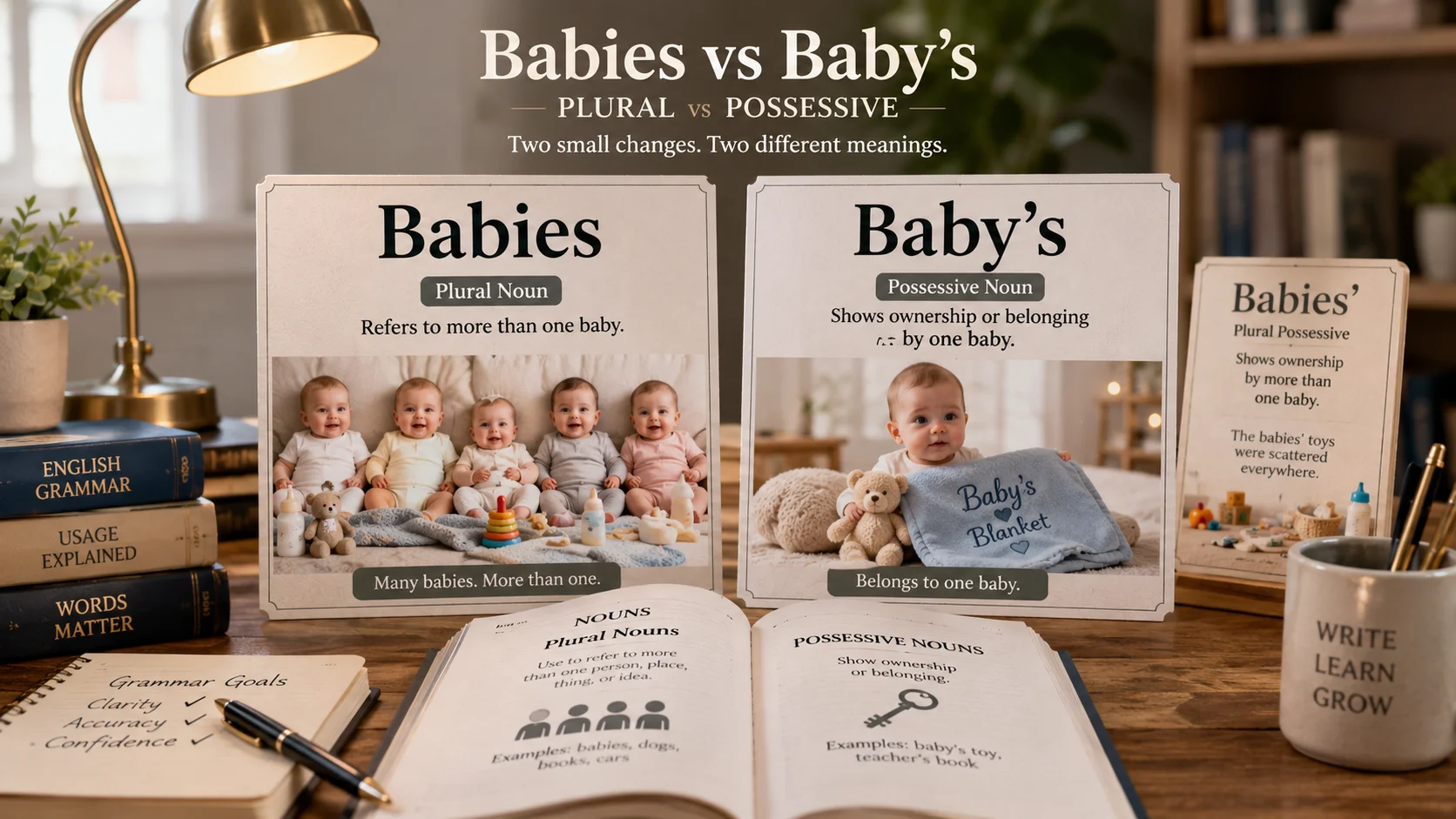
Babies or baby’s have different grammatical functions. Babies is the plural form of the noun baby, meaning more than one infant, while baby’s is the possessive form of baby, showing that something belongs to one baby. Confusing them can change the meaning of a sentence and lead to common spelling and grammar mistakes.
Have you ever paused while writing to wonder “babies” or “baby’s” is the correct choice? Although these words look similar, they serve different purposes in English, and using the wrong form can change the meaning of your sentence. you are writing a parenting blog, preparing a school assignment, or creating content for a professional website, understanding this small spelling difference can make your writing clearer and more accurate. The key is knowing you are talking about more than one baby or showing that something belongs to a baby.
In this guide, we will explain the difference between babies and baby’s, including their meanings, grammatical roles, and correct usage in everyday and formal writing. You will discover simple rules, practical examples, and common mistakes to avoid. By the end, you will know exactly when to use each form and feel more confident applying this essential English grammar rule.
Babies or Baby’s | What’s the Difference?
The difference between babies and baby’s is straightforward once you understand plural and possessive nouns. Although the two forms look similar, they do completely different jobs in a sentence.
Babies is the plural form of baby. It refers to two or more babies.
For example:
The babies are sleeping.
The sentence refers to more than one infant, so babies is correct.
Baby’s, on the other hand, is the singular possessive form of baby. It shows that something belongs to, is associated with, or relates to one baby.
For example:
The baby’s blanket is on the chair.
Here, the blanket belongs to one baby, so baby’s is correct.
| Word | Part of Speech | Meaning | Example |
|---|---|---|---|
| Baby | Noun | One infant or very young child | The baby is smiling. |
| Babies | Plural noun | More than one infant or young child | The babies are smiling. |
| Baby’s | Singular possessive noun | Something belonging to one baby | The baby’s toy is new. |
| Babies’ | Plural possessive noun | Something belonging to multiple babies | The babies’ toys are new. |
This comparison also introduces a form that is often overlooked: babies’.
If you are talking about something belonging to several babies, use babies’, not baby’s.
For example:
The babies’ clothes were placed in separate bags.
The apostrophe comes after the s because the noun is already plural.
Quick Recap
Babies means more than one baby.
Baby’s means something belonging to one baby.
Babies’ means something belonging to multiple babies.
The apostrophe changes the grammatical function, not simply the spelling.
Is Babies or Baby’s a Grammar, Vocabulary or Usage Issue?
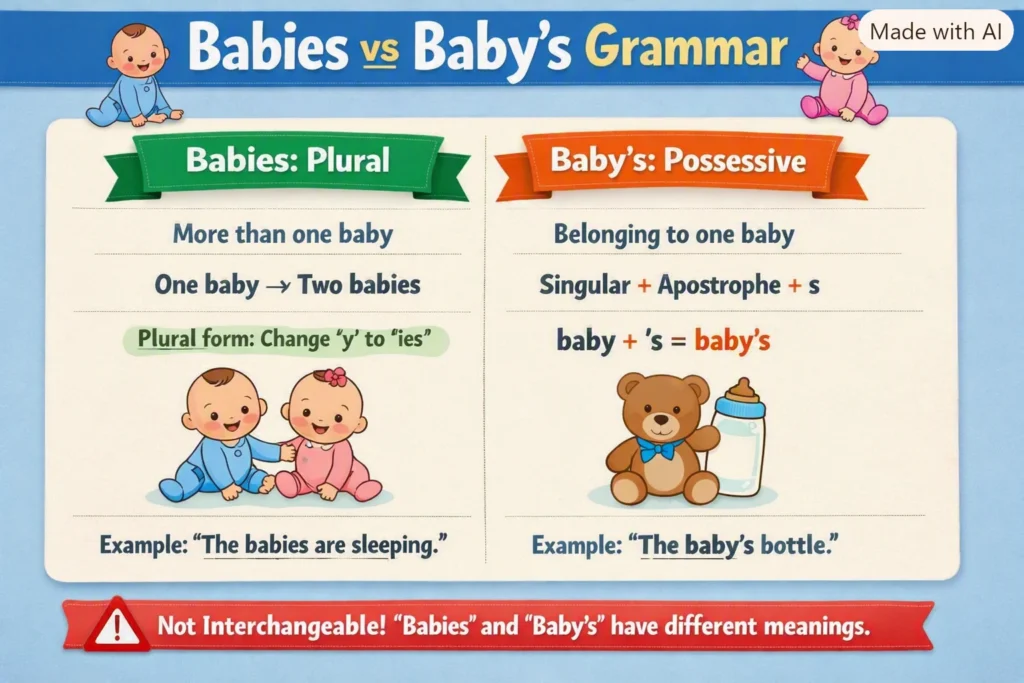
The confusion between babies and baby’s is primarily a grammar and punctuation issue involving number and possession. It isn’t a vocabulary difference because both forms come from the same noun, baby.
The central question is you are talking about more than one baby or something belonging to one baby.
If you are simply making baby plural, change the final y to ies:
one baby
two babies
This follows a common English pluralization pattern. When a consonant comes before the final y, the y generally changes to ies when the word becomes plural.
However, possession works differently.
To show that something belongs to one baby, keep the singular noun and add an apostrophe followed by s:
baby + ‘s = baby’s
The result is baby’s.
These forms aren’t interchangeable. Replacing one with the other can produce a grammatical error or change the intended meaning.
In formal writing, academic writing, workplace communication, parenting materials, medical documents, and educational resources, using the correct form is especially important because precise wording prevents ambiguity.
In casual communication, people may overlook an apostrophe or make a spelling mistake, but the underlying grammatical distinction remains the same.
When to Use Babies
Use babies when you mean two or more infants or very young children. It is simply the plural form of baby.
For example:
The babies are playing together.
Several babies were enrolled in the program.
The hospital cares for premature babies.
The babies slept peacefully throughout the afternoon.
The word babies does not indicate ownership. It only tells the reader that more than one baby is being discussed.
Workplace Example
A childcare center might write:
The staff members are responsible for supervising the babies during nap time.
The word babies is correct because the staff members are supervising multiple infants.
Another example is:
The daycare provides separate sleeping areas for babies and toddlers.
Again, babies refers to a group.
Academic Example
A research paper might state:
The study examined how babies respond to different sounds during the first year of life.
The researcher is discussing infants in general, so the plural noun babies is appropriate.
Technology Example
A parenting application might display:
Track your babies’ sleep patterns.
Notice something interesting here. Babies by itself means multiple babies, but babies’ expresses possession by multiple babies.
Therefore, the sentence uses the plural possessive form because the sleep patterns are associated with the babies.
Usage Recap
Use babies when you mean more than one baby.
Do not use baby’s simply because you are talking about multiple babies.
If no ownership is involved, babies is normally the form you need.
When to Use Baby’s
Use baby’s when you mean something belonging to one baby or something directly associated with one baby.
For example:
The baby’s bottle is on the table.
The bottle belongs to or is associated with one baby.
Other examples include:
The baby’s room is ready.
The baby’s name is written on the card.
I washed the baby’s clothes.
The baby’s doctor recommended additional rest.
In each sentence, baby’s modifies another noun and indicates a relationship with one baby.
Workplace Example
A childcare worker might write:
The baby’s feeding schedule has been updated.
This means the feeding schedule belongs to or concerns one particular baby.
Academic Example
A developmental psychology textbook might say:
The baby’s response was recorded during the experiment.
The phrase refers to the response of one baby.
Technology Example
A smart parenting application could display:
Your baby’s sleep data is ready.
The possessive form is necessary because the data relates to one baby.
If the application is tracking multiple children, the wording might instead be:
Your babies’ sleep data is ready.
Here, babies’ is the plural possessive form.
Usage Recap
Use baby’s when one baby possesses something or is associated with something.
The apostrophe comes before the s because baby is singular.
If multiple babies possess something, use babies’ instead.
When You Should NOT Use Babies or Baby’s
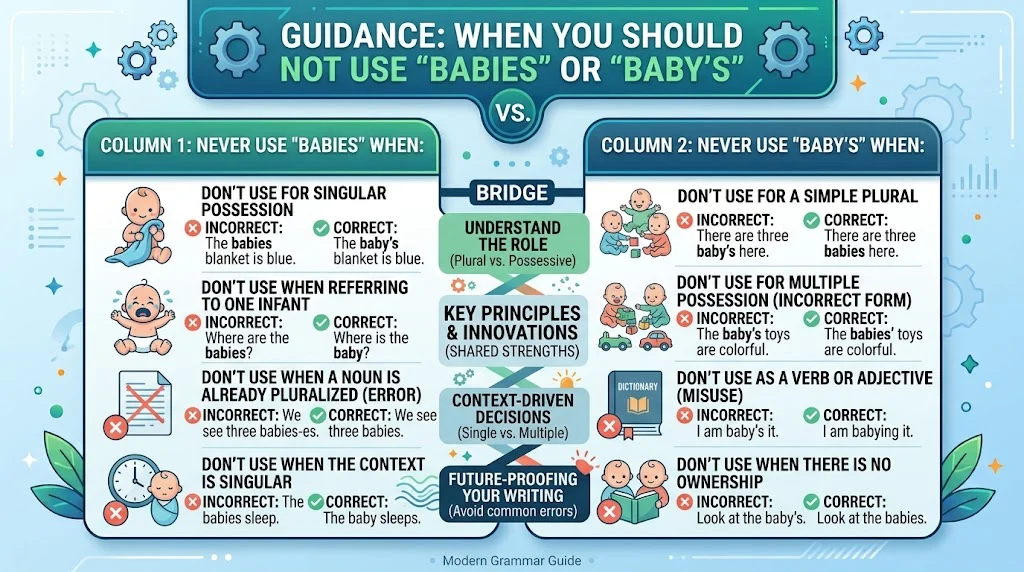
Understanding when not to use each form can prevent many common errors.
1. Do Not Use Baby’s for a Simple Plural
Incorrect:
There are three baby’s in the room.
Correct:
There are three babies in the room.
The sentence refers to three infants, not ownership.
2. Do Not Use Babies When Showing Singular Possession
Incorrect:
The babies blanket is blue.
Correct:
The baby’s blanket is blue.
One baby is associated with the blanket, so the possessive form is required.
3. Do Not Use Baby’s for Multiple Babies
Incorrect:
The baby’s were playing together.
Correct:
The babies were playing together.
The sentence needs a plural noun, not a possessive noun.
4. Do Not Use Babies for One Infant
Incorrect:
The babies is sleeping.
Correct:
The baby is sleeping.
The subject is singular, so baby is required.
5. Do Not Confuse Babies’ With Baby’s
Incorrect:
The baby’s toys were placed in the shared room.
If several babies own or use the toys, this wording suggests one baby.
Better:
The babies’ toys were placed in the shared room.
6. Do Not Add an Apostrophe Just to Make a Noun Plural
Apostrophes don’t normally make ordinary English nouns plural.
Incorrect:
The baby’s are adorable.
Correct:
The babies are adorable.
7. Do Not Assume Similar Appearance Means Similar Function
The words look related because they are related, but their grammatical functions differ.
Babies expresses number.
Baby’s expresses possession.
Common Mistakes and Decision Rules
| Correct Sentence | Incorrect Sentence | Explanation |
|---|---|---|
| The babies are sleeping. | The baby’s are sleeping. | Multiple infants require the plural form. |
| The baby’s blanket is soft. | The babies blanket is soft. | One baby’s blanket requires singular possession. |
| The babies’ toys are colorful. | The baby’s toys are colorful. | Multiple babies require plural possession. |
| Two babies arrived early. | Two baby’s arrived early. | The plural form is babies. |
| The baby’s bottle is empty. | The babies bottle is empty. | The bottle belongs to one baby. |
| The babies are in the nursery. | The baby’s are in the nursery. | The sentence describes multiple babies, not possession. |
| The babies’ parents attended the meeting. | The baby’s parents attended the meeting. | The parents belong to or are associated with multiple babies. |
Decision Rule
If you mean more than one infant, use babies.
If you mean something belonging to one baby, use baby’s.
If you mean something belonging to multiple babies, use babies’.
This simple three part distinction solves most questions about the correct form.
Babies or Baby’s in Modern Technology and AI Tools
Modern technology frequently uses these forms in interfaces, applications, databases, parenting platforms, and artificial intelligence systems.
For example, an application might say:
Track your baby’s development.
This is correct when the account concerns one infant.
For a family tracking several infants, the interface could say:
Track your babies’ development.
AI writing tools also need to distinguish these forms according to grammatical context. If a user asks an AI system to correct a sentence such as The baby’s are sleeping, the system should recognize that the intended meaning is probably plural and recommend The babies are sleeping.
Likewise, if the sentence is The babies bottle is missing, the appropriate correction depends on the intended meaning. If one baby owns the bottle, it should be The baby’s bottle is missing. If several babies share or possess bottles, The babies’ bottles are missing may be appropriate.
Context therefore matters more than visual similarity.
The Etymology Behind Baby, Babies and Baby’s
The noun baby has a long history in English and developed from early forms associated with infant speech and words used for very young children. The spelling and pronunciation have changed over time, but the modern noun is firmly established in standard English.
The plural form babies follows a broader English spelling pattern. When a noun ends in a consonant followed by y, the final y commonly changes to ies when forming the plural.
Compare:
| Singular | Plural |
|---|---|
| Baby | Babies |
| City | Cities |
| Story | Stories |
| Family | Families |
| Country | Countries |
Possessive formation follows another grammatical rule. The singular noun baby takes ‘s, producing baby’s.
The important lesson is that pluralization and possession are separate grammatical processes.
An Expert Perspective
A useful grammatical principle is this: A plural ending tells you how many, while an apostrophe generally tells you about possession or relationship.
That distinction explains why babies and baby’s cannot be used interchangeably.
Case Study 1: Childcare Communication
Imagine a childcare center preparing a notice that says:
Parents should label their baby’s belongings.
This is appropriate when each parent is being asked to label the belongings of their own individual baby.
However, a notice discussing a group might say:
Staff should organize the babies’ belongings separately.
The first example uses singular possession, while the second uses plural possession.
The grammatical change makes the intended relationship clearer.
Case Study 2: Educational Content
Consider an educational article comparing developmental patterns:
Babies begin developing new communication skills during infancy.
Here, babies is correct because the article discusses infants generally.
Now consider:
A baby’s communication skills develop rapidly during infancy.
Here, baby’s is correct because the sentence discusses the characteristics or development of one baby.
The distinction allows writers to move naturally between general observations and individual examples.
Author expertise: Written by a language and SEO content specialist focused on clear English usage, grammar education, search intent, and reader friendly explanations.
Error Prevention Checklist
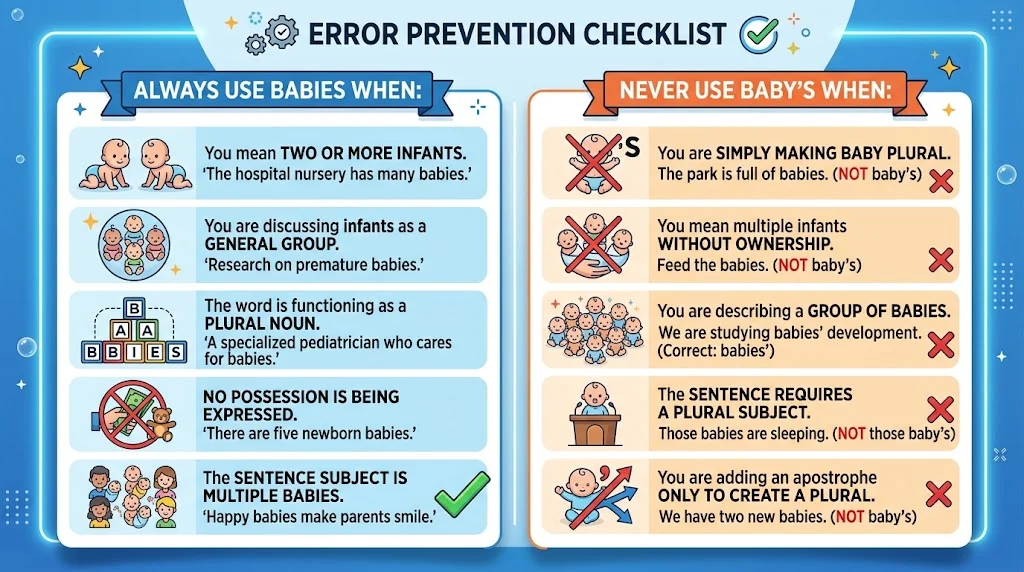
Always Use Babies When
- You mean two or more infants.
- You are discussing infants as a general group.
- The word is functioning as a plural noun.
- No possession is being expressed.
- The sentence subject is multiple babies.
Never Use Baby’s When
- You are simply making baby plural.
- You mean multiple infants without ownership.
- You are describing a group of babies.
- The sentence requires a plural subject.
- You are adding an apostrophe only to create a plural.
Remember that baby’s is not the plural of baby.
Babies, Baby’s and Babies’ Compared
| Form | Meaning | Example |
|---|---|---|
| Baby | One infant | The baby is awake. |
| Babies | More than one infant | The babies are awake. |
| Baby’s | Something belonging to one baby | The baby’s crib is new. |
| Babies’ | Something belonging to multiple babies | The babies’ cribs are new. |
This four form comparison is useful because many writers understand babies and baby’s but forget babies’.
The apostrophe position is the key.
In baby’s, the apostrophe appears before the s because the noun is singular.
In babies’, the apostrophe appears after the s because the noun is already plural.
Related Grammar Confusions You Should Master
Learning this distinction can make several other English grammar questions easier.
- Child or Children: Learn the irregular plural of child.
- Woman or Women: Understand the difference between singular and plural pronunciation and spelling.
- Person or People: Learn when the irregular plural is required.
- Baby or Babies: Apply the consonant plus y pluralization rule.
- Baby’s or Babies’: Distinguish singular possession from plural possession.
- Its or It’s: Separate possession from contraction.
- Parents or Parent’s: Identify plural versus singular possessive forms.
- Teachers or Teacher’s: Understand when an apostrophe is required.
- Children’s or Childrens: Recognize irregular plural possessives.
- Mothers or Mother’s: Distinguish a simple plural from singular possession.
Mastering these patterns is more useful than memorizing isolated spellings because the same grammatical principles appear throughout English.
FAQs
Are babies and baby’s the same thing?
No. Babies is the plural of baby, while baby’s is the singular possessive form showing that something belongs to one baby.
Is babies the correct plural of baby?
Yes. The standard plural of baby is babies because the final consonant followed by y changes to ies.
When should I use baby’s in a sentence?
Use baby’s when you are referring to something belonging to or associated with one baby, such as the baby’s toy.
Is baby’s a plural word?
No. Baby’s is a singular possessive form. It does not mean more than one baby.
What is the plural possessive form of baby?
The plural possessive form is babies’. It refers to something belonging to or associated with multiple babies.
Should I write babies or baby’s when talking about two infants?
Write babies because you are describing more than one infant and are not expressing possession.
Is babies’ different from baby’s?
Yes. Baby’s indicates possession by one baby, while babies’ indicates possession by multiple babies.
Why is baby’s sometimes written incorrectly as babies?
The forms are confused because they look and sound related, but one expresses possession and the other expresses plurality.
Which is correct: the babies are sleeping or the baby’s are sleeping?
The correct sentence is “The babies are sleeping” because the sentence refers to multiple infants and does not express possession.
Conclusion
The difference between babies or baby’s becomes clear when you identify the grammatical purpose of the word.
Use babies when you mean more than one infant. Use baby’s when something belongs to or is associated with one baby. When something belongs to several babies, use babies’.
A quick test can help. Ask yourself you are answering how many? or whose? If the answer is more than one, choose babies. If the answer is one baby’s possession, choose baby’s. If several babies share ownership, choose babies’.
Once you understand the difference between plural nouns and possessive nouns, this spelling question becomes much easier. The apostrophe isn’t decorative. It carries grammatical meaning, so placing it correctly helps your writing remain precise, professional, and easy to understand.
Discover More Related Articles:
- Fien or Fein | Stop Making This Common Spelling Mistake In 2026
- Licence or License | The Difference Every English Learner Should Know In 2026
- Useing or Using | Clear Up This Common English Confusion Today In 2026