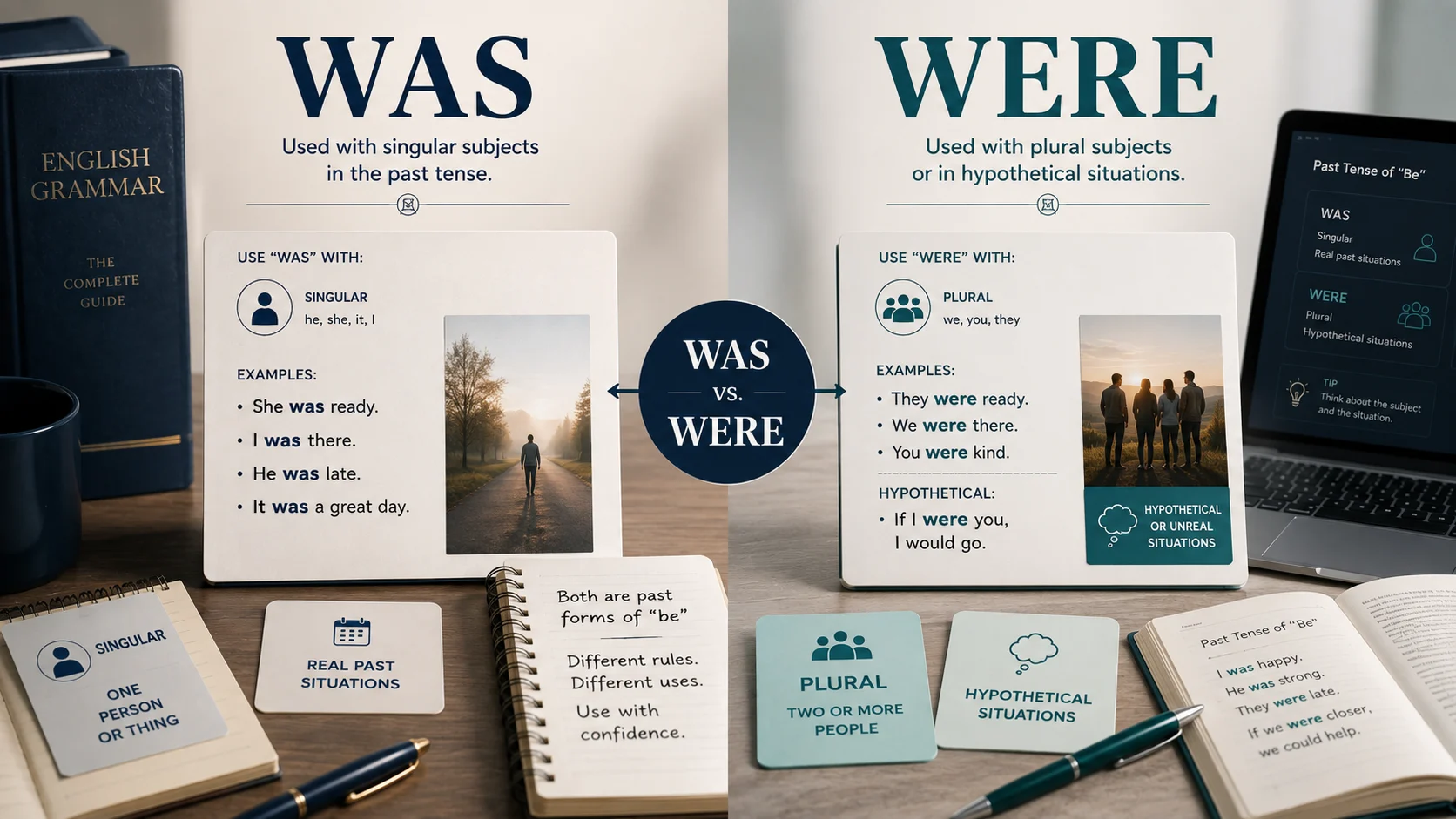
Were or was depends on the subject, the tense, and you are describing a real situation or a hypothetical one. “Was” usually agrees with singular subjects, while “were” agrees with plural subjects. However, “were” also appears with singular subjects in formal hypothetical expressions such as “If I were you.”
The choice between were or was is one of the most common English grammar questions because both forms are past tense forms of the verb “be.” The basic distinction is straightforward: “was” normally follows singular subjects such as “I,” “he,” “she,” and “it,” while “were” normally follows plural subjects such as “we,” “they,” and “you.” The difficulty begins when English uses “were” with singular subjects in hypothetical or unreal situations.
This distinction matters because choosing the wrong form can change the grammatical meaning of a sentence. Compare “I was tired” with “If I were tired.” The first sentence presents tiredness as a real past condition. The second introduces a hypothetical possibility.
For learners, writers, students, professionals, and anyone preparing formal English, understanding this difference is more useful than memorizing isolated rules. Once you identify the subject and determine the situation is real or hypothetical, the correct form becomes much easier to choose.
Core Definitions
“Was” and “were” are both past tense forms of “be,” but they perform different grammatical functions depending on the subject and sentence structure.
What Does “Was” Mean?
“Was” is the singular past tense form of “be.” It is commonly used with “I,” “he,” “she,” and “it.”
Examples include:
I was at home yesterday.
She was confident about the presentation.
He was late for work.
The computer was unusually slow.
The museum was crowded.
In each example, “was” describes a past state, condition, identity, location, or situation.
“Was” can also appear in questions.
Was she at the meeting?
Was the report finished?
Was he responsible for the project?
The important point is that “was” normally describes a real or presented as real past situation.
What Does “Were” Mean?
“Were” is the past tense form of “be” used with plural subjects and with “you.”
Examples include:
We were ready.
They were excited.
You were correct.
The students were prepared.
The documents were available online.
“Were” also has an important special function. It can be used with singular subjects in hypothetical, unreal, or contrary to fact expressions.
If I were you, I would wait.
If she were more careful, she might avoid the mistake.
I wish he were here.
This special use is often called the irrealis or subjunctive use of “were.”
Were vs Was: What’s the Difference?
The main difference between “was” and “were” is subject agreement in ordinary past tense sentences. “Was” generally goes with singular subjects, while “were” generally goes with plural subjects and “you.” In hypothetical constructions, however, “were” can follow a singular subject.
| Form | Typical subject | Main use | Example |
|---|---|---|---|
| Was | I, he, she, it | Singular past situations | She was tired. |
| Were | You, we, they | Plural past situations and “you” | They were tired. |
| Were | Singular hypothetical subject | Unreal or hypothetical situations | If I were you, I would leave. |
| Was | Singular subject | Real or presented as real past condition | I was there yesterday. |
Mini Recap
“Was” is normally used with singular subjects in ordinary past statements.
“Were” is normally used with plural subjects and with “you.”
“Were” can also be used with singular subjects in hypothetical or unreal expressions.
The key is to consider both subject agreement and sentence meaning.
Is Were vs Was a Grammar, Vocabulary or Usage Issue?
This is primarily a grammar and usage issue, not a vocabulary issue. “Was” and “were” belong to the same verb, “be,” and both indicate past time. The distinction comes from grammatical agreement and sentence construction.
In ordinary statements, the choice is governed mainly by the subject.
She was happy.
They were happy.
The first subject is singular, so “was” is appropriate. The second subject is plural, so “were” is appropriate.
The more advanced issue appears when a sentence expresses something hypothetical, imagined, wished for, or contrary to reality.
If I were rich, I would travel more.
I wish he were here.
In formal standard English, “were” is traditionally preferred in these constructions because the sentence is not simply describing a past event. It is presenting an unreal or hypothetical condition.
In casual speech, however, you may hear “was” in some hypothetical constructions, particularly in everyday conversation. That does not mean the two forms are equally suitable in every context. Academic writing, professional communication, examinations, and careful formal prose generally favor the traditional subjunctive “were” in clearly hypothetical expressions.
This makes “were” especially important for advanced English learners. A sentence can sound natural in casual conversation while still being less appropriate in formal writing.
When to Use “Was”
Use “was” when the subject is singular and the sentence describes a real or presented as real past situation.
Workplace Example
The manager was available after lunch.
Here, “manager” is singular and the sentence describes a past workplace situation. “Was” is the natural choice.
Another example is:
The employee was responsible for preparing the report.
The subject “employee” is singular, so “was” agrees with it.
Academic Example
The study was conducted over a period of six months.
“Study” is singular, and the sentence reports an actual research process. Therefore, “was” is appropriate.
You could also write:
The experiment was successful.
The result was statistically significant.
The professor was satisfied with the findings.
Technology Example
The application was unavailable for several hours.
The subject “application” is singular. The sentence reports an actual past condition, so “was” is correct.
Similarly:
The server was offline.
The device was connected to the network.
The software was updated yesterday.
Usage Recap for “Was”
Use “was” with singular subjects in ordinary past statements.
It commonly describes actual past conditions, events, identities, locations, and states.
It is particularly common in factual workplace, academic, and technology writing.
When to Use “Were”
Use “were” with plural subjects and with “you” in ordinary past tense sentences. Also use “were” in many formal hypothetical or unreal constructions, even when the subject is singular.
Workplace Example
The employees were informed about the policy change.
“Employees” is plural, so “were” is required.
You were responsible for contacting the client.
“You” takes “were,” the listener is one person or several people.
For hypothetical workplace situations, consider:
If I were the manager, I would revise the policy.
The situation is hypothetical, so “were” is preferred.
Academic Example
The researchers were interested in the results.
“Researchers” is plural, so “were” is correct.
For a hypothetical argument:
If the sample were larger, the findings might be more reliable.
The larger sample is hypothetical, so “were” is appropriate.
Technology Example
The devices were connected to the same network.
“Devices” is plural, which requires “were.”
A hypothetical example would be:
If the system were configured differently, the error might disappear.
The sentence discusses an imagined condition, so “were” is the standard formal choice.
Usage Recap for “Were”
Use “were” with plural subjects and with “you.”
Use “were” with singular subjects in formal hypothetical and unreal constructions.
Look for expressions such as “if,” “wish,” and hypothetical reasoning as possible signals.
When You Should NOT Use “Was” or “Were”
Several common mistakes occur because writers focus only on a noun looks singular or plural. The surrounding grammar also matters.
1. Do Not Use “Was” With a Plural Subject
Incorrect:
The students was prepared.
Correct:
The students were prepared.
“Students” is plural, so “were” is required.
2. Do Not Use “Were” With an Ordinary Singular Subject
Incorrect:
The report were completed yesterday.
Correct:
The report was completed yesterday.
“Report” is singular and the sentence describes an actual past event.
3. Do Not Automatically Use “Was” After “I”
A common misconception is that “I” always requires “was.”
That is true for ordinary past statements:
I was tired.
But it is not true for every construction:
If I were you, I would reconsider.
4. Do Not Use “Were” Simply Because a Sentence Contains “If”
The word “if” does not automatically require “were.”
For example:
If she was at the office yesterday, she probably saw the message.
This can describe a real possibility concerning the past.
However:
If she were at the office, she would know about the meeting.
This presents a hypothetical or contrary to fact situation.
5. Do Not Treat “You” Like Other Singular Pronouns
Although “you” can refer to one person, standard English uses “were” with “you.”
You were right.
Not:
You was right.
6. Do Not Change “Was” to “Were” Merely to Sound Formal
Formal writing does not mean replacing every instance of “was” with “were.”
The correct form depends on grammar and meaning, not perceived sophistication.
7. Do Not Ignore the Difference Between Real and Unreal Conditions
Compare:
If I was wrong, I apologize.
If I were wrong, I would admit it.
The first can refer to uncertainty about an actual past situation. The second commonly presents the condition as hypothetical.
8. Do Not Assume Casual Speech Defines Formal Standard English
Everyday English sometimes uses “was” in places where traditional formal grammar prefers “were.” For academic writing and examinations, the standard distinction is safer.
Common Mistakes and Decision Rules
| Correct sentence | Incorrect sentence | Explanation |
|---|---|---|
| She was at work yesterday. | She were at work yesterday. | “She” is singular and the statement describes a real past situation. |
| They were at work yesterday. | They was at work yesterday. | “They” is plural and requires “were.” |
| I was tired after the meeting. | I were tired after the meeting. | “I” normally takes “was” in ordinary past statements. |
| If I were you, I would wait. | If I was you, I would wait. | Formal standard English uses “were” for this hypothetical expression. |
| You were correct. | You was correct. | “You” takes “were” in standard English. |
| The files were missing. | The files was missing. | “Files” is plural. |
| The file was missing. | The file were missing. | “File” is singular. |
| I wish he were here. | I wish he was here. | “Were” is traditionally preferred for an unreal or wished for state. |
Decision Rule Box
For ordinary past situations: choose “was” with I, he, she, and it, and choose “were” with you, we, and they.
For hypothetical or unreal situations: “were” is preferred with singular subjects in formal standard English, as in “If I were you.”
This rule is more accurate than simply memorizing “I was” and “you were.”
Was and Were in Modern Technology and AI Tools
Modern software, artificial intelligence systems, grammar checkers, and writing assistants frequently evaluate “was” and “were” through subject agreement and sentence structure.
For example, an automated grammar system may identify the error in:
The applications was updated.
The plural noun “applications” requires “were.”
However, context makes hypothetical constructions more challenging:
If I were responsible for the system, I would change the configuration.
A sophisticated language model must understand that “I” normally takes “was,” but the hypothetical construction calls for “were.”
This distinction demonstrates an important principle in modern language technology: grammar cannot always be solved through word replacement. Meaning, syntax, subject agreement, tense, and sentence structure all contribute to the correct answer.
AI writing tools can help identify likely errors, but writers should still understand the underlying rule. A grammar suggestion is most useful when the writer understands why the correction works.
Authority and Trust: Why the Distinction Matters
The forms “was” and “were” have developed from the historical forms of the verb “be,” one of the most irregular and frequently used verbs in English. Their modern distribution reflects older patterns of person, number, tense, and mood.
The special use of “were” in expressions such as “If I were you” is associated with the English subjunctive. This construction has remained particularly visible in formal English because it clearly marks hypothetical or contrary to fact meaning.
“If I were you” is a classic example of the English irrealis use of “were.”
The practical value of this distinction becomes clear when we examine realistic editing situations.
Case Study 1: Academic Editing
Consider a student writing:
If the sample was larger, the conclusion would be stronger.
If the writer means a genuinely hypothetical larger sample, changing “was” to “were” produces:
If the sample were larger, the conclusion would be stronger.
The revision makes the hypothetical relationship more explicit and aligns with formal standard usage.
Case Study 2: Professional Communication
Suppose a workplace email says:
If I was responsible for the project, I would change the process.
If the writer is presenting an imaginary role rather than questioning they actually held responsibility, the stronger formal version is:
If I were responsible for the project, I would change the process.
The correction improves grammatical precision without changing the central idea.
These examples illustrate why the distinction matters beyond grammar exercises. Correct verb selection helps readers understand a writer is reporting reality, expressing uncertainty, or imagining an alternative situation.
Author expertise: Written from a professional English grammar and SEO content perspective, with attention to standard usage, sentence structure, modern communication, and learner focused explanations.
Error Prevention Checklist
Always Use “Was” When
The subject is “I” in an ordinary past statement.
The subject is “he,” “she,” or “it” in an ordinary past statement.
A singular noun describes a real or presented as real past situation.
You are reporting a factual past condition rather than an unreal hypothetical.
Examples:
I was busy.
She was ready.
The system was stable.
Always Use “Were” When
The subject is “you,” “we,” or “they.”
The subject is a plural noun.
You are using a formal hypothetical construction with a singular subject.
You are expressing an unreal wish or imagined condition.
Examples:
You were correct.
We were prepared.
They were waiting.
If I were you, I would ask first.
Related Grammar Confusions You Should Master
Understanding this distinction becomes easier when you also understand other commonly confused forms.
Was vs Were
The central distinction involves singular agreement, plural agreement, and hypothetical meaning.
Is vs Are
These are the present tense equivalents that follow similar subject agreement patterns.
Has vs Have
These forms also depend on the subject and can cause similar agreement errors.
Was vs Has Been
“Was” generally presents a past state, while “has been” connects a past situation to the present.
Had vs Have
These forms involve tense and subject relationships and are especially important in perfect constructions.
Could vs Would
These modal verbs often appear in hypothetical sentences and can influence how conditional statements are interpreted.
If I Was vs If I Were
This is one of the most important advanced distinctions involving the verb “be.”
Who Was vs Who Were
The correct choice depends on the grammatical number of the subject represented by “who.”
There Was vs There Were
The noun following the existential construction determines the appropriate form.
I Was vs I Were
“I was” is standard for ordinary past statements, while “I were” appears mainly in specific hypothetical or subjunctive constructions.
Were or Was: The Final Rule
The most reliable way to choose between “was” and “were” is to examine the subject first and then examine the meaning of the sentence. In ordinary past statements, singular subjects generally take “was,” while plural subjects and “you” take “were.”
Then check for a hypothetical or unreal meaning. If the sentence describes an imagined, wished for, or contrary to fact situation, formal standard English often uses “were” even with a singular subject.
That is why both of these sentences are correct:
I was at the meeting yesterday.
If I were at the meeting, I would have more information.
The first sentence describes an actual past situation. The second describes a hypothetical one.
Once you learn to separate ordinary past statements from hypothetical constructions, this grammar question becomes much easier. Rather than choosing by instinct, identify the subject, determine the situation is real or hypothetical, and then select the appropriate form.
FAQs
Is “were” plural only?
No. “Were” is normally plural, but it also appears with singular subjects in formal hypothetical and unreal constructions such as “If I were you.”
Should I say “if I was” or “if I were”?
Use “if I were” when presenting a hypothetical or contrary to fact situation. “If I was” can be appropriate when referring to uncertainty about an actual past situation.
Why do we say “If I were you”?
“If I were you” uses the traditional subjunctive form of “be” to mark a hypothetical situation. The speaker is not literally the other person.
Is “I was” always correct?
No. “I was” is correct for ordinary past statements, but formal hypothetical expressions can require “I were,” as in “If I were responsible.”
Is “you was” ever correct in standard English?
No. Standard English uses “you were,” whether “you” refers to one person or multiple people.
Which is correct, “they was” or “they were”?
“They were” is correct in standard English because “they” takes the plural form of the past tense verb “be.”
Is “I wish I was” grammatically correct?
It occurs frequently in informal English, but “I wish I were” is the traditional formal standard when expressing an unreal or hypothetical state.
Is “if she was” always wrong?
No. “If she was at the office” can refer to uncertainty about a real past event. “If she were at the office” usually presents the situation as hypothetical.
Do grammar checkers always choose the right form?
Not necessarily. Software can identify many agreement errors, but context determines whether a sentence describes reality, uncertainty, or an unreal hypothetical situation.
Conclusion
The difference between were or was is ultimately about subject agreement and meaning. “Was” normally follows singular subjects in ordinary past statements, while “were” follows plural subjects and “you.” The important exception is the formal hypothetical use of “were,” as in “If I were you” and “I wish he were here.”
For everyday writing, academic work, professional communication, and careful formal English, the safest approach is simple: check the subject first, then ask the sentence describes a real past situation or an unreal hypothetical one. That two step process prevents most errors and gives you a reliable way to choose the correct verb.
Discover More Related Articles:
- Jewellery or Jewelry | Which Version Is Right for Your Audience In 2026
- Lisa or Lena | Why Are These Names So Easy to Confuse In 2026
- Si or Sí | The Common Spanish Spelling Confusion Explained In 2026