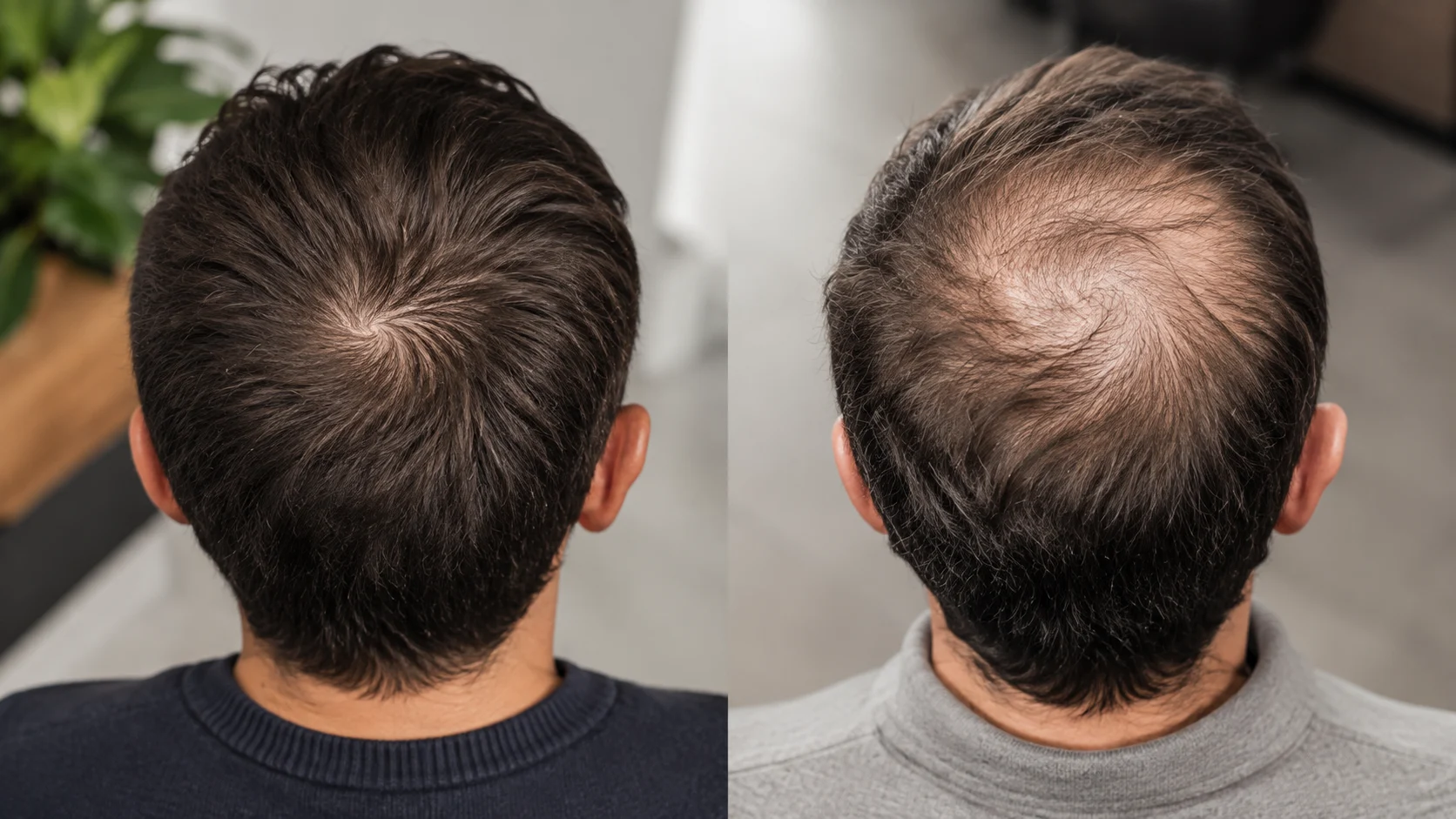
A cowlick is a natural hair growth pattern in which hair grows in a circular or opposing direction, often making the scalp appear more visible at the crown. Balding, by contrast, involves progressive hair thinning or loss. The confusion matters because a normal hair whorl can resemble early hair loss, while genuine thinning can sometimes be mistaken for a harmless cowlick.
Have you ever noticed a small patch of hair sticking up or a spot on your scalp that looks thinner than usual? You might wonder it is simply a cowlick or a sign of balding. Although both can make your scalp more visible, they have different causes and appearances. A cowlick is a natural hair-growth pattern that causes strands to grow in different directions, while balding involves hair loss that may gradually become more noticeable over time.
Understanding the difference between a cowlick and balding can help you avoid unnecessary worry and recognize when a change in your hair deserves attention. In this guide, we’ll explain their key differences, common signs, and practical ways to distinguish normal hair growth from potential hair loss. If thinning persists or worsens, a dermatologist can help identify the underlying cause.
Cowlick or Balding | What’s the Difference?
The easiest way to understand the difference is to look at how the hair behaves over time. A cowlick is primarily a growth pattern. Balding is a change in hair density, thickness, or coverage.
A cowlick is a noun referring to an area where hair grows in a distinctive direction rather than lying uniformly with surrounding strands. The crown is a particularly common location because hair naturally forms a whorl there.
Balding is a noun describing progressive hair loss or thinning. It may appear as a widening part, increasing scalp visibility, a receding hairline, or reduced density around the crown.
Here is a simple comparison:
A cowlick can make the crown look thinner without actual hair loss.
True balding generally involves a measurable change in density or strand thickness.
Photographs taken under different lighting can make either condition appear more dramatic.
The most useful clue is the appearance remains stable or progressively changes.
Is Cowlick or Balding a Grammar, Vocabulary or Usage Issue?
This is not a grammar problem. It is a vocabulary and visual interpretation issue.
The words describe two different concepts and aren’t interchangeable. A cowlick identifies a direction or pattern of hair growth, while balding describes a reduction in hair coverage or density.
In everyday conversation, someone might say, “My hair looks thin at the back because of my cowlick.” That statement can be perfectly reasonable if the hair is still growing normally but naturally separates around the crown.
In a more formal or academic context, terms such as hair whorl, hair density, follicular miniaturization, and hair thinning provide greater precision. Medical discussions may also distinguish between temporary shedding, progressive pattern hair loss, and other causes of alopecia.
The distinction is especially important when discussing photographs. A brightly lit photograph taken directly above the crown can expose the scalp through a normal hair whorl. That doesn’t automatically mean the person is experiencing hair loss.
How to Recognize a Cowlick
A cowlick often becomes noticeable when hair refuses to lie in the same direction as the surrounding strands. At the crown, the hair may spiral around a central point, creating an area that appears lighter or more open.
This is a normal hair growth pattern. It can be present from childhood and may become easier to see when hair is short, wet, oily, or styled in a way that separates the strands.
A person with thick hair can still have a prominent cowlick. Hair texture also affects how obvious it appears. Straight hair may expose the pattern more clearly than tightly curled hair, although either texture can have a cowlick.
Workplace example
Imagine an employee preparing for a professional photograph. The overhead lighting makes the crown look unusually open. After washing and styling the hair normally, the apparent gap disappears.
That situation is more consistent with a visible hair whorl than obvious progressive thinning.
Academic example
In a biology or anatomy discussion, a student might describe a cowlick as a localized pattern caused by the direction in which hair follicles are oriented. The emphasis is on growth direction rather than loss of follicles.
Technology example
Modern smartphones can exaggerate the appearance of a cowlick. High resolution cameras capture individual strands and scalp contrast very clearly, particularly under strong overhead lighting.
Usage recap
A cowlick is usually about direction, arrangement, and pattern. If the same area has looked essentially the same for years, especially when the hair surrounding it remains dense, a natural cowlick is a reasonable explanation.
How to Recognize Balding
Balding is more concerning when there is evidence of a continuing change.
One of the strongest clues is progressive hair thinning. You may notice that the crown looks increasingly sparse, the front hairline is moving backward, or individual hairs appear finer than they used to be.
Another important clue is a change in density. If an area that previously had dense coverage gradually begins showing more scalp even when the hair is dry and styled normally, the change deserves attention.
Pattern hair loss can affect different areas depending on the individual. Some people first notice a receding hairline. Others notice crown hair loss or a widening part.
Workplace example
Consider someone who compares photographs from several years apart and notices that the crown has become progressively more visible despite having a similar haircut. The important detail isn’t one photograph. It is the consistent change across time.
Academic example
In a dermatology discussion, progressive reduction in hair diameter can be more informative than simply observing scalp is visible. Miniaturization can cause hairs to become increasingly fine and less capable of providing coverage.
Technology example
Digital photographs can help someone observe changes over time, provided the photographs are taken under similar conditions. Consistent lighting, camera angle, hairstyle, and hair length make comparisons much more meaningful.
Usage recap
Balding is associated with change, reduced density, finer hairs, and progressive loss. A single photograph cannot reliably establish someone is balding.
When You Should NOT Use Cowlick or Balding
Several common situations can lead to an incorrect conclusion.
The key principle is simple: appearance in one moment is less informative than a consistent pattern of change.
Common Mistakes and Decision Rules
People often make the mistake of treating every visible patch of scalp as evidence of hair loss. That approach is unreliable because normal hair growth patterns can naturally create spaces between strands.
Decision Rule
If the concern is hair growing in a particular direction, think about a cowlick or natural hair whorl.
If the concern is progressive reduction in density, increasing scalp visibility, or finer hair, consider hair thinning or balding and seek professional assessment if the change continues.
Cowlick or Balding at the Crown | Why the Crown Causes Confusion
The crown is one of the hardest areas to judge visually because it already has a natural circular growth pattern.
Hair follicles in the crown don’t all point in exactly the same direction. Instead, they commonly form a whorl. As strands radiate outward, they can leave small spaces through which the scalp is visible.
This creates an important visual trap.
Imagine a dense lawn with grass growing outward from one central point. The soil may be visible at the center even though the lawn is healthy. Hair can create a similar visual effect.
The situation becomes more complicated when hair becomes shorter. Short strands have less length to overlap neighboring strands, so the scalp can appear more prominent.
Hair products can also affect the appearance. Gel, oil, wax, water, and heavy styling products can cause strands to group together, increasing visible scalp between them.
Case Studies | What the Visual Pattern Can Tell You
Case study one: The lifelong crown spiral
A 28 year old man notices that his crown looks unusually open in photographs. He compares recent pictures with older photographs and discovers that the same spiral pattern was visible several years earlier.
His surrounding hair remains dense, and there is no obvious progression in the exposed area.
The concrete result is that the appearance is much more consistent with a stable cowlick than progressive crown hair loss. The important evidence is stability over time rather than the appearance of scalp in a single image.
Case study two: Progressive crown thinning
A 36 year old man notices that his crown looks increasingly sparse over a period of three years. Photographs taken under similar conditions show gradually increasing scalp visibility. He also notices that some hairs around the area look finer than the surrounding strands.
The concrete result is a pattern that warrants professional evaluation for progressive hair loss rather than being dismissed as a normal cowlick.
These examples illustrate why time is such an important diagnostic clue. A cowlick can be visually dramatic while remaining stable. Hair loss tends to reveal itself through change.
Cowlick and Balding in Modern Technology and AI Tools
Artificial intelligence and image analysis tools can identify patterns in photographs, but they shouldn’t be treated as definitive diagnostic systems.
An AI image tool may recognize that the crown contains visible scalp, but visibility alone does not tell it the cause is a cowlick, lighting, wet hair, styling, natural density, or actual hair loss.
Technology becomes more useful when photographs are standardized. Taking pictures from the same angle, under similar lighting, with similar hair length can make visual comparisons more meaningful.
A useful digital record should focus on change over time, rather than repeatedly analyzing one photograph.
Etymology and Language Background
The word cowlick has an interesting history. It is associated with the appearance of hair that seems to have been licked or pushed by a cow, particularly because the hair may stand or lie in an unusual direction.
The term is informal but widely understood in everyday English.
Balding comes from the adjective bald, combined with the ending that indicates an ongoing process or condition. In everyday language, it refers broadly to developing hair loss.
An expert style summary would be: A visible scalp area is an observation, while progressive loss of hair density is a process. The two should not be treated as identical.
That distinction is useful because visual appearance alone can be misleading.
Error Prevention Checklist
Always use cowlick when
Never use balding when
You have only noticed a single photograph.
The hair is wet or heavily coated with styling product.
Bright overhead lighting is creating strong scalp contrast.
The same crown pattern has existed for many years without obvious progression.
You are assuming that every visible scalp area represents follicle loss.
When actual progressive thinning is suspected, the more useful approach is to document the change and discuss it with a qualified medical professional.
Related Grammar Confusions You Should Master
Although this topic is primarily about vocabulary and interpretation rather than grammar, several related language distinctions are useful when describing hair accurately.
FAQs
How can I tell if I have a cowlick or balding?
Look for change over time. A stable crown pattern is more consistent with a cowlick, while progressively thinner coverage suggests hair loss.
Does a cowlick mean you are going bald?
No. A cowlick is a normal hair growth pattern and does not by itself indicate progressive hair loss.
Why does my crown look bald when I have a cowlick?
The circular direction of the hair can separate strands and expose the scalp, especially when the hair is short, wet, oily, or illuminated from above.
Can a cowlick become more noticeable with age?
Yes. Changes in hair length, texture, density, or styling can make an existing cowlick more visible even when the underlying growth pattern remains normal.
Is visible scalp at the crown always a sign of hair loss?
No. Scalp visibility can result from a natural hair whorl, lighting, wet hair, styling, or naturally lower density.
What does early crown hair loss look like?
Early crown thinning may involve gradually increasing scalp visibility, reduced density, and increasingly fine hairs rather than a sudden completely bald area.
Can photographs show I am balding?
Photographs can help reveal changes when taken consistently, but a single photograph cannot reliably distinguish a cowlick from every possible cause of thinning.
Should I see a doctor for progressive hair thinning?
If you notice persistent or progressive loss, a qualified medical professional can assess the pattern and determine further evaluation is appropriate.
Does a receding hairline mean the crown is also balding?
Not necessarily. Hair loss patterns vary, and changes at the hairline do not automatically mean the crown is undergoing the same process.
Conclusion
The difference between a cowlick and balding comes down largely to pattern versus progression. A cowlick is a natural arrangement of hair that can expose a small amount of scalp, especially around the crown. Balding involves an actual change in hair coverage, density, thickness, or distribution.
If your crown has looked essentially the same for years, a natural hair whorl may explain what you’re seeing. If photographs consistently show increasing scalp visibility, finer hairs, a widening part, or a receding hairline, the situation deserves closer attention.
Don’t judge your hair from one photograph alone. Consider lighting, hair length, moisture, styling, and changes over time. That simple approach can prevent a normal cowlick from being mistaken for hair loss while also helping genuine thinning receive appropriate attention.
Understanding cowlick or balding is ultimately about using the right description for what you can actually observe. A visible scalp is not automatically evidence of baldness, and a changing pattern should not automatically be dismissed as a harmless cowlick.
Discover More Related Articles:
- Effective or Affective | Clear Up This Tricky English Confusion In 2026
- Pancakes or Waffles | Which Breakfast Choice Is Better for You In 2026
- Blanky or Blankie | Which Spelling Is Correct & When Should You Use Each In 2026