Plandid and candid describe different kinds of photographs and moments. Candid is a standard English word meaning natural, spontaneous or openly expressed, while plandid is an informal blend of planned and candid used for something deliberately arranged to look spontaneous. Knowing the distinction prevents awkward usage, especially in professional and academic writing.
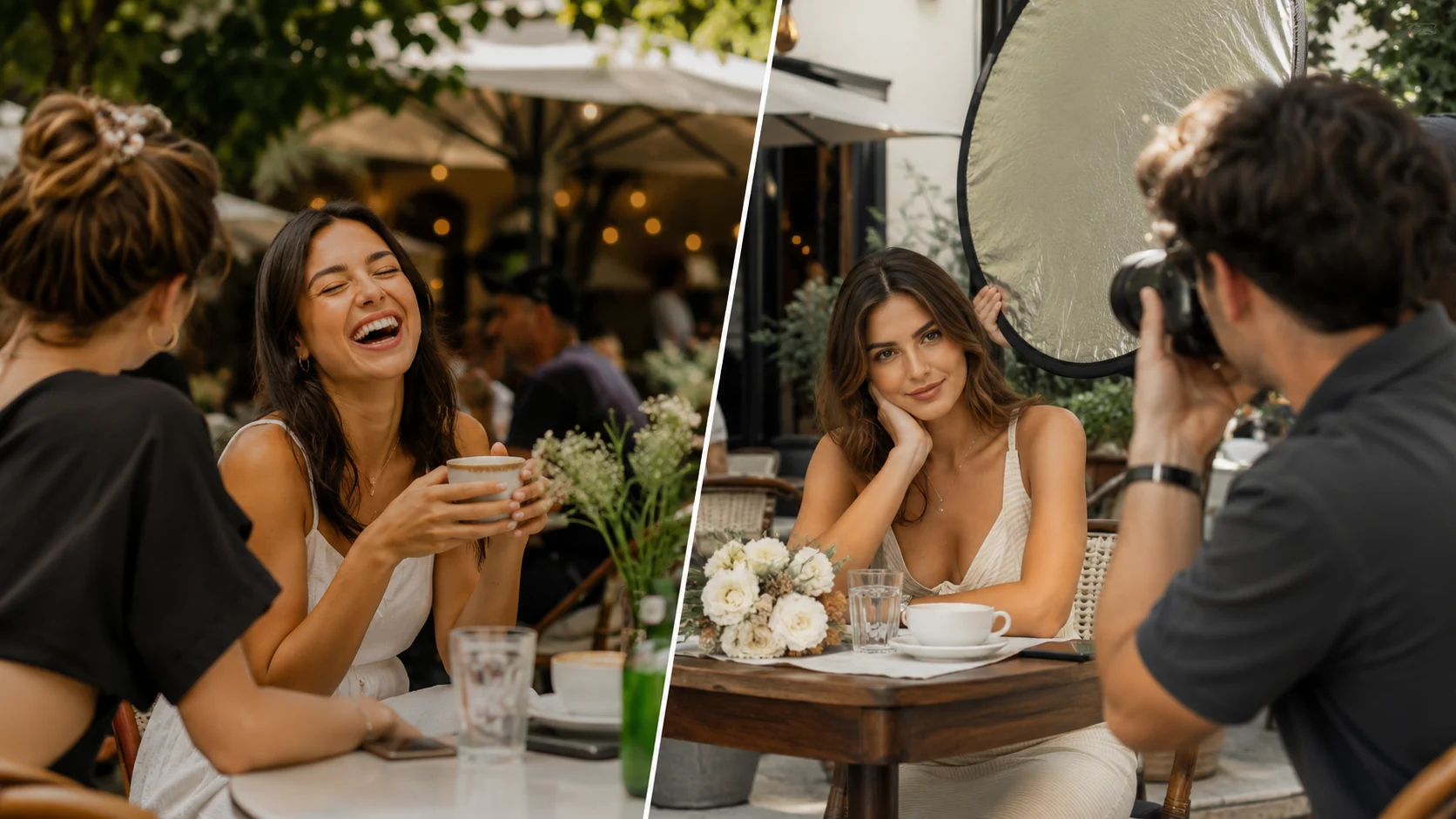
Have you ever taken a photo that looks spontaneous but was actually carefully planned? That is where plandid or candid can become confusing. A candid photo captures a natural moment without obvious preparation, while a plandid photo is deliberately arranged to look effortless and spontaneous. Understanding candid vs plandid helps you choose the right word when describing modern photography and social media content.
So, what is the plandid meaning? Plandid is an informal blend of “planned” and “candid.” The plandid or candid meaning depends on the moment was genuinely spontaneous or intentionally staged. In simple terms, plandid and candid meaning describes two different approaches to appearing natural in photos. This guide explains candid or plandid, including plandid vs candid, with clear examples and practical usage tips so you can confidently tell them apart.
Plandid vs Candid | What’s the Difference?
| Feature | Candid | Plandid |
|---|---|---|
| Word type | Standard English word | Informal blend word |
| Meaning | Natural, spontaneous, or honest | Planned to appear natural or spontaneous |
| Photography | Usually captures an unposed moment | Looks unposed but is deliberately arranged |
| Origin | From established English vocabulary | Blend of planned and candid |
| Formal writing | Appropriate | Usually avoided unless discussing the term |
| Social media | Common | Common in discussions of staged natural photos |
| Main idea | Genuine spontaneity | Planned spontaneity |
The simplest way to understand the difference is to focus on the moment was genuinely spontaneous or deliberately arranged to appear spontaneous.
Candid is an established English adjective and noun. As an adjective, it can describe someone who speaks honestly and openly, such as “She gave a candid opinion.” In photography, a candid photograph is generally understood as an image that captures a person naturally rather than through a deliberately posed setup.
Plandid is a modern slang term formed by blending planned and candid. It describes a photograph that looks spontaneous but was actually arranged, directed, or deliberately posed. The word has been associated particularly with social media photography and influencer culture.
A candid moment happens naturally or is presented openly.
A plandid moment is deliberately created to produce the appearance of spontaneity.
Candid is the safer choice for standard English.
Plandid works best when you are specifically discussing staged natural looking photography or social media culture.
Is Plandid vs Candid a Grammar, Vocabulary or Usage Issue?
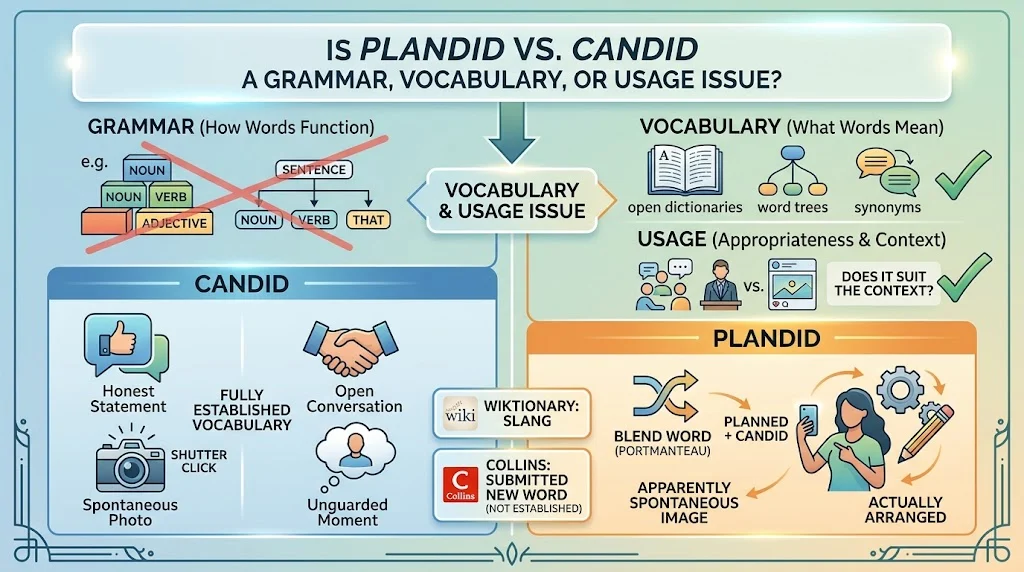
The confusion is primarily a vocabulary and usage issue, rather than a traditional grammar problem.
Grammar determines how words function within sentences. Vocabulary determines what words mean and when they are appropriate. In this case, the important question is the word accurately describes the situation and suits the context.
Candid is fully established English vocabulary. It can describe an honest statement, an open conversation, a natural photograph, or an unguarded moment.
Plandid is different. It is a blend word, also called a portmanteau. It combines elements of planned and candid to create a term for an apparently spontaneous image that has actually been arranged. Wiktionary classifies it as slang, while Collins lists it as a submitted new word suggestion rather than presenting it as an ordinary established entry.
That distinction matters in formal writing.
If you’re writing a university essay about photography, use precise language such as “staged photograph,” “posed photograph,” or “apparently candid photograph” unless the subject specifically requires the term plandid.
If you’re writing a social media article, discussing Instagram culture, or explaining contemporary photography vocabulary, plandid can be useful because it communicates a very specific idea in a compact way.
The words aren’t interchangeable. Calling a carefully arranged photograph candid can imply that it was genuinely spontaneous. Calling it plandid communicates the opposite idea: it was planned to look candid.
When to Use Candid
Candid is the better choice when you mean something genuine, natural, unguarded, or frank.
In everyday conversation, you might say, “I appreciate your candid opinion.” Here, candid has nothing to do with photography. It means honest and direct.
In photography, you could say, “The photographer captured a candid moment during the dinner.” The implication is that the people were not deliberately posing for the photograph.
Workplace example
A manager might say, “I want a candid discussion about the project’s problems.”
Here, candid means honest and straightforward. It does not mean casual or careless. A candid conversation can still be professional.
Academic example
A researcher might write, “The photographs were intended to capture candid interactions between participants.”
This wording clearly communicates that the images were intended to represent natural interactions rather than staged poses.
Technology example
A photo editing application might offer tools for improving a candid photograph. The image could be cropped, brightened, or adjusted without changing the original description of the moment as candid.
Usage recap: Use candid for genuine spontaneity, natural moments, honest communication, and unguarded expression. It is suitable for casual, professional, and academic contexts.
When to Use Plandid
Use plandid when you specifically want to describe something that has been planned to look candid.
Imagine someone visits a beautiful café. They place their coffee precisely beside a notebook, arrange their sunglasses, position themselves near a window, and ask a friend to photograph them while they pretend not to notice.
The photograph may look effortless.
The process was not.
That is exactly the situation the slang term plandid is designed to describe. The term has been used in discussions of Instagram photography, influencer presentation, and the broader idea of manufactured authenticity.
Workplace example
A marketing team might casually describe a deliberately staged behind the scenes photograph as a plandid during an internal creative discussion.
However, the word would be less appropriate in a formal report. A professional report would be clearer if it said “staged lifestyle photograph” or “planned photograph designed to appear spontaneous.”
Academic example
In an academic paper discussing social media self presentation, plandid may be appropriate if the researcher defines the term before using it. Scholarly research has used the concept when discussing staged spontaneity and authenticity on image based social platforms.
Technology example
A smartphone camera, timer, tripod, burst mode, and editing application can make a supposedly spontaneous photograph much easier to arrange. The technology doesn’t make the photograph candid simply because the final image looks natural.
Usage recap: Use plandid for an intentionally staged image or performance designed to resemble something candid. Treat it as informal vocabulary rather than a universal replacement for candid.
When You Should NOT Use Plandid or Candid
| Situation | Correct Choice | Reason |
|---|---|---|
| Someone gives an honest opinion | Candid | Candid means frank or straightforward |
| A person is photographed naturally | Candid | The moment is not deliberately staged |
| A photo is arranged to look spontaneous | Plandid | The image was planned to appear natural |
| You are writing an academic paper | Candid | It is standard English |
| You are discussing Instagram photography | Plandid | The informal term can describe staged natural looking images |
| You are writing a professional report | Candid or staged photograph | Plandid may sound too informal |
| Someone speaks openly about a difficult issue | Candid | It describes honesty and openness |
| A photographer deliberately directs the subject | Plandid | The appearance of spontaneity was planned |
There are several situations where choosing the wrong term can change the meaning.
One particularly important point is that candid has more than one meaning. It can describe a photograph, but it can also describe a person’s speech, attitude, or response.
Plandid is much narrower.
Common Mistakes and Decision Rules
| Correct Sentence | Incorrect Sentence | Explanation |
|---|---|---|
| She gave a candid answer during the interview. | She gave a plandid answer during the interview. | Candid means honest and direct here. |
| The photographer captured a candid moment. | The photographer captured a plandid moment. | A genuinely spontaneous moment is candid. |
| They created a plandid photograph for social media. | They created a candid photograph for social media. | The photograph was deliberately arranged to look spontaneous. |
| The campaign used staged photographs. | The campaign used candid photographs. | Staged photographs are deliberately arranged. |
| Her candid response surprised everyone. | Her plandid response surprised everyone. | Plandid is not normally used to describe honest speech. |
One common mistake is assuming that plandid is simply an incorrect spelling of candid. It isn’t. It is an intentionally created blend word with a specific informal meaning.
Another mistake is assuming that every photograph taken outside a studio is candid. A photograph can be taken outdoors and still be heavily staged.
Decision Rule
If you mean genuine spontaneity, natural appearance, or frank honesty, use candid.
If you mean something deliberately planned to appear spontaneous, plandid can be used in informal or social media contexts.
Do not treat plandid as the standard form of candid. They describe different ideas.
Plandid and Candid in Modern Technology and AI Tools
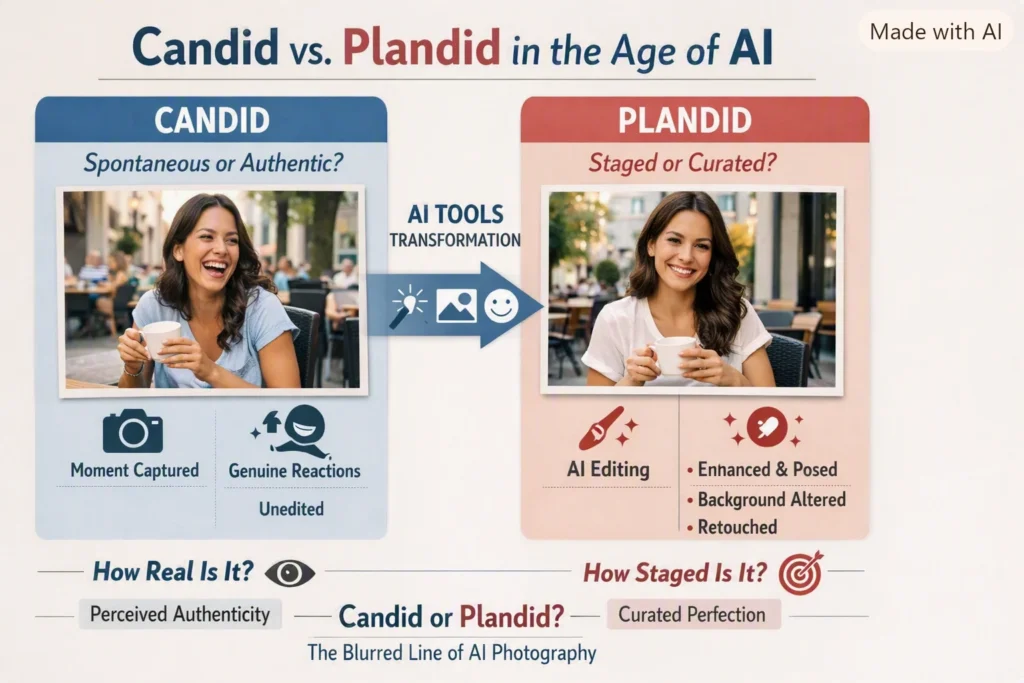
Modern technology has made the boundary between spontaneous and staged photography more complicated.
A smartphone can be placed on a tripod, a timer can be activated, burst photography can capture dozens of frames, and editing software can make the final image appear effortless. The viewer sees one polished moment, while the creator may have controlled almost every element.
AI tools add another layer.
Generative editing can remove distractions, alter backgrounds, improve lighting, change facial expressions, and reconstruct parts of an image. As these technologies become easier to use, the visual appearance of spontaneity tells viewers less about how an image was actually produced.
This is why the distinction between candid and plandid is useful beyond social media slang. It highlights a larger question about perceived authenticity.
Research on social media photography has specifically discussed plandids as carefully choreographed images that imitate spontaneous self presentation.
Authority and Trust | Where Did These Words Come From?
Candid has a much longer linguistic history. The word ultimately comes from Latin candidus, associated with whiteness and brightness. English later developed figurative meanings connected with openness, fairness, and frankness.
Its photographic sense developed from the broader idea of an unguarded or natural moment.
Plandid is considerably newer. It is a blend of planned and candid. Early online usage appeared before the term became associated with the Instagram trend that received substantial attention around 2017. Collins records a 2017 submission defining it as a photograph that was planned but made to look as though the subject had been caught unaware.
A useful expert style principle is this:
A candid image captures spontaneity, while a plandid image recreates the appearance of spontaneity.
That distinction captures the central semantic difference without treating the informal term as a spelling error.
Case Study 1: Instagram and the Planned Natural Look
Research into social media photography has examined how plandids function as carefully choreographed representations of everyday life. One study describes them as photographs that can require substantial time, attention, and resources because creators may repeatedly stage scenes until the desired natural looking result appears.
The concrete finding is important: participants did not always maintain a strict distinction between selfies and plandids, showing that real world users can treat these categories as overlapping rather than perfectly separate.
Case Study 2: Coachella Self Presentation
A 2023 study of 200 location tagged Instagram posts from the 2017 Coachella festival found that attendees were concerned less with simply documenting the music and more with curating a visual sense of taste, experience, and place. The study identified the use of the plandid as one technique for adding a sense of spontaneity to this carefully constructed presentation.
The result illustrates why the word matters. A photograph can be carefully curated while still being designed to communicate an impression of natural experience.
Author expertise: This article applies established principles of English usage, lexical development, contemporary vocabulary, and digital language analysis to distinguish standard English from informal internet terminology.
Error Prevention Checklist
Always use Candid when
- You mean honest or frank.
- You mean natural or spontaneous.
- You are describing an unposed photographic moment.
- You are writing formal or academic English.
- You want a widely understood standard English word.
Never use Plandid when
- You simply mean honest.
- You mean a genuinely spontaneous event.
- You are correcting a spelling mistake.
- You need a formal term but have not defined the slang.
- The photograph was genuinely unplanned.
Use plandid when its precise meaning is useful: something planned, staged, or directed to create the appearance of candid spontaneity.
Related Grammar Confusions You Should Master
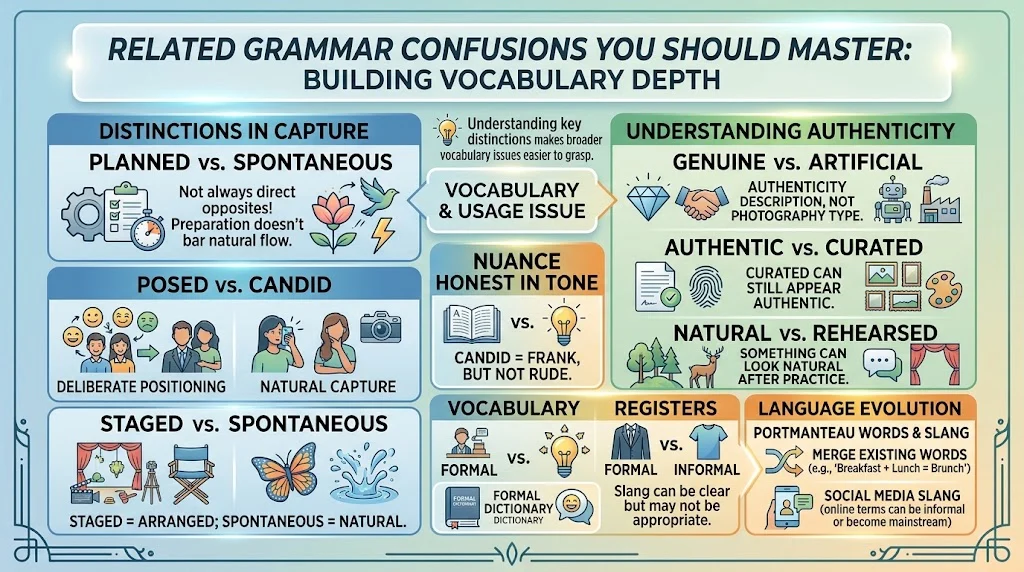
Once you understand this distinction, several related vocabulary questions become easier.
- Planned vs spontaneous: preparation and natural occurrence are not opposites in every context.
- Posed vs candid: a posed image involves deliberate positioning, while candid usually suggests natural capture.
- Staged vs spontaneous: staged means deliberately arranged, while spontaneous suggests something arising naturally.
- Genuine vs artificial: these describe authenticity rather than photographic technique.
- Authentic vs curated: curated content can still appear authentic even when carefully selected.
- Natural vs rehearsed: something can look natural while being rehearsed beforehand.
- Honest vs blunt: candid means frank, but it does not necessarily mean rude.
- Formal vs informal vocabulary: slang can be perfectly understandable without being appropriate in every context.
- Portmanteau words: English frequently creates new words by combining existing ones.
- Social media slang: online communities regularly develop vocabulary that may remain informal or eventually become mainstream.
FAQs
Is plandid a real English word?
Plandid is a recognized informal blend used to describe something planned to look candid, especially a photograph. It is not equivalent to the standard word candid.
What does plandid mean in photography?
A plandid is a photograph that appears spontaneous or unposed but was actually arranged, directed, or deliberately created to produce that appearance.
What does candid mean in photography?
Candid describes a photograph that captures a natural or unposed moment rather than a deliberately staged pose.
Is plandid the opposite of candid?
They contrast with each other in an important way, but plandid is better understood as a planned imitation of candid appearance rather than a simple grammatical opposite.
Can I use plandid in formal writing?
You can use it when discussing the term itself, social media culture, or contemporary photography, but formal writing may be clearer with phrases such as staged photograph or planned photograph.
Is candid only used for photographs?
No. Candid can also describe honest opinions, direct answers, open conversations, and frank expressions.
Why do people call staged photos plandid?
The term combines planned and candid to describe the deliberate creation of an image that gives viewers the impression of spontaneous authenticity.
Is plandid an adjective or noun?
Plandid is most commonly used as a noun for the photograph itself, although informal usage can also extend it into descriptive forms.
Should I write candid or plandid on a professional website?
Use candid when you mean genuine spontaneity or honesty. Use plandid only when the specific concept of planned spontaneity is relevant and your audience will understand the informal term.
What does plandid or candid mean?
Candid means natural or unposed, while plandid means a photo that looks candid but was actually planned or posed.
Conclusion
The choice between plandid and candid depends on what actually happened.
Use candid for something natural, spontaneous, unguarded, or honestly expressed. It is the established English word and works comfortably in everyday, professional, and academic writing.
Use plandid when you are talking about a deliberately arranged image or moment designed to look spontaneous. It is a useful modern slang term, particularly in discussions of social media, photography, influencer culture, and curated authenticity.
The easiest way to remember the distinction is simple: candid happens naturally, while plandid is planned to look natural.
That single distinction will help you choose the right word without confusing standard English with contemporary internet vocabulary.
Discover More Related Articles:
- Effective or Affective | Clear Up This Tricky English Confusion In 2026
- Pancakes or Waffles | Which Breakfast Choice Is Better for You In 2026
- Blanky or Blankie | Which Spelling Is Correct & When Should You Use Each In 2026